
Most men over fifty have never seriously considered that they might live to one hundred. Not as a realistic planning horizon, not as a daily operating standard, not as something that has any meaningful bearing on the choices they make about how to eat, how to train, how to manage stress, how to invest in their relationships, or how to use the years they have left. One hundred sounds like the kind of number that belongs to other people: the genetically fortunate, the disciplined few, the people who show up in newspaper stories on milestone birthdays still sharp enough to give a quote.
That assumption is outdated. And for the man who is fifty right now, it is the assumption that may be quietly costing him the most important strategic insight available to him.
The U.S. centenarian population is expected to increase fourfold over the next three decades. The man who is fifty today and makes the daily decisions that the research on extreme longevity consistently identifies as determining, is not chasing a fantasy. He is running a strategy with documented results. And perhaps more importantly, he is running the only standard that produces the daily decisions a man who wants to perform at the highest possible level for the maximum possible duration actually needs to be making.
This is not about optimism. It is about operating logic.
What the Centenarian Research Actually Shows
Environmental factors like diet, exercise, and stress management account for about 50 percent of longevity, while genetics only explains about 25 percent of the difference between those who live to 100 and those who do not.
That ratio matters enormously. The widespread assumption that longevity is primarily a genetic lottery, that some people are simply built to last and others are not, and that the man without exceptional longevity genes is mostly at the mercy of his biology, is not supported by the evidence. The majority of what determines whether a man makes it to one hundred is within his direct control. Half of the equation is lifestyle. Genetics accounts for a quarter. The remainder is environment and circumstance.
Thirty percent of centenarians, 56 percent of semi-supercentenarians, and nearly 70 percent of supercentenarians escape major age-related disease, including dementia. A further 53 percent of centenarians delay the onset of major age-related disease until age 80 or beyond. Male centenarians have better physical and cognitive functional status than female centenarians, despite the greater probability of survival to extreme old age among women.
The last point demands attention from every man reading this. Men who make it to one hundred tend to arrive there in better shape than women who make it. Researchers at the New England Centenarian Study describe male centenarians as escapers, people who largely avoid the accumulation of disease that characterizes typical aging, rather than survivors who endure chronic conditions for extended periods. The men who live to 100 tend to be healthier. They generally have very good physical and cognitive function.
This is not an argument for complacency about the odds. Men remain significantly less likely than women to reach one hundred. It is an argument for a specific strategy: the man who wants to be among those who do arrives not through survival of accumulated disease, but through the deliberate, consistent behaviors that delay or prevent disease onset entirely. That strategy is available. It requires decision, not luck.
The Standard That Changes Every Decision
Here is where the goal of making it to one hundred becomes something more than a longevity aspiration. It becomes an operating standard that changes every daily decision a man makes.
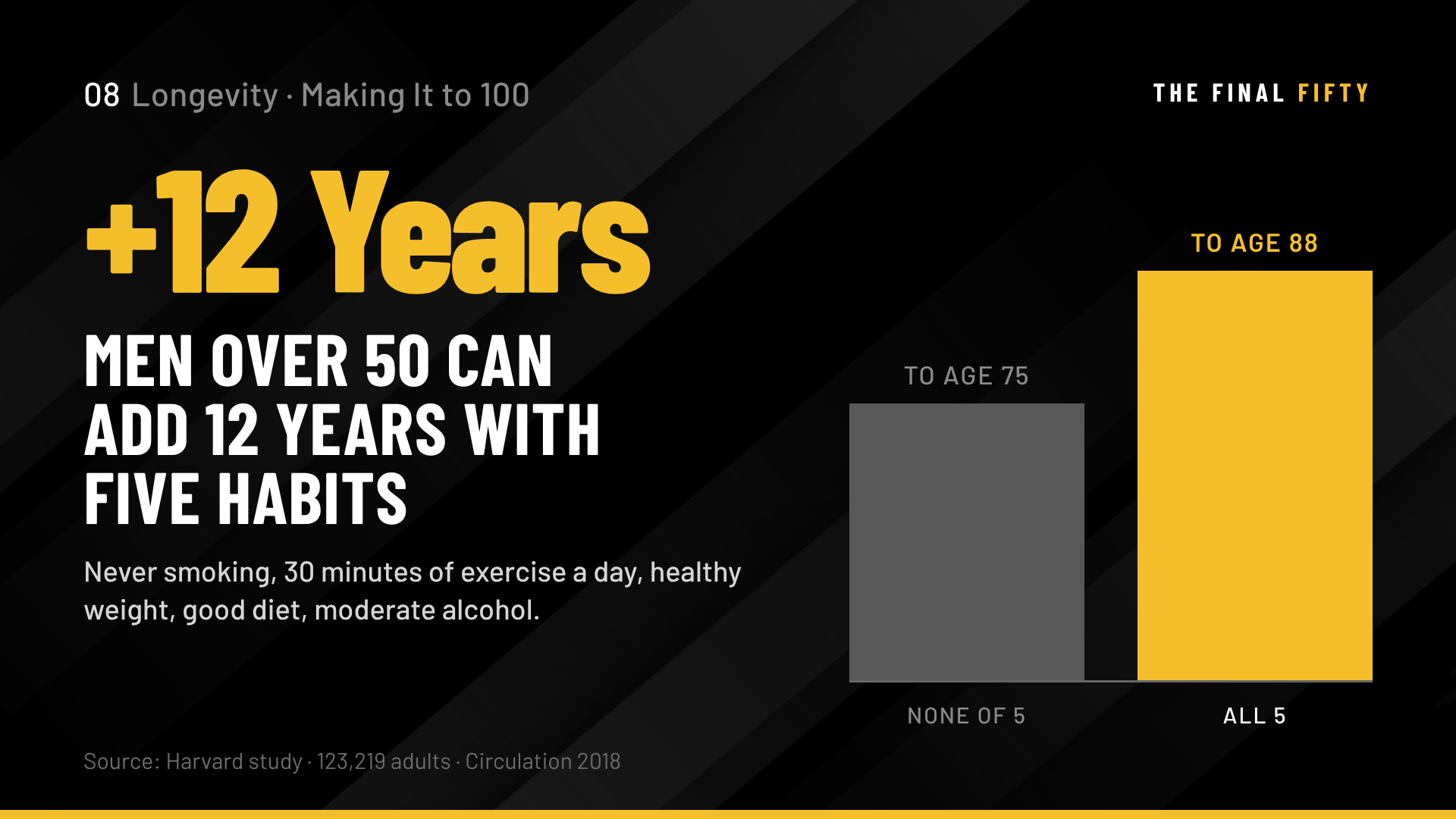
A large prospective cohort study of over 46,000 men and women found that for men with seven to eight healthy lifestyle factors, life expectancy at age 40 was 46.8 additional years, meaning a realistic trajectory toward the late eighties. The potential impact of healthy lifestyle adoption on lifetime gain persisted over the age of 80, particularly in older men, and the benefits were more pronounced in patients with existing major comorbidities.
The implications are significant. Lifestyle behaviors compound over time in the same way that financial investments do. The man who holds his standard consistently across the second half of his life is not just living longer. He is living better for longer, preserving the physical and cognitive function that makes the additional years worth having. And the research makes clear that it is never too late to start: the gains persist even for men over 80 with existing health conditions.
An eight-week lifestyle intervention program for men aged 50 to 72 that addressed diet, supplements, sleep, exercise, and stress management was associated with a decrease in biological age of 3.23 years compared to controls. Eight weeks. Measurable biological age reduction in eight weeks for men in the exact demographic reading this article. The standard is not a distant goal. It produces measurable returns in the near term, while the compounding of those returns across decades produces the long-term result.
The man who orients his daily decisions around making it to one hundred does not need separate motivation for each individual healthy behavior. The standard answers those questions before they are asked. The man who is genuinely trying to make it to one hundred does not eat like it does not matter. He does not skip training because he does not feel like it. He cannot afford to, and more importantly, he does not want to.
What the Standard Actually Demands Day to Day
The research on centenarians identifies the same cluster of behaviors across populations, cultures, and study designs with striking consistency. These are not exotic interventions or expensive protocols. They are the fundamentals, held to a high standard and sustained across decades.
Among centenarians, a healthier lifestyle score incorporating dietary diversity, exercise status, sleep quality, smoking status, and drinking status had a clear dose-response relationship with survival time. Each one-point higher lifestyle score was linked to a 6.9 percent longer survival time, and intermediate and favorable lifestyles added 3.79 and 11.04 additional months of survival respectively compared to unfavorable lifestyles.
More of the right inputs produces more of the right outputs. Not linearly, not dramatically in any single week, but cumulatively and powerfully across the years.
Physical training holds the central position. The men who make it to one hundred and arrive there in functional health are almost uniformly people who kept their bodies moving throughout their lives. Not elite athletes, not competitive bodybuilders, not men who sacrificed everything else for physical performance. People who moved consistently, who maintained strength and cardiovascular capacity, who kept their bodies engaged with the kind of physical demand that preserves the systems that deteriorate fastest in sedentary aging.
Sleep is the recovery mechanism without which every other investment yields diminished returns. In a study of about 500,000 British people, irregular sleep patterns were associated with a 50 percent higher risk of early death compared to those with regular sleep patterns. The man who trains hard and eats well but chronically undervalues sleep is undermining the most important recovery and repair window his body has.
Social connection operates as a genuine longevity variable, not a quality-of-life enhancement. People over 65 who are socially active daily are three times more likely to live for five more years compared to those who almost never engage in social activities. The brotherhood is not optional from a longevity standpoint. The men who make it to one hundred and remain sharp and engaged and purposeful are, almost without exception, men embedded in relationships that demanded their presence and gave their life a social architecture that solitude cannot replicate.
Stress management is the variable that most high-performing men address last and least effectively. Chronic stress does not just feel bad. It accelerates biological aging through cortisol elevation, inflammatory cascades, immune suppression, and the hormonal disruption that undermines every other health investment a man makes. The man who trains four days a week and sleeps seven hours but runs at maximal chronic stress is not neutralizing those other investments. He is fighting against himself.
The Real Reason to Aim for One Hundred
The goal of making it to one hundred is not, ultimately, about the number. As longevity researchers at the New England Centenarian Study put it: the goal is not to get everyone to live to age 100. What they are trying to understand is how to live to whatever age, the seventies, eighties, or nineties, in very good health.
That is the actual point. The one-hundred-year standard is not a guarantee or a promise. It is the orientation that produces the daily decisions that maximize the probability of spending the years ahead in genuine health, genuine function, and genuine engagement with the life a man has built. A man who aims for one hundred and makes it to eighty-seven in excellent physical and cognitive condition has not failed to reach his goal. He has spent the last thirty-seven years living at the highest possible standard, building relationships, contributing professionally, training his body, and doing work that matters. He has used the standard the way it is meant to be used.
The man who does not aim for one hundred, who accepts the cultural default of gradual decline and managed deterioration from his mid-fifties onward, does not get the same thirty-seven years. He gets a different version of them. Quieter. Smaller. Less engaged, less functional, less full of the things that make time worth having.
The choice is available right now. Not in the abstract, not in some future version of circumstances that never quite arrives. In the daily decisions of what to eat, how to train, how to sleep, how to manage stress, and how to invest in the people and the mission that make the decades ahead worth every standard they demand.
One hundred is the horizon. The standard is today.
THE FINAL 50 FRAMEWORK
THE REFRAME
Making it to one hundred is not a fantasy for the genetically exceptional. It is a strategy available to the man who holds the right daily standard consistently across the second half of his life. The goal is not the number. The goal is what the number demands: a daily operating standard that produces the physical health, the cognitive function, and the engaged, purposeful life that makes every additional decade worth the effort required to earn it.
THE STANDARD
The Final 50 man orients every significant daily decision around the question of what the man who makes it to one hundred actually does. Not occasionally. Not when circumstances are favorable. Every day. He trains. He eats for performance and longevity. He sleeps. He manages stress. He invests in the relationships that sustain him. He holds the standard not because every day is easy but because the orientation toward one hundred makes every choice that falls short of it illegible.
THE PRACTICE
This week, calculate how many years remain between your current age and one hundred. Not as a morbid exercise but as a planning horizon. If you are fifty-two, you have forty-eight years ahead of you as a potential operating window. What does a man who intends to use all forty-eight of those years at a high level do differently today than the man who is running on the cultural default? Identify one specific change that the forty-eight-year horizon demands and that the shorter default does not. Start there.
THE AUDIT
Across the five variables the centenarian research consistently identifies as determinative: training consistency, nutritional quality, sleep, stress management, and social connection. Where are you holding the standard the one-hundred-year goal demands? Where are you not? Score yourself honestly from one to ten on each. The lowest score is where the most significant return on investment currently sits.
THE PROMPT
The men in your brotherhood are also running some planning horizon, consciously or not, and that horizon is shaping every decision they make about their health, their relationships, and how they spend the years ahead. What would change in the conversation you are having with those men if everyone in the room was explicitly operating from the one-hundred-year standard? What decisions would look different? What investments would be easier to justify? That conversation is worth having. It is one of the most clarifying things available to men who are serious about the second half.


