
There is a specific kind of professional confidence that develops over decades of building real competence in a real field. It is earned, not assumed. It is the product of thousands of hours of execution, of problems solved, of judgment developed through repeated contact with the actual consequences of decisions. A man at fifty who has built well in his professional life carries a depth of capability that no twenty-eight-year-old in the same organization can replicate, regardless of energy, regardless of enthusiasm, and regardless of how many hours that younger person works.
That confidence is warranted. It is also, if a man is not careful, the thing that quietly ends his professional relevance before he ever sees it coming.
The mistake is not in recognizing the value of accumulated experience. The experience is real and it matters enormously. The mistake is in believing that experience operates as a permanent asset rather than a depreciating one, that the edge built over twenty-five years of serious professional work maintains itself without continued investment, that arriving at fifty with deep expertise means the work of development is finished.
It does not. And the man who stops building in the second half of his career on the basis that he has already built enough is making one of the most consequential professional errors available to him.
The Hard Reality of Skill Decay
The professional environment a man at fifty is operating in is not the one he was trained for. It is not even the one he was operating in five years ago. Research shows the half-life of skills has compressed dramatically, from over ten years four decades ago to around four to five years today, with technical skills in fields like AI dropping to just two to two and a half years.
Read that number carefully. The technical knowledge a professional built in 2020 is already losing its value. The frameworks, tools, platforms, and methodologies that defined expert-level performance five years ago are being replaced at a pace that no generation of professionals has ever had to navigate before.
The World Economic Forum’s Future of Jobs Report predicts that 44 percent of workers’ skills will be disrupted between 2023 and 2028. Nearly half of what the workforce currently knows how to do will need to be significantly updated or replaced within five years. That is not a technology story. It is a professional survival story, and it applies to every man over fifty regardless of industry, regardless of seniority, and regardless of how strong his current standing is.
According to a 2024 Workplace Training Report, over 50 percent of older workers received no technology training from their employer in the past year, compared to 27 percent of younger workers. The irony is that the people most at risk from skill obsolescence are the ones receiving the least institutional support to address it. The man over fifty who is waiting for his organization to develop his professional relevance is waiting for something that the data suggests is unlikely to arrive.
The Specific Trap Men Over 50 Fall Into
Skill decay is a universal threat. The specific trap that catches men in the second half of their careers is subtler than simply failing to learn new things. It is the gradual shift from building professional value to managing professional status.
The man who has arrived somewhere, who has the title, the reputation, the institutional knowledge, the relationships that took twenty-five years to develop, has every incentive to protect what he has built rather than risk it on the uncertainty of building something new. Protecting starts to look like wisdom. It starts to look like the sophisticated understanding of which battles to pick. It starts to look like the earned confidence of a man who knows his field deeply.
What it actually looks like, from the perspective of the organization and the market, is a man who stopped growing. Tool-specific expertise without strategic context, process ownership with no adaptability, and authority based purely on title or tenure rather than influence are the exact patterns that cause experienced professionals to lose impact in environments that are flattening and accelerating.
The man who is the institutional expert in a system that the organization is replacing, the man whose authority derives from seniority in a culture that has moved to influence and output, the man whose professional identity is built around what he knows rather than what he can figure out, is a man whose relevance is declining whether he sees it or not.
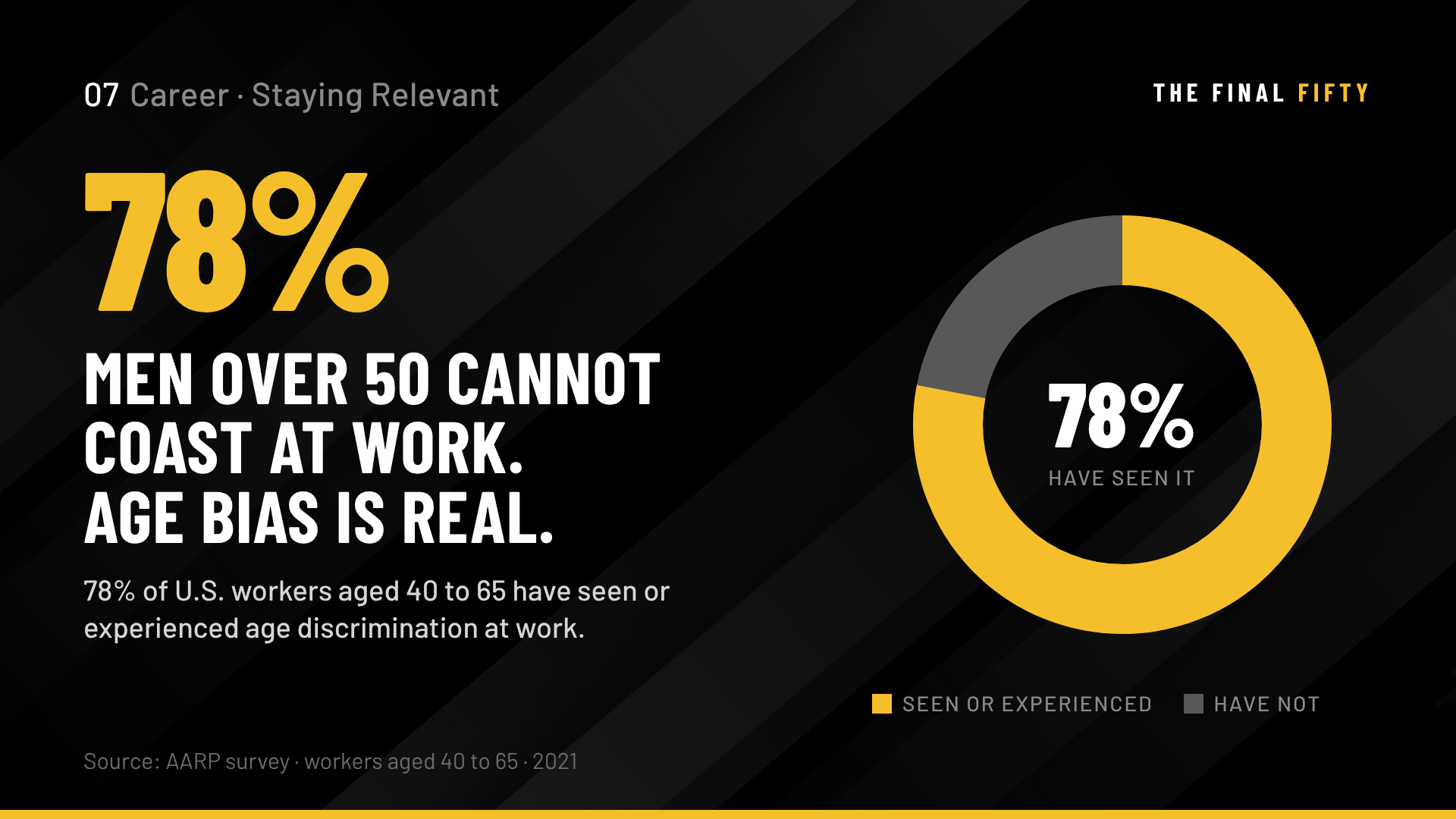
64 percent of workers age 50 and older have reported seeing or experiencing age discrimination in the workplace, and 22 percent feel they are being pushed out of their jobs because of their age. Subtle forms of age discrimination have been experienced by 60 percent of workers 50-plus, including assumptions that older employees are less tech-savvy, resistant to change, and given preference for younger employees for training opportunities.
These assumptions are self-fulfilling when a man allows them to be. They are demonstrably false for the man who refuses to let them be.
What the Second Half of a Career Actually Requires
The professional second half is not a continuation of the first half with the hard parts behind him. It is a recalibration that demands a different kind of investment than the one that built the first half.
The first half was about building depth. Becoming excellent in a specific domain, accumulating the track record, developing the judgment that comes from years of real execution. That work produced something real and it should not be abandoned. But your forties and fifties can be the most valuable years of your career if you treat experience as a platform rather than a destination.
The platform is what experience provides. What a man builds on that platform in the second half determines his professional trajectory for the next twenty years. That building requires three specific investments that most men over fifty are not making consistently.
The first is continuous skill development. Not the occasional conference or the certificate program completed once a decade. A structured, ongoing commitment to staying current in the domain a man operates in, expanding into adjacent areas that increase his value, and developing fluency in the technologies and methodologies that are reshaping how work gets done. Microsoft’s 2024 Work Trend Index found that 73 percent of baby boomers are already integrating AI into their daily work, matching younger generations. The men who made that investment are not the ones being assumed to be technologically obsolete. They are the ones demonstrating something more powerful than technical skill: the combination of deep experience and adaptive capability that no young professional in the organization can match.
The second investment is network cultivation. The professional network a man built in the first half of his career is one of his most valuable assets, and it is one that requires active maintenance to retain its value. Relationships go cold. Industries evolve and the people in them move. The network that was current five years ago needs ongoing investment to remain the active, productive asset it was at its peak. Workers aged 65 and older have an average job tenure of 10.3 years, compared to just 3.2 years for workers aged 25 to 34. That stability is an asset when it reflects deep investment in relationships and context. It is a liability when it reflects stagnation in a narrowing circle.
The third investment is visibility. The man who has spent the first half of his career building quietly, doing excellent work and letting results speak for themselves, needs to recalibrate in the second half. The results still have to be there. But in a market where assumptions about older workers run at 60 percent and training opportunities go disproportionately to younger colleagues, the man who does not actively make his value visible is the man who allows those assumptions to fill the vacuum his silence creates. Mentoring, writing, speaking, advising, leading high-visibility projects, these are not self-promotional exercises. They are the actions that keep a man’s professional presence current and his value legible to the people who make decisions about who remains in the room.
The Advantage That Does Not Decay
Here is what the conversation about professional relevance after fifty consistently undervalues. While technical skills have a half-life measured in years, the skills that underpin genuine professional impact have a half-life that is essentially indefinite.
Leadership, communication, problem-solving, and adaptability are the durable skills, with half-lives of seven and a half years or longer. These are the insurance policy against obsolescence. And most people spend their time developing the perishable skills, not the durable ones.
The man at fifty who has spent twenty-five years developing genuine judgment, who knows how to lead through uncertainty, who can read the politics of a complex organization and move within them effectively, who has the relationships and the credibility and the track record to get things done that younger professionals cannot, has assets that do not appear on any resume skill list and that cannot be replicated by someone who started their career in 2015.
The strategy is not to compete with younger professionals on the terms that favor youth. It is to compete on the terms that favor the full, accumulated capability of a man who has been building for fifty years and has not stopped.
That requires staying current. It requires adapting. It requires the kind of deliberate professional investment in the second half that the first half demanded, applied now with the additional leverage that only experience can provide.The edge
does not maintain itself. But it also does not disappear. It is either built on or abandoned. And the men who build on it in the second half produce the kind of professional results that make the assumption of obsolescence look exactly like what it is: a failure of imagination applied to the wrong man.
THE FINAL 50 FRAMEWORK
THE REFRAME
Professional relevance after fifty is not a passive benefit of having built something strong in the first half. It is an active, ongoing commitment to staying current, staying visible, and staying valuable in a professional environment that is changing faster than any previous generation of experienced professionals has had to navigate. The edge does not maintain itself. The man who understands that is the man who still has one at sixty-five.
THE STANDARD
The Final 50 man treats his professional development as a non-negotiable investment, not an optional extra for when the calendar permits. He is learning continuously in his field. He is expanding into the technologies and methodologies that are reshaping how his industry works. He is maintaining and growing his network with the same intentionality he brings to his training. He is making his value visible, not assuming it will be seen. The professional standard does not relax in the second half. It adapts.
THE PRACTICE
This week, identify the specific skill or capability that is most at risk of becoming obsolete in your professional domain over the next three years. Not in general. Specifically, in your field, in your role, at your level. Then identify one concrete action that moves you toward current fluency in that area and put it in the calendar before the week is out. One skill identified. One action scheduled. That is where the rebuild starts.
THE AUDIT
When did you last learn something genuinely new in your professional domain, not a refinement of what you already know but something that required you to build a new capability from a position of real unfamiliarity? If the honest answer is that you cannot remember, you have the information you need about where the professional edge has been quietly eroding. That erosion is reversible. But it requires seeing it clearly first.
THE PROMPT
The men in your brotherhood are navigating the same professional second half you are, and the conversation about staying relevant, about what to learn, about how to position experience as an asset rather than a liability, is one that most men over fifty are having in isolation if they are having it at all. Who in your circle is doing this well? Who has figured out how to stay sharp and visible and genuinely valuable in the second half at a level that challenges what you are doing? Ask them directly. That conversation accelerates every man who is willing to have it.


