
Walk into any commercial gym and watch how men over fifty train. Many of them are on machines. Leg extensions, cable crossovers, seated bicep curls, chest flys. Isolation exercises that work one muscle at a time, that feel manageable on aging joints, and that produce the illusion of effort without the physiological demand that actually changes anything.
This is not a criticism of those men. It is a description of what happens when a man over fifty adopts the wrong framework for training in the second half. The belief that compound movements are too risky, too demanding, or better left to younger athletes is one of the most expensive training errors available. It costs a man the hormonal response, the functional strength, the bone density protection, and the mortality risk reduction that only multi-joint, multi-muscle loading can produce.
The compound movements are not the advanced option. They are the foundational option. And for men over fifty who want a body that performs, that lasts, and that protects their independence and quality of life across the next three decades, they are not negotiable.
Why Compound Movements Are Different
Before identifying the specific movements, it is worth understanding precisely why they produce results that isolation exercises cannot replicate regardless of volume or effort.
When you perform squats, deadlifts, or presses, your body releases more growth hormone and testosterone than during single-joint movements. Research shows these multi-joint exercises also improve neuromuscular efficiency, your brain’s ability to recruit muscle fibers effectively, and this efficiency becomes increasingly valuable as you age, helping maintain functional movement patterns that support daily activities while reducing injury risk.
That hormonal response is particularly relevant for men over fifty who are already navigating declining testosterone and growth hormone levels. Every training session is an opportunity to either support or suppress the hormonal environment. Compound movements support it. Isolation exercises, by comparison, produce a fraction of the systemic hormonal signal.
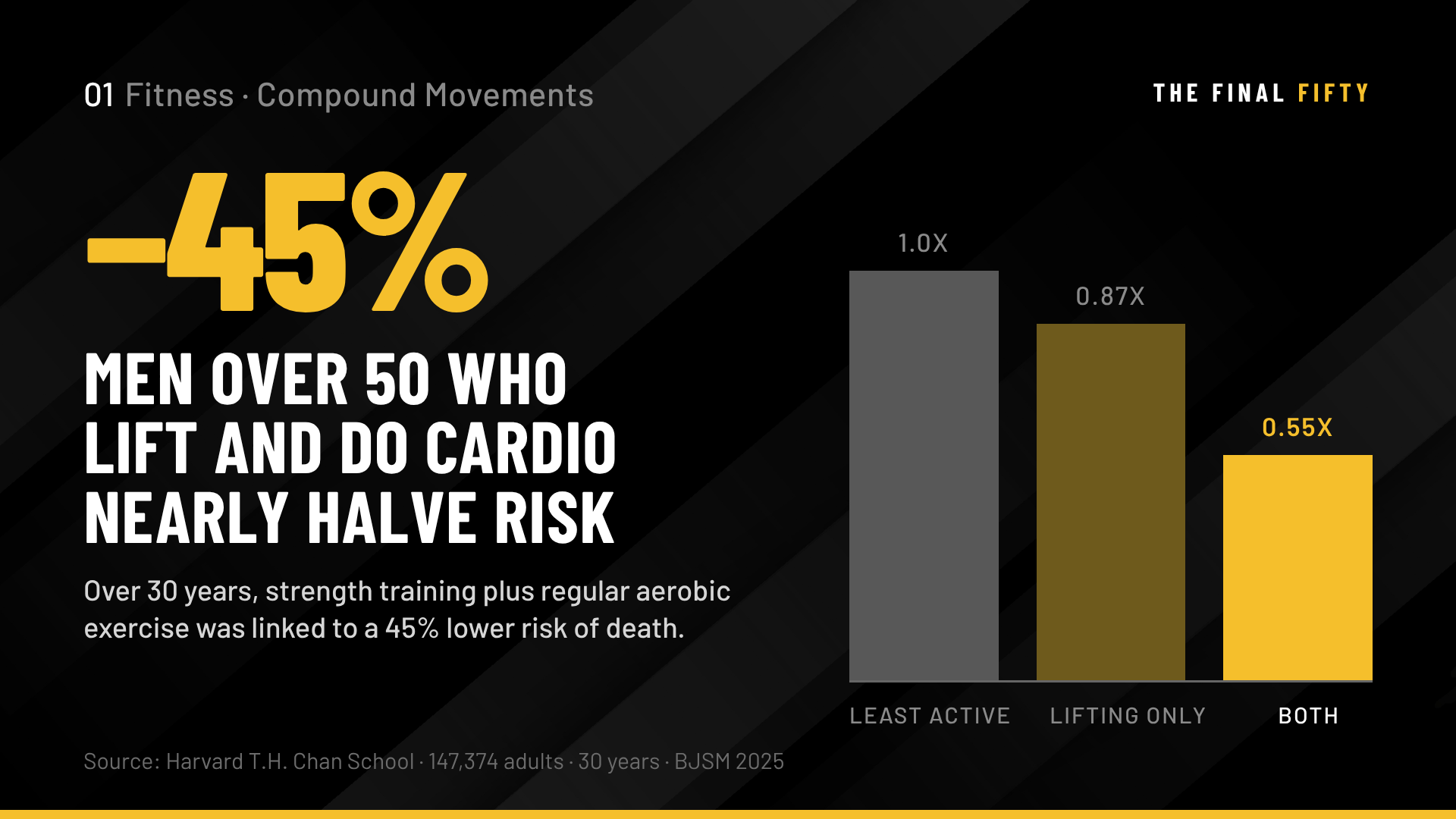
A landmark study tracking 147,374 participants over three decades found that those who combined aerobic exercise with strength training, including compound movements like squats, presses, and lunges, saw up to a 45 percent lower risk of death compared to those who were sedentary, with the greatest reductions among men who incorporated both modalities consistently.
Strength training is not just a body composition tool. It is a survival variable. And the movements that produce the greatest systemic effect are the ones that load the most muscle simultaneously.
The Foundation: The Five Movement Patterns
Every complete training program for a man over fifty is built around five fundamental movement patterns. These patterns, not specific exercises, are what matter. The specific exercise within each pattern can be modified based on injury history, mobility limitations, and equipment availability. The patterns themselves are non-negotiable.
The Squat Pattern
The squat is the most fundamental expression of lower body strength and the movement most directly predictive of functional capacity across the second half of a man’s life. In a study of older adults, those with lower quadriceps strength had a 51 to 65 percent higher risk of earlier death, even after adjusting for age, race, body size, physical activity, and inflammation. Older adults who take longer than 15 seconds to stand from a chair five times are nearly three times more likely to die earlier and 84 percent more likely to be hospitalized than those who complete the task faster.
The squat pattern builds and maintains the quadriceps, glutes, hamstrings, and core that make every lower body function possible, from getting off the floor to climbing stairs to carrying something heavy. For men with knee limitations, a box squat, goblet squat, or leg press preserves the pattern while reducing joint stress. The goal is to maintain the movement, not to abandon it because the barbell back squat feels uncomfortable.
Research on squat training in older adults confirms that home-based weight-bearing squat training improves lower limb function and performance in physical functional tests related to activities of daily living, and that these training benefits occur regardless of whether squats are performed at shallow or deeper depths. The depth argument, which keeps many men from squatting at all, is largely irrelevant. What matters is that the pattern is loaded consistently.
The Hip Hinge Pattern
The deadlift and its variations represent the most complete posterior chain exercise available. They train the hamstrings, glutes, lower back, upper back, traps, and grip simultaneously. No isolation exercise trains the posterior chain with anywhere near this efficiency, and the posterior chain is precisely what deteriorates most visibly in sedentary aging: the rounded shoulders, the forward head posture, the weak lower back, the flat glutes that make a man look and move like he is collapsing forward.
powerful predictors of survival in longevity research, with studies following 140,000 subjects finding that grip strength predicts cardiovascular, respiratory, and cancer outcomes as well as all-cause mortality. Squats and deadlifts are foundational movements that belong in a training week whether a man is 25, 55, or 75.
For men with lower back concerns, the Romanian deadlift or trap bar deadlift reduces spinal loading while preserving the posterior chain stimulus. The movement pattern remains intact. The specific loading strategy adapts to the individual.
The Push Pattern
Horizontal and vertical pressing builds the chest, shoulders, and triceps while demanding core stability and shoulder health. The bench press, dumbbell press, overhead press, and push-up are all expressions of the push pattern, and each has a role depending on a man’s shoulder health and training age.
The overhead press deserves specific attention for men over fifty. Pressing weight overhead requires thoracic extension, shoulder mobility, and core bracing in combination, making it one of the best functional assessments of upper body health available. A man who cannot press weight overhead with control has revealed a limitation that will eventually show up in daily life. Training the movement addresses the limitation while building the pressing strength that transfers to everything from putting luggage in an overhead compartment to getting up off the floor.
The Pull Pattern
Rows and pull variations are the counterbalance to pressing and arguably the most underdeveloped movement pattern in men who trained through the first half of their lives with a bench press focus. The muscles of the upper back, the rhomboids, rear deltoids, lats, and biceps, are the postural foundation that keeps a man upright and pain-free across decades of desk work, driving, and the forward-flexed positions that daily modern life demands.
Compound movements including squats, deadlifts, presses, rows, and hip thrusts cover the full body and develop the strength patterns most relevant to daily life and fall prevention. Isolation exercises have their place but should complement rather than replace compound movements, and older adults benefit from slightly longer rest periods between sets, typically 90 seconds to two minutes for compound movements.
Rows in every form, barbell rows, dumbbell rows, cable rows, chest-supported rows, build the pulling capacity that balances the pressing work and protects the shoulder complex from the impingement and rotator cuff issues that sideline men over fifty who press without adequate pulling volume.
The Carry Pattern
in training programs for men over fifty and one of the most valuable. Carrying heavy loads while walking builds grip strength, core stability, shoulder health, and cardiovascular capacity simultaneously. It produces no joint impact. It requires no specific training equipment. And it directly replicates one of the most common functional demands of real life.
Loaded carries build grip strength as a direct byproduct of the primary training stimulus. That is the definition of efficient training for a man who wants to maximize the functional return on every session.
How to Build the Program Around These Patterns
The five movement patterns do not all need to appear in every session. What a well-designed program for a man over fifty does is ensure that every pattern appears at least once across the training week, that the loading progresses over time within what recovery allows, and that modifications are made proactively rather than reactively.
A man training three days per week can cover all five patterns in a full-body format, hitting the squat and hinge one session, the push and pull the next, and rotating through with a carry variation added to each. A man training four days per week can use an upper-lower split that allows more volume per pattern while maintaining the recovery window that the second half of life requires.
Normative strength data from nearly 810,000 powerlifting competition entries confirms that men well into their eighties are still squatting, pressing, and deadlifting at levels that would be impressive for general population men decades younger. The ceiling on what is achievable with compound movements after fifty is far higher than most men believe, and the floor on what is required to protect health and function is far higher than most men are currently meeting.
The compound movements are the foundation because nothing else produces the systemic effect they produce. Not the machines. Not the isolation work. Not the cable exercises that allow a man to feel busy without loading anything that matters.
A man who builds his training program around these five patterns, who modifies intelligently when circumstances require it but never abandons the patterns themselves, is building a body that will carry him well into his seventies, eighties, and beyond.
That is what the foundation is for.
THE FINAL 50 FRAMEWORK
THE REFRAME
Compound movements are not what men over fifty graduate away from as they get older. They are what men over fifty build their entire training program around because nothing else produces the hormonal response, the functional strength, the bone density protection, or the mortality risk reduction that multi-joint loading delivers. The machines have their place. The isolation work has its place. That place is secondary to the foundation, not in place of it.
THE STANDARD
The Final 50 man trains the five fundamental movement patterns every week without exception. He squats. He hinges. He pushes. He pulls. He carries. The specific exercise within each pattern adapts to his body, his history, and his current capacity. The pattern itself does not get abandoned because it became uncomfortable or unfamiliar. He modifies intelligently. He never quits the pattern.
THE PRACTICE
This week, map your current training program against the five movement patterns. Squat, hinge, push, pull, carry. Which patterns are present in your current weekly training? Which are absent? Which have been quietly dropped in favor of machines or isolation work that feels safer? Identify the missing pattern. Add one exercise that addresses it before the week is out. One pattern restored, held consistently, changes the training result.
THE AUDIT
When did you last deadlift? When did you last perform a loaded squat with meaningful weight? When did you last row as much as you press? If the honest answers reveal that the compound foundation has been quietly dismantled in favor of the path of least resistance, you now have a clear picture of what has been lost and what is available to be rebuilt. The movements are still there. The question is whether the man who used to do them still is.
THE PROMPT
The men in your brotherhood are training with varying degrees of intensity, structure, and foundational intelligence. Who in your circle has built their training around the compound movements in a way that is producing results worth paying attention to? What would it look like to share a training session with that man, to train the foundation together, to hold each other to the standard that the second half demands? That conversation, followed by a session, is worth more than any training article available.


