
Most men over fifty are living with a condition they cannot feel, cannot name, and have never been formally diagnosed with. It does not announce itself with acute symptoms or a clear clinical threshold. It accumulates quietly across years of dietary choices, sleep deficits, chronic stress, and sedentary hours, building in the background of a life too busy to notice what is happening at the cellular level.
It is called inflammaging. Chronic, low-grade, systemic inflammation that accelerates with age and drives the disease processes that most men attribute to simply getting older.
The development of chronic, low-grade systemic inflammation in the elderly has been associated with increased incidence of chronic diseases, geriatric syndromes, and functional impairments. Inflammaging represents a significant risk factor for age-related frailty, morbidity, and mortality, and many chronic diseases including cardiovascular diseases, atherosclerosis, metabolic syndrome, type 2 diabetes, neurodegenerative diseases, and cancer have been associated with chronic inflammation.
That is not a narrow list. That is the majority of what kills and disables men in the second half of their lives. And the research is clear that the food a man eats every day is one of the most powerful variables he has direct control over in determining whether he fuels that process or fights it.
This article is about what to eat and what to cut. Not as a wellness suggestion. As a strategic health decision with consequences that compound across the decades ahead.
What is Inflammaging?
Before addressing the diet, it is worth understanding the mechanism. Inflammation is not inherently a problem. Acute inflammation is the immune system doing exactly what it is designed to do: responding to injury or infection with a rapid, targeted cascade that clears the threat and initiates repair. The problem is not inflammation. The problem is inflammation that never resolves.
Chronic, low-grade systemic inflammation is now recognized as a thread that runs through cardiovascular disease, metabolic syndrome, type 2 diabetes, autoimmune conditions, depression, certain cancers, and several skin conditions. Researchers call it inflammaging, inflammation driven by metabolic stress and the accumulation of small daily insults rather than by any single illness. What feeds it includes poor sleep, stress, and alcohol, but dietary choices represent one of the most consistent and modifiable drivers.
The man at fifty who is eating in a way that consistently elevates inflammatory markers is not doing something that feels immediately harmful. He is doing something that feels entirely normal because it is normal. The standard American dietary pattern is a pro-inflammatory pattern, and most men are running it without realizing they have a choice.
What to Cut: The Inflammatory Load Most Men Are Carrying
The foods that drive chronic inflammation do so through specific biological mechanisms, not through abstract nutritional concepts. Understanding the mechanism is what makes the cut permanent rather than temporary.
Added sugar and refined carbohydrates are the primary dietary driver of metabolic inflammation. The biggest culprits in most people’s diets are sugary beverages, cereals, sauces, and packaged snacks where sugar is added during manufacturing. Several categories of food promote chronic, low-grade inflammation when eaten regularly: added sugars, trans fats, processed meats, refined grains, excess alcohol, and heavily processed foods containing certain additives. These foods trigger specific biological cascades that raise levels of inflammatory signaling molecules in the blood, and the effects compound over time.
Research indicates that excessive intake of carbohydrates and sugars can contribute to inflammation. A study published in Diabetes Care found that diets with a higher glycemic load are positively correlated with elevated CRP concentrations. CRP, C-reactive protein, is the primary blood marker of systemic inflammation and one of the most powerful independent predictors of cardiovascular disease risk. A dietary pattern that consistently elevates CRP is a dietary pattern that is quietly accelerating the disease processes most likely to shorten a man’s life and reduce its quality.
The omega-6 to omega-3 fatty acid ratio is the second major dietary driver of inflammation, and it is one that most men are getting catastrophically wrong. For most of human history, people consumed omega-6 and omega-3 fatty acids in roughly a 4 to 1 ratio. The typical Western diet has pushed that ratio to about 20 to 1, heavily favoring omega-6. This imbalance predisposes the body to exaggerated inflammatory responses and sustains chronic low-grade inflammation. The shift happened largely because of refined seed oils, soybean, corn, sunflower, and safflower, that now dominate cooking and processed food manufacturing.
Inflammation and oxidative stress are central mechanisms of aging. As we age, the body becomes less efficient at repairing oxidative damage and resolving inflammation. Diets that increase lipid peroxidation may place additional strain on aging systems, including mitochondria, joints, and the nervous system. The cumulative effect of daily exposure to high omega-6 seed oils through packaged snacks, restaurant cooking, and processed food manufacturing is a sustained inflammatory signal that most men have never identified as a variable they control.
Ultra-processed food is the category that contains nearly all of these inflammatory inputs simultaneously. It is where added sugar, refined grains, seed oils, and synthetic additives converge into a dietary product that the human body has no evolutionary experience managing. Eliminating ultra-processed food is not a restriction. It is the removal of the primary delivery vehicle for the inputs that are doing the most damage.
What to Eat: The Animal-Based Anti-Inflammatory Foundation
The anti-inflammatory diet is not, as the conventional health narrative often frames it, a plant-forward, low-fat, grain-centered approach. The research on what actually reduces inflammatory markers points clearly toward the nutrient-dense animal foods that provide the specific fatty acids, vitamins, and minerals that the human inflammatory response depends on.
Fatty fish is the most powerful single food available for reducing systemic inflammation. Omega-3 fatty acid supplementation has been shown to reduce levels of inflammatory markers like CRP, interleukin-6, and TNF-alpha. EPA and DHA work differently against chronic inflammation, suggesting each has its own important role in regulating the immune system. Consuming at least two servings of wild-caught fatty fish per week is one of the highest-leverage nutritional decisions available for men who want to reduce their inflammatory burden.
Salmon, sardines, mackerel, and herring deliver EPA and DHA directly in the form the body can use without conversion. No plant-based omega-3 source, including flaxseed, chia, or walnuts, provides EPA and DHA in meaningful quantities. They provide ALA, which the body converts to EPA and DHA at a rate of less than five percent. For a man trying to shift a 20 to 1 omega-6 to omega-3 ratio toward something that reduces rather than sustains inflammation, fatty fish is not optional.
Grass-fed beef provides a fundamentally different nutritional profile than grain-fed beef, and the distinction matters specifically for inflammation. Grass-fed beef is rich in conjugated linoleic acid, CLA, which has known anti-inflammatory properties. Wild fish like salmon and sardines deliver omega-3 fatty acids long celebrated for calming inflammation. Even organ meats like liver bring a dense supply of vitamins A, D, and zinc, all crucial for a healthy immune system.
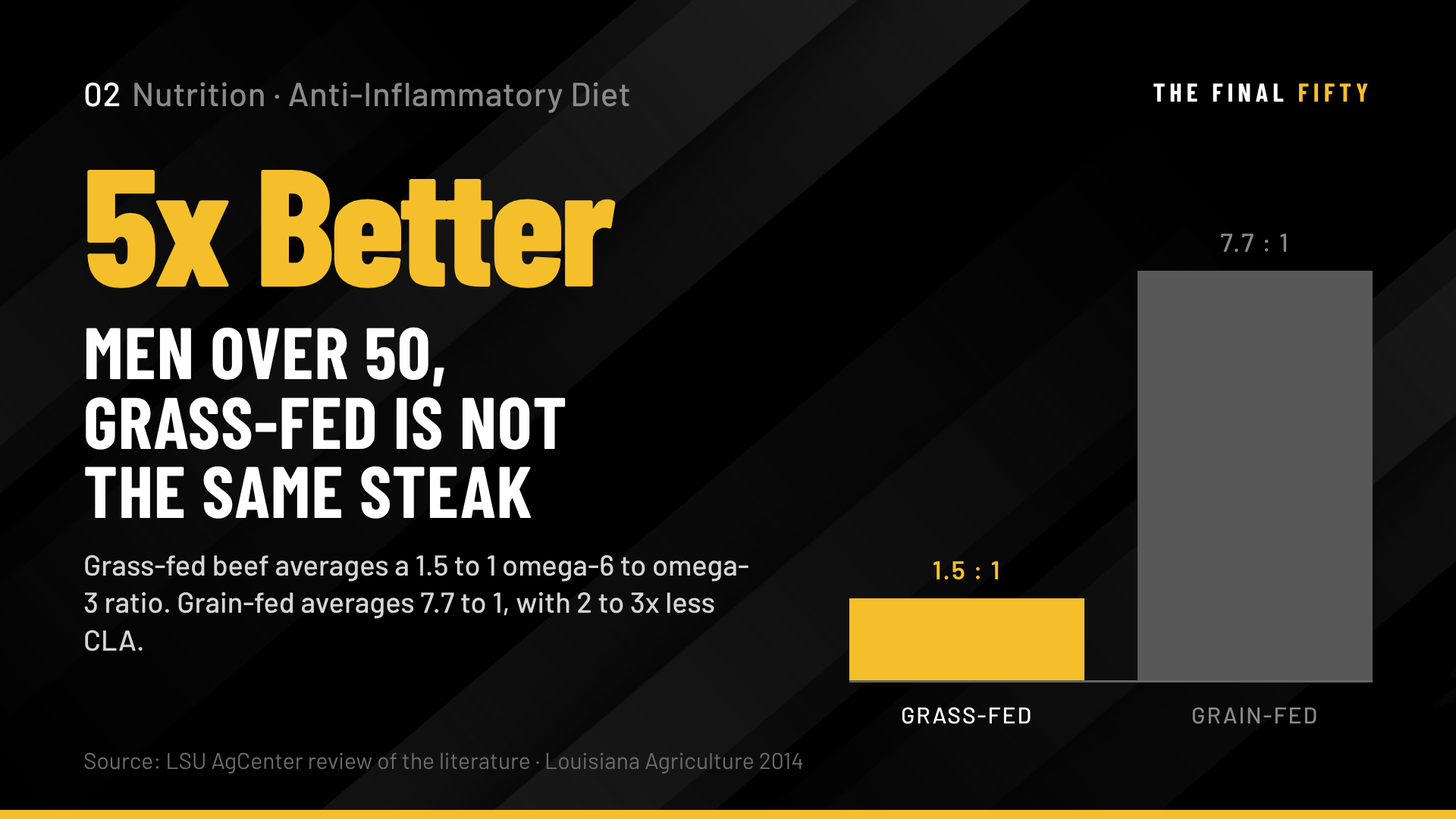
Grass-fed beef has an omega-6 to omega-3 ratio of approximately 1.5 to 1, dramatically better than grain-fed beef’s 7.5 to 1. It also provides two to three times more CLA and significantly more vitamin E. The man who builds his red meat consumption around grass-fed sources is not eating the same food as the man eating conventional grain-fed beef from an inflammatory standpoint.
Eggs from pasture-raised sources similarly provide a superior inflammatory profile. Pasture-raised eggs are higher in omega-3 fatty acids, vitamins A, D, and E, and antioxidants compared to conventional eggs. Quality sourcing is not optional for the man who is using his dietary choices as a deliberate anti-inflammatory tool.
Organ meats, particularly liver, deliver the vitamins and minerals most directly involved in regulating immune function and managing inflammation: vitamin A, vitamin D, zinc, copper, and B vitamins. A man whose diet includes liver once or twice a week is addressing multiple nutritional deficiencies simultaneously that, in their absence, allow inflammatory signaling to operate without adequate regulation.
The Dietary Pattern That Makes It Systematic
The anti-inflammatory approach for men over fifty is not a collection of individual foods. It is a pattern, and the pattern has two sides.
The elimination side removes the primary inflammatory inputs: added sugar eliminated, not reduced. Refined seed oils replaced with animal fats, butter, tallow, and olive oil. Ultra-processed food removed entirely because it delivers the first two inputs in concentrated form alongside a catalog of additional inflammatory ingredients. Refined grains minimized because they spike blood sugar, elevate insulin, and produce the glycemic environment that drives metabolic inflammation.
The addition side builds the nutritional foundation that supports resolution of inflammation: fatty fish multiple times per week. Grass-fed and pasture-raised animal proteins as the foundation of every meal. Organ meats included regularly for their dense micronutrient delivery. Animal fats used for cooking, providing the stable, heat-resistant fat profile that does not oxidize into inflammatory compounds the way seed oils do under heat.
Research on elderly men found that those characterized by low levels of systemic inflammation demonstrated higher intake of anti-inflammatory dietary components including vitamin D and favorable omega-3 to omega-6 ratios, compared to those with elevated systemic inflammation. Low inflammation was associated with significantly better physical performance and gait speed.
That connection, between dietary pattern, inflammatory status, and physical performance, is exactly what a man over fifty who is serious about the second half needs to understand. The anti-inflammatory diet is not just a disease prevention strategy. It is a performance strategy. The man who runs a lower inflammatory load recovers faster from training, maintains better cognitive function, protects his joints and connective tissue, and sustains the hormonal environment that the second half demands.
The research on what actually drives inflammation and what actually resolves it does not support the conventional low-fat, plant-forward model. It supports a pattern built around the elimination of processed, industrial food and the consistent consumption of the nutrient-dense animal foods that the human inflammatory system was built to function alongside.
That is the diet. The choice to build it is available at the next meal.
THE FINAL 50 FRAMEWORK
THE REFRAME
Chronic inflammation is not a diagnosis men over fifty receive. It is a process they are either fueling or fighting with every meal they eat, and most men are fueling it without knowing it. The anti-inflammatory diet is not a restrictive protocol for the health-obsessed. It is the dietary standard that the second half demands of every man who intends to perform at a high level and avoid the diseases that prematurely end the careers, the training, and the lives of men who ate exactly the way the culture told them was fine.
THE STANDARD
The Final 50 man has eliminated the primary inflammatory inputs from his diet: added sugar, refined seed oils, and ultra-processed food. He eats fatty fish at least twice a week. He builds his meals around grass-fed and pasture-raised animal proteins. He includes organ meats regularly. He uses animal fats for cooking. His dietary pattern is not perfect at every meal, but it is the default from which exceptions are taken deliberately rather than the exception from which the standard occasionally appears.
THE PRACTICE
This week, identify the single highest-volume source of inflammatory input in your current diet. For most men it is one of three things: sugary beverages, cooking with seed oils, or a daily ultra-processed food habit that feels minor but is delivering a consistent pro-inflammatory signal. Pick the highest-volume source. Eliminate it this week. Not reduce it. Eliminate it. Then build from there.
THE AUDIT
When did you last have a CRP test? If your answer is never or more than twelve months ago, you are managing your inflammatory status without data. A high-sensitivity CRP test is inexpensive, widely available, and tells you exactly where your inflammatory baseline currently sits. A reading below 1.0 mg/L is optimal. Between 1.0 and 3.0 is elevated risk. Above 3.0 is a signal that demands immediate dietary intervention. Get the test. Then use the result.
THE PROMPT
The men in your brotherhood are eating pro-inflammatory diets with the same lack of awareness that most men bring to this question. Who in your circle has actually addressed this, has made the dietary changes that show up in their lab work, their energy, their recovery, and their body composition? That conversation, held between men who are serious about the long game, accelerates every man’s decision to treat nutrition as the performance variable it actually is.


