
The bathroom scale is the most widely used body health measurement tool available to men over fifty. It is also the least informative. A number on a scale measures total mass, which is the combined weight of muscle, fat, bone, organs, water, and everything else the body contains. It does not distinguish between any of these components. It does not tell a man whether the mass he carries is predominantly muscle or predominantly fat, whether his visceral fat has increased while his subcutaneous fat decreased, whether his muscle mass has declined while his body weight held steady, or whether the weight he lost last month came from fat or from the lean tissue he has been training to build and maintain.
Two men can weigh exactly the same and have radically different health, performance, and longevity profiles depending on how that identical weight is distributed between muscle, fat, and specifically visceral fat. The man at 190 pounds with 20 percent body fat and 152 pounds of lean mass has a fundamentally different metabolic, hormonal, and cardiovascular health picture from the man at 190 pounds with 32 percent body fat and 129 pounds of lean mass. The scale says they are identical. The body composition data says they are not remotely the same.
After fifty, this distinction becomes more consequential than at any earlier point in a man’s life, because the specific changes the second half produces, the muscle loss of sarcopenia, the visceral fat accumulation driven by declining testosterone and increasing insulin resistance, and the body recomposition that occurs even without weight change as fat replaces muscle in the tissues, make total body weight a progressively less accurate indicator of health status with each passing year. The man whose weight has been stable for five years while his muscle mass has declined and his visceral fat has increased has been looking at a reassuring number on the scale while his body composition was quietly moving in the wrong direction.
Why the Scale Fails After 50: The Body Recomposition Problem
The specific phenomenon that makes the scale most misleading in the second half is body recomposition without weight change: the simultaneous loss of muscle mass and gain of fat mass that occurs in many men over fifty as a result of declining testosterone, declining physical activity, inadequate protein intake, and the anabolic resistance that aging produces. A man can lose two kilograms of muscle and gain two kilograms of fat across a year of sedentary living and inadequate nutrition. His weight will not change. His body composition will have significantly deteriorated.
Visceral fat increases with age, and once men reach the 50th percentile for overall body fat, visceral fat levels may double between their twenties and fifties. This visceral fat accumulation is not visible on the scale in any meaningful way, because visceral fat is deep abdominal fat surrounding the organs rather than subcutaneous fat that adds visible bulk. The man who looks approximately the same as he did five years ago and whose weight has not changed significantly may have experienced a substantial increase in visceral fat that has replaced the muscle tissue the intervening years of inadequate training and declining testosterone removed.
Sarcopenia, the age-related loss of muscle mass and function, compounds the problem. Men can lose three to five percent of muscle mass per decade after thirty, with losses accelerating after fifty in the absence of deliberate resistance training and adequate protein intake. A man who loses five kilograms of muscle mass across his fifties while gaining five kilograms of fat mass will weigh exactly the same. But he will have meaningfully reduced his resting metabolic rate, his strength, his functional capacity, his insulin sensitivity, his hormonal health, and his longevity trajectory. None of this is visible on the scale.
Beyond body mass index, body composition metrics including skeletal muscle, fat mass, and visceral adipose tissue offer deeper insights into nutrition and disease risk. These measures are essential for both cross-sectional assessments and longitudinal tracking, providing a clearer picture of health changes over time. The scale provides neither cross-sectional insight nor longitudinal accuracy. It provides a number that conflates the health variables that most need to be separated.
BMI: The Scale’s Even Less Informative Relative
Body mass index, weight in kilograms divided by height in meters squared, has the cultural authority of a clinical measurement despite being a ratio of two numbers that tells a clinician nothing about how the weight being measured is composed. BMI was developed in the nineteenth century as a population-level statistical tool, not as an individual health assessment instrument, and its application to individual clinical assessment produces the specific errors that become most consequential in the man over fifty.
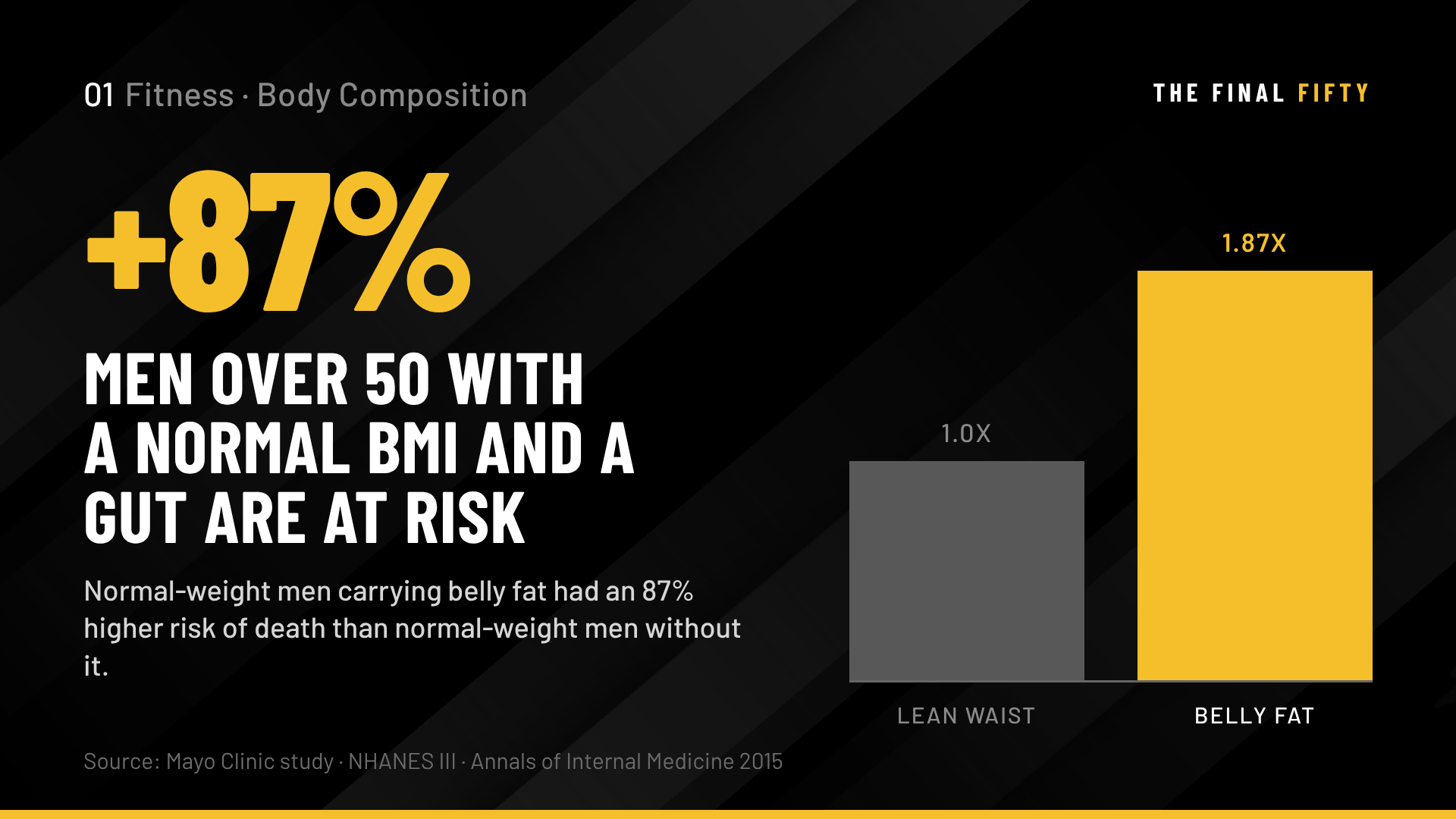
A muscular man over fifty with substantial lean mass and low body fat may have a BMI in the overweight range. His body composition is excellent. The BMI says he is overweight. Conversely, the man with a BMI in the normal range who carries significant visceral fat and inadequate muscle mass, the body composition profile that the research associates with the highest metabolic and cardiovascular risk, may be classified as healthy based on BMI while his actual health risk is substantially elevated. Obesity and low muscle mass are major public health concerns, especially in older adults, due to their strong links to cardiovascular disease, cancer, and mortality. BMI captures neither.
The sarcopenic obesity phenotype, the combination of excess fat mass and inadequate muscle mass that is particularly common and particularly dangerous in men over fifty, is nearly impossible to identify from BMI alone. A man with sarcopenic obesity may have a BMI in the normal or mildly overweight range while simultaneously carrying the combination of metabolic risk factors that the fat excess produces and the functional limitation that the muscle deficit produces. This is the body composition profile that most requires accurate measurement and most consistently escapes detection when scale weight and BMI are the primary tools.
What to Measure Instead: The Four-Metric Body Composition System
The body composition assessment system that provides the information the scale cannot requires four specific measurements that together produce an accurate picture of the muscle, fat, and visceral fat distribution that determines health and performance outcomes in men over fifty.
Waist circumference is the first and most accessible. A waist measurement above 40 inches in men is associated with substantially elevated cardiovascular risk, metabolic syndrome, insulin resistance, and the visceral fat burden that drives the hormonal consequences described throughout the hormonal health pillar of this series. Waist circumference measured consistently at the same anatomical landmark, at the navel level for men, is a reliable and cost-free proxy for visceral fat that can be tracked monthly without any equipment beyond a tape measure. It is more predictive of cardiovascular mortality than BMI. It directly reflects the visceral fat that the hormonal health articles establish as the primary driver of the hypogonadal-obesity cycle. And it changes in response to the interventions this platform describes in proportion to their effectiveness.
Waist-to-height ratio is the second. Dividing waist circumference by height produces a ratio whose threshold of 0.5 is the boundary the research associates with elevated metabolic risk across different body sizes and ethnicities. A man whose waist circumference in inches divided by his height in inches exceeds 0.5 is carrying a visceral fat burden that elevated his cardiometabolic risk independent of his total body weight. This ratio is more sensitive than waist circumference alone because it accounts for body size variation.
Body fat percentage is the third, and the one that most directly measures the fat-to-lean composition that scale weight cannot reveal. The target body fat percentage for men over fifty for optimal health and performance is in the range of 15 to 22 percent, with performance-oriented men targeting the lower end and general health targets somewhat higher. Body fat percentage can be estimated through bioelectrical impedance analysis, which is available in consumer-grade scales and devices with moderate accuracy, through skinfold caliper measurements with appropriate reference equations, or through DEXA scanning, which is the reference standard for body composition measurement. A 2025 study in the British Journal of Radiology confirmed that DEXA produces measurements closely matching those of CT scan, particularly for fat and lean mass in the limbs and abdomen, establishing it as the most accurate non-invasive body composition tool available.
Appendicular lean mass is the fourth and the most directly relevant to the sarcopenia prevention that the second half’s physical investment is designed to produce. Appendicular lean mass measures the muscle mass in the arms and legs, which is the portion of lean mass most sensitive to training, most affected by sarcopenia, and most predictive of functional capacity and longevity outcomes. DEXA provides appendicular lean mass directly. When divided by height squared, it produces the appendicular lean mass index, whose threshold values define low muscle mass as a clinical finding. The man who knows his appendicular lean mass index and tracks it annually knows whether his training and nutritional investment is successfully maintaining the muscle mass that the second half’s functional capacity depends on.
DEXA Scanning: The Baseline Assessment Every Man Over 50 Should Have
DEXA scanning, dual-energy X-ray absorptiometry, is the body composition measurement tool that provides all four meaningful metrics simultaneously and with the accuracy that consumer devices and anthropometric measurements cannot fully replicate. It measures total body fat mass, total lean mass, appendicular lean mass, visceral fat area, and regional body composition across the arms, legs, and trunk in a single fifteen-minute scan at minimal radiation exposure. Many longevity physicians suggest establishing a baseline DEXA body composition scan around age 40 to track changes over time, with subsequent scans every one to two years to identify trends that individual measurements cannot reveal.
The cost of DEXA body composition scanning, typically between $75 and $300 depending on location and provider, is among the lowest available for a clinical measurement that provides this level of specificity. It is considerably less than most supplement purchases that men over fifty make in the service of the body composition outcomes the DEXA scan is needed to measure. The man who is investing in training, nutrition, sleep, and hormonal optimization without a baseline DEXA body composition assessment has no way of knowing whether those investments are producing the specific body composition outcomes they are designed to produce, because the scale, the mirror, and subjective assessment cannot detect the muscle-to-fat composition changes that training and nutrition are supposed to drive.
The baseline DEXA scan produces the specific numbers that convert the body composition goal from a vague intention to get in better shape into a specific measurable target: reduce visceral fat area from X to Y, increase appendicular lean mass from A to B, reduce body fat percentage from M to N. Each of these is a specific, trackable, evidence-based target that the annual reassessment can compare against to determine whether the body composition investment of the past twelve months has produced its intended outcome.
The Metrics That Replace the Scale in Daily Tracking
The DEXA scan provides the precise baseline and the annual or semi-annual progress check. The daily and monthly tracking that the operating system described throughout this platform requires does not need DEXA frequency. It needs the simpler metrics that provide adequate sensitivity to the meaningful changes the daily and weekly investments are producing.
Waist circumference measured weekly or monthly at a consistent anatomical landmark, under consistent conditions such as first thing in the morning before eating, provides the most accessible ongoing proxy for the visceral fat change that most directly reflects the effectiveness of the training, nutritional, and hormonal management investments. A declining waist measurement over months reflects genuine visceral fat reduction. A stable or increasing waist measurement despite a stable or declining scale weight reflects the body recomposition problem, muscle loss alongside fat gain, that requires the intervention that scale weight alone would not have prompted.
Training performance metrics are the second daily tracking tool for body composition. The progressive loading that resistance training produces is the primary driver of muscle mass maintenance and development, and the training log that documents whether the loads are progressing is a more sensitive indicator of whether muscle is being built or lost than any measurement of scale weight. The man whose primary compound movements are progressing across the year, whose deadlift, squat, and row loads are higher at year’s end than at year’s start, is maintaining and building the lean mass that his annual DEXA will confirm. The man whose loads have stagnated or declined while his weight has held stable is experiencing the muscle loss and fat accumulation that the scale is not reporting.
The mirror assessment, conducted honestly and regularly, is not vanity. It is the most immediate visual proxy for the body composition changes that measurements quantify. The man who notices that his abdominal profile has changed without a corresponding change in scale weight, that his shoulders and arms look less developed than they did six months ago, or that the waist of his clothing fits differently than it did a year ago, is receiving body composition information that the scale is not providing. These observations are less precise than the DEXA measurements but more frequent, and they provide the early signals that prompt the more precise assessment before the body composition change has progressed to the point where correction is more demanding.
What the Right Metrics Produce
The shift from scale-centric to composition-centric body measurement produces a fundamentally different relationship with the body’s changes in the second half. The man who measures his waist weekly, tracks his training loads, gets a DEXA scan annually, and evaluates his body composition against the four specific metrics described in this article knows what his body is doing rather than what it weighs. He knows whether the muscle is being maintained or lost. He knows whether the visceral fat is declining or accumulating. He knows whether the investments he is making are producing the body composition outcomes they are designed to produce or whether the approach requires adjustment.
The man who tracks only the scale is measuring total mass with a tool that cannot distinguish the changes that matter from the changes that do not. He will be reassured by weight stability that is muscle loss replacing fat gain. He will be discouraged by weight gain that is muscle growth alongside fat reduction. He will miss the gradual visceral fat accumulation that his hormonal health articles have established as the most dangerous body composition change available, because visceral fat accumulates without necessarily changing scale weight.
The right metrics for the second half are the metrics that track what changes in the second half and what matters for the longevity, the hormonal health, the functional capacity, and the performance that The Final 50 platform is designed to build and protect. The scale is not that tool. The four-metric system described in this article is.
What the Right Metrics Produce
The shift from scale-centric to composition-centric body measurement produces a fundamentally different relationship with the body’s changes in the second half. The man who measures his waist weekly, tracks his training loads, gets a DEXA scan annually, and evaluates his body composition against the four specific metrics described in this article knows what his body is doing rather than what it weighs. He knows whether the muscle is being maintained or lost. He knows whether the visceral fat is declining or accumulating. He knows whether the investments he is making are producing the body composition outcomes they are designed to produce or whether the approach requires adjustment.
The man who tracks only the scale is measuring total mass with a tool that cannot distinguish the changes that matter from the changes that do not. He will be reassured by weight stability that is actually muscle loss replacing fat gain. He will be discouraged by weight gain that is actually muscle growth alongside fat reduction. He will miss the gradual visceral fat accumulation that his hormonal health articles have established as the most dangerous body composition change available, because visceral fat accumulates without necessarily changing scale weight.
The right metrics for the second half are the metrics that track what actually changes in the second half and what actually matters for the longevity, the hormonal health, the functional capacity, and the performance that The Final 50 platform is designed to build and protect. The scale is not that tool. The four-metric system described in this article is.
THE FINAL 50 FRAMEWORK
THE REFRAME
The bathroom scale measures total mass. Total mass after fifty is the least informative body composition indicator available because the specific changes the second half produces, the muscle loss of sarcopenia, the visceral fat accumulation of the hypogonadal-obesity cycle, and the body recomposition without weight change that declining testosterone and activity drive, are invisible to the scale. Two men who weigh the same can have radically different health profiles. The man who measures composition rather than total mass is tracking what changes in the second half and what determines the health, hormonal, and functional outcomes the second half requires.
THE STANDARD
The Final 50 man does not use scale weight as his primary body composition indicator. He measures his waist circumference monthly at a consistent landmark and tracks the trend. He knows his body fat percentage and his appendicular lean mass from a baseline DEXA scan, updated annually. He tracks his training performance metrics as the ongoing proxy for whether lean mass is being maintained or built. He evaluates his body composition against the four specific targets that the evidence-based framework establishes: waist circumference below 40 inches, waist-to-height ratio below 0.5, body fat percentage in the 15 to 22 percent range, and appendicular lean mass index above the threshold that clinical low muscle mass is defined by.
THE PRACTICE
This week, take two measurements that you may not have taken recently. First, measure your waist circumference at the navel level, first thing in the morning before eating, with the tape measure parallel to the floor. Record the number. Second, calculate your waist-to-height ratio by dividing your waist circumference in inches by your height in inches. If the ratio exceeds 0.5, you have identified the primary body composition target that the second half’s training and nutritional investment should be directed toward. If you have not had a DEXA body composition scan in the past two years, schedule one this month. The scan is the baseline. Everything else is tracked against it.
THE AUDIT
When did you last know your body fat percentage and your appendicular lean mass? If the honest answer is never or years ago, you have been tracking your body composition with the wrong tool across the most important body composition decade of your life. The waist measurement you take this week and the DEXA scan you schedule this month are the beginning of the composition-centric tracking that replaces the scale as the primary indicator. What does your waist circumference tell you that the scale has not been telling you? That gap between the scale’s story and the waist measurement’s story is the body composition information you have been missing.
THE PROMPT
The body composition conversation most men in the brotherhood have never had is the specific one about what each man’s body fat percentage, waist circumference, and appendicular lean mass are, rather than what each man weighs. Who in your circle has done a DEXA body composition scan and knows his specific composition metrics? What did the DEXA reveal that the scale had not been reporting, and what specific changes in training or nutrition did the information prompt? That conversation, grounded in actual composition data rather than scale weight, produces the collective body composition intelligence that every man in the brotherhood needs to manage this most misunderstood health variable of the second half.


