
The supplement industry generates more revenue from men over fifty than from any other demographic, because the second half’s biological changes create a set of specific deficits and specific performance concerns that marketing is exceptionally skilled at exploiting. The testosterone boosters that deliver a modest zinc dose in an expensive proprietary blend. The recovery formulas with clinical doses of one ingredient and label doses of six others. The longevity compounds whose preliminary cell-line data has been extrapolated into marketing claims that the human clinical research does not yet support.
Cutting through this noise requires a single organizing question: what does the research on this supplement support in human clinical trials in men over fifty specifically, and at what dose does the evidence exist? That question applied honestly to the full supplement market produces a short list. The honest hierarchy matters more than the marketing.
The supplements with the strongest evidence for addressing the specific physiological changes that men over fifty face converge on four primary interventions: creatine monohydrate for muscle preservation and cognitive function, vitamin D3 for testosterone support, bone health, and immune function, omega-3 fatty acids for cardiovascular protection and neurological support, and magnesium for testosterone production, sleep architecture, and insulin sensitivity. Each addresses a specific gap that the second half’s biology creates and that the average dietary pattern does not fill. Each has a dose, a form, and a mechanism that the research specifies clearly enough to state with confidence.
This article covers those four in the depth they deserve, followed by a brief honest assessment of the supplements that some men over fifty will benefit from and others will not, depending on their specific situation.
Creatine Monohydrate: The Most Underused Supplement Available to Men Over 50
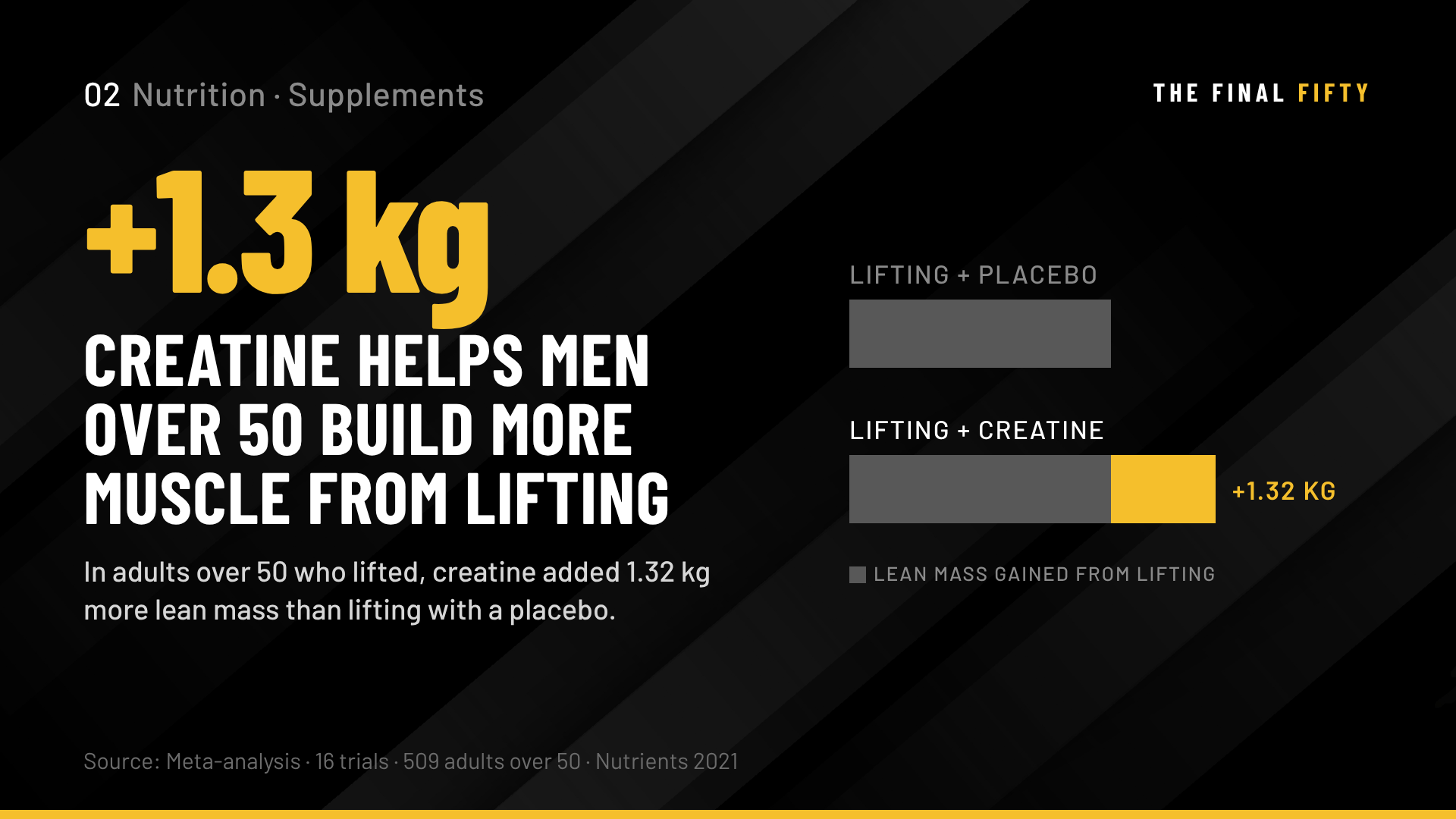
Creatine is the most evidence-backed supplement for older adults across multiple domains simultaneously, and it is the supplement most consistently absent from the protocols of men over fifty who are not competing athletes. Over 500 peer-reviewed studies confirm creatine’s direct impact on strength and power output. The research specifically on older adults is extensive enough to produce specific clinical recommendations that the athletic performance research base alone does not fully capture.
Creatine’s primary mechanism is the replenishment of phosphocreatine stores in muscle tissue, which serves as the rapidly available energy substrate for high-intensity muscular contractions. In the context of resistance training, this translates to more total work completed per session, better maintenance of force output across multiple sets, and faster recovery between sets. For men over fifty managing the anabolic resistance that reduces training efficiency, the additional training volume that creatine’s energy substrate support enables produces meaningfully greater total training stimulus per session than the same training without creatine supplementation.
The muscle preservation benefit extends beyond the training session through creatine’s direct anabolic effects at the cellular level. Creatine increases the expression of myogenic regulatory factors that govern muscle fiber development and maintenance. In aging muscle, these regulatory pathways decline in sensitivity, and creatine supplementation partially counteracts this decline. Men who supplement creatine alongside resistance training show greater preservation of muscle mass and function than those who train without it, making creatine a muscle preservation tool as well as a performance tool.
The cognitive benefits are the least commonly known and among the most practically significant for men over fifty. A 2025 meta-analysis in Frontiers of Nutrition analyzed 16 trials and found creatine supplementation improved memory, attention, and processing speed. The mechanism involves creatine’s role in cerebral energy metabolism: the brain, like muscle tissue, relies on phosphocreatine as a rapid energy buffer, and creatine supplementation increases brain phosphocreatine availability in a way that enhances the energy supply to neurons during cognitively demanding tasks. For a man investing in his cognitive longevity, creatine is the supplement whose cognitive benefit is most robustly established in controlled trials.
The dose is straightforward: 3 to 5 grams of creatine monohydrate daily. The loading protocol, taking 20 grams per day for five to seven days to saturate muscle creatine stores rapidly, is optional. It produces faster saturation but identical final creatine stores to the maintenance dose taken consistently over three to four weeks. For men who are not in a competitive hurry, 3 to 5 grams daily with no loading phase produces the same outcome over a slightly longer timeline with none of the gastrointestinal discomfort that loading doses sometimes produce.
The form matters: creatine monohydrate is the specific form with the largest evidence base. Alternative forms including creatine ethyl ester, buffered creatine, and creatine hydrochloride are marketed as superior in absorption and tolerability, but the independent research does not consistently support these claims. Creatine monohydrate is the most studied, the most affordable, and the most evidence-supported form available. It can be taken at any time of day. Taking it with the post-training meal on training days may provide a modest advantage through the insulin-mediated uptake enhancement that carbohydrate and protein co-ingestion produces, but the daily total is the primary driver of tissue saturation, not the timing.
Vitamin D3: The Hormone Deficiency Most Men Do Not Know They Have
Vitamin D is technically a hormone precursor rather than a vitamin, and its role in male physiology extends far beyond the bone health context in which it is most commonly discussed. Vitamin D3 plays a regulatory role in testosterone production, immune function, cardiovascular health, insulin sensitivity, mood regulation, and the inflammatory management that the second half’s longevity investment depends on. Men over fifty who have never had their serum 25-hydroxyvitamin D level tested are likely operating in deficiency or insufficiency without knowing it, because the clinical symptoms of vitamin D insufficiency, reduced testosterone, impaired immune function, mood disruption, and increased inflammatory markers, are precisely the symptoms that the aging process is expected to produce and that therefore go uninvestigated as potential vitamin D deficiency.
Vitamin D is produced in the skin through UV-B exposure from sunlight, in a reaction that depends on the skin’s exposure to the UVB wavelengths that are only present at sufficient angles during certain hours and seasons. Men over fifty have reduced skin conversion efficiency compared to younger men from the same sun exposure, live increasingly indoor professional lives, and live at latitudes where adequate UVB exposure is seasonally restricted in a large proportion of the population. The result is that vitamin D insufficiency, defined as serum 25-hydroxyvitamin D below 30 nanograms per milliliter, is common in men over fifty even in climates with substantial annual sun exposure.
The testosterone connection is direct and documented. Vitamin D receptors are present on the Leydig cells that produce testosterone, and vitamin D has been shown to support testosterone synthesis through its regulatory effects on the steroidogenic enzymes in those cells. Men with adequate vitamin D levels have consistently higher testosterone compared to vitamin D-deficient men in population studies, and correcting vitamin D deficiency through supplementation has been shown to increase testosterone in deficient men.
The dose target is serum 25-hydroxyvitamin D above 30 nanograms per milliliter, with most longevity and hormone-focused physicians targeting 40 to 60 nanograms per milliliter for optimal benefit across the full range of vitamin D-sensitive biological systems. A daily supplement of 2,000 to 4,000 IU of vitamin D3, taken with a fat-containing meal to support the fat-soluble absorption that vitamin D requires, is the dose range that most men with baseline deficiency or insufficiency need to reach and maintain optimal serum levels. The specific dose required is individual and should be confirmed by testing rather than assumed: a man with severely deficient serum levels may require 5,000 IU daily to reach optimal status, while a man who spends significant time outdoors may maintain optimal levels on 2,000 IU.
Vitamin D3 should be taken with vitamin K2. The K2 pairing is not marketing but mechanism: vitamin D3 increases calcium absorption from the gut, and vitamin K2 activates the proteins that direct calcium into bone and teeth rather than into arterial walls and soft tissue. Taking vitamin D3 without K2 increases calcium absorption without ensuring that the calcium goes where it should go. The combination of D3 and K2 taken together produces the calcium management that bone health requires without the arterial calcification risk that elevated calcium absorption without adequate K2 can produce. The K2 form that the research most supports is MK-7, the long-chain menaquinone form found in fermented foods, at 90 to 200 micrograms daily alongside the D3 dose.
Omega-3 Fatty Acids: Cardiovascular and Neurological Protection in a Daily Capsule
Omega-3 fatty acids, specifically EPA and DHA from marine sources, are the nutritional intervention with the most extensive human clinical trial evidence base for cardiovascular protection in men over fifty. The VITAL trial, one of the largest randomized controlled trials of vitamin D and omega-3 supplementation, involving 20,000 men and women, established that omega-3 supplementation at 1 gram of combined EPA and DHA daily significantly reduced major cardiovascular events in participants without prior cardiovascular disease. For men over fifty whose cardiovascular risk is increasing with each year, this primary prevention benefit represents one of the most directly evidence-supported reasons to supplement.
The mechanisms through which omega-3 fatty acids provide cardiovascular protection are multiple and well-established. EPA and DHA reduce serum triglycerides, with the evidence for triglyceride reduction particularly strong at higher doses of 2 to 4 grams per day of combined EPA and DHA. They reduce platelet aggregation, reducing the thrombotic risk that cardiovascular events depend on. They improve arterial compliance, reducing the stiffness that elevates systolic blood pressure and cardiovascular workload. And they reduce systemic inflammation through the prostaglandin and leukotriene pathways that the balance between omega-6 and omega-3 fatty acids in the diet governs.
The cognitive benefit is the second domain of omega-3 evidence directly relevant to men over fifty. DHA is the primary structural fatty acid of neuronal cell membranes, comprising approximately 30 to 40 percent of the fatty acids in the grey matter of the brain. It is not synthesized adequately from plant-source omega-3 precursors in most adults, making dietary or supplemental DHA from marine sources the primary means of maintaining adequate brain DHA status. A systematic review and dose-response meta-analysis published in BMC Medicine in 2024 found that omega-3 supplementation influenced cognitive function in individuals without dementia, with DHA having a particularly significant positive effect. For the man investing in his cognitive longevity, omega-3 supplementation is the nutritional intervention whose cognitive mechanism is most clearly grounded in the brain’s structural biology.
The dose that the research most supports is 1 to 2 grams of combined EPA and DHA daily for cardiovascular and cognitive protection, with 2 to 4 grams for targeted triglyceride reduction. The form matters: triglyceride form omega-3, as found in fish oil rather than the ethyl ester form found in some concentrates, is absorbed approximately 70 percent more efficiently than the ethyl ester form in the presence of a meal. Choosing a product that specifies its omega-3 in triglyceride form and taking it with a fat-containing meal produces the most efficient delivery to the tissues where EPA and DHA’s effects occur. The caution at high dose: evidence from some analyses suggests that supplementation above 1 gram per day may raise atrial fibrillation risk in some populations. Men with existing atrial fibrillation or significant arrhythmia history should discuss omega-3 dosing with their physician before supplementing at higher doses.
Magnesium: The Mineral Most Men Are Deficient In and Most Frequently Ignore
Magnesium is the fourth most abundant mineral in the human body and a cofactor in over 300 enzymatic reactions, including the synthesis of testosterone, the regulation of insulin sensitivity, the production of melatonin for sleep initiation, and the muscular contraction and relaxation cycle that training performance depends on. It is also the mineral most likely to be deficient in the dietary pattern of the average man over fifty, not because dietary sources are unavailable but because the food processing that removes magnesium from grains and the reduced absorption efficiency of aging combine to produce deficiency at the cellular level despite apparently adequate dietary exposure.
The testosterone connection is supported by multiple research pathways. Magnesium is essential for testosterone synthesis at the enzymatic level, functioning as a cofactor in the reactions that produce testosterone from its precursors. Magnesium deficiency suppresses free testosterone by increasing SHBG levels, which binds testosterone and reduces the bioavailable fraction. Studies have found significant positive correlations between serum magnesium and free testosterone in men, and supplementation has been shown to increase both total and free testosterone in deficient men. For men over fifty whose testosterone is already declining through age-related mechanisms, correcting magnesium deficiency through supplementation addresses one of the modifiable drivers of that decline.
The sleep benefit is the second and the one with the most immediately noticeable effect for most men who begin supplementing. Magnesium regulates the nervous system through its role as a natural calcium channel antagonist, producing the calming effect on neuromuscular and nervous system activity that supports the transition to sleep. It directly influences melatonin production and the GABA receptor activation that deep sleep stages require. Men who supplement magnesium consistently report improvements in sleep onset speed, sleep depth, and the feeling of restoration upon waking, reflecting the improved slow-wave sleep architecture that magnesium’s neurological effects support.
The dose is 300 to 400 milligrams of elemental magnesium at bedtime, which is both when it is most effective for sleep support and when the intestinal tolerance for magnesium is highest relative to daytime dosing. The form is critically important: magnesium oxide, the most commonly sold form, is the least bioavailable and the most likely to produce the gastrointestinal distress that makes men stop taking it. Magnesium glycinate is the most bioavailable and best-tolerated form, with the glycine component adding its own sleep-supporting effects through NMDA receptor modulation. Magnesium malate is an alternative that some men tolerate better and that may have additional benefits for muscle recovery through the malate anion’s role in the citric acid cycle. Either form is appropriate. Magnesium oxide is not the form to use if the goal is actual tissue magnesium repletion rather than label-dose compliance.
The Situational Supplements: What Some Men Over 50 Need and Others Do Not
Beyond the four primary supplements whose evidence base and prevalence of need in men over fifty justify recommending them broadly, several supplements have strong evidence for specific situations that apply to some but not all men in this demographic.
CoQ10 ubiquinol is the most relevant situational supplement for men over fifty who are taking statin medications. Statins reduce CoQ10 synthesis alongside LDL cholesterol production, because both share the mevalonate pathway from which they are produced. The depletion of CoQ10 by statin use is the mechanism most commonly cited in the muscle pain and fatigue that a significant minority of statin users experience. CoQ10 supplementation at 100 to 200 milligrams of the ubiquinol form daily does not reduce statins’ cardiovascular benefits but may address the mitochondrial energy production deficit that statin-induced CoQ10 depletion produces in susceptible individuals. For men not taking statins, CoQ10 supplementation has a weaker evidence base for benefits and a lower priority relative to the four primary supplements.
Vitamin B12 is the situational supplement most relevant to men over fifty who have reduced stomach acid production, which impairs the intrinsic factor-mediated B12 absorption that adequate stomach acid enables. Men taking proton pump inhibitors for acid reflux or GERD, which is common in the second half’s demographic, are at elevated risk of B12 deficiency from the acid suppression those medications produce. B12 deficiency produces neurological consequences including cognitive decline, peripheral neuropathy, and mood disturbance, and its correction requires the methylcobalamin form for neurological applications rather than the cyanocobalamin form found in most inexpensive supplements. Men on long-term acid-suppressing medications should have their B12 status assessed and supplement if deficiency or insufficiency is confirmed.
Zinc deserves mention as the mineral whose deficiency most directly affects testosterone production at the enzymatic level, but whose supplementation is only warranted when deficiency is present. Most men eating an animal-based dietary pattern are meeting zinc requirements through red meat, shellfish, and dairy. Supplementing zinc without a documented deficiency provides no additional testosterone benefit and can produce copper depletion through competitive absorption. Men following a diet lower in animal foods should have their zinc status assessed before supplementing, and men with confirmed deficiency should supplement at 25 to 40 milligrams of zinc gluconate or zinc citrate daily, not at higher doses that risk copper interference.
A well-designed multivitamin is nutritional insurance rather than targeted intervention. It provides useful coverage of the multiple micronutrient gaps that are common in men over fifty whose dietary variety is limited, but it does not replace the targeted supplementation of the four primary supplements at clinical doses. Most men’s multivitamins provide vitamin D at 800 to 1,000 IU, which is insufficient to correct deficiency, and magnesium at a dose and in a form that is inadequate for the targeted benefits described above. The multivitamin is the baseline. The four primary supplements are the targeted interventions that address the specific deficits and specific biological changes the second half produces at the doses and in the forms that the research supports.
THE FINAL 50 FRAMEWORK
THE REFRAME
The supplement market produces noise in proportion to its revenue from men over fifty. The honest hierarchy that cuts through it is built on one question: what does the controlled clinical trial evidence support in men over fifty at a specific dose and in a specific form? That question applied to the full market produces four primary answers: creatine monohydrate for muscle preservation and cognitive enhancement, vitamin D3 with K2 for testosterone support and bone health, omega-3 in triglyceride form for cardiovascular and neurological protection, and magnesium glycinate for testosterone, sleep, and insulin sensitivity. Each of these addresses a specific gap the second half’s biology creates. The rest of the market is evaluated against the same standard before any dollar is spent on it.
THE STANDARD
The Final 50 man takes creatine monohydrate at 3 to 5 grams daily, vitamin D3 at 2,000 to 4,000 IU with 100 to 200 micrograms of K2 MK-7, omega-3 in triglyceride form at 1 to 2 grams combined EPA and DHA, and magnesium glycinate at 300 to 400 milligrams elemental at bedtime. He has had his serum 25-hydroxyvitamin D tested and has adjusted his D3 dose based on the result rather than on a generic recommendation. He takes each supplement with a fat-containing meal where absorption is enhanced by dietary fat. He has assessed whether his specific situation warrants CoQ10, B12, or zinc based on the criteria described in this article rather than adding them by default.
THE PRACTICE
This week, inventory what you are currently taking against the four primary supplements described in this article. For each of the four, confirm the dose you are taking matches the evidence-based target, confirm the form is the bioavailable form the research specifies, and confirm that the timing is optimized for absorption. If creatine is absent, add 5 grams daily starting today. If vitamin D3 has not been blood-tested in the past 12 months, request the test at the next blood draw. If magnesium is present but in oxide form, replace it with the glycinate form at the same dose. If omega-3 is present but in ethyl ester form rather than triglyceride form, replace it with the more bioavailable triglyceride formulation. One audit. Four improvements if needed. Significant upgrade to the foundation.
THE AUDIT
What is your current serum 25-hydroxyvitamin D level? If the honest answer is that you do not know because you have never had it tested, you have been supplementing or not supplementing vitamin D without the information required to know whether the dose is appropriate. The vitamin D test is a single line on a standard blood panel. It is the most important piece of information for calibrating the supplement whose dose is most individual-specific and whose deficiency is most commonly unknown. Know the number. Calibrate the dose. Retest in three months to confirm the target has been reached.
THE PROMPT
The supplement conversation most men in the brotherhood have never had at the level of specific evidence is the one about which supplements each man is taking, at what dose, in what form, and why. Most men in the brotherhood are taking something. Most have never compared their protocol against the evidence hierarchy this article describes. The man who has assessed his current protocol against the four primary supplements, who knows his vitamin D level, who has switched to the bioavailable forms the research supports, has something specific and valuable to share with every man in the brotherhood who is spending money on supplements that the evidence does not support at the level that the evidence-backed four are supported. That specific comparison, supplement by supplement and dose by dose, produces the collective nutritional intelligence the brotherhood should be providing.


