
The man over fifty who has been training consistently across the second half has, by most measures, been doing the right thing for his joint health even if he has not been thinking about it in those terms. The man who has reduced or eliminated training because of joint pain or concerns about joint damage has been operating from an assumption that the research does not support and that produces worse joint outcomes than the training he avoided. And the man who has been doing neither, who has neither maintained an active training program nor significantly reduced his activity, is on the accumulation-without-architecture trajectory that the previous pillar’s financial articles described, except the currency being accumulated without a plan is not money but joint deterioration.
Approximately 30 percent of adults over the age of 45 show signs of knee osteoarthritis on x-ray, and about half of them experience significant pain and mobility problems. Osteoarthritis affects more than 500 million people worldwide and is the most common joint disorder in the aging population. But prevalence on an x-ray and the functional consequences a man experiences are not the same thing, and the most important finding in the contemporary joint health research is the one that converts the osteoarthritis statistics from a fatalistic picture into an actionable one: the behavior choices a man makes regarding exercise, load management, body composition, and nutritional support produce meaningfully different joint outcomes across the decades, and those behavior choices are available right now.
Understanding what happens to joints after fifty, why the conventional wisdom about protecting joints by resting them is wrong, and what the research supports for keeping a man moving well across the next thirty years is the content of this article.
What Happens to Joints After 50: The Specific Biology
A joint is the meeting point of two bones, cushioned by cartilage, lubricated by synovial fluid, stabilized by ligaments, and powered by the surrounding musculature. Each of these components changes with age, and understanding how they change is the foundation for understanding what can be done about it.
Cartilage is the component that receives the most attention in joint health discussions, and for good reason. Articular cartilage has no blood supply of its own. It receives nutrients through diffusion from the synovial fluid that surrounds it, and that diffusion is driven by the compression and decompression cycle that joint loading produces. When a joint bears weight, cartilage is compressed, squeezing out waste products. When the load is released, the cartilage expands and draws in synovial fluid with its nutrients. This is the mechanism that explains why movement is essential for cartilage health rather than damaging to it: exercise allows the joint fluid to enter the cartilage, supplying it with nutrients, while rest denies the cartilage the loading cycle it depends on for nutrition.
After fifty, cartilage becomes thinner and less resilient. The proteoglycans that give cartilage its compressive strength decrease in number and in quality. The water content of cartilage changes. These are real biological changes. They do not mean cartilage health cannot be supported and maintained. They mean that the support and maintenance behaviors become more important precisely because the cartilage’s inherent resilience is reduced.
Synovial fluid production declines with age, reducing the lubrication and the nutrient delivery that the joint depends on. The muscles surrounding the joint, which act as shock absorbers reducing the impact load that reaches the cartilage and bone surfaces, decline in strength and in the reflexive responsiveness that prevents the joint from bearing asymmetric loads that damage cartilage preferentially in specific locations. Collagen production declines, reducing the quality of the ligaments and tendons that stabilize the joint and the connective tissue matrix of the cartilage itself. These simultaneous age-related changes create the conditions in which osteoarthritis develops: the joint is receiving less support, less lubrication, and less nutritional delivery at exactly the time when its intrinsic resilience has decreased.
The interventions that most directly address each of these changes are the same interventions this platform describes across the fitness and nutrition pillars for their benefits to every other biological system. Exercise maintains cartilage health through the loading cycle that drives synovial fluid diffusion. Strength training builds the muscle mass that absorbs joint loading and protects cartilage from asymmetric stress. Body composition management reduces the mechanical load that excess body weight places on weight-bearing joints. Nutritional support through collagen, protein, and anti-inflammatory dietary patterns supports the connective tissue matrix that joint structures depend on. The joint health investment and the broader second-half health investment are not separate programs. They are the same program producing different returns simultaneously.
The Counterintuitive Finding: Exercise Protects Joints, Rest Damages Them
The most important and most consistently misunderstood finding in joint health research is that exercise does not damage cartilage or accelerate osteoarthritis in the absence of specific injury or biomechanical abnormality. It protects against both. The fear that exercise wears down cartilage, particularly in men over fifty who have been training for decades, is the fear that produces the most damaging intervention available: stopping training to protect the joints.
Many people with joint pain avoid sports and exercise because they are afraid of putting more strain on their joints and wearing them down further. But the research now confirms that this is counterproductive. The joints that are not used enough suffer from inadequate nutrient delivery, reduced synovial fluid production, and the muscle atrophy that removes the shock absorption the joint depends on for protection. Exercise increases the blood supply and metabolic processes and supplies the joint fluid with nutrients. The cartilage benefits from the loading cycle. The muscles that protect the joint benefit from the strength training that builds them. The man who rests his aching joint is not protecting it. He is denying it the nutrition and the structural support that movement provides.
A review of 217 randomized clinical trials conducted between 1990 and 2024 examined exercise therapies for knee osteoarthritis. The comprehensive analysis found that aerobic exercise is the most effective option for managing knee osteoarthritis, with activities like walking, cycling, and swimming outperforming other exercise types in reducing pain and improving movement. A landmark Cochrane review confirmed that exercise reduces pain and improves function in people with knee osteoarthritis. These are not findings that suggest exercise can be tolerated despite joint pain. They are findings that establish exercise as among the most effective treatments available.
Strength training’s contribution is specific and distinct from aerobic exercise’s benefit. People with a history of strength training had significantly lower rates of frequent knee pain, knee osteoarthritis as seen on x-ray, and osteoarthritis-related joint pain. The effect was most pronounced in older age groups, meaning strength training may be especially beneficial specifically for people in their fifties, sixties, and seventies. Controlled loading through resistance exercise stimulates cartilage health, which means the joint itself benefits, not just the muscles around it. The muscles surrounding the joint act as shock absorbers. Strengthening those muscles through resistance training reduces the pressure placed on the joint surfaces and reduces the asymmetric loading that produces the cartilage damage patterns characteristic of osteoarthritis.
Body Composition as the Most Modifiable Joint Health Factor
Of all the modifiable variables that affect joint health after fifty, body composition has the largest individual impact because it operates through the most direct mechanism: the mechanical load that excess body weight places on weight-bearing joints, amplified by the ground reaction forces of movement.
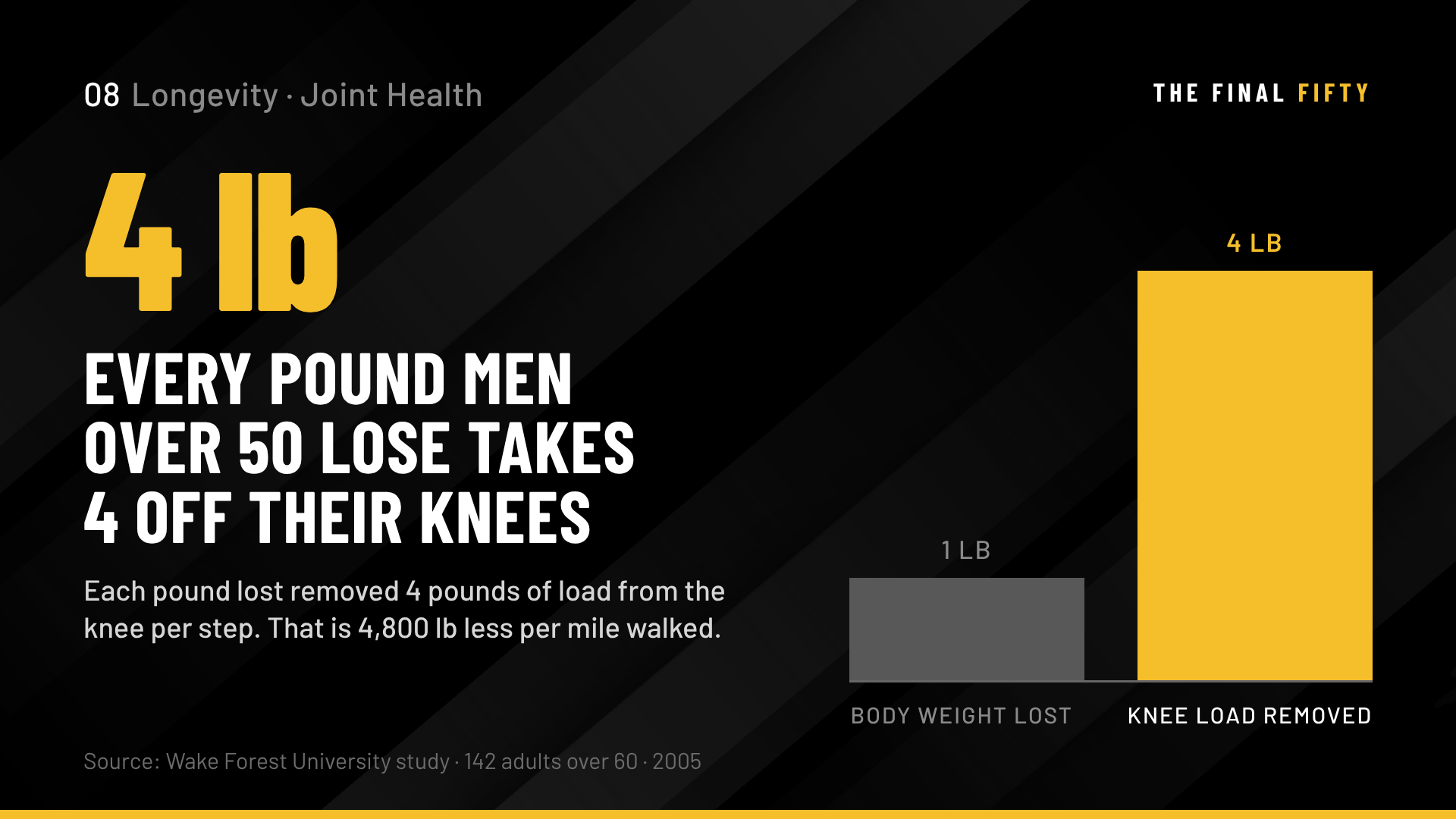
Every kilogram of excess body weight places approximately three to four kilograms of additional force on the knee joint during walking and six to eight kilograms during stair climbing. This mechanical amplification means that the man who is carrying ten kilograms of excess body weight is subjecting his knee cartilage to between 30 and 80 kilograms of additional load with every step, hundreds of thousands of times per year. Reduced degenerative cartilage changes are associated with weight loss, making it a possible preventive therapy for people at risk for knee osteoarthritis.
The body composition management described throughout this platform’s nutrition and training pillars is therefore not only a metabolic health and hormonal health investment. It is a joint health investment whose return compounds with every kilogram of excess body weight eliminated and every year of reduced joint loading that follows. The man who reduces excess body weight by ten kilograms through the body recomposition approach described in this series is not only improving his insulin sensitivity and his testosterone environment. He is removing tens of millions of kilograms of cumulative annual joint loading from his knee cartilage, which represents one of the most directly consequential joint health interventions available.
The body composition target that the Final 50 platform establishes, a waist circumference below 40 inches and a body fat percentage appropriate for the man’s training age and metabolic health, is the joint health target as well. The man who has not achieved this target and who is experiencing joint pain should understand that the body composition gap is likely contributing to the joint pain through the mechanical loading pathway, and that addressing the composition is addressing the joint health simultaneously.
Load Management: Training Smarter for Joint Longevity
The man who has been training for decades and who wants to maintain his joints across the next thirty years needs to understand load management as the specific practice of structuring training volume, intensity, and exercise selection to provide adequate stimulus for adaptation while protecting joint structures from the cumulative mechanical stress that training at excessive volume or intensity produces.
Load management for joint health is not the same as reducing training. It is the intelligent organization of training so that the joints receive sufficient load to maintain the cartilage health and the muscle strength that protect them, while avoiding the specific loading patterns that produce overuse injury and the cumulative joint damage that excessive training volume generates. The periodization principles described in the fitness pillar of this series are the load management framework applied to the joint health context: planned variation in training volume and intensity, with planned deload periods that allow the connective tissue adaptation that training demands and the recovery that connective tissue requires.
Exercise selection for joint health in the man over fifty requires awareness of the specific joint angles and loading patterns that produce the greatest cartilage stress and the movement modifications that maintain the training stimulus while distributing load more evenly across the joint surface. Deep knee flexion under load, which places the patellofemoral joint under its highest compressive forces, is a specific loading pattern that many men over fifty need to manage through range-of-motion reduction or exercise substitution when the knee is symptomatic. Hip-dominant alternatives to knee-dominant movements, Romanian deadlifts and hip thrusts as alternatives to deep squats, maintain the lower body training stimulus while reducing the specific loading pattern that symptomatic knees cannot currently absorb.
Movement quality is the second load management dimension. The man whose training mechanics produce asymmetric joint loading, because of limited mobility, muscular imbalances, or movement pattern deficiencies that redistribute load from the intended muscles to the joint surfaces, is accumulating joint stress that well-executed mechanics would not produce. The mobility investment described throughout the fitness pillar, specifically hip mobility, thoracic mobility, and ankle mobility, is the joint protection investment that addresses the loading asymmetries that restricted movement patterns impose.
The Nutritional Support for Joint Health
The nutritional inputs that most directly support joint health after fifty complement the training and load management investments at the biochemical level, providing the raw materials for cartilage maintenance and repair that the dietary patterns this platform describes elsewhere also support for their other health benefits.
Collagen is the most extensively researched nutritional intervention for joint health, and the evidence base has become sufficiently robust to state specific recommendations. Oral supplementation with hydrolyzed collagen peptides, at levels of at least 10 grams daily for a minimum of six months, has demonstrated improvements in joint pain and cartilage quality in multiple randomized controlled trials. A 12-week randomized double-blind placebo-controlled pilot study found significant improvements in knee osteoarthritis symptoms including symptoms, sport and recreation capacity, and quality of life in a collagen supplementation group versus placebo. Benefits are most evident after six months of consistent use at levels of at least 10 grams daily.
The mechanism through which oral collagen supplementation supports joint health involves both direct provision of the amino acids that cartilage matrix synthesis requires and signaling effects on chondrocytes, the cells responsible for cartilage maintenance and repair. The specific amino acid profile of hydrolyzed collagen, high in glycine, proline, and hydroxyproline, provides the raw material for the collagen synthesis that cartilage depends on for its structural integrity.
The anti-inflammatory dietary pattern described throughout this platform’s nutrition pillar is the second nutritional dimension with direct joint health implications. Chronic systemic inflammation, driven by the ultra-processed food inputs, seed oils, and excessive refined carbohydrate that the inflammatory dietary pattern contains, elevates the inflammatory mediators that drive cartilage degradation in osteoarthritis. The animal-based, anti-inflammatory dietary foundation this platform recommends reduces the systemic inflammatory burden that joint tissue operates in, reducing the rate of cartilage breakdown and supporting the local tissue environment in which cartilage maintenance and repair can occur most effectively.
Omega-3 fatty acids, particularly EPA and DHA from fatty fish, have documented anti-inflammatory effects that are specifically relevant to joint health. The twice-weekly fatty fish standard this platform establishes throughout the nutrition pillar is a joint health standard as well, providing the EPA and DHA that modulate the prostaglandin and leukotriene pathways through which the joint inflammation of osteoarthritis produces its symptoms. The man who is meeting the fatty fish standard is providing his joint tissue with an anti-inflammatory nutritional environment that supplements the other joint health investments.
The Thirty-Year Perspective: Decisions Made Now, Consequences Lived Then
The joint health decisions a man over fifty makes in the next ten years determine whether he is moving well at seventy-five or managing the consequences of the decisions made during the most important preventive window available. The man who maintains his body composition, trains consistently with intelligent load management, and supports his joints nutritionally through the interventions the research supports is not eliminating the biological changes of aging from his joint tissue. He is managing the rate and the severity of those changes in a way that the research consistently distinguishes from the trajectory of the man who does not.
Osteoarthritis affects 10 percent of men aged sixty and older with symptomatic presentations. The x-ray changes are more prevalent than the symptoms, and the gap between x-ray evidence of joint changes and the functional consequences a man experiences is substantially determined by the surrounding muscle strength, the body weight the joint is carrying, the inflammatory environment the joint is operating in, and the activity level that maintains the synovial fluid circulation that joint tissue depends on. All of these are modifiable. All of them respond to the investments described in this article. The man who makes those investments in his fifties is managing the thirty-year joint health trajectory from the most favorable position available.
The man who stops training because his joints hurt is making the decision that the research most consistently identifies as producing the worst long-term joint outcomes: the deconditioning that removes the muscle protection, the reduced synovial fluid circulation that denies the cartilage its nutrition, and the body composition consequence of reduced caloric expenditure that increases the mechanical loading. The man who continues training with intelligent load management, exercise selection appropriate for the joint’s current capacity, and the nutritional support the joint tissue requires is managing his joint health with the evidence-based approach that produces the best thirty-year trajectory available.
THE FINAL 50 FRAMEWORK
THE REFRAME
Exercise does not damage joints. It protects them. The cartilage that receives no loading cycle receives no nutritional delivery from synovial fluid. The muscle that surrounds the joint and protects it from asymmetric loading atrophies without the training that maintains it. The body weight that mechanical loading amplifies into cartilage stress increases when caloric expenditure falls with reduced activity. The man who rests his joints to protect them is implementing the behavioral intervention most consistently associated with the worst long-term joint outcomes. The man who trains with intelligent load management, maintains his body composition, and supports his joints nutritionally is implementing the interventions the research identifies as most protective across the thirty-year trajectory.
THE STANDARD
The Final 50 man maintains his training program as the primary joint health intervention, modifying exercise selection and range of motion when specific joints require accommodation without eliminating the training stimulus the joint structures depend on. He maintains the body composition standard as a joint health investment, understanding that every kilogram of excess body weight is amplified three to eight times at the knee joint with every step. He takes 10 grams of hydrolyzed collagen peptides daily as a nutritional joint health investment supported by the research evidence. He maintains the twice-weekly fatty fish standard for its EPA and DHA contribution to the joint tissue inflammatory environment.
THE PRACTICE
This week, assess your primary joints, knees, hips, shoulders, and lower back, against three specific questions: Is your training currently avoiding any of these joints entirely because of pain, versus modifying the specific exercise selection and range of motion that the joint’s current capacity requires? Is your body composition within the range where excess mechanical loading is a primary driver of any joint pain you are experiencing? And are you providing the nutritional support, collagen, omega-3 fatty acids, and anti-inflammatory dietary foundation, that joint tissue requires alongside the mechanical stimulus of training? Honest answers to these three questions identify the specific joint health interventions most immediately available to you.
THE AUDIT
How has your joint pain or joint function changed in the past two years, and what has your training history across those two years looked like? The man whose joint pain has increased during a period of reduced training has likely experienced the deconditioning-related joint deterioration that reduced muscle protection and reduced synovial fluid circulation produce. The man whose joint pain has decreased during a period of maintained or improved training has demonstrated in his own body the mechanism that the 217-trial review established at the population level. Which direction has your joint health moved, and what does the training history over the same period say about the mechanism?
THE PROMPT
The brotherhood conversation about joint health most men over fifty have never had is the specific one about what each man is doing, or not doing, for his joints beyond managing the pain of training. Who in your brotherhood has successfully modified his training to accommodate a specific joint limitation while maintaining the overall stimulus? What specific exercise substitutions, load management approaches, and nutritional investments has he found most effective? That conversation, grounded in specific experience and specific evidence, is more useful than the general advice to take care of your joints that most men have received and none of them have translated into a specific protocol.


