
The transition from fathering children to being the father of adults is one of the least-discussed adjustments in a man’s relational life, and one of the most consequential. It happens gradually, without a clear marker, and most men navigate it without ever consciously recognizing that it has occurred or that the approach that served the relationship well during the raising years is precisely the approach that now creates distance.
The man who raised his children with structure, guidance, and authority built those tools for a developmental phase that has ended. The adult child sitting across from him at dinner is not the person who needed direction at fourteen. He or she is a person who is building something, navigating something, becoming something, and who has the full capacity to choose whether the relationship with their father is a resource they draw from or a presence they manage around.
That capacity to pull back is the variable most fathers over fifty are underestimating. Research shows that as many as 27 percent of the population has cut off ties with at least one close family member, usually a parent and most often the father. The estrangement typically does not arrive as a dramatic confrontation. It arrives as the calls that get shorter, the visits that get less frequent, the conversations that stay at the surface because going deeper has too often led somewhere uncomfortable. It is the slow accumulation of small experiences that gradually shift the relationship from one the adult child values and seeks toward one they participate in out of obligation.
The father who wants to maintain a genuinely close relationship with his adult children is not managing a relationship that will sustain itself without attention. He is building a relationship that requires a fundamentally different approach than the one the raising years demanded, and that building requires understanding what works now.
What the Research Establishes About Stakes
The long-term value of a strong father-adult child relationship, described in detail in the previous article in this series on fatherhood, bears restating here in the specific context of the adult relationship.
Parent-child relationship quality predicts higher subjective well-being in adulthood across diverse cultures and contexts. A positive association between relationship quality and flourishing was found in all 22 areas of a 202,898-person global study, significant in 21 of them. The effect size of the association, while modest at the individual level, is consistent enough across cultures and circumstances to establish that the quality of the father-adult child relationship is a genuine predictor of the adult child’s wellbeing across their lifespan.
A close father is associated with a higher number of male social ties in an adult child’s network, and this effect is specifically associated with the father rather than the mother. Fathers may generate unique forms of social capital due to their gendered parental status. The implication is that the father-adult child relationship is not simply one relationship among many. It shapes the adult child’s broader social world in ways that a close mother relationship does not replicate.
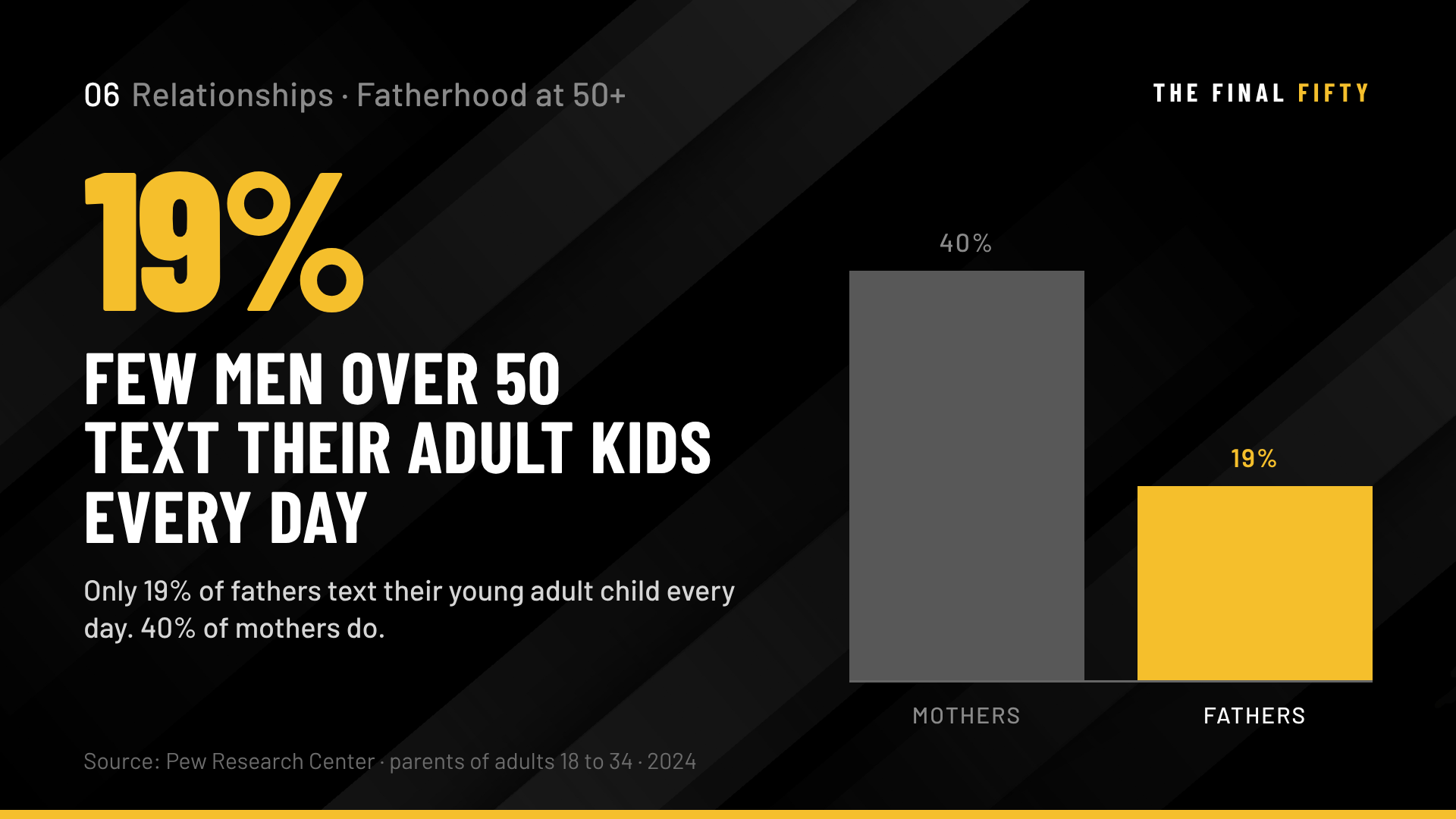
Pew Research Center data from a 2024 survey found that 77 percent of parents report excellent or very good relationships with their young adult children, but that fathers are significantly less likely than mothers to say their relationship with their adult child is excellent. Fathers tend to use fewer channels of communication and communicate less frequently and for shorter amounts of time than mothers. When there was a significant difference in relationship satisfaction, it always favored the mother.
The gap between how fathers experience their relationships with adult children and how those adult children experience the same relationships is real, documented, and actionable. The father who believes the relationship is fine because there is no active conflict may be operating without the information that would allow him to see what is happening. The relationship does not require conflict to be losing ground. It requires only the slow accumulation of interactions that the adult child finds less valuable than the ones they would choose instead.
The Single Greatest Threat: Unsolicited Advice
If there is one behavioral pattern that most consistently and most silently damages the father-adult child relationship across cultures and family types, the research and clinical literature point clearly to one: the unsolicited offer of guidance, opinion, and advice that the adult child did not ask for and does not need.
The dynamic between a parent and a younger child and a parent and an adult child are very different. When children are young, the parent is in charge. As they grow, they become more independent and need less direction. The relationship changes toward something more like interdependence, where adult children may be looking for wisdom or support through a relationship that is on a more equal footing. However, the evolution of the parent-child bond is not always easy to navigate.
Unsolicited advice can feel like criticism or a lack of trust in their abilities. Rather than initiate a conversation about something sensitive, adult children who experience frequent unsolicited advice are more apt to stay at the surface to prevent themselves from getting hurt. If a father is frequently offering unrequested opinions about a child’s partner, job, finances, or life choices, the adult child’s instinct is to share less, not more. The father who offers advice without being asked is not strengthening his influence. He is dismantling the conditions that make influence possible.
The research on father-son communication specifically is illuminating. High conversation orientation in father-son relationships tends to ease emotional closeness, autonomy, and mutual understanding. In contrast, high conformity orientation, the expectation that the adult child will align with the father’s views and values, can suppress open dialogue and foster avoidance, resentment, or hostility. The father who creates space for the adult child to disagree, to make different choices, to become someone different than the father might have planned, is the father whose relationship stays close. The father who makes agreement or conformity a condition of warmth is the father whose relationship slowly contracts to the minimum required by family obligation.
The reframe that the research supports is simple but not easy: the role of the father of an adult child is not to guide but to be available, not to direct but to be present, not to evaluate but to be interested. Asking, not telling. Listening, not solving. The question, ‘Would you like my thoughts on this, or would you prefer to figure it out on your own?’ is not just a courtesy. It is the behavioral embodiment of the respect for autonomy that adult children need to feel before they will open the relationship to deeper engagement.
The Communication Reality and What to Do About It
Fathers use fewer channels of communication and communicate less frequently and for shorter amounts of time than mothers. This is not primarily a time constraint. It is a pattern built across decades of a communication style that was appropriate for professional relationships and functional family coordination but was never designed for the warmth and frequency that sustaining a close relationship with an adult child requires.
The good news embedded in this research finding is that frequency matters more than duration or depth in sustaining connection. More communication is better, especially when at least some of the messages are sent simply to maintain contact rather than convey important pieces of information. A text that says nothing more than thinking of you, or a quick call that covers nothing consequential, is not a trivial gesture. It is one of the most reliable mechanisms for maintaining the sense of connection that makes the deeper conversations possible when they are needed.
The specific channel matters less than the fact of initiating across multiple channels. Adult children want to feel reachable through the medium that works for them at the moment. Some prefer text for quick exchanges and phone calls for meaningful ones. Some prefer video calls, especially with geographic distance. Some prefer the occasional in-person visit that holds more weight than any digital communication. Meeting adult children in the channels they prefer, asking rather than assuming, adjusting rather than expecting them to adapt, is the behavioral commitment that removes friction from the relationship.
The father who waits to be called is not honoring appropriate boundaries. He is creating a communication void that the adult child interprets, often accurately, as low investment. Most of the time, if a father calls, the adult child calls back. The initiative is not a violation of the adult child’s autonomy. It is the signal that the father is interested enough to reach across the gap rather than waiting for the gap to be closed from the other side.
Showing Up for What Matters to Them, Not What Matters to You
The most concrete behavioral expression of investment in an adult child’s life is showing up for what matters to them, not to a father’s schedule or preferences, but to the adult child’s actual world.
This requires knowing what that world contains. It requires asking real questions about the work they are doing, the relationships they are navigating, the challenges they are currently managing, and the direction they are building toward, and then actually listening to the answers without redirecting the conversation toward advice, comparison to the father’s experience, or any other form of reorientation toward the father’s frame. The adult child who feels their father is genuinely curious about their life does not need to be managed into connection. The curiosity creates it.
Support during significant life events, whether joyous or challenging, is where the relationship either deepens or reveals its limitations. The father who shows up for the things his adult children care about, the professional milestone, the difficult period, the new relationship, the geographic move, not in an intrusive or obligation-creating way but in the simple sense of being present and interested, is building the relational credit that allows for genuine closeness across the years ahead.
The research on a study of more than 15,000 adolescents found that those who reported high levels of satisfaction with their communication and overall relationship with their parents had better health, greater optimism, and higher quality romantic relationships in adulthood. They also reported fewer depressive symptoms and less substance abuse. The investment in the relationship with adult children is not nostalgia for what the relationship was when the children were young. It is the ongoing contribution to who those adults continue to become.
The Modeling That Never Stops
The most important and least consciously managed form of father influence on adult children is not what a father says but what a father does, specifically what the adult child can observe him doing in the years after the active parenting phase ends.
The man over fifty who is building the second half of his life deliberately, who is training, investing in his health, developing his relationships, pursuing meaningful work, engaging with the world with curiosity and purpose, is modeling something that adult children absorb whether or not either party has named what is happening. The father who is declining into passivity, whose days lack structure and purpose, whose engagement with the world is contracting, is modeling that too.
Previous research identified that men are often unwilling or unable to communicate affection with their own children even when they are emotionally close, and that fathers communicate closeness in a different way than mothers, which could potentially explain why their closeness results in unique outcomes relative to mother closeness. For many men, the most natural expression of love for an adult child is not verbal. It is the consistency of showing up, the reliability of being available, the evidence of a father who is genuinely engaged with his own life and genuinely interested in theirs.
A close father produces unique forms of social capital for the adult child. He expands their social network in ways a close mother does not. He models relational behavior that shapes how adult sons engage in their own relationships. He provides a form of stability and continuity in the adult child’s life that no other relationship quite replicates.
The relationship does not maintain itself. It is built, actively, by a father who has made the shift from director to companion, from authority to availability, from the man who shaped who his children became to the man who is genuinely interested in who they are continuing to become. That shift, made deliberately and held consistently, is what keeps the relationship close across the decades that remain.
THE FINAL 50 FRAMEWORK
THE REFRAME
The father-adult child relationship is not the continuation of the raising relationship. It is a new relationship with a new architecture, one built on mutual respect, genuine curiosity, and the consistent demonstration that the father is interested in the adult his child has become rather than invested in continuing to shape them. The tools that built the first-half relationship, direction, guidance, and authority, are precisely the tools that damage the second-half relationship when applied in the same way. The father who makes this shift earns something the raising years never produced: a relationship the adult child chooses.
THE STANDARD
The Final 50 man holds the unsolicited advice to an absolute minimum, asking if his perspective is wanted before offering it. He initiates contact across multiple channels at a frequency that communicates investment without creating pressure. He shows up for what matters to his adult children rather than expecting them to organize around what matters to him. He asks questions and listens to the answers without redirecting to advice or his own experience. He models the life he wants them to see, not through performance but through the genuine daily work of the second half.
THE PRACTICE
This week, initiate contact with each of your adult children in a way that has no informational purpose. Not a logistics call. Not a check-in triggered by a specific event. A simple reach: a text, a call, a brief note that says nothing more than that you were thinking of them. Do this for each adult child this week and resist the urge to fill any subsequent conversation with advice or questions about their choices. Ask what is happening in their world. Listen to the answer. Let the conversation go where they take it.
THE AUDIT
In the last month, how many times did you offer an opinion or piece of advice to an adult child who had not asked for it? How many of your interactions were initiated by you versus them? When you are with your adult children, what percentage of the conversation is about their lives versus yours, or about your perspective on their choices? Honest answers to those three questions tell you more about the current state of the relationship than any general sense of how things are going. The data in those conversations is where the investment decision lives.
THE PROMPT
The men in your brotherhood are navigating the same transition in their relationships with adult children, and most of them have never explicitly discussed what the second-half father relationship looks like when it is working well. Who in your circle has built a genuinely close relationship with his adult children that the adult children are clearly choosing rather than obligated to maintain? What does he do differently? That conversation, held honestly between men who are serious about the relationships that matter most, is one of the most valuable ones available in the second half.