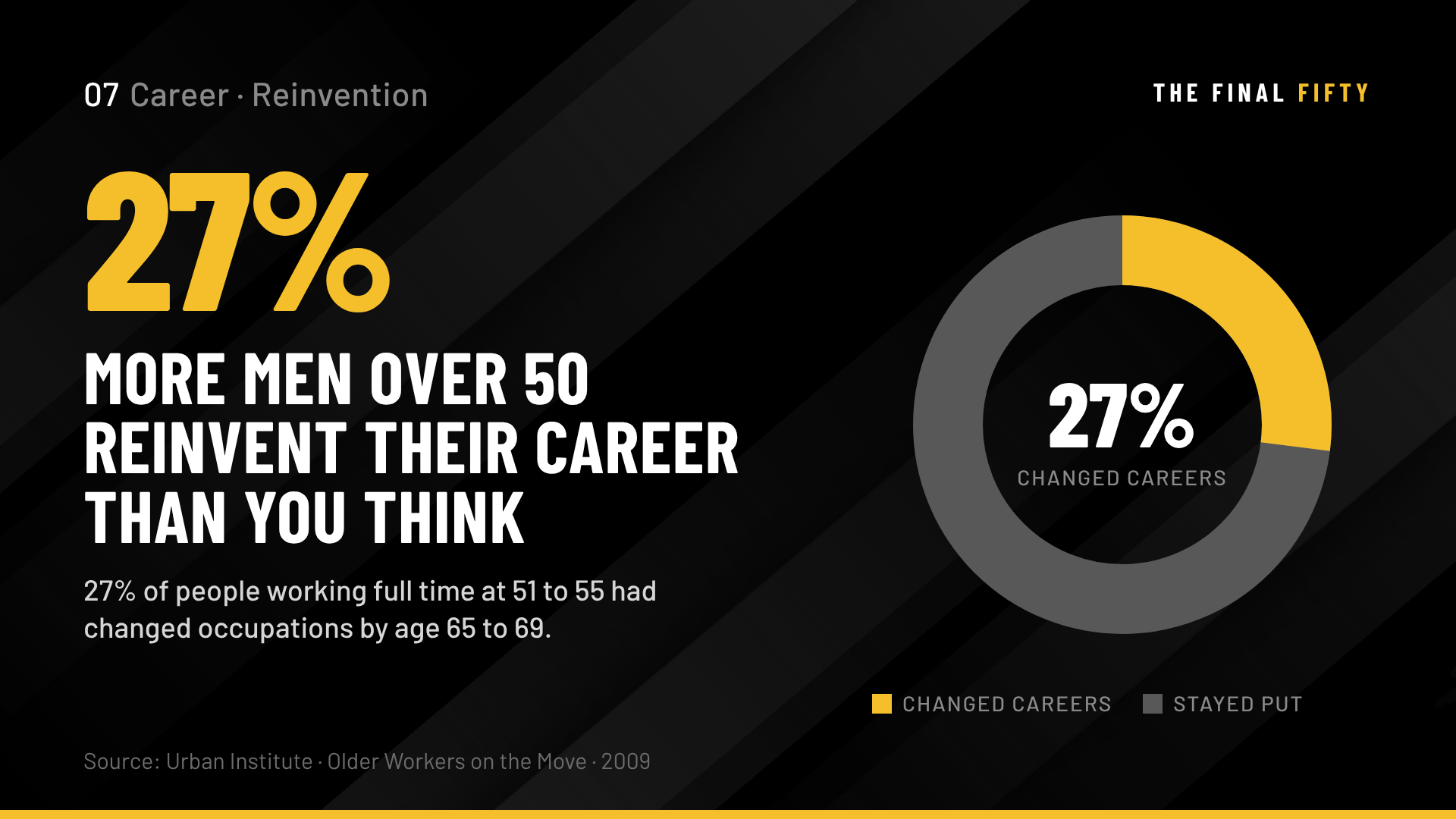
There is a belief that shapes most men’s thinking about professional reinvention that is wrong in a specific and costly way. It is the belief that changing direction means starting over. That the experience, the reputation, the judgment, the relationships, the hard-won knowledge of how industries and organizations work, all of it gets set aside when a man decides to build something different in the second half of his career.
This belief produces two equally damaging outcomes. It convinces men who need to change direction to stay in situations that no longer serve them, because the perceived cost of transition feels catastrophically high. And it convinces men who attempt reinvention to enter their new direction from a position of unnecessary weakness, presenting themselves as beginners when they are not.
Both outcomes are the product of the wrong frame. Professional reinvention after fifty is not the erasure of what came before. It is the application of what came before to something new. The accumulated experience is not the liability. It is the asset. The question is whether a man knows how to make it visible in the new context and whether he has correctly distinguished between what transfers directly and what requires deliberate updating.
The Data on What Actually Happens
The cultural story about career reinvention after fifty is darker than the data warrants. Most men approaching a professional pivot at fifty carry assumptions about the success rate of such transitions that do not reflect what research shows happens when experienced professionals make deliberate, well-planned career changes.
According to research from the American Institute for Economic Research, 82 percent of workers over 45 who attempt career changes succeed in their new roles. Workers aged 65 and older represent the fastest-growing segment of the U.S. labor force, and workers aged 65 and older have an average job tenure of 10.3 years, compared to just 3.2 years for workers aged 25 to 34. When experienced professionals find the right opportunity, they commit.
Research shows that midlife career pivots often lead to higher earnings. According to the Organisation for Economic Co-operation and Development, workers aged 45 to 54 who voluntarily change jobs see an average wage growth of 7.4 percent, while those aged 55 to 64 still see a 3.5 percent increase. Career change after 50 is not about chasing a dream or having a midlife crisis.
The success rate is 82 percent. Average wage growth for men in their late forties and early fifties who voluntarily change careers is 7.4 percent. These are not the numbers most men carry when they contemplate reinvention. The cultural story says it is risky, difficult, and unlikely to produce the outcomes that staying put would. The research says something quite different.
The critical variable separating the successful transitions from the unsuccessful ones is not age. It is preparation. The men who reinvent successfully are the ones who treat the transition as a deliberate professional project rather than an emotional response to circumstances, who identify their transferable assets before they need them, and who build into the new direction from a position of clarity about what they bring rather than anxiety about what they lack.
The Distinction That Changes Everything: Reinvention vs. Escape
Before addressing how to reinvent, it is worth being honest about why. The distinction between reinvention and escape is the most important one available in this conversation, and most men do not make it explicitly enough to protect themselves from the consequences of getting it wrong.
There are three fundamentally different reasons people want to change careers, and they require different responses. Environmental mismatch occurs when the field is right but the specific environment, company, culture, management, or structure is wrong. Many people pursue a pivot when what they need is a better environment in the same field, at considerable cost. The first question is: have you tried the best version of your current environment?
The man who is burned out from a specific company or a specific set of circumstances, but whose domain expertise is genuinely aligned with his strengths and values is not a candidate for career reinvention. He is a candidate for a better version of what he already does. The man who has genuinely outgrown his current direction, whose skills and judgment have evolved beyond what his current context can use, or whose values have clarified to a point where the work he is doing no longer aligns with who he has become, is a candidate for real reinvention.
The distinction matters because these two situations require different solutions, and applying the more dramatic solution to the simpler problem is one of the most expensive professional mistakes available. Reinventing a career takes time, money, energy, and opportunity cost. Changing environments within a known domain is simpler and less costly. The man who knows which situation he is in makes a better decision.
What Transfers and What Does Not
The practical starting point for any professional reinvention is an honest, specific inventory of what a man brings to a new context. Not in the general terms of experience and expertise, but in the specific terms of skills, knowledge, relationships, and capabilities that have value across different domains.
Transferable skills are the talents and abilities you can take with you from one job to another. They are not tied to a single industry or specific role. Instead, they are the core competencies that make you effective in any professional environment. For professionals looking to switch industries, leveraging transferable skills is one of the most effective strategies available. It allows you to reframe your narrative. You are not starting over. You are simply applying your proven toolkit to a new set of challenges.
For a man over fifty who has spent twenty-five years building real competence in his domain, the transferable asset list is almost always longer and more valuable than he initially perceives. Project management. Leadership under pressure. Stakeholder navigation. Financial judgment. Organizational pattern recognition. The ability to assess risk with the calibration that comes from having been wrong about things and having learned from those mistakes in real time. Client relationship building. The judgment to know which problems are worth solving and which are not. These are not generic soft skills. They are genuinely hard capabilities that took decades to develop and that most competitors in any new context simply do not have at the same level.
What does not automatically transfer is domain-specific technical knowledge that has no equivalent in the new direction. The regulatory framework of one industry. The specific software ecosystem of one profession. The institutional relationships built in one geography or market. These are real gaps that require deliberate attention, but they are learnable gaps, and they sit on top of a foundation of genuine transferable capability that cannot be learned quickly because it can only be built through years of actual execution.
Successful career pivots are rarely cliff jumps. They are bridges built while still standing on the current shore. This typically includes skill acquisition, determining what specific skills the target field requires that you do not currently have, and building the most critical ones before leaving your current role where possible. It also includes proof of work: side projects, volunteer work, freelance engagements, or portfolio pieces that demonstrate capability in the new domain before asking someone to hire you for it.
The bridge metaphor is the most accurate one available. The man who has identified his destination, mapped his transferable assets, identified the specific gaps, and begun building into the new direction while still operating in the current one is not taking a risk. He is managing a transition. The man who quits his current role and jumps toward something undefined is the one taking a risk. These are different activities even though both might be described as career reinvention.
The Narrative Problem and How to Solve It
The practical challenge that most men over fifty encounter in professional reinvention is not competence. It is narrative. The ability to explain, convincingly and specifically, why the experience of the first half translates to genuine value in the new context.
In 2024, 58 percent of career transition candidates pivoted to entirely new occupations. The market is moving. More people are making significant career shifts than at any previous point in modern professional history. The stigma that once attached to career reinvention after fifty has not disappeared, but it has diminished significantly as the pace of industry change has made reinvention a survival strategy rather than an admission of failure.
The narrative that works is the one that connects the past to the future through the lens of transferable value rather than the lens of change. The man who presents himself as starting over is positioning himself as a beginner. The man who presents himself as a domain expert bringing a specific, high-value capability to a new application of that expertise is positioning himself as a senior resource with an unusual and genuinely valuable profile. The credentials are identical. The frame is different. The outcomes in the hiring and client engagement context are dramatically different.
Reframe every significant accomplishment from the first half of the career in the language of the new direction. Not what the role was called. What it produced. Not what industry it was in. What skills and judgment it developed that have direct value in the new context. The man who spent twenty years in finance moving into corporate advisory is not a finance person learning something new. He is an expert in capital allocation, risk assessment, and complex stakeholder management who is applying those capabilities to a slightly different client need. That is a different and far more compelling professional profile.
The Financial Bridge
Reinvention after fifty works best when it is not financially desperate. The man who has built the financial discipline described elsewhere in this content library, who has managed his income to produce savings and investment rather than only lifestyle, has the most important asset in any reinvention: time.
Time to validate the new direction before committing fully. Time to build the network in the new domain before needing it to produce income. Time to develop the proof-of-work that demonstrates capability to new stakeholders. Time to take on the first lower-paying engagement in the new context that opens the door to the full-value engagement that follows it.
We have finally lived long enough to know what we want. After decades of making decisions based on what parents expected, what society values, what pays the bills, we develop what can be called sage clarity. The ultimate midlife skill is knowing your own mind and heart. You could not have done this at 25. You had not lived enough yet.
Sage clarity, combined with financial stability, is the specific combination that makes professional reinvention after fifty a genuine opportunity rather than a desperate leap. The man who knows what he wants and has the resources to pursue it deliberately is not at a disadvantage relative to a younger person making a similar transition. He is at an advantage, because the clarity and the stability are things that younger competitors are still in the process of building.
The reinvention is not about what he is leaving. It is about what he is bringing.
THE FINAL 50 FRAMEWORK
THE REFRAME
Professional reinvention after fifty is not starting over. It is redirecting. The man who walks into a new professional direction carrying twenty-five years of judgment, relationships, pattern recognition, and earned self-knowledge is not a beginner wearing an experienced man’s face. He is a senior professional with an unusual and genuinely valuable profile that no one who has been doing the new thing for only five years can replicate. The reinvention is not the abandonment of what was built. It is the application of what was built to a new purpose.
THE STANDARD
The Final 50 man approaches professional reinvention as a deliberate professional project, not as an emotional response to dissatisfaction. He has distinguished between environmental mismatch that requires a different context and genuine misalignment that requires a different direction. He has inventoried his transferable assets specifically, not generally. He has identified the gaps between his current capabilities and the target direction and has a plan to close them. He is building the bridge while still standing on the current shore. He is not jumping.
THE PRACTICE
This week, if professional reinvention is something you are considering, conduct a specific transferable skills inventory. Not a list of job titles and responsibilities. A list of capabilities: what you can do, at what level of sophistication, with what evidence of having done it. Then research three roles or directions you are considering and map your capabilities against what those directions require. The overlap is almost certainly larger than you believe and the gaps are almost certainly more specific and learnable than you fear. That mapping tells you where you are.
THE AUDIT
Have you made the distinction between wanting a different environment and wanting a different direction? These require different responses and produce different outcomes when confused. If you are considering reinvention, ask honestly: have you experienced the best version of what you currently do, in the best context available for doing it? If the answer is no, that exploration comes before the reinvention conversation. If the answer is yes and the dissatisfaction persists, then the reinvention conversation is real.
THE PROMPT
The men in your brotherhood are navigating their own professional second half decisions, and the conversation about reinvention, about what it takes and what it produces, is one that most men are having alone rather than with the people who have relevant experience and genuine investment in their success. Who in your circle has already made a significant professional pivot? Who has changed direction deliberately and come out the other side with a clearer sense of what they are building? That conversation, held between men who are serious about the work, is more valuable than any career coach or career change article, including this one.