
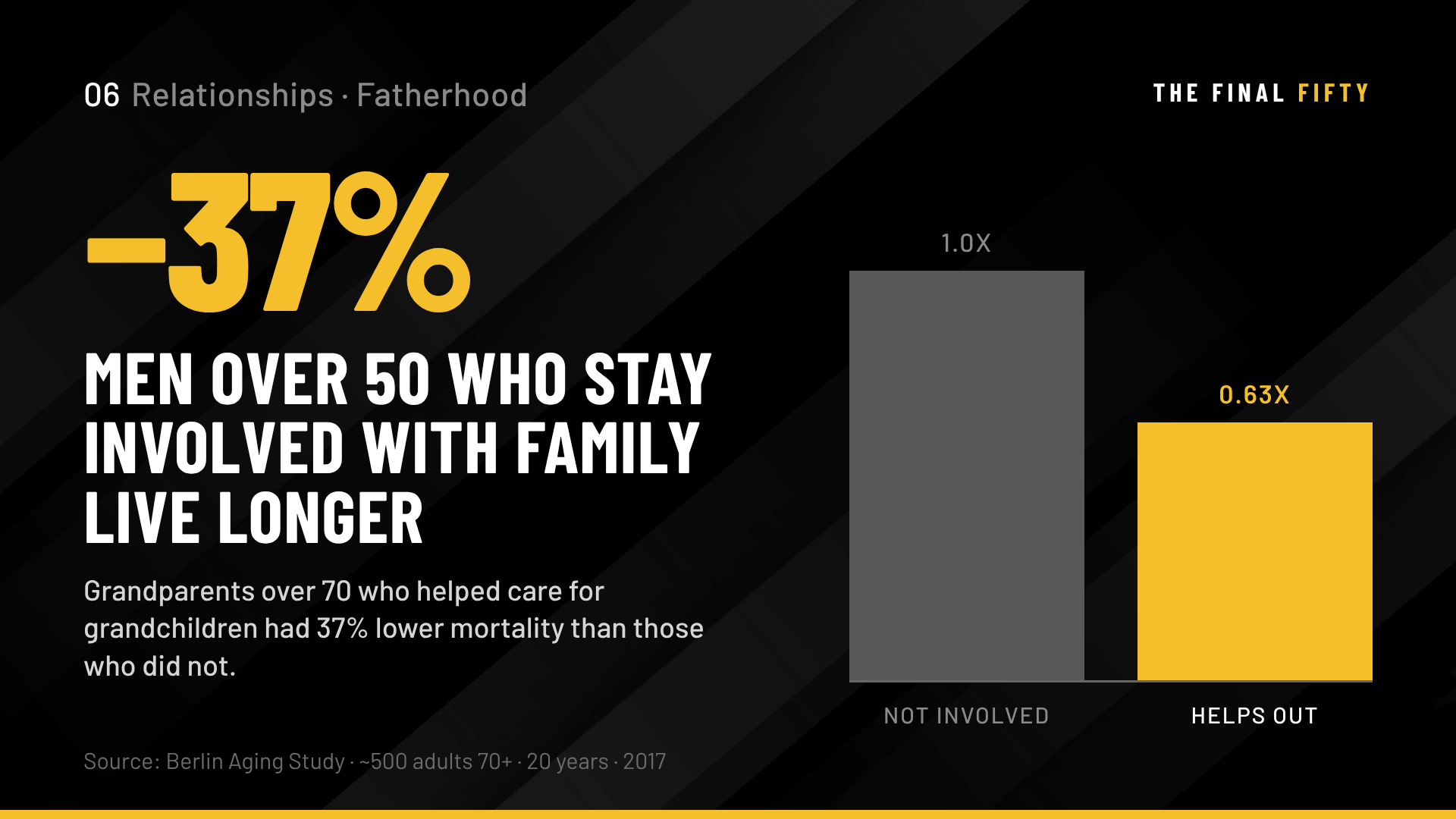
Most men arrive at fifty with the core work of raising children behind them or actively underway, and a relationship with those children that reflects everything the first half of their lives demanded and everything those demands cost them in terms of presence, attention, and investment.
That cost is not unique to any individual man. The first half of a man’s professional life is typically the most demanding period of career building. The financial pressures of the family formation years are real and significant. The physical and psychological energy required to perform at a high level professionally while being available to young children is a genuine resource constraint that produces genuine consequences for the quality of presence a man can offer during the years when his children are youngest.
The man at fifty is standing at a specific moment in the fatherhood timeline. Whatever the investment looked like in the years behind him, what matters now is what it looks like in the years ahead, and the years ahead represent a different kind of fatherhood than the one that came before. Not necessarily harder. Often more important. Always shaped by the specific stage the children are in and the specific kind of father each stage requires.
Understanding what the research shows about fatherhood across life stages, what it reveals about the lasting impact of father presence and quality, and what it tells a man about the specific work available to him right now, is the starting point for one of the most consequential investments a man in the second half of his life can make.
What the Research Says About the Long-Term Stakes
The evidence on the impact of father involvement and relationship quality is no longer limited to studies of young children. The research has followed the effects across decades and into adulthood, and what it reveals changes the frame from whether a man is present in his children’s lives to what the quality and nature of his presence actually produces over a lifetime.
In a pre-registered multilevel modeling analysis using data from the Global Flourishing Study, researchers tested whether retrospective parent-child relationship quality predicts adult well-being in a representative sample of 202,898 adults living in 21 countries and one territory. The findings showed that parent-child relationship quality predicts higher subjective well-being in adulthood across diverse cultures and contexts.
Father involvement with children is significantly associated with children’s positive mental, cognitive, social, and physical outcomes. Long-term research suggests that the quality and quantity of father involvement during childhood affects the son’s physiological stress regulation system in adulthood.
The biology follows the relationship. A man over fifty whose children are teenagers, young adults, or fully established adults has not passed the point where his involvement matters. The research shows the opposite: that the effects of father-child relationship quality show up in adult wellbeing, stress physiology, relationship capacity, and mental health outcomes in ways that persist across the full lifespan.
The quality, not just the presence, of paternal involvement during childhood has a lasting impact on how sons view romantic relationships. Men who rated their fathers as emotionally warm and supportive during their upbringing were more likely to believe that men invest in their partners and that women expect commitment. These beliefs were tied to a greater willingness to invest in their own romantic relationships as adults.
What a man models in his relationship with his children shapes what his sons believe is possible in their own relationships. That modeling does not end when children reach adulthood. It continues at every stage of the relationship, in every interaction, in every moment of genuine engagement or genuine absence.
Fatherhood of Adult Children: The Work That Most Men Underestimate
The transition from fathering children who need direct care and guidance to fathering adults who are building their own lives is one of the most significant and least discussed adjustments in a man’s parenting life.
The instinct to continue parenting adult children the way they were parented as teenagers, with advice, correction, and guidance offered from a position of parental authority, consistently produces the distance and disconnection that both parties feel but that most families navigate without ever naming clearly.
Fathers continue to play an important and active role in their children’s lives long after childhood. Fathers are important because they can enable the successful launching of children into being autonomous and socially-integrated adults. Research consistently suggests that fathers continue to play a role well into adulthood.
The role changes even as the relevance persists. The father of an adult child is not a guide to a person who needs direction. He is a relationship that, when it works well, provides the adult child with a connection to their origins, a source of unconditional regard, and a man whose life and choices continue to inform and shape their own.
The fathers who navigate this transition most effectively make a specific shift: from directing to listening, from advising to asking, from the position of authority to the position of interest. The man who calls his adult children to check in on what is happening in their lives, who asks questions and listens to the answers without immediately offering solutions or comparisons to his own experience, who shows up for the events that matter in their lives without making attendance conditional on agreement with their choices, is building a relationship that both he and his children want to sustain.
The father who continues to parent adult children as if they still require parental authority typically gets the outcome that authority tends to produce in people who no longer owe it: distance.
Fatherhood of Teenage Children: The Work That Requires the Most Patience
For men whose children are in adolescence during the years around fifty, the fathering challenge is specific and demanding. Adolescence requires a father to hold a paradox: remaining fully present and engaged with a child who is developmentally oriented toward independence and periodically uncomfortable with the closeness that full parental engagement requires.
The father-daughter bond is particularly profound in certain aspects. Daughters’ closeness with their fathers has been shown to have a profound effect on adult depressive symptoms, marital outcomes, and educational and career achievements. Father presence and quality significantly predict adolescent resilience and psychological security.
Father-youth intimacy is associated with fewer depressive symptoms for boys and girls across most of adolescence. Engaged fathers enhance cognitive skills, reading proficiency, and self-esteem, while reducing risks of behavioral issues.
The man at fifty with teenage children is fathering during the most consequential period for the protection of those specific outcomes. The adolescent relationship with the father, its warmth, its consistency, its ability to withstand the turbulence of adolescent identity formation, is one of the most powerful predictors of adult mental health and life outcomes available in the parenting research.
That relationship is sustained not through authority, which adolescents typically resist at exactly the moment it is most applied, but through availability. Through the consistent demonstration that the father is present, interested, and unshakeable in his commitment to the relationship even when the adolescent is least interested in reciprocating. The conversations that happen in cars, on walks, during shared activities, when the adolescent has not specifically consented to a conversation but finds themselves in one anyway, are often the most important ones.
Fatherhood of Young Children After 50: The Advantage and the Demand
For men who have young children in their fifties, whether from a first family, a second family, or a late start, the fathering situation is different from either of the above and carries its own specific opportunities and challenges.
A Penn State study found that by age 7, children whose fathers were less attentive to them at 10 months of age were more likely to have signs of poorer health, including higher inflammation and blood sugar. Fathers who were more caring early on co-parented better, and children from those families had lower inflammation and healthier blood markers.
The man at fifty with young children has an asset the younger father typically does not: the second-half mindset that has already been described in this content library. He has, in most cases, moved beyond the most demanding period of proving himself professionally. He carries a clarity about what matters that often does not arrive until the career pressure has reduced. He is, if he has done the work this platform describes, more present and less distracted than he was at thirty-five. Those assets are available to apply to fathering at a depth that was not accessible when the demands of the first half were at their peak.
The physical demands are real. The man at fifty who is training, sleeping, and managing his stress is capable of the sustained physical engagement that young children require. The man who is not is not. The choice to maintain physical capacity in the second half is, for men with young children, also a fatherhood decision.
What Every Stage Has in Common
Across the stages, across the ages of the children, across the specific demands each configuration of family presents, the research points consistently to the same core variable as the most determinative factor in the quality of the father-child relationship: presence. Not physical presence as a technicality. Presence as the experience the child or adult child has of whether this man is actually here when he is here.
The quality of fathering has shown to be more meaningful than the simple frequency of interactions between fathers and children. Behaviors modeled by one generation seem to be reenacted by the next, setting the stage and creating relational trajectories for fathers to follow with their own children.
The man who attends his teenager’s event while reviewing email on his phone has not produced presence. The man who calls his adult daughter while mentally composing a response to something she has not yet finished saying has not produced presence. The man who plays with his young child while his mind is occupied with the professional problem he did not resolve before leaving the office has not produced presence.
Presence is the experience of being fully attended to. Of being the actual focus of this man’s attention rather than the nominal recipient of his physical proximity. And it is the variable the research most consistently identifies as the one that children, at every age, most need and most accurately perceive.
For a man at fifty who has spent twenty-five years training his attention toward professional demands, the development of genuine presence is not automatic. It is a skill that must be as deliberately built as any other second-half competency. The morning routine, the stress management protocol, the reduced phone dependence, the mindfulness practice, these are not lifestyle choices that exist separately from fatherhood. They are the upstream work that makes genuine presence with children possible.
The father who wants to be the father his children need at every stage of their lives is building something that requires him to be the best possible version of himself. The investment in his own physical health, his own mental clarity, his own presence and availability is not separate from his investment in his children. In the second half, it is the same investment.
THE FINAL 50 FRAMEWORK
THE REFRAME
Fatherhood does not end when children grow up. It changes. The man who was needed for direction and provision in the first half of the parenting journey is needed for presence, availability, and genuine interest in the second half. The research makes clear that father-child relationship quality predicts adult wellbeing, mental health, and life outcomes in ways that persist across the full lifespan. The investment in being the father your children need right now, at whatever stage they are in, is one of the highest-return activities available to a man over fifty.
THE STANDARD
The Final 50 man shows up for his children at every stage of their lives with the quality of presence the research identifies as determinative: full attention, without the phone, without the professional preoccupation, without the advice waiting to be delivered while they are still speaking. He adjusts his approach as his children mature: from guidance to support, from authority to availability, from director to resource. He models the standard he wants his sons to become and the standard he wants his daughters to expect from men.
THE PRACTICE
This week, initiate one interaction with each of your children that is entirely on their terms. Not the interaction you think they need. The one they would choose if given the option. For adult children, that might mean calling to ask what is happening in their life without bringing any agenda of your own. For teenagers, it might mean showing up for an activity or conversation they care about without making it about what you think they should also care about. For young children, it means full physical presence without the phone in the room. One interaction, per child, fully on their terms. That is the practice.
THE AUDIT
When did you last have a conversation with each of your children in which you asked more questions than you answered, in which you listened more than you spoke, and in which the conversation was entirely about their life rather than your perspective on their life? If the honest answer is that you cannot remember, you have identified the most important fatherhood gap currently available to close.
THE PROMPT
The men in your brotherhood are all navigating fatherhood in the second half, at different stages with different children and different specific challenges. The conversation about what it means to be the father your kids need right now, not in the abstract but in the specific, is one that most men never have with each other. What would it look like to hold that conversation inside the brotherhood, to share what is working and what is not, and to hold each other accountable to the standard that the research says matters and that the people you love the most deserve?