
Most conversations about testosterone treat it like a dial. When it is high, a man performs well. When it is low, he does not. The dial turns down with age. That is the extent of the understanding most men carry into the second half of their lives, and it is the reason most men manage the consequences without ever addressing the causes.
The actual biology of testosterone production is more specific than that. More mechanical. More responsive to the choices a man makes every day. And far more actionable than the simplified version suggests.
Understanding how testosterone is produced, how its effects are delivered at the cellular level, what happens to that production system across the decades after fifty, and which parts of the decline are physiological inevitabilities versus which parts are lifestyle-driven acceleration, gives a man the information he needs to treat this not as something happening to him but as something he has genuine leverage over.
That leverage starts with understanding the mechanism.
Where Testosterone Comes From
Testosterone production in the male body is not a simple process. It is an orchestrated cascade involving three separate organs, each dependent on the others, operating through a feedback system of remarkable precision.
In males, the majority of testosterone is synthesized in the Leydig cells of the testes, while testosterone production is governed by the hypothalamic-pituitary-gonadal axis, a key endocrine system component involving dynamic interactions between the hypothalamus, pituitary gland, and gonads.
The cascade begins in the hypothalamus, a region of the brain the size of an almond that sits at the intersection of the neurological and hormonal systems. The hypothalamus releases gonadotropin-releasing hormone, GnRH, in pulses roughly every 90 minutes. Those pulses travel down to the pituitary gland, a structure the size of a pea at the base of the brain, which responds by releasing two hormones into the bloodstream: luteinizing hormone, LH, and follicle-stimulating hormone, FSH.
LH is involved in the synthesis of testosterone via binding to the interstitial cells of the testes, the Leydig cells, which respond to the LH signal by synthesizing and secreting testosterone into the bloodstream.
Once circulating testosterone reaches a certain threshold, it feeds back to the hypothalamus and pituitary to signal that production is sufficient. The pulsing slows. Less GnRH is released. Less LH reaches the testes. Testosterone production drops back. The feedback loop restores balance. This negative feedback mechanism operates continuously, calibrating hormonal output to demand with remarkable sensitivity.
The cholesterol-to-testosterone conversion that happens inside the Leydig cell is a multi-step enzymatic process, and every step in that process can be affected by what a man eats, how he sleeps, how much stress he carries, how much body fat he carries, and how well he manages his metabolic health. This is not a closed system that runs independently of lifestyle. It is a responsive system that reflects the conditions a man creates for it every single day.
What Testosterone Actually Does
Before addressing decline, it is worth being specific about the scope of testosterone’s function. Most men think of testosterone primarily in the context of muscle and libido. Both are accurate. Neither is complete.
Testosterone’s biological functions are extensive, influencing reproductive and systemic health. It plays a vital role in sexual functions, muscle protein synthesis, bone metabolism, fat distribution, and cardiovascular health. The hormone also affects mood, cognitive function, and erythropoiesis, underscoring its importance in both physical and mental health.
Erythropoiesis, the production of red blood cells, is not a function most men associate with testosterone. But it explains directly why men with low testosterone often experience persistent fatigue that no amount of sleep seems to resolve. Fewer red blood cells means less oxygen delivered to working tissue. Less oxygen means lower energy, slower recovery, and reduced physical capacity. The fatigue is not psychological. It is physiological, and it has a specific hormonal driver.
The metabolic dimension is equally important. Testosterone regulates metabolism, including fat distribution, insulin sensitivity, and glucose metabolism. Low testosterone levels are associated with increased body fat and insulin resistance, which can lead to an increased risk of metabolic disorders, such as type 2 diabetes. The man who is gaining weight despite reasonable dietary effort, whose body composition keeps shifting toward fat and away from muscle regardless of training, may not have a diet or training problem. He may have a hormonal problem that is making every other effort less effective.
Beyond its well-established influence on sexual function, muscle mass, bone density, and metabolic regulation, growing evidence indicates that testosterone meaningfully affects mood regulation, cognition, motivation, and overall mental health, through androgen receptors widely distributed throughout the brain. The motivational flatness, the reduced competitive drive, the sense that ambition has become effort rather than energy, these are not character changes in the man over fifty who is experiencing them. They are the cognitive and psychological manifestations of an inadequate hormonal signal to the brain’s androgen receptors.
Understanding this scope matters because it changes what a man looks for when he assesses whether his testosterone situation needs attention. The question is not only whether libido has declined. It is whether energy, mood, body composition, cognitive sharpness, motivation, and physical recovery are performing at the level his standard requires.
The Mechanisms of Decline After 50
Testosterone decline with age is real, measurable, and driven by specific biological mechanisms rather than a general wearing out of the system. Understanding these mechanisms is what separates the man who can intervene intelligently from the man who simply accepts the outcome.
The primary mechanism is at the level of the Leydig cells themselves. Age-related hypogonadism is due to a combination of primary hypogonadism from testicular failure and secondary hypogonadism from hypothalamic-pituitary axis failure. The mechanism of primary hypogonadism in aging men may be a combination of decreased number of Leydig cells, acquired defects in the steroidogenic pathway, as well as a disruption of the regulatory systems within the cells.
The Leydig cell population in the testes decreases with age. The cells that remain become less responsive to the LH signal from the pituitary. This age-related decline in testosterone appears to occur, in part, due to a significant decline in the ability of aged Leydig cells to produce testosterone maximally in response to luteinizing hormone. The signal is being sent. The factory is receiving it. The factory is simply producing less output per signal than it used to.
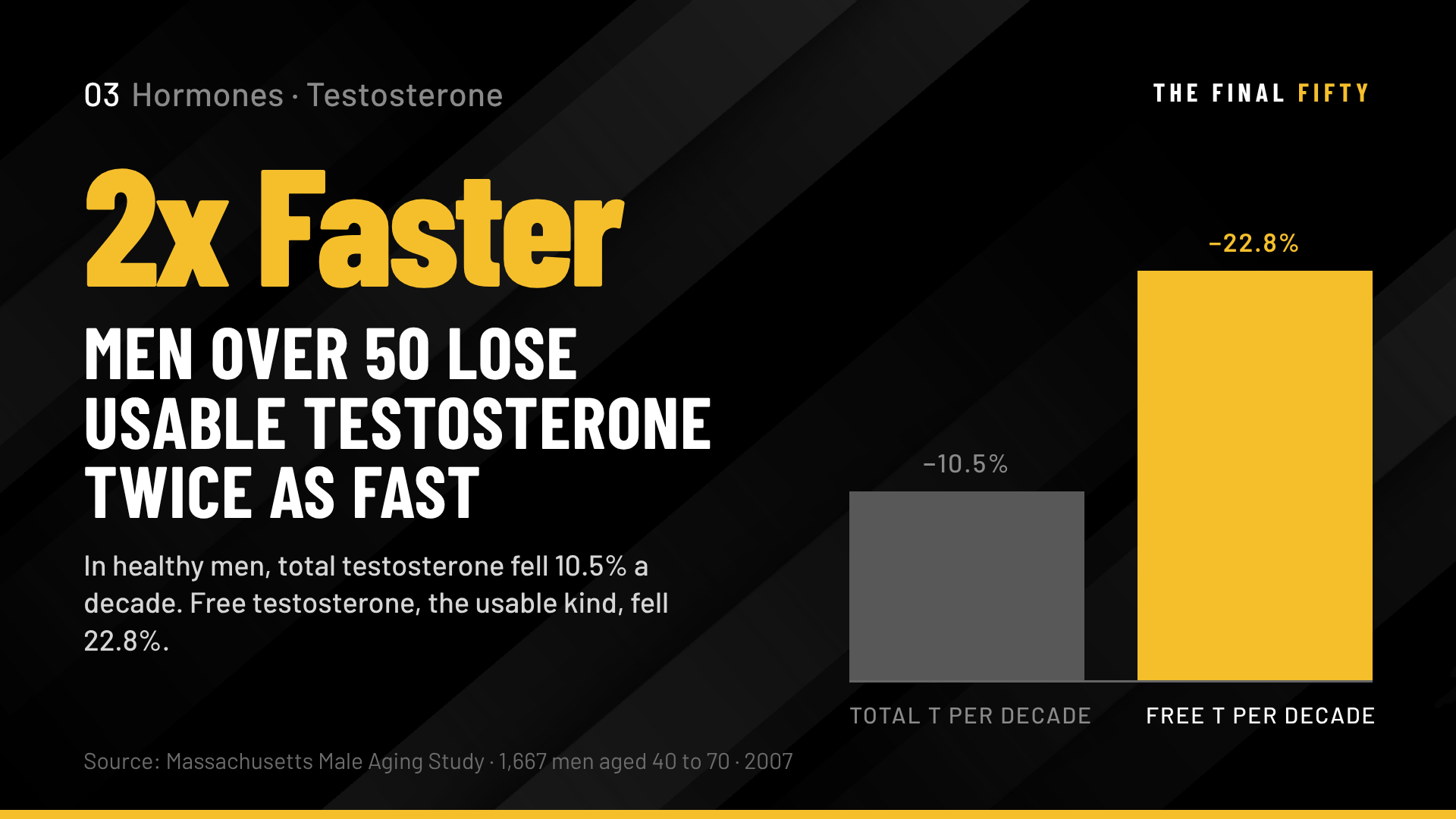
The second mechanism operates at the level of sex hormone binding globulin, SHBG. Serum free testosterone concentration decreases more with age than total testosterone because of an age-related increase in serum SHBG levels. Since the circulating non-SHBG bound testosterone levels, free and albumin-bound, are the biologically available hormones at target tissues, the fall in bioavailable testosterone is steeper than the decline in total testosterone.
SHBG is the protein that binds to testosterone in the bloodstream and renders it hormonally inactive. It cannot enter cells. It cannot bind to androgen receptors. It cannot do any of the things that testosterone is responsible for doing. A man whose total testosterone appears adequate on a standard lab panel but whose SHBG is high may be experiencing the full symptomatic picture of low testosterone because the fraction of hormone his tissues can use is significantly lower than the total number suggests. This is why measuring only total testosterone without measuring free testosterone and SHBG gives an incomplete and potentially misleading picture.
The third mechanism involves body fat and the enzyme aromatase. Visceral fat contains an enzyme called aromatase, which converts testosterone into estradiol. More body fat means more aromatase activity, which lowers free testosterone, which in turn encourages further fat gain. Insulin resistance develops concurrently, compounding the hormonal imbalance.
This creates a self-reinforcing cycle that accelerates the decline in ways that go far beyond the normal age-related trajectory. The man who gains body fat, particularly visceral fat around the organs, is not just accumulating excess weight. He is actively converting his remaining testosterone into estrogen while simultaneously lowering the insulin sensitivity that would allow him to address the fat accumulation. The hormonal deterioration and the body composition deterioration drive each other forward. Neither resolves without addressing both.
The Distinction Between Natural Decline and Accelerated Decline
This is the most important practical insight available from understanding the mechanism of testosterone decline: there is a meaningful difference between the natural, gradual, age-related reduction in testicular steroidogenic capacity that represents normal male aging, and the accelerated decline that results from lifestyle factors layered on top of that natural trajectory.
Aging exerts profound effects on the hypothalamic-pituitary-gonadal axis and Leydig cells, precipitating testosterone reduction which adversely affects male health. However, the mechanisms by which testosterone declines are multifactorial and not solely attributable to chronological age.
A 2023 study in Frontiers in Endocrinology identified the p38 MAPK pathway as a key mechanism behind Leydig cell aging. Researchers found that a high-fat diet triggered the same decline through overlapping pathways. In other words, obesity does not just affect body composition. It appears to accelerate the same biological processes that drive age-related testosterone loss.
Poor sleep suppresses nocturnal testosterone production, which is when the majority of daily testosterone synthesis occurs. Chronic stress elevates cortisol, which directly competes with and suppresses testosterone production. Sedentary behavior eliminates the training stimulus that supports Leydig cell function and testosterone secretion. A high-carbohydrate, processed food diet drives the insulin resistance and visceral fat accumulation that activates aromatase and accelerates hormonal conversion.
The man at fifty who is sleeping poorly, managing chronic stress without a structured protocol, carrying excess body fat, and not training with meaningful intensity is not experiencing only normal age-related testosterone decline. He is experiencing normal age-related testosterone decline plus the accelerated version driven by every lifestyle factor he has not addressed.
Twenty percent of men aged over 60 have total testosterone levels below the normal range, and the figure rises to 50 percent in those aged over 80. The figures concerning free testosterone are even higher given the concurrent increase in SHBG levels.
Those numbers are averages, not destinies. They describe what happens to men who take no systematic approach to supporting their hormonal health. They are not predictive for the man who understands the mechanism, addresses the accelerating factors, and manages his hormonal environment as deliberately as he manages his training or his professional output.
That management starts with understanding what is happening. This article is that starting point.
THE FINAL 50 FRAMEWORK
THE REFRAME
Testosterone decline after fifty is not a single event with a single cause. It is a multifactorial process with both inevitable components and highly modifiable ones. The man who understands the mechanism is not waiting for something to happen to him. He is actively managing the lifestyle inputs that determine how steeply and how quickly the decline progresses, and he is doing so from a position of biological literacy rather than cultural resignation.
THE STANDARD
The Final 50 man knows how testosterone is produced, what depletes it, and what supports it. He trains with sufficient intensity to maintain the stimulus that supports testicular steroidogenic function. He sleeps at the level that protects nocturnal testosterone synthesis. He manages his body composition to limit aromatase activity. He manages stress to prevent cortisol from suppressing hormonal output. He measures his full hormonal panel including free testosterone, total testosterone, and SHBG, not just the number his doctor’s lab considers normal.
THE PRACTICE
This week, audit your lifestyle against the four primary accelerators of testosterone decline: sleep quality and duration, chronic stress without a management protocol, excess body fat particularly around the midsection, and training intensity insufficient to produce a meaningful hormonal stimulus. Identify which of the four is having the greatest impact on your hormonal environment right now. Address that one first. The mechanism responds to the inputs. Change the inputs.
THE AUDIT
Do you know your free testosterone number? Not your total testosterone. Your free testosterone and your SHBG. If the answer is no, you are managing your hormonal health without the data most relevant to how testosterone is functioning in your body. Request the full panel. Read the free testosterone number and the SHBG number alongside the total. That is where the real picture is.
THE PROMPT
The biological mechanisms behind testosterone decline are not widely understood among men over fifty, and the gap between what most men know and what is happening in their bodies is one of the most actionable knowledge gaps available in the second half. Who in your brotherhood is operating with this level of understanding? Who is not? The conversation that closes that gap does not happen in a doctor’s office. It happens between men who are serious enough about the second half to understand what is driving it.


