The story the world has written for men at fifty is almost entirely about subtraction.
Subtract the physical performance. Subtract the ambition. Subtract the hunger that drove the first half and replace it with something called perspective, which is what wisdom looks like when it stops competing. Subtract the expectation of building anything significantly new. What remains, according to the cultural script, is a man who manages what he has accumulated, maintains what he has built, and begins the long, dignified process of acceptance.
Most men walk into their fifties carrying that story without ever having consciously agreed to it. They absorbed it gradually, from the comments people made at their birthday party, from the way their doctor started adding the words ‘for your age’ to everything positive, from watching the men around them shift from building mode to maintenance mode without discussion and without resistance. The story arrived the way most limiting stories arrive: quietly, incrementally, and without a formal moment of choice.
The first and most important work of the second half is not physical. It is not professional. It is not relational. It is the rejection of that story at the level of identity, not just intention, and the replacement of it with something that actually reflects what the evidence says about what men over fifty are capable of.
What the Research Says About How Belief Shapes Biology
The connection between how a man thinks about aging and how his body actually ages is not motivational language. It is documented science, and the findings are more dramatic than most people realize.
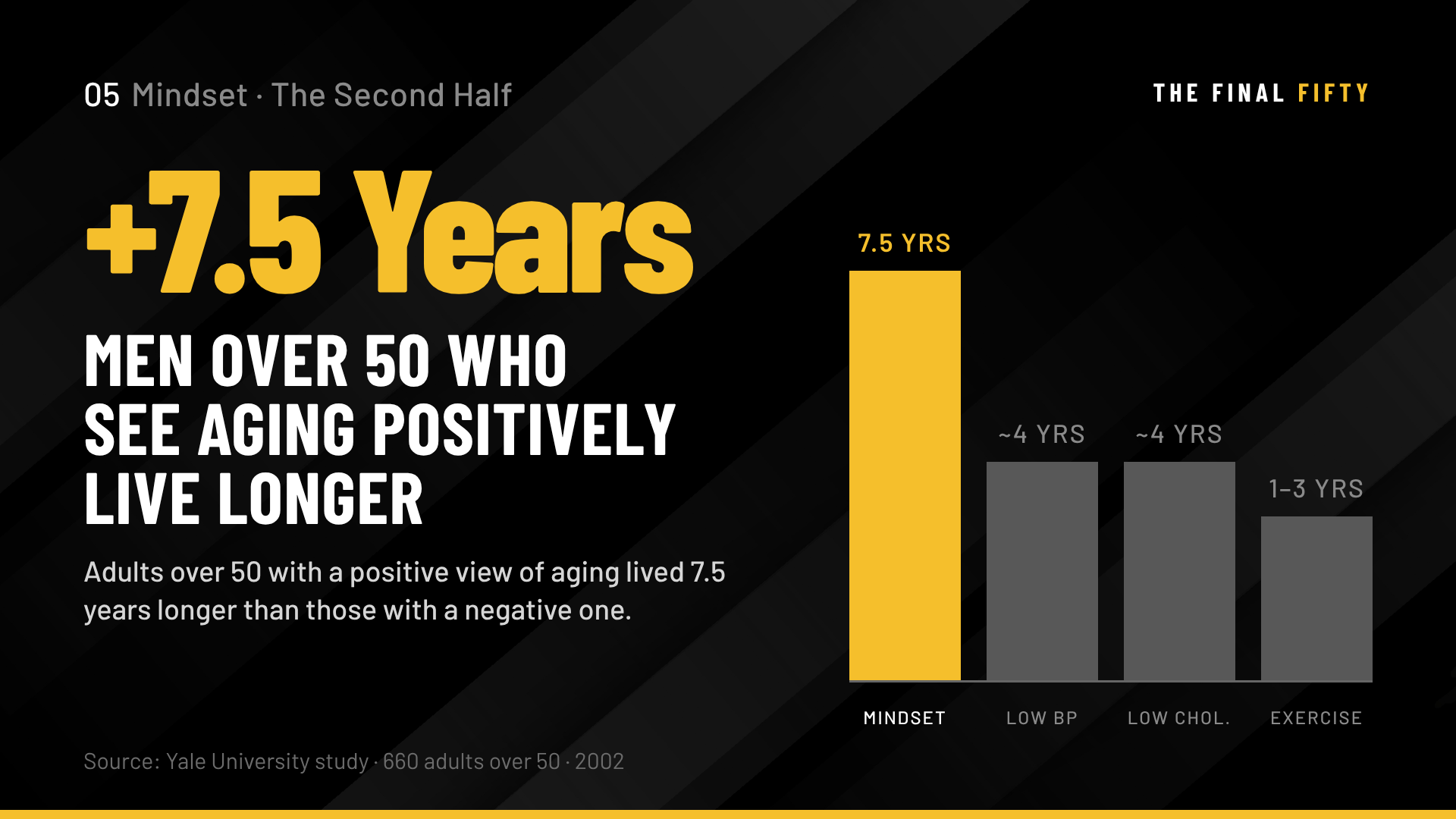
Yale psychologist Becca Levy spent more than two decades studying the relationship between self-perception of aging and measurable health outcomes. Participants with more positive self-perceptions of aging at baseline had better functional health over the course of the study and lived an average of 7.5 years longer than those with more negative self-perceptions of aging, and these health advantages remained after adjusting for baseline functional health and other relevant variables.
Thinking positively about getting older extends life by seven and a half years on average, which is more than the longevity gained from low blood pressure or low cholesterol, or by maintaining a healthy weight, abstaining from smoking, and exercising regularly.
That is not a typo. A mindset shift toward aging produces a larger measurable impact on lifespan than not smoking. The man who cleans up his nutrition, trains consistently, and optimizes his sleep but carries a fundamentally negative internal story about what fifty means and what the years ahead hold is leaving the single highest-leverage variable on the table.
Levy found that people’s cortisol levels rise by roughly 40 percent from their fiftieth to eightieth birthdays if they have negative attitudes to aging. Those with positive views, in contrast, show a slight decline in cortisol over the same period. Over the years, heightened cortisol can have a negative impact on the hippocampus, on the immune system, and on the cardiovascular system.
The biology follows the belief. This is not metaphysics. It is the measurable, documented, physiological consequence of what a man tells himself this stage of life means.
The Fixed Mindset of Fifty
Stanford psychologist Carol Dweck’s research on fixed versus growth mindsets provides a second lens for understanding what happens to men in the second half when the wrong framework takes hold.
A growth mindset is the belief that human capacities are not fixed but can be developed over time, and mindset research examines the power of such beliefs to influence human behavior. The fixed mindset is its opposite: the belief that abilities and capacities are set, that the ceiling is visible, that the work of development is finished.
Most men in their fifties are not running a consciously fixed mindset. They would not describe themselves as believing their best performance is behind them. But the behavioral evidence tells a different story. The man who stopped pushing the edge of his strength training because he decided heavy lifting is for younger men is running a fixed mindset about physical capacity. The man who stopped pursuing aggressive professional growth because he decided he has already proved himself is running a fixed mindset about what building still looks like at this stage. The man who accepted a diminished version of his relationships because he decided depth of connection is something that was built in the first half and maintained in the second is running a fixed mindset about what intimacy and presence still require of him.
The fixed mindset at fifty does not announce itself as limitation. It announces itself as earned rest. As wisdom. As having arrived somewhere. That is precisely what makes it dangerous.
Research examining adults aged 60 to 80 found that higher levels of a growth mindset were associated with better aging outcomes including improved emotion regulation and attention regulation. When both openness and growth mindset were included as predictors of successful aging, only growth mindset emerged as a significant predictor.
The difference between the men who thrive in the second half and the men who decline in it is not primarily physical. It is not primarily circumstantial. It is the mindset they are running, the story they are telling about what this stage of life is and what it demands of them.
What the Shift Actually Looks Like
Reframing fifty as a beginning rather than a winding down is not positive thinking in the motivational poster sense. It is an evidence-based recalibration of what is actually true about what a man at this stage has available to him.
The man at fifty carries something the man at thirty was still building toward: the specific and irreplaceable combination of physical capability, professional experience, hard-won judgment, social capital, and clarity about what matters that only fifty years of actual living can produce. That combination is not a consolation prize for lost youth. It is a more powerful set of assets than raw energy alone, applied to a more clearly defined mission than ambition alone.
The mindset shift is from subtraction to addition. From what is being lost to what is now available. From managing what was built in the first half to building something that only becomes possible in the second. This is not denial of the physical changes that come with age. Those changes are real and addressed directly throughout this platform. It is the refusal to let those changes define the ceiling when the ceiling is still being determined.
A man who wakes up at fifty-two and decides he is just getting started is not delusional. He is accurate. The research on human performance, on cognitive function, on physical adaptation, on what produces the highest-quality and longest lives, points consistently in one direction. The men who treat the second half as an expansion rather than a contraction are the men who produce more, build more, contribute more, and live longer while doing it.
The Standard That Holds the Mindset in Place
Mindset alone is not enough. A man can believe the right things about what fifty represents and still drift into the slow default when life gets hard and motivation runs thin. What holds the mindset in place is not belief. It is the daily standard built around that belief.
The standard is what keeps a man training when he does not feel like it. The standard is what keeps him investing in the relationships that matter when it would be easier to maintain them at the surface. The standard is what keeps him building professionally when coasting would be invisible and comfortable and completely unjustifiable. The belief is the foundation. The standard is the structure built on top of it. And the daily execution of the standard is what turns a mindset shift from a moment of clarity into a second half that actually looks different from the one the world wrote.
The men who are going to look back from seventy and recognize that the years after fifty were the best of their lives are not the men who had the easiest circumstances or the most favorable biology. They are the men who told themselves the right story, built the right standard around it, and refused to let either one go when the world kept presenting reasons to do exactly that.
That story starts with a decision made right now, in the actual current version of a man’s life, regardless of what the first fifty years produced and regardless of what the culture has been saying about what fifty means.
The decision is simple: this is not a slowdown.
It is a build.
THE FINAL 50 FRAMEWORK
THE REFRAME
The story you tell yourself about what fifty means is not background noise. It is a biological variable with measurable consequences for how long you live, how well you function, and what your body is capable of producing in the decades ahead. The research on positive self-perception of aging is not soft science. It is some of the most robust longevity data available. The mindset shift is not optional. It is foundational to everything else this platform builds.
THE STANDARD
The Final 50 man does not operate from the cultural story about what fifty means. He operates from the evidence of what fifty makes possible. He holds a growth mindset across all three pillars, which means he is building physically, building professionally, and building personally in the second half, not managing or maintaining. He knows that the standard he holds today is shaping the man he will be at sixty, seventy, and eighty, and he treats that knowledge as a daily operating instruction.
THE PRACTICE
Write down the story you have been running about this stage of your life. Not what you believe consciously but what your daily decisions reveal you believe. Do the choices you are making about training, about professional ambition, about relational investment, reflect a man who believes the best is still ahead? Or do they reflect a man who has quietly accepted that the ceiling is visible and that the work of development is mostly done? Name the story that is actually operating. Then decide whether it is the one you are willing to keep running.
THE AUDIT
Where has the fixed mindset taken hold without your awareness? Which areas of your life have shifted from building to maintaining without a deliberate decision to make that shift? Strength and physical performance. Professional ambition and forward momentum. The depth and investment in your most important relationships. Pick the area where the drift has been most significant. That is where the mindset shift produces its first visible result.
THE PROMPT
The men in your brotherhood are running their own stories about this stage of life, and those stories are either pulling the standard up or quietly validating the drift. What story are the men closest to you telling about fifty? Is it the story of the man who is just getting started or the one who has already arrived? That conversation, held directly and without the usual social softening, is one of the most important ones available inside the brotherhood.