Most men approach the morning the same way they approach everything that does not feel urgent: reactively. The alarm goes off, the phone comes out, the email gets checked, the news gets absorbed, and before a single intentional decision has been made, the day has already started setting its own agenda. Fifteen minutes in, the man is responding to what the world wants from him rather than executing what he decided the night before.
This is not a productivity problem. It is an identity problem. The man who hands the first hour of his day to other people’s priorities, to notification badges and email threads and whatever chaos walked in overnight, is a man who has already decided, without realizing it, that his standard is something he maintains when circumstances allow rather than something he holds regardless of what the morning brings.
The morning routine is not a wellness ritual. It is a declaration of ownership over the only thing in the day a man can genuinely control before the world shows up to take it from him.
Why the Morning Matters More After 50
The biology of the morning changes after fifty in ways that make the first hour of the day both more powerful and more fragile than it was two decades earlier.
When a man opens his eyes on waking, cortisol levels should naturally begin to rise by an average of 50 percent. In the 30 minutes after waking, there should be a sharp, normal increase. By the 60-minute mark cortisol levels have peaked and begin to decline. This is called the cortisol awakening response, and it is one of the most important biological events of the day. It is the body’s internal alarm system, mobilizing energy, sharpening focus, and preparing the system for the demands ahead. In men over fifty, this response begins to flatten. The spike is less pronounced, the hormonal signal less clean. The result is the kind of morning grogginess, slow mental startup, and low early energy that men in the second half often attribute to aging but which is, in significant part, a product of how they spend those first sixty minutes.
Men’s testosterone levels follow a clear daily pattern, peaking early morning between 7 and 10 AM before slowly dropping throughout the day. Young and middle-aged men show pronounced variations where morning testosterone can be 25 to 30 percent higher than evening measurements. That peak is an asset. A man who trains in that window, who makes his most demanding decisions, who does his most important work in the hours when his hormonal environment is most favorable, is using the biology of the morning rather than sleeping through it or surrendering it to a phone screen.
The morning is also when cognitive resources are fullest. Behavioral researchers at Princeton and Stanford have documented the decision fatigue effect: every decision made throughout the day consumes mental energy. Checking your phone or email first thing drowns your most valuable cognitive hours in other people’s priorities. The man who protects that window is protecting the most valuable cognitive resource he has. The man who spends it scrolling is spending peak currency on nothing.
The Non-Negotiable Foundation: Consistent Wake Time
Before any conversation about what to do in the morning, there is a conversation about when to start it. The research on circadian health is clear and unambiguous: consistency of wake time is more important than the time itself. Going to bed and waking up at the same time every day, or within a tight window, strengthens your circadian rhythm, optimizes the cortisol awakening response, and improves sleep quality. Irregular wake times disrupt your internal clock, flatten your cortisol awakening response, and impair testosterone production.
A man over fifty who wakes at different times depending on what the schedule demands, on weekdays versus weekends, on nights after a late social event versus nights when he was in bed by ten, is running a disrupted hormonal and neurological system every single morning. The inconsistency costs him more than the sleep does. Picking a wake time and holding it within thirty minutes seven days a week is the single structural decision that makes everything else in the morning more effective.
What the First 60 Minutes Should Actually Contain
The most effective morning routine for a man over fifty is not the most elaborate one. It is the one that covers the biological essentials, protects the cognitive window, and runs automatically without requiring daily willpower to execute. The goal is a sequence that becomes so consistent it generates its own momentum rather than depending on motivation to start.
The first action after waking is hydration, not coffee. After seven to eight hours of sleep, the body is physiologically dehydrated. That dehydration impairs cognitive function, reduces physical performance, and creates the mental fog that most men misidentify as a need for caffeine. Water first, then coffee. Sixteen to twenty ounces with electrolytes if the man trains fasted in the morning. This is not a significant change. It is a two-minute insertion at the start of the sequence that produces a measurable difference in cognitive clarity within fifteen minutes.
The second action is sunlight exposure. Sunlight exposure first thing in the morning helps regulate the circadian rhythm, improve sleep quality, and increase morning cortisol levels, which naturally peak in the early hours. It also stimulates vitamin D production, which is critical for testosterone and overall health. Ten to fifteen minutes of outdoor light exposure, without sunglasses, without a phone in hand, is one of the highest-leverage inputs a man over fifty can deliver to his hormonal and neurological system every morning. It does not require a walk. It does not require a gym. It requires stepping outside and being present for fifteen minutes. Most men over fifty have never done this consistently, which means most men over fifty are starting every day with a disrupted internal clock that compromises everything that follows.
Training belongs in the morning for most men over fifty, not because the research definitively proves morning is superior to every other time, but because it is the window that life has the least ability to take away. The afternoon meeting runs long. The evening event gets added to the calendar. The morning, protected by the discipline of an early wake time, belongs to the man who claims it. Morning exercise may be particularly effective for reinforcing the central clock, stabilizing the expression of core clock genes, and leading to a robust cortisol awakening response and properly timed melatonin suppression. This central alignment improves sleep quality, which in turn promotes the nocturnal release of anabolic hormones like growth hormone, creating a favorable systemic environment for muscle repair.
Intention setting does not need to be a journaling practice that takes thirty minutes and feels like homework. It can be three minutes with a notebook and three questions: what does today need to accomplish, what is the standard I am holding today, and what is the one thing that if it gets done makes the day a success regardless of what else happens. Psychologist James Pennebaker’s research on expressive writing found that putting thoughts on paper reduces stress and improves cognitive performance. Three minutes of freewriting is enough to clear the mental buffer and begin the day with intention rather than noise.
The phone stays down until the routine is complete. This is the boundary that most men find hardest to hold and that produces the most significant return when they do. The morning routine is a protected sequence. The moment the phone enters it, the sequence belongs to everyone else.
The Routine That Runs on Automatic
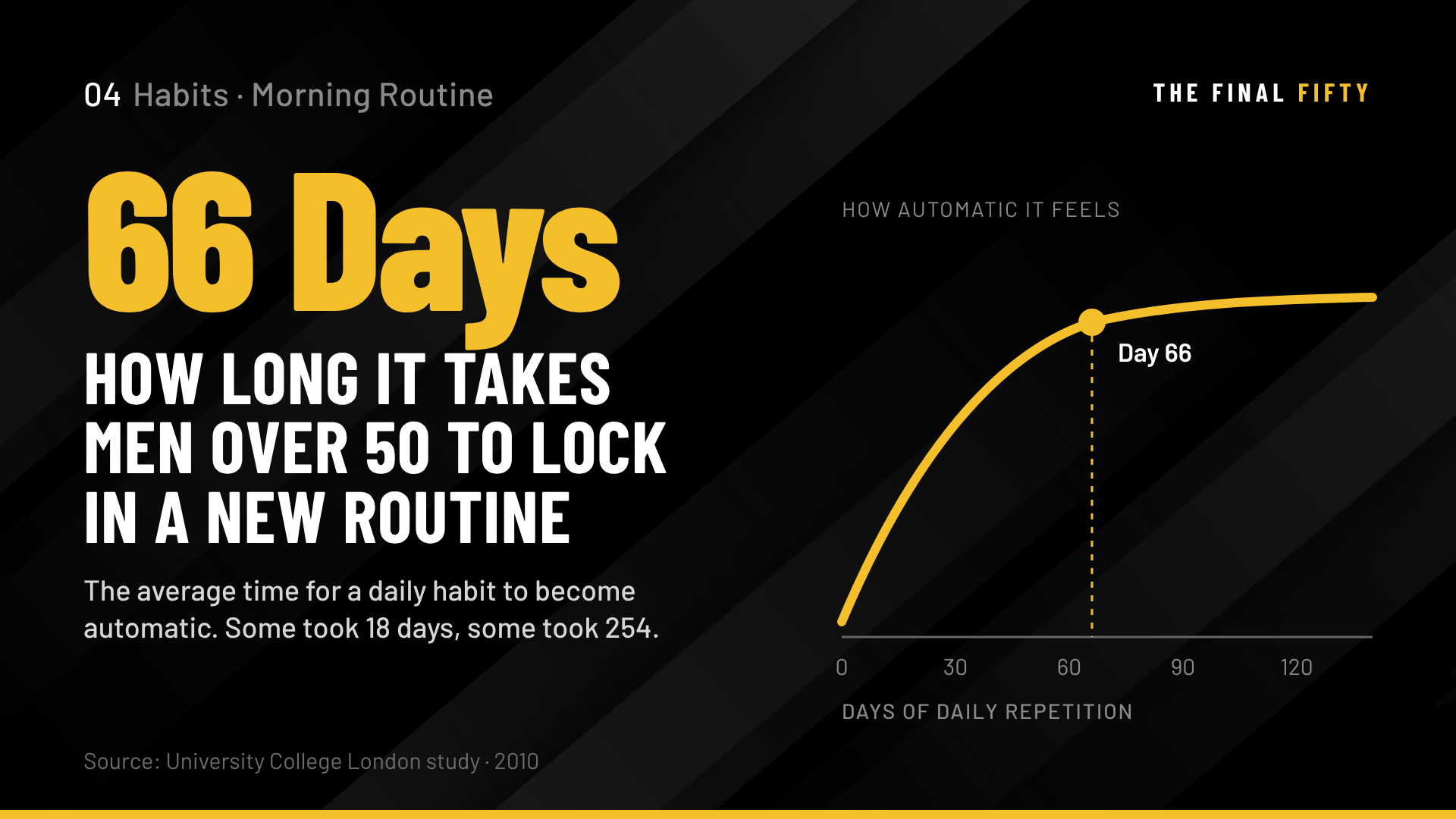
Your brain seeks predictability, which explains why structured mornings can reduce cortisol levels by up to 50 percent compared to chaotic wake-ups. A consistent morning routine creates neural efficiency by satisfying your brain’s craving for predictability.
That is the design objective for every man building a morning routine after fifty. Not the most impressive routine. Not the one that looks best written out. The one that runs automatically, that requires the least daily decision-making to execute, and that consistently delivers the physical, hormonal, and cognitive preparation that the second half demands.
The man who gets up at the same time, hydrates, gets outside, trains, and sets his intention before the world has any claim on his attention has done more for his physical performance, his hormonal health, his cognitive output, and his daily standard in sixty minutes than most men do in a full morning of reactive activity.
That is what the routine is for. Not optimization as a hobby. Ownership of the day before the day has a chance to own him.
THE FINAL 50 FRAMEWORK
THE REFRAME
The morning routine is not a self-improvement strategy for men who have extra time. It is the daily act of claiming ownership over the only window the day cannot take from you before you are ready to defend it. Every man over fifty who hands that window to his phone, his inbox, or the chaos of whatever walked in overnight has made a choice about whose priorities matter most. The routine is how that choice gets reversed.
THE STANDARD
The Final 50 man has a morning sequence and he runs it. Not on the days when it is easy and he feels motivated. Every day. Same wake time within thirty minutes. Hydration before caffeine. Sunlight before screens. Training before the schedule has a chance to crowd it out. Intention set before the first email is opened. The standard does not negotiate with the morning.
THE PRACTICE
This week, identify the single biggest leak in your current morning. Most men over fifty have one of three: they are inconsistent with wake time, they go straight to the phone, or they skip the physical work because the morning is already gone by the time they have addressed everything else. Pick the leak. Plug it this week before adding anything else. One fixed leak held consistently for seven days is more valuable than a new twelve-step protocol that collapses by Wednesday.
THE AUDIT
What does your morning currently produce? Not what you intend it to produce. What does it actually deliver in terms of physical output, mental clarity, and intentionality going into the day? If the honest answer is that you are reactive before you are ready, that the day is already setting its agenda before you have set yours, the morning is where the rebuild starts.
THE PROMPT
The brotherhood runs on shared standards. What does the morning routine look like for the men you respect most, the ones performing at the level you are building toward? Ask them. Not for their full protocol. For the one thing they protect in the morning that they credit with the most return. That conversation produces more useful information than any morning routine article, including this one.