
There is a hierarchy of variables that determine a man’s health outcomes, performance trajectory, and quality of life in the second half. Most men would organize that hierarchy by placing the visible, measurable inputs at the top: training consistency, nutritional quality, sleep adequacy, stress management. These are the variables that receive the most deliberate attention and the most systematic investment in the Final 50 framework, and they deserve that attention.
But the research points to a variable that sits above all of them in its predictive power — one that most men have never thought of as a performance variable at all, one that is not measured in the gym or in the lab, and one that most of the second-half health and performance conversation never addresses directly.
That variable is what a man believes about himself and about what the second half of his life is.
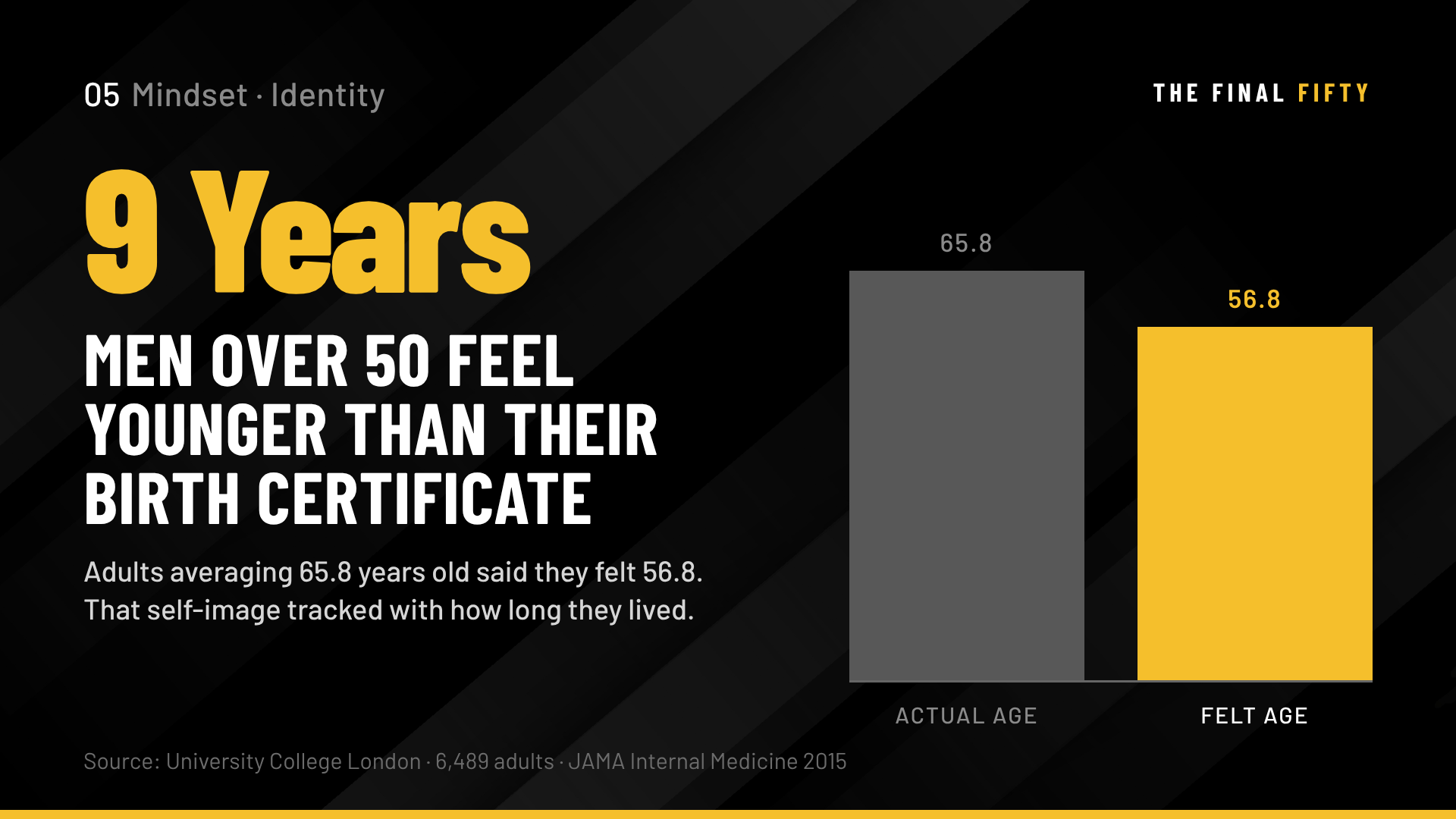
Yale School of Public Health researcher Becca Levy and her colleagues tracked 660 adults aged 50 and over across 23 years, measuring their self-perceptions of aging at baseline and then comparing those perceptions against survival records. The finding has been replicated, extended, and cited in the research literature for two decades. Older individuals with more positive self-perceptions of aging lived 7.5 years longer than those with more negative self-perceptions. This survival advantage remained after controlling for age, gender, socioeconomic status, functional health, and loneliness. It was larger than the longevity benefit of low blood pressure, low cholesterol, not smoking, lower BMI, and regular exercise, each of which extends life by one to four years. A man’s beliefs about his own aging had a greater impact on how long he lived than the most widely promoted behavioral health interventions available.
This is not a soft finding. It is a 23-year longitudinal study of 660 people whose survival was tracked against national death records. And it changes the frame for what the most important work of the second half is.
What Self-Perception of Aging Measures
The self-perception measure used in Levy’s research captured something specific. It was not optimism in general or positive thinking as an abstract disposition. It was the specific set of beliefs a man holds about what aging means for him personally: whether he sees the second half of his life as a period of decline, limitation, and progressive loss of relevance, or as a period of continued development, capability, and meaningful contribution.
The items that measured negative self-perception of aging asked about agreement with propositions like as you get older you are less useful, or that aging necessarily means becoming less capable of doing what matters. The men who agreed with those propositions, who had internalized the cultural story of decline and diminishment that surrounds aging in most Western societies, died earlier. Not slightly earlier. An average of 7.5 years earlier.
The mechanism, partially mediated by what the researchers described as will to live, is not primarily about positive thinking producing magical outcomes. It is about the downstream behavioral and physiological consequences of holding a particular identity. The man who believes that the second half of his life is a period of meaningful building continues to make the behavioral investments that health and performance require, because those investments make sense within his self-concept. The man who believes the second half is primarily a period of managed decline makes the investments that managed decline requires, which are considerably smaller. The identity is upstream of the behavior. The behavior is upstream of the outcome. The outcome, measured across 23 years and against national death records, is 7.5 years of life.
A subsequent study from the same research program found that those with more positive self-perceptions of aging in 1975 reported better functional health from 1977 to 1995, even after controlling for baseline measures of functional health, self-rated health, age, gender, race, and socioeconomic status. The positive identity was not a consequence of better health at baseline. It was a predictor of better health across 18 years. The direction of causation is from belief to outcome, not the reverse.
The Identity the Culture Has Been Building
The beliefs a man holds about his own aging were not formed in isolation. They were absorbed from a cultural environment that treats aging in a specific and largely negative way, and the absorption typically began decades before the man arrived at fifty.
Age-related stereotypes are acquired in a two-stage process: individuals first absorb the broader cultural stereotypes about aging that surround them across their adult years, and then, as they age, those stereotypes become self-referential. The man who spent decades in a professional culture that implicitly treated older workers as less innovative, less technically current, and less valuable than younger ones has been absorbing a narrative about what aging means professionally. The man who consumed popular media that treated middle-aged and older men primarily as figures of comedy or irrelevance has been absorbing a narrative about what aging means socially. Unlike stereotypes targeting racial or other minority groups, which people can often recognize and actively resist from early in life, stereotypes about aging are acquired decades before the person becomes their target and are therefore rarely questioned.
The cultural narrative about aging for men in the second half of their lives runs roughly like this: the peak was earlier, the decline begins now, the window for doing significant things is closing, and the appropriate orientation is toward protection of what was built rather than construction of what has not yet been attempted. This narrative is not accurate. It is not supported by the research on what men in their fifties and beyond are capable of, what entrepreneurial outcomes they produce, what intellectual contributions they make, what physical performance levels they can sustain, or what the quality of their relationships and their experience of life looks like when they invest deliberately in those dimensions. But it is the default narrative, and absent a deliberate replacement, it becomes the identity.
The man at fifty who has absorbed this narrative without examining it is carrying a self-concept that is working against everything else he is trying to build. He can train consistently, eat well, sleep adequately, and manage his stress, and still be operating with a fundamental belief about what his life is and what it can produce that limits what those investments will generate.
What the Research Supports as an Alternative
The positive self-perception of aging that the Levy research identifies as the longevity-protective variable is not the performance of optimism or the suppression of accurate assessment. It is a specific, evidence-grounded orientation toward the second half that is available to any man who examines the actual evidence about what the second half produces rather than accepting the cultural default about what it is.
A meta-analysis synthesizing 33 studies with a combined sample of 43,556 older adults found that more positive self-perceptions of aging were significantly related to higher psychological well-being across the full range of wellbeing measures studied. The effect was not attributable to selection bias or confounding by initial health status. The relationship between how men perceive their aging and how they experience it is robust enough across multiple independent research programs to be treated as a causal relationship rather than a correlation of uncertain direction.
The specific identity that the research supports for men over fifty is not one of denial about the real biological changes that the second half involves. Testosterone declines. Recovery takes longer. Some capabilities that were available at thirty-five require more maintenance at fifty-five. These are real, and a man who ignores them is not holding a positive aging identity. He is holding an inaccurate one, which produces its own set of downstream problems.
The identity that the research supports is one that holds the biological changes as variables to be managed rather than trajectories that determine the outcome, that locates capability in the specific advantages the second half provides, depth of knowledge, stability of character, clarity of values, quality of relationships, and freedom from the proving that organized the first half, and that frames the second half of life as the building period for something that the first half was laying the groundwork for rather than as the maintenance period for what the first half produced.
A man with this identity is not performing positivity. He is holding an accurate assessment of what the evidence says about second-half capability that happens to differ substantially from what the cultural narrative suggests. The 1.8 times entrepreneurial success advantage for fifty-year-old founders. The cognitive advantages of accumulated knowledge and pattern recognition. The relational depth that decades of lived experience produces. The clarity about what matters that most men do not develop until the first half’s proving pressure has reduced enough to allow it. These are second-half advantages, available to the man whose identity has been built around them rather than around the cultural narrative of decline.
Identity as the Operating System
The metaphor that captures the relationship between identity and every other performance variable in the Final 50 framework is the operating system. Every application runs on the operating system. Every input goes through it. Every output is shaped by it. A man can install the most effective applications available, training, nutrition, sleep, stress management, relationship investment, and they will all run at the level the operating system supports. An operating system built around the identity of decline and managed maintenance supports a certain level of output from those applications. An operating system built around the identity of deliberate second-half construction supports a different and substantially higher level of output from the same applications.
This is why identity is the most important variable. Not because it replaces the other variables, but because it determines the ceiling on what the other variables can produce. The man whose training is disciplined but whose self-concept is that he is past his peak will train toward the level that someone past his peak trains toward. The man whose training is disciplined and whose self-concept is that he is in the building phase of the second half will train toward the level that someone in a building phase trains toward. Same behavior, different identity, different ceiling, different outcome across years.
The Levy research makes this concrete. The 7.5 year longevity difference was not between men who trained and men who did not, or between men who ate well and men who did not. It was between men who believed the second half of their lives was a period worth investing in and men who believed it was not. The belief was the variable. Everything else followed from it.
Building the right identity for the second half is not a motivational project. It is a performance project, grounded in the same quality of evidence that supports the training protocols, the nutritional standards, and the recovery practices that the rest of this content library describes. The evidence says that what a man believes about himself and about what the second half can produce is the most important determinant of what the second half produces. That makes the identity work not the soft component of the second half performance system. It makes it the foundation.
THE FINAL 50 FRAMEWORK
THE REFRAME
What a man believes about his own aging is not a soft psychological variable. It is the most powerful predictor of longevity and functional health in the second-half research literature. The Yale study of 660 adults tracked across 23 years found that positive self-perceptions of aging produced a 7.5 year survival advantage over negative ones, larger than the benefit of not smoking, regular exercise, or low blood pressure and cholesterol. The belief is upstream of the behavior. The behavior is upstream of the outcome. Changing the belief changes everything downstream of it.
THE STANDARD
The Final 50 man has examined the identity he holds about the second half of his life, identified the cultural narrative of decline that may be embedded in it without having been consciously chosen, and replaced it with an identity grounded in the actual evidence about second-half capability: the entrepreneurial advantage, the pattern recognition, the relational depth, the values clarity, and the freedom from proving that the second half provides. He holds this identity not as a performance of positivity but as an accurate assessment of what the evidence says about who he is and what the second half can produce. He builds from that identity rather than managing from the alternative.
THE PRACTICE
This week, write two paragraphs. The first: what story have you been telling yourself about what the second half of your life is and what it can produce? Write it honestly, without editing toward what it should be. The second: what is the identity that the actual evidence about second-half capability supports, specifically your depth of expertise, your accumulated relationships, your clarity about what matters, and the freedom the second half provides from the pressures that organized the first? The gap between the two paragraphs tells you how much of the cultural narrative of decline you have absorbed without examining and how much identity work is available to do. The examination is the first step toward replacement.
THE AUDIT
What is the implicit ceiling on what you believe your second half can produce? Not what you would say if asked directly, but what your actual daily decisions and investments reflect about what you believe is possible. The man whose investment level reflects a belief that the second half is primarily about maintaining what was built in the first has answered the audit question. The man whose investment level reflects a belief that the most significant building of his life is still ahead has answered it differently. The investment level is the honest answer. What does yours say about the identity that is running the system?
THE PROMPT
The men in your brotherhood are each operating from some version of an identity about what the second half means and what it can produce. Most of them have never made that identity explicit or examined whether it reflects what the evidence supports or what the culture defaulted them into. What would it mean to have the conversation about second-half identity directly inside the brotherhood, to share what each man believes about what this period of his life is and what it can generate, and to hold each other to the identity that the evidence supports rather than the one the culture provides by default? That conversation, held honestly, is the most important one this platform asks the brotherhood to have.


