
The health variables that men over fifty are most likely to track and invest in are the ones that come with quantifiable targets and visible feedback. Training performance. Body composition. Blood markers. Sleep duration and quality. The daily standard is held, the measurement is taken, the feedback arrives. The investment-to-outcome relationship is visible enough to sustain the discipline the investment requires.
Social health does not come with those features. There is no blood test for friendship quality. No wearable that tracks the depth of a man’s social connections. No clear daily target whose achievement can be confirmed and logged. And the consequences of social isolation, unlike the consequences of sleep deprivation or elevated inflammatory markers, do not arrive with immediate feedback that signals a problem requiring attention. They accumulate silently, across years, in the cardiovascular system, the immune system, the cognitive function, and the hormonal environment of a man who has been managing every other health variable while allowing the social one to atrophy through the benign neglect of a full and busy life.
The research on this is now comprehensive enough, and the effect sizes large enough, to place social health not in the lifestyle preferences category but in the clinical health variables category alongside the inputs that this platform addresses with the most systematic rigor.
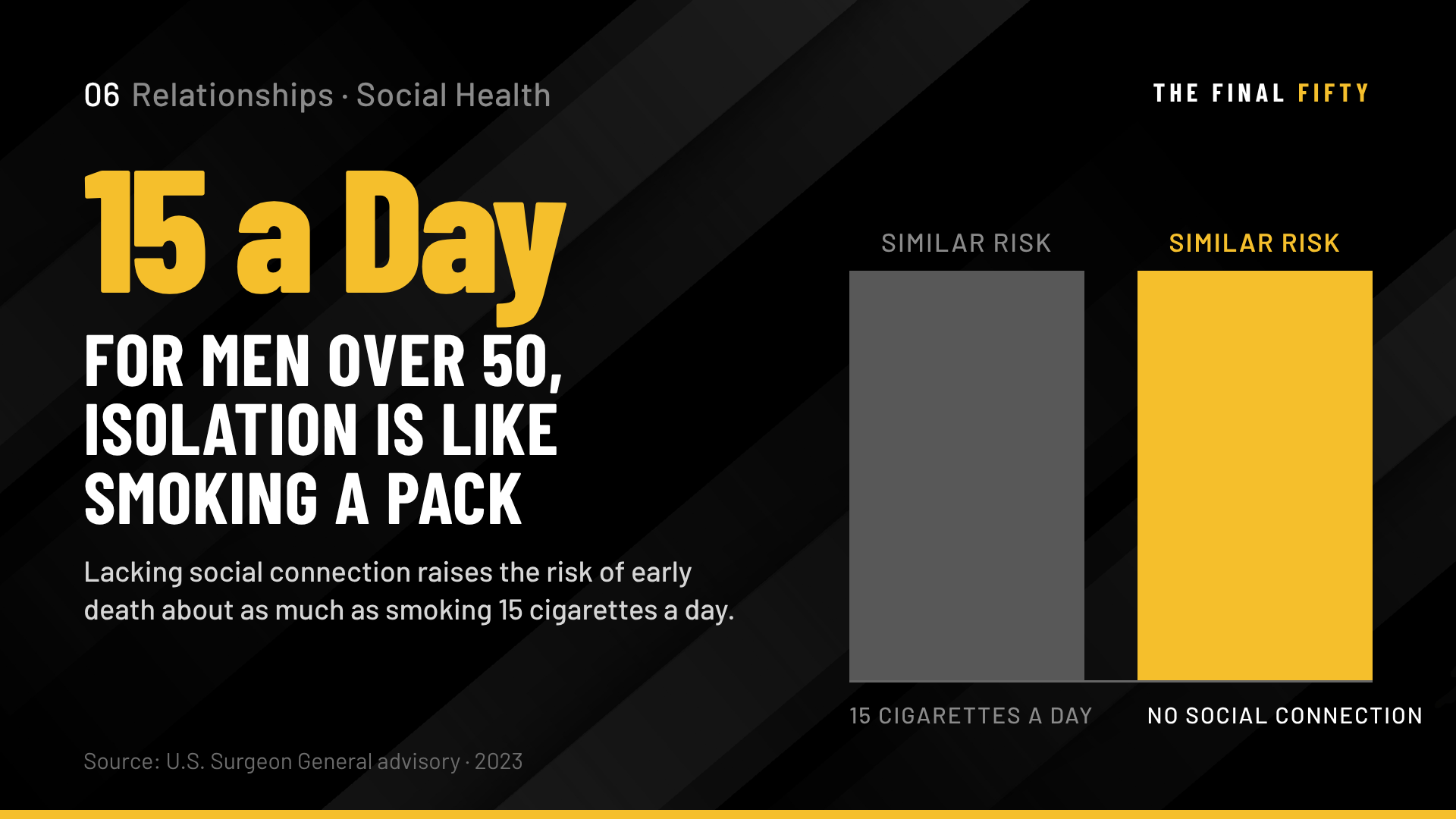
Strong social relationships boost survival rates by approximately 50 percent. Social isolation carries health risks comparable to smoking 15 cigarettes a day. These are not metaphors from a self-help book. They are the findings of a meta-analysis of 148 studies covering more than 300,000 participants, conducted by researchers at Brigham Young University and published in PLOS Medicine. The magnitude of the social connection effect on mortality is comparable to, and in some analyses larger than, the effects of well-established behavioral health interventions. A man who is managing his cardiovascular risk, his inflammatory markers, and his hormonal health while allowing his social world to atrophy is not managing his health comprehensively. He is managing most of it while leaving one of its most consequential variables largely unaddressed.
The Biological Mechanisms: How Social Connection Affects the Body
The mortality and morbidity effects of social connection are not mediated solely through behavior, meaning that the benefit of social connection is not simply that friends encourage healthier choices. The biological mechanisms are direct and specific, operating through pathways that affect the cardiovascular, immune, hormonal, and neurological systems in ways that are measurable in blood and tissue.
Men who maintain robust social connections experience lower cortisol levels, reduced inflammatory markers, and enhanced cardiovascular health compared to their socially isolated counterparts. The mechanism is not subtle. Chronic social isolation activates the same stress response systems that chronic psychological stress activates, producing sustained elevation of cortisol and inflammatory cytokines that over time produce the cardiovascular damage, immune suppression, and metabolic dysfunction described throughout this series in the context of chronic stress.
Social isolation changes how the immune system functions, causing inflammation that becomes harmful when it persists. People who are isolated show higher levels of stress hormones, blood pressure, and inflammation markers linked to numerous diseases. The physiological signature of chronic loneliness is not distinguishable from the signature of chronic stress, because the two conditions activate the same biological alarm system. The nervous system does not distinguish between the threat of a predator, the threat of ongoing interpersonal conflict, and the threat of social exclusion. All three activate the same fight-or-flight cascade. All three, when sustained, produce the same downstream biological damage.
The cognitive consequences are equally specific. Lower social support is associated with greater subjective cognitive decline in men over 65 at odds ratios of 2.6, meaning that isolated men were 2.6 times more likely to report confusion or memory loss compared to their socially connected counterparts, controlling for other variables. Social engagement influences neuroplasticity and cognitive aging directly: men who regularly interact with diverse social groups maintain better memory function, executive control, and processing speed as they age. The mental stimulation of meaningful conversation and shared activity creates new neural pathways while protecting existing ones from age-related decline. Dementia risk increases by 50 percent with social isolation, making social connection one of the most powerful modifiable risk factors for cognitive preservation available.
Men who maintain strong social connections produce more telomerase, the enzyme that protects chromosome ends and slows cellular aging. Their immune systems maintain better surveillance against cancer cells and infections, while their cardiovascular systems show improved heart rate variability and blood pressure regulation. The biological case for social health is not dependent on a single mechanism or a single study. It is the convergent finding of multiple research programs, across multiple populations, measured through multiple biological pathways.
Why the Effect Is Larger for Men Than for Women
The social health research produces a consistent finding about sex differences that is directly relevant to men over fifty: the health consequences of social isolation are more severe for men than for women, and men are more likely to experience the specific form of social isolation that produces the most severe consequences.
Men’s social identities tend to be more narrowly organized around productive roles, and men rely more heavily on their primary partner for emotional support and social connection than women do. This means two things for men over fifty. First, when a primary role changes or ends, men lose a disproportionate share of their social connection infrastructure alongside it, because the role was the primary vehicle for that connection. Second, when the partner relationship is the primary or sole source of social connection, any disruption to that relationship, through conflict, illness, or loss, removes almost the entire social support structure simultaneously.
Cultural expectations around masculinity often discourage emotional expression and help-seeking behaviors, leading many men to struggle in silence when relationships become strained or lost. This cultural conditioning creates barriers to forming the deep, supportive friendships that provide the full health benefits of social connection. The man who can describe his professional network in detail but cannot identify three men who know what is happening in his life is not socially connected in the sense that the research identifies as health-protective. He is surrounded by acquaintances while experiencing the physiological profile of isolation.
Social connection as a public health issue has been increasingly recognized by research and policy communities. The current rates of social isolation represent a significant population health concern, with the proportion of people reporting meaningful social connection declining across decades in most Western countries. For men over fifty, who are both statistically more likely to be socially isolated and physiologically more vulnerable to the consequences of that isolation, the personal health implication of this population-level trend is not abstract. It is the specific health risk that most men in this demographic are living with without having named it as a risk or treated it as the health investment that the evidence says it is.
The Specific Mechanisms Through Which Social Connection Protects Health
Understanding the specific mechanisms through which social connection produces its health effects helps a man direct his social investment toward the dimensions that carry the most biological return, rather than treating all social activity as equivalent.
The stress buffering mechanism is the most immediate and most consistently documented. Social support moderates the cortisol response to stressors: the man who has social connection experiences lower cortisol elevation in response to the same stressor than the man who faces it alone. This is not a psychological comfort effect. It is a measurable reduction in the biological stress response that, accumulated across the repeated stressors of a full life over years, produces meaningfully lower inflammatory burden and cardiovascular strain than the same stressors produced in social isolation.
The behavioral mechanism is real but secondary. Men with strong social networks are more likely to maintain the health-protective behaviors described throughout this platform, because social norms within a health-oriented community support those behaviors and because the accountability structure of friendship applies social pressure toward maintaining them. The man in a brotherhood that trains together, that holds each other to nutritional standards, and that monitors each other’s sleep and recovery is getting social pressure in the direction of health. This mechanism is important but does not explain the full magnitude of the social connection effect on mortality, which persists even after controlling for differences in health behaviors between socially connected and isolated individuals.
The neurological stimulation mechanism operates through the cognitive engagement that meaningful social interaction requires. Rich social interaction demands executive function, emotional processing, perspective-taking, and the kind of complex social cognition that is among the most cognitively demanding activities available to the human brain. This cognitive demand protects against the neural pathway deterioration that underlies cognitive decline, in the same way that physical training protects against the muscle deterioration that underlies physical frailty. Social engagement is cognitive training with a social dimension, and men who maintain it across the second half of their lives are protecting their cognitive reserve in ways that solitary activities cannot replicate.
The meaning and purpose mechanism is perhaps the least biological but among the most clinically significant. Men with strong social connections report higher will to live, greater sense of purpose, and more positive self-perceptions of aging, the variable identified in the previous article in this series as the most powerful longevity predictor available. The social connection and the positive aging identity are mutually reinforcing: the man who is known and valued by other men carries his sense of self into the second half from a more stable foundation than the man who is navigating it alone.
What Social Health Requires
The social health investment that produces the health benefits documented in the research is not social activity in the general sense of being present at events where other people are also present. It is the quality of connection that distinguishes a friend from an acquaintance, a brotherhood from a professional network, a community from a calendar of group activities.
Robust evidence documents social connection factors as independent predictors of mental and physical health, with some of the strongest evidence on mortality. The connection that predicts these outcomes is characterized by perceived support, by the sense that others know and care about the man specifically rather than the role he occupies, and by the reciprocal investment of interest and availability that distinguishes friendship from the comfortable social surfaces that most men settle for.
Quality matters more than quantity in the social health research. The man with three friends who know him well and who provide real support during the difficult periods of the second half has a different health profile from the man with thirty acquaintances he likes and no one who knows him at the level that constitutes social connection. The research does not reward volume of social contact. It rewards depth, reciprocity, and the quality of support that connection provides.
This means the social health investment for men over fifty is not primarily about attending more events or joining more organizations. It is about developing and maintaining the small number of relationships that provide the specific form of connection that carries the health return. The brotherhood of three to five men who know each other, who show up during the difficult periods, and who hold each other to a standard that includes the social investment itself, is the social health asset that the research most consistently identifies as health-protective.
Men who maintain this form of connection live longer, think more clearly, experience less cardiovascular disease, carry lower inflammatory burden, and report higher quality of life in the second half than men who do not. These are not soft outcomes. They are the health outcomes that this platform is built around pursuing. And they are, by the research, significantly influenced by whether the social health variable is being managed with the same intentionality as the physical, nutritional, hormonal, and cognitive variables that receive the most deliberate attention.
The friendship is the health investment. Treating it as one, with scheduling discipline and deliberate commitment, is not something that requires apology or explanation. It is what the evidence requires.
THE FINAL 50 FRAMEWORK
THE REFRAME
Social health is not a lifestyle preference for men who have time for it after the serious work of the second half is done. It is a clinical health variable with mortality consequences that a meta-analysis of 148 studies covering over 300,000 participants placed in the same tier as smoking cessation, regular exercise, and blood pressure management. The man who manages every other health variable with systematic discipline while allowing his social world to atrophy is not managing his health comprehensively. He is managing most of it while the most invisible variable accumulates its consequences without measurement or intervention.
THE STANDARD
The Final 50 man treats his social health with the same scheduling discipline and deliberate investment that he brings to his training program. He maintains three to five friendships characterized by mutual knowledge, support, and reciprocal investment, not by shared professional interest or convenient proximity. He schedules social investment with the same non-negotiability as his training sessions, because the research places the health return in the same tier. He knows that the quality of his social connections is predicting his cognitive trajectory, his cardiovascular health, and the length of his life in ways that no blood test currently measures but that the research consistently documents.
THE PRACTICE
This week, assess your social health honestly against the research standard. Not how many people you know or how many events you attend. How many men currently know what is happening in your professional situation, your health, your primary relationship, and your inner experience of the second half you are building? If the honest answer is zero or one, you have identified the health variable with the largest gap between its documented importance and the investment you are currently making in it. Identify one man this week with whom a deeper conversation is available if you initiate it. Initiate it. That is the first investment.
THE AUDIT
When did you last spend time with a man who knows you well enough to notice when something is wrong before you tell him? When did you last have a conversation that went deeper than the professional context or the comfortable surface that male social convention settles for? When did you last initiate contact with a man in your circle for no logistical reason, simply because the relationship matters and you wanted to invest in it? Honest answers to those three questions tell a man exactly where his social health investment stands relative to what the research says it should be.
THE PROMPT
The men in your brotherhood are each managing their social health with varying degrees of intentionality, and most of them have never had a direct conversation about social health as a health variable rather than as a lifestyle preference. What would it mean to name the investment explicitly inside the brotherhood, to commit collectively to the quality of connection that the research identifies as health-protective, and to hold each other to the standard that friendship is not what happens when everything else is handled? It is one of the things that determines how long and how well everything else gets to happen.


