
Every man over fifty starts the day with an advantage he does not know he has, and most of them spend that advantage before they have gotten out of bed.
The first sixty minutes after waking are not just the beginning of the day. They are a distinct biological window, governed by a specific hormonal cascade, operating under neurological conditions that do not repeat at any other point in the twenty-four hour cycle. The brain is running a different program in that window than it runs at noon, at three in the afternoon, or at nine in the evening. The body is producing hormones at levels that will not be seen again until tomorrow morning. The cognitive resources that are available in those sixty minutes are at their daily peak and will deplete steadily from the moment a man begins making decisions and responding to demands.
That is not a motivational concept. It is a biological fact. And the man who understands it stops treating the morning as the time before the day starts and starts treating it as the highest-return hour available to him every twenty-four hours.
For men over fifty, that window matters more, not less, than it did at thirty-five. Because the hormonal inputs that make it valuable are already under pressure from age-related decline, the choices made inside that window have an outsized effect on the quality of the entire day that follows.
The Cortisol Awakening Response: The Body’s Daily Launch Sequence
The first thing that happens physiologically when a man wakes up is not gentle. It is a hormonal surge that the research community calls the cortisol awakening response, and it is one of the most studied and least understood events in daily human biology.
In healthy individuals, the majority of cortisol secretion occurs within several hours surrounding morning awakening. A highly studied component of this secretory period is the cortisol awakening response, the rapid increase in cortisol levels across the first 30 to 45 minutes after morning awakening. This strong cortisol burst at the start of the active phase has been proposed to be functional in preparing the organism for the challenges of the upcoming day.
Shortly after awakening, a sharp 38 to 75 percent increase, averaging around 50 percent, occurs in the blood level of cortisol in about 77 percent of healthy people of all ages. The cortisol awakening response reaches a maximum approximately 30 minutes after awakening, though it may still be heightened by 34 percent an hour after waking.
This is not the damaging chronic cortisol elevation that accompanies unmanaged stress. This is a targeted, time-limited hormonal mobilization that serves a specific purpose: preparing every system in the body and brain for the demands of the coming day. It mobilizes glucose for energy. It primes the immune system. It sharpens alertness and attentional readiness. It signals the entire hormonal cascade to begin its daily cycle.
The cortisol awakening response can set up a tonic background tone to mobilize metabolism and energy supply for the brain and body, and proactively modulates human emotion and cognition. In plain terms: the cortisol awakening response is the body loading itself for the day ahead. It is anticipatory. It is preparing for what is coming. And the way a man uses the sixty minutes in which this biological preparation is occurring determines whether that preparation is channeled into something that matters or wasted on passive consumption before it has a chance to do its work.
The Testosterone Window: The Second Biological Advantage
Cortisol is not the only hormone running at its daily maximum in the first hour after waking. Testosterone follows the same pattern.
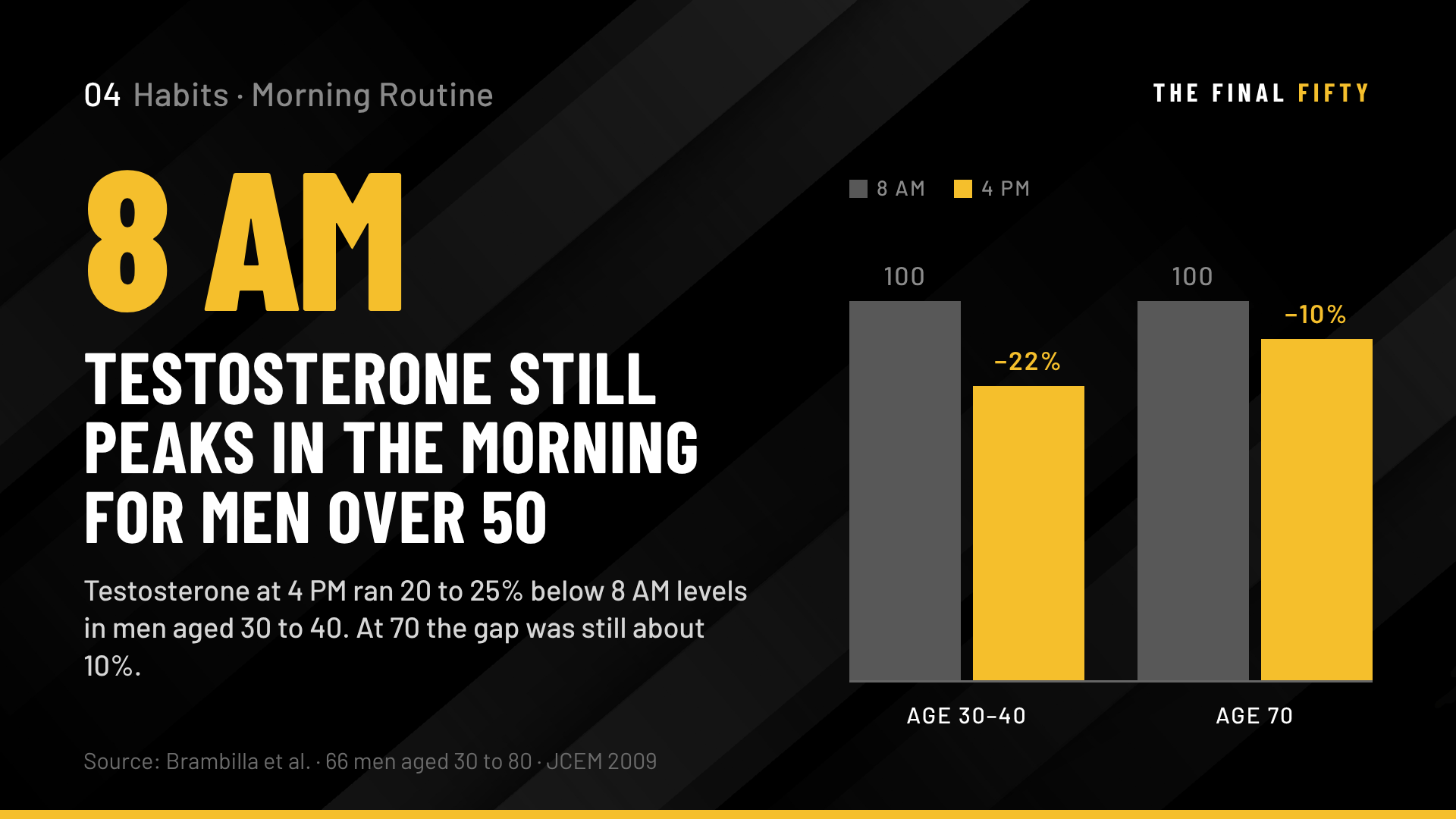
Testosterone levels peak between 0530 and 0800 hours, depending on the study, with trough levels occurring approximately 12 hours later. Although diurnal variation of testosterone declines with age, testosterone measurements should be restricted to morning hours at all ages.
GnRH secretion in adulthood is pulsatile and highest during sleep, with subsequent highest peaks of testosterone occurring during the early morning hours. Nevertheless, testosterone levels decline gradually with aging, mainly due to the attrition of Leydig cells and hypothalamic GnRH pulse generation slowdown.
The significance of this for men over fifty is direct. As testosterone levels decline with age, the morning peak represents the daily maximum of a hormone that is already running lower than it was a decade ago. A man over fifty who trains in the morning is training in the hormonal environment most favorable to the adaptive response he is trying to produce. A man over fifty who uses the morning for intentional cognitive work is doing that work at the hormonal peak most supportive of the focus, drive, and decisiveness that testosterone contributes to.
Testosterone influences mental clarity, decision-making, and confidence. The morning window is the time for tasks that require high concentration or performance, such as writing, critical thinking, or any work that demands sustained focus. This is not a performance strategy for the hyper-optimized. It is the most basic application of the body’s natural daily hormonal architecture to the decisions about what to do and when.
What Happens When the Phone Wins the Morning
The reason most men over fifty fail to use the morning window effectively is not a lack of discipline or intention. It is one specific habit that has been normalized so completely that it no longer registers as a choice: checking the phone within the first minutes of waking.
A 2024 study published in Psychoneuroendocrinology measured cortisol levels in two groups. Group A checked phones within five minutes of waking. Group B waited 60 or more minutes before phone checking. The group that checked phones immediately showed significantly disrupted cortisol awakening response patterns.
The cortisol awakening response is a preparation signal. It is the body loading itself for the day’s demands based on what the brain anticipates those demands will be. The moment a man introduces the phone into that preparation window, he replaces his own intentions and priorities with whatever the phone is carrying: other people’s urgencies, news designed to provoke reaction, social media engineered to capture attention, and email chains that belong to someone else’s agenda.
When you wake up, your brain is in a state called sleep inertia, a groggy transition between sleep and wakefulness. This is a delicate period when cognitive functions are not yet fully restored. Grabbing your phone and flooding your brain with notifications, social media feeds, or emails overstimulates the prefrontal cortex, which is responsible for decision-making and impulse control. This barrage of information can lead to mental fatigue before you have even gotten out of bed, making your mind feel cluttered and less focused for the rest of the day.
Early morning screen use also impacts mental sharpness and emotional resilience throughout the day. The immediate influx of information can overload cognitive capacity, reducing the ability to concentrate and make thoughtful decisions. Checking the phone first thing in the morning creates a reactive mode as opposed to a proactive one, which can increase stress and anxiety levels.
The sixty minutes that the biology has engineered as preparation time, as the window of peak hormonal readiness and cognitive availability, are handed over entirely to reactive processing of other people’s demands. The man who does this every morning is not managing his morning. He is surrendering it before the first intentional decision has been made.
The Architecture of a High-Leverage Morning
What makes the first sixty minutes high-leverage is not any single activity. It is the deliberate use of a biological window whose conditions do not repeat. The specific activities a man fills that window with should reflect his actual priorities, but the biological logic of the window applies to all of them.
Hydration first, before caffeine, addresses the physiological dehydration that accumulates across seven to eight hours of sleep and that suppresses cognitive function and physical performance until corrected. This is a two-minute intervention with a measurable return.
Sunlight exposure in the first thirty minutes of the day amplifies the cortisol awakening response and anchors the circadian rhythm that governs every hormonal system operating for the rest of the day. It does not require a walk or an elaborate routine. It requires stepping outside and being present for ten to fifteen minutes. Most men over fifty have never done this with any consistency.
Physical training in the morning, particularly for men over fifty, uses the testosterone peak and the cortisol mobilization together. The hormonal environment of the first hour after waking is more favorable for training adaptation than any other window. A man who protects the morning for physical training is not just managing his schedule. He is aligning his training with the biology that supports the best possible return on that training.
Intentional thought, whether journaling, planning, or whatever form of deliberate mental work a man uses to set direction for the day, belongs in the first hour because the cognitive environment is at its clearest before the decision fatigue that accumulates across the day has had any opportunity to begin. Three minutes of written intention about what the day needs to accomplish is not a self-help exercise. It is the allocation of peak cognitive resources to the question of what matters.
The Return on Investment of the Protected Morning
The man who protects sixty minutes every morning is not protecting sixty minutes. He is protecting the sixty minutes that determine the quality of the remaining sixteen hours. The hormonal state he creates in the morning governs his energy, his cognitive performance, his emotional regulation, and his physical readiness for the rest of the day. The reactive mode he creates by surrendering the morning to the phone governs all of the same things, in the opposite direction.
For men over fifty, where the hormonal environment of the morning is the daily peak of systems that are already under age-related pressure, this distinction is not a lifestyle preference. It is a performance decision with compounding consequences across the decade.
The morning is the highest-leverage hour available. The only question is who it belongs to.
THE FINAL 50 FRAMEWORK
THE REFRAME
The first sixty minutes after waking are not the beginning of the day in the casual sense. They are a distinct biological window during which the hormonal and neurological conditions for peak performance exist and will not be replicated again until tomorrow. Every minute of that window spent in reactive mode, responding to the phone, the news, or other people’s urgencies, is a minute of peak biological readiness spent on someone else’s agenda. The morning belongs to the man who claims it before anything else can.
THE STANDARD
The Final 50 man protects sixty minutes every morning without exception. No phone for the first hour. Hydration before caffeine. Sunlight before screens. Physical training or intentional physical movement before the schedule asserts its demands. Written intention before the reactive processing of other people’s needs begins. The morning window is non-negotiable, not because it feels good but because the biology makes it the highest-return investment available every single day.
THE PRACTICE
This week, implement one specific boundary in the morning: no phone for the first thirty minutes after waking. Not sixty yet. Thirty. Put the phone in another room the night before so the first reach is not for it. Use those thirty minutes for hydration, sunlight, and whatever physical or intentional work matters most. Thirty days of this one change, held consistently, produces a measurable shift in daily energy, cognitive clarity, and sense of ownership over the day. Start there.
THE AUDIT
What happens in your first sixty minutes right now? Not what you intend. What happens. At what point does the phone enter the morning? What portion of the first hour is spent in reactive mode versus intentional mode? What portion of that biological peak is being used for your own priorities versus other people’s? The honest answer to those questions tells you exactly how much of your highest-leverage daily hour you are currently using versus surrendering.
THE PROMPT
The men in your brotherhood are running morning routines, or they are running morning chaos with good intentions. Who in your circle has genuinely protected the morning in a way that shows up in how they perform for the rest of the day? What would it look like to share what you are building here and to hold each other accountable to the standard that the morning demands? That conversation, followed by action, is more valuable than any productivity tool available.


