Every man over fifty who has been at something for long enough reaches a point where the question surfaces: is this still the right thing to be doing? Sometimes the question arrives quietly, as a low-grade disengagement that makes the work feel heavier than it used to. Sometimes it arrives as a specific moment of clarity in which a future that looks like the present, extended for another fifteen years, feels unacceptable. Sometimes it arrives as crisis, an external disruption that removes the choice from the deliberate category and forces the question without the luxury of preparation.
However the question arrives, most men handle it badly. Not because they lack intelligence or self-awareness, but because they are trying to answer a question whose terms are not clear enough to answer honestly. They are conflating things that need to be distinguished before any productive decision can be made. They are allowing psychological biases that operate below the level of conscious reasoning to push the decision in a direction that feels right without being right. And they are usually having this conversation alone, or in their heads, without the frameworks or the external perspective that would allow them to see what is happening.
The distinction this article addresses is not between staying and going. It is between two fundamentally different reasons that the question is being asked: burnout, which is depletion that can be recovered from, and misalignment, which is a structural incompatibility between who a man has become and what he is spending his professional life doing. One calls for recommitment. The other calls for reinvention. Getting these two confused is one of the most expensive professional mistakes available to a man over fifty, in either direction.
The Two Reasons Men Over 50 Question What They Are Doing
Burnout interventions like resilience workshops, mindfulness apps, and flexible schedules assume depleted energy. But misalignment is not depletion. You cannot rest someone back into meaning. This is the most important distinction available in the reinvent-versus-recommit decision, and it is the one most men fail to make clearly before they act.
Burnout is the state a man arrives at when the demands of his work have exceeded his capacity to sustain them without adequate recovery. It produces exhaustion, cynicism, and a reduced sense of professional efficacy. Its characteristic feature is that the man experiencing it can usually identify the work, the domain, the role, or the organization as the thing he is burned out from, and he can usually, with some imagination, picture what a recovered version of engagement with that work might look like. Burnout is about the conditions of the work. Change the conditions, provide real recovery, address the structural drivers of the depletion, and the capacity to engage returns.
Misalignment is different. It is the state a man arrives at when the values, interests, and sense of purpose he now holds are no longer served by what he is professionally doing. It is not primarily about depletion. It is about direction. The man who is misaligned can often perform his work competently. He can often sustain a reasonable level of professional output. What he cannot do is find the work meaningful in the way that second-half life requires meaning to feel, because the work is not connected to the person he has become or the contribution he now wants to make.
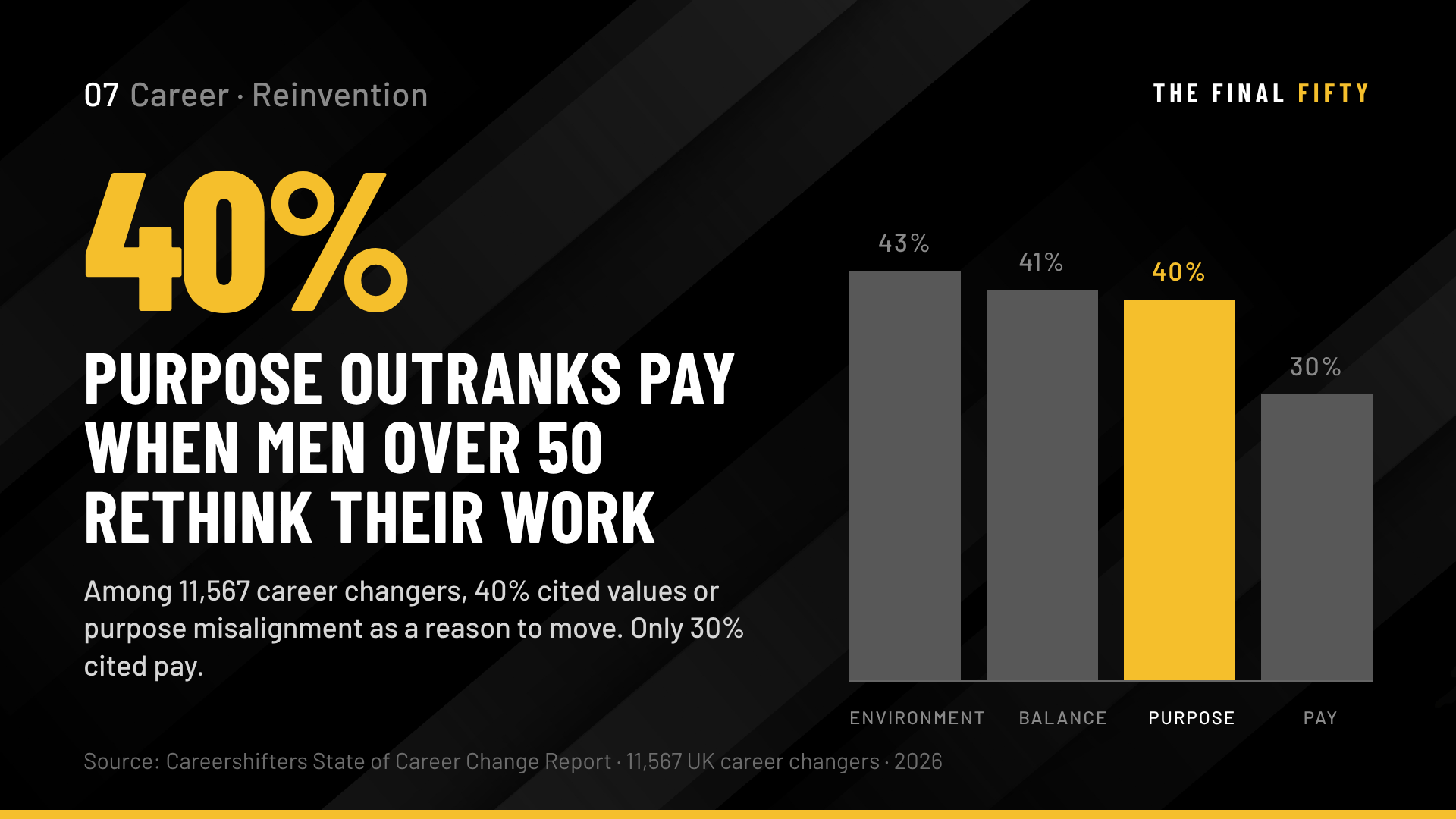
The three leading motivations for career change among adults in 2026 are unsupportive or unhealthy work environments at 43 percent, poor work-life balance or wellbeing at 41 percent, and values or purpose misalignment at 40 percent. Pay remains important but ranks lower at 30 percent, a finding that consistently surprises people who assume financial dissatisfaction is the primary driver of midlife change. For men over fifty, the values and purpose misalignment driver is increasingly central, not because financial concerns have disappeared but because the second half of life has a different relationship with meaning than the first half did.
The diagnostic question that separates burnout from misalignment is specific: if the conditions of the work were substantially improved, if the environment were better, the workload more manageable, the recognition more appropriate, the work-life balance more supportive, would the work itself feel meaningful enough to continue? If the honest answer is yes, the issue is burnout and the resolution is recovery and condition change. If the honest answer is no, something more fundamental has shifted, and the resolution requires a different kind of examination.
The Sunk Cost Problem: Why Men Stay When They Should Go
The sunk cost fallacy is the cognitive bias whereby individuals give undue weight to past investments, resulting in continued commitment even when the future benefits are diminished. In career terms, this produces the man who stays in a professional context that is no longer serving him not because staying is the rational choice but because leaving feels like admitting that the years already invested were wasted.
The unfortunate truth of the sunk cost fallacy is that it becomes a reinforcing cycle. The more time a man commits to something, the more loss he will feel walking away and making a new decision. The longer he has been in the role, the larger the identity investment, and the larger the identity investment, the more threatening the prospect of leaving becomes. The work becomes who he is rather than what he does, and questioning the work becomes indistinguishable from questioning himself.
Research on age and sunk cost decisions offers an interesting finding: older adults are less susceptible to the sunk cost fallacy than younger adults. This cognitive advantage of age, the ability to separate past investments from future decisions with greater clarity, is one of the genuinely useful features of the second-half mindset. The man over fifty who has done the identity work described elsewhere in this content library, who has separated his sense of self from the specific roles and titles that have defined his professional life, is in a better position than a younger man to evaluate whether the current direction serves his future rather than simply protecting his investment in his past.
The practical test for sunk cost reasoning is also specific: is the primary argument for staying the future value of what will be created, or is it the past cost of what would be abandoned? The man who is primarily arguing from what he would lose by leaving rather than what he would gain by staying is likely in the grip of sunk cost reasoning rather than genuinely strategic thinking. These are not the same argument. Only one of them is a valid basis for a professional decision.
The Environmental Trap: Confusing a Bad Environment for a Wrong Direction
The mirror problem to the sunk cost trap is equally damaging: leaving a direction that is fundamentally right because the current environment is wrong, and mistaking the environmental mismatch for evidence of fundamental misalignment.
There are three fundamentally different reasons people want to change careers, and they require different responses. Environmental mismatch is when the field is right but the specific environment, the company, the culture, the management, or the structure is wrong. Many people pursue a pivot when what they need is a better environment in the same field, at considerable cost. The first question is: have you tried the best version of your current environment?
If you’ve felt disengaged for over a year despite efforts to re-engage, it may be a sign you’ve stayed too long. That threshold, roughly a year of consistent effort to re-engage without genuine improvement, is one of the more practically useful diagnostic markers available. The man who has genuinely attempted to improve the conditions of his current professional situation and who has experienced one year or more of sustained disengagement despite those efforts is likely past the point where the environment is the primary variable.
But the man who has not tested the best version of his domain, who is responding to one company or one role or one set of circumstances as if they represent the full range of what his profession or industry has to offer, is at risk of abandoning a direction that fits him well for reasons that could be addressed with a less dramatic intervention.
Begin by identifying what feels misaligned: the tasks, the company culture, or the larger career path. Explore opportunities for growth inside your current role, but if misalignment persists, start planning for a career shift. The sequence matters. The environmental exploration comes before the reinvention decision, not after it.
The Identity Question at the Center of the Decision
This is the question that most men avoid most skillfully, because it requires a level of honest self-examination that the professional habits of the first half rarely support: what have I become, and is what I am doing an expression of that person or a performance of someone I used to be?
By midlife, a man has accumulated something invaluable: self-knowledge. He has seen what works for him and what does not. His values have been tested by real experience, not just theory. The values, interests, and sense of purpose that organized the first half of his professional life were built on a foundation of who he was at twenty-five or thirty-five. The person who has emerged from twenty-five years of living, learning, succeeding, failing, and understanding himself more deeply is not necessarily best served by the same professional direction that served the earlier version.
This is not dissatisfaction or restlessness. It is the natural consequence of human development. A 2025 qualitative study of 27 adults aged 41 to 55 who had undergone significant career transitions found that participants described growth in self-awareness, resilience, and empowerment as consistent outcomes of midlife career change. Midlife transitions involve more than occupational change. They encompass shifts in identity, values, and life orientation. The men and women navigating this well are not running away from something. They are running toward something they have finally identified clearly enough to pursue.
Harvard Business School professor Herminia Ibarra describes career reinvention not as a sudden decision but as a process of experimenting with new professional identities over time. Her research shows that successful career changers do not figure out who they want to be and then act on it. They act their way into new ways of thinking. Trying small experiments, taking on side projects, building new networks, and accumulating evidence about what feels right are the mechanics of authentic reinvention, and they take time.
This insight is important for men over fifty who are feeling the pull toward reinvention but who are waiting for clarity before acting. The clarity does not arrive before the experimentation. It arrives through it. The man who insists on knowing exactly what the new direction looks like before he begins exploring is using certainty as a reason not to start. Certainty is the outcome of the exploration process, not its prerequisite.
The Test That Distinguishes the Two Decisions
The reinvention-versus-recommitment decision is ultimately not answerable through introspection alone. It requires both honest self-examination and external reality-testing against the specific conditions that each decision produces.
The recommitment decision is right when the current direction is fundamentally aligned with who a man is and what he wants to contribute, when the disengagement is primarily driven by conditions that are addressable, and when a recovered and reinvigorated version of engagement with the current domain is genuinely imaginable. The three in four career changers who have been thinking about changing careers for a year or more before acting are often people who needed that deliberation time not because the reinvention was right but because they needed to test whether the recommitment was possible first.
The reinvention decision is right when the values and purpose misalignment is fundamental, when genuine effort to re-engage has not produced meaningful improvement over a sustained period, when the identity the man has built in the second half of his life is not well served by continuing in the current direction, and when the forward-looking case for reinvention is stronger than the backward-looking case for protection of past investment. Encore careers consistently show higher levels of job satisfaction than the careers they follow, because the decision to enter them is made with the kind of self-knowledge that only experience produces.
Neither decision is right by default. Both require honest examination of the specific evidence available rather than the comfort of a general cultural story about whether staying or going is the more admirable or courageous choice. Men who reinvent when they should have recommitted lose the accumulated capital of direction and expertise unnecessarily. Men who recommit when they should have reinvented invest more years in a direction that was already calling for change. Both errors are expensive. The distinguishing examination is the work that prevents them.
THE FINAL 50 FRAMEWORK
THE REFRAME
The reinvent-versus-recommit question is not primarily a question about courage or risk tolerance. It is a diagnostic question about what is driving the professional dissatisfaction, and it has two very different answers that require two very different responses. Burnout calls for recovery and condition change. Misalignment calls for reinvention. Getting these two things confused, in either direction, is one of the most expensive professional mistakes available in the second half. The honest examination that distinguishes them is the most important professional decision work a man over fifty can do.
THE STANDARD
The Final 50 man does not allow professional dissatisfaction to accumulate into a crisis that forces the decision under pressure. He examines his professional situation with honesty and regularity, distinguishing the conditions of his work from the direction of his work, testing the best version of his current environment before concluding that the direction itself needs to change, and recognizing the sunk cost reasoning that keeps men in situations longer than the forward-looking case supports. When the evidence points clearly to reinvention, he pursues it deliberately and early rather than late and desperately. When the evidence points to recommitment, he commits fully rather than half-heartedly while keeping an eye on the exit.
THE PRACTICE
This week, answer three questions with specific, honest responses rather than general impressions. First: is your primary dissatisfaction with the conditions of your current work, or with the direction of your current work? Name the difference specifically. Second: if the conditions were substantially improved, would the work itself feel meaningful enough to continue? Third: have you genuinely tested the best version of your domain, or are you evaluating the domain based on its worst current expression? The answers to those three questions do not make the decision for you. They make the decision possible to make honestly.
THE AUDIT
What is the actual argument you are making for staying in your current professional direction? Is it primarily forward-looking, about what the work will produce and why it aligns with who you are now, or is it primarily backward-looking, about what the years already invested mean and what leaving would imply about them? The honestly backward-looking argument is sunk cost reasoning. It is not a valid basis for a forward-looking decision. If the forward-looking case is strong on its own merits, stay and commit fully. If it requires the backward-looking case to be compelling, the signal is worth examining.
THE PROMPT
The men in your brotherhood are each somewhere in the reinvent-versus-recommit question, even if they have not named it as such. The man who is most visibly successful may be the one most privately questioning whether the direction is still right. The man who appears most settled may be the one who has answered the question most deliberately. What would it look like to have the conversation directly inside the brotherhood, not as crisis disclosure but as serious strategic discussion between men who are all navigating the second half professionally? That conversation, held honestly and without performance, produces the kind of clarity that the internal version of the same conversation rarely reaches.