
Men over fifty fall into one of two camps when it comes to cardiovascular training. The first group skips it almost entirely, prioritizing the strength work that produces visible results and treating cardio as the category they will get back to when the schedule opens up. The second group does cardio consistently but at the wrong intensity for the wrong reasons, accumulating hours on the treadmill or the elliptical at a moderate pace that feels like effort but produces neither the performance gains nor the longevity adaptations the investment should be generating.
Both camps are leaving the most important return on cardiovascular training on the table, and for the same reason: they do not have a clear picture of what cardiovascular training is actually supposed to do for a man over fifty, which specific physiological adaptations it is supposed to produce, and which training approaches produce those adaptations most efficiently.
The answer is not complicated once the target is clear. The target is VO2 max: the maximum rate at which a man’s body can consume and use oxygen during intense effort. It is not simply a measure of how hard he can breathe or how long he can run. It is the integrated measure of how efficiently the entire oxygen delivery and utilization system operates, from the heart’s pumping capacity to the mitochondrial density in muscle tissue that converts oxygen into energy. And it is, by the most comprehensive research available, the single strongest predictor of longevity that fitness science has identified.
A landmark study of over 122,000 patients at the Cleveland Clinic found that cardiorespiratory fitness was inversely associated with mortality with no upper limit to the benefit. The people in the highest fitness categories had the lowest risk of death from any cause, by a margin larger than any other lifestyle intervention studied. Each one milliliter per kilogram per minute increase in VO2 max has been associated with approximately 45 additional days of life expectancy across a 46-year follow-up study. This is not a marginal benefit. It is the most powerful single fitness variable available to a man who wants to extend not just his lifespan but the quality and capability of the years that lifespan contains.
VO2 max declines by approximately 10 percent per decade after age 30 without specific training to prevent it. By fifty, the unaddressed decline is significant. The cardiovascular training that most men over fifty are doing, or not doing, is not reversing that decline. The training described in this article is.
What VO2 Max Actually Predicts and Why It Matters
Understanding VO2 max as the target changes how a man evaluates whether his cardiovascular training is working. It is not a measure of how much he sweats, how tired he feels, or how many calories a tracker attributes to the session. It is a measure of the actual adaptive state of the cardiovascular and metabolic system, and it responds specifically to training that challenges it at or near its upper limits.
VO2 max reflects the functional status of nearly every major physiological system simultaneously: the heart’s pumping capacity, the lungs’ gas exchange efficiency, the blood’s oxygen-carrying capacity, the capillary density that delivers oxygenated blood to muscle tissue, and the mitochondrial capacity within muscle cells that converts oxygen into usable energy. A high VO2 max means the entire system is working efficiently. A low VO2 max means the system has capacity deficits that compound over time into the cardiovascular vulnerability that defines aging in men who do not specifically address it.
Highly trained men aged 60 to 70 have been shown to have more than 100 percent more mitochondria than age-matched untrained men, with significantly better mitochondrial function. The mitochondrial difference between active and sedentary men of the same age is not a minor performance variable. It is a fundamental difference in cellular energy production that affects every system in the body and that separates men who remain genuinely functional and high-performing across the second half from men who manage a progressively diminishing physical capacity.
Lifelong exercisers and master athletes display lean mass, minimal body fat, and physical and metabolic function similar to that of individuals 30 years younger. This is not genetic outlier data. It is the documented result of maintaining cardiovascular training specifically across the adult lifespan. The ceiling on what is achievable is far higher than the cultural narrative about aging would suggest, and the floor on what is required to protect the trajectory is higher than most men’s current training addresses.
Zone 2: The Foundation That Most Men Are Missing
The cardiovascular training approach that most effectively builds the aerobic base and supports VO2 max development has two components that work together. The first is Zone 2 training: sustained aerobic effort at approximately 60 to 70 percent of maximum heart rate, the intensity at which conversation remains possible and the body sustains effort primarily through fat oxidation.
Zone 2 feels almost too easy. That feeling is precisely why most men skip it or push through it without spending enough time in it. The discomfort that signals productive effort in strength training is absent. A man maintaining Zone 2 intensity on a bike or a brisk walk could hold a conversation without losing his breath. It does not feel like the intensity that produces adaptation.
The physiology tells a different story. Zone 2 training at sufficient volume is the primary stimulus for mitochondrial biogenesis, the creation of new mitochondria in muscle cells that underlies the metabolic capacity improvements associated with cardiovascular fitness. It is the primary stimulus for capillary development, the growth of new blood vessels that improve oxygen and nutrient delivery to muscle tissue. These are foundational adaptations that drive long-term cardiovascular health and longevity, and they are produced most efficiently by the training intensity most men avoid because it does not feel hard enough.
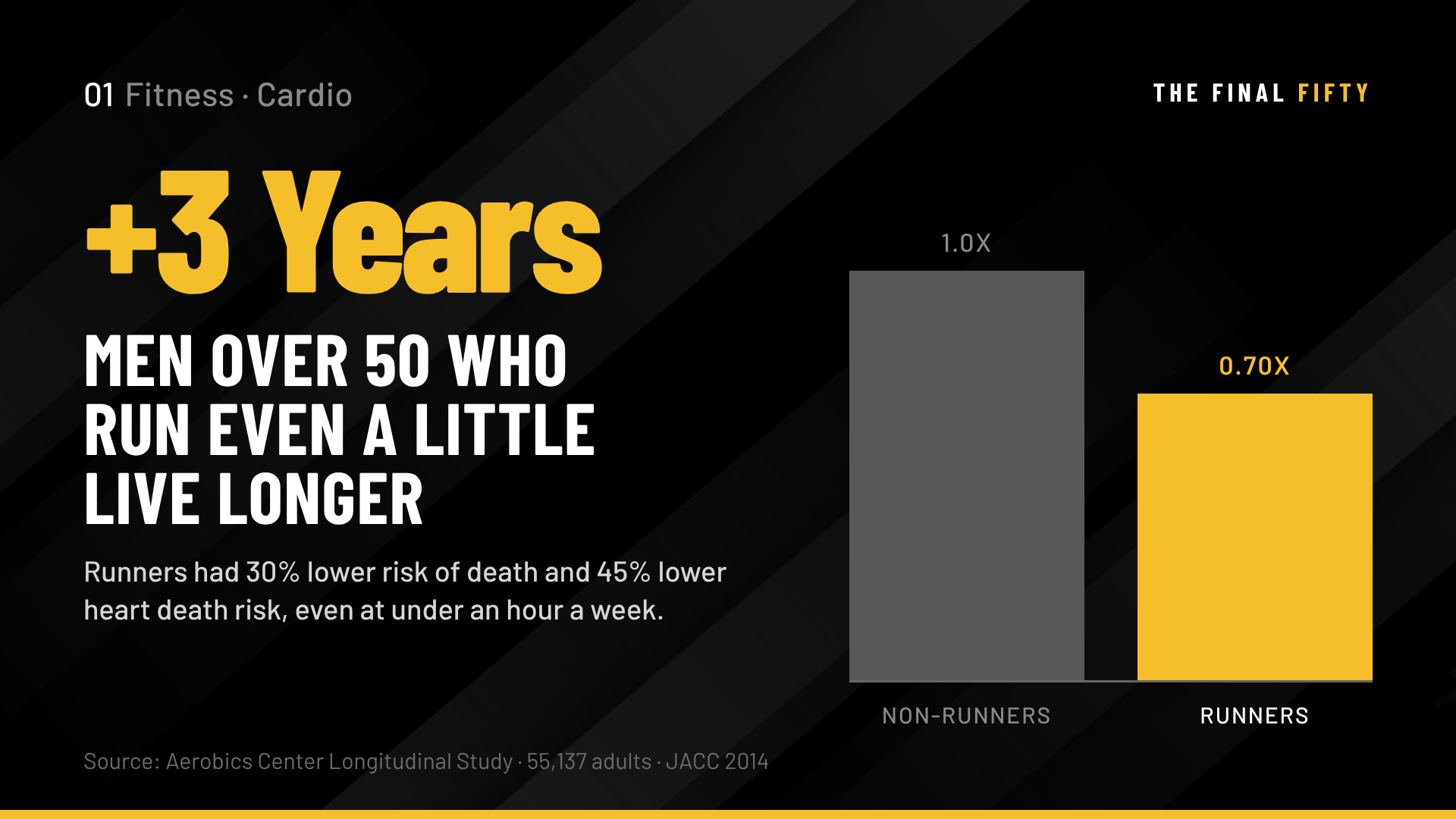
Meeting the minimum of approximately 150 minutes per week of moderate-intensity aerobic activity is associated with meaningful reductions in mortality risk and estimated gains of three to four years in life expectancy. For men specifically targeting cardiovascular development and VO2 max improvement, 180 to 200 minutes per week of Zone 2 training distributed across three to four sessions produces the mitochondrial and capillary adaptations that form the aerobic base. The modality matters less than the zone and the consistency: cycling, swimming, rowing, incline walking, any sustained aerobic effort at conversational intensity for 40 to 60 minutes per session.
High-Intensity Work: The Ceiling Raiser
Zone 2 builds the base. High-intensity interval work is what actually raises the VO2 max ceiling. Steady-state moderate cardio maintains what a man has. Intervals push the cardiovascular system to its actual maximum capacity and force the adaptation that moves the number.
The research on HIIT in older men is specific and compelling. In a study of previously sedentary men with an average age of 62, high-intensity interval training produced a 17 percent increase in total testosterone and a 4.5 percent increase in free testosterone alongside the cardiovascular adaptations. The same protocol produced significant increases in VO2 max that substantially exceeded the gains from equivalent time spent at moderate intensity. In an eight-week study, subjects training with high-intensity interval protocols improved VO2 max by 12.3 percent, versus 6.9 percent in a group doing five 30-minute moderate-intensity sessions per week. Nearly double the cardiovascular gain in roughly 90 percent less time.
The interval protocol that produces this response without excessive recovery cost for men over fifty is straightforward: three minutes of hard effort at or near maximum capacity, followed by three minutes of active recovery at easy pace, repeated three to five times per session, one to two sessions per week. This is not an elaborate protocol. It is under 30 minutes including warm-up and cool-down. It produces the VO2 max stimulus that longer moderate sessions do not, and it fits within the weekly training structure without compromising the resistance training sessions that remain the primary physical investment.
The testosterone findings are particularly relevant for the hormonal health context established elsewhere in this series. The same training that raises VO2 max and builds cardiovascular fitness simultaneously supports the hormonal environment through the acute testosterone response and the improved testosterone-to-cortisol ratio that high-intensity work produces compared to sustained moderate-intensity cardio.
What This Looks Like in a Training Week
The cardiovascular training that serves men over fifty most comprehensively integrates with the resistance training described in the strength sections of this series rather than competing with it. The two modalities address complementary physiological needs and can be structured within the same weekly schedule without either undermining the other when recovery is managed intelligently.
Three to four Zone 2 sessions per week at 40 to 60 minutes each provide the aerobic base volume. One to two high-intensity interval sessions in the complementary windows push the VO2 max ceiling. At least 24 hours of separation between a heavy resistance session and a high-intensity interval session protects the recovery systems that both draw on. Zone 2 sessions can be performed on the same day as resistance training without significant interference when placed after the strength work rather than before it.
The modality should be the one a man will do consistently, at the correct zone, with the correct volume. Cycling is the most joint-friendly option for men managing lower-body wear from decades of activity. Swimming adds upper-body cardiovascular stimulus with zero impact. Rowing engages both upper and lower body aerobically. Incline walking achieves Zone 2 heart rates for men whose walking pace on flat ground does not elevate effort sufficiently. The equipment and the location are secondary to the zone and the consistency.
The Reversal Evidence That Changes the Frame
The most important finding for men over fifty who are not currently training their cardiovascular system at the levels the research supports is what happens when they begin.
A University of Texas Southwestern Medical School study reviewed the health of five men at age 20 and again at age 50. At fifty, their overall health had declined significantly. After their second review, each man committed to a six-month exercise program that gradually increased activity levels. The results were striking: six months of training returned their cardiovascular capacity to levels comparable to their initial assessment at twenty. Three decades of cardiovascular decline were substantially reversed in six months of consistent, progressive training.
It is never too late to begin. Even older adults see dramatic improvements in body composition and metabolic health with structured cardiovascular exercise. The man who starts at fifty-three and trains consistently for six months is not playing catch-up with men who have been training since thirty. He is rebuilding the cardiovascular foundation that the decades without training allowed to decline, and the biology responds to the training stimulus regardless of when that stimulus arrives.
For men who have been primarily focused on resistance training and who have not included structured cardiovascular work in their program, the addition of Zone 2 and high-intensity interval training is the addition of the single most powerful longevity tool available in the fitness research. Everything in this platform is built on the assumption that a man who starts building now can influence his trajectory across the next several decades. Cardiovascular training is the variable that most directly determines the quality and the length of the trajectory itself. It is not optional for the man who is serious about what the second half can be.
Do the Zone 2 work. Do the intervals. Measure the VO2 max through the wearable or the structured test. Watch the number move. That number is not a fitness metric. It is the most direct available measure of how long and how well this man intends to live.
THE FINAL 50 FRAMEWORK
THE REFRAME
Cardiovascular training is not the category that gets addressed when the strength work is covered and the schedule permits. It is the training variable whose primary measure, VO2 max, is the single strongest predictor of longevity in the fitness research. A man who trains his cardiovascular system with the same intention he brings to strength work is not adding a supplementary health investment. He is protecting the physiological foundation that determines how long he lives and how capable those years are. The skipped cardio session is not a minor scheduling decision. It is a compounding withdrawal from the most important fitness account available.
THE STANDARD
The Final 50 man includes structured cardiovascular training in his weekly program without exception. He accumulates a minimum of 150 minutes per week of Zone 2 aerobic work at conversational intensity, the pace that builds the mitochondrial and capillary foundation of cardiovascular health. He includes one to two Zone 5 interval sessions per week using the three-minute hard, three-minute recovery protocol repeated three to five times. He knows his estimated VO2 max and tracks it as a primary health and performance metric, not a secondary fitness curiosity.
THE PRACTICE
This week, add one Zone 2 session of 40 minutes at conversational pace to your existing training. Not the intensity where talking becomes difficult. The intensity where you could hold a full sentence comfortably for the entire 40 minutes. Do it three times this week on non-consecutive days. Use whatever modality produces the least joint friction. Track how your resting heart rate responds over the following days and notice how the cardiovascular sessions affect your recovery from resistance training. That is the aerobic base beginning to develop. Hold it and build from there.
THE AUDIT
Do you know your estimated VO2 max? Most wearable fitness trackers now calculate it from heart rate data during exercise. If you have not looked at that number, look at it this week and compare it to the age-referenced norms for men in your age range. If your number places you below average for your age, you have identified the single most impactful fitness target available for your longevity trajectory. If it places you above average, you have a baseline to protect and build. Either way, the number is the data. Manage from it.
THE PROMPT
The men in your brotherhood are each somewhere on the cardiovascular fitness spectrum, and most of them have never discussed VO2 max as the longevity variable the research identifies it as. Who in your circle has genuinely invested in their cardiovascular fitness in a structured way, with a specific zone-based approach and measurable results? What protocol are they running and what has it produced? That conversation, specific about what is working and what the numbers actually show, changes how every man in the brotherhood thinks about the cardio work he has been treating as optional.


