
The annual physical that most men over fifty are getting is not the annual physical they should be getting. This is not primarily a criticism of the healthcare system, though the system has genuine limitations. It is a description of a structural mismatch between what a reactive, symptom-oriented medical visit is designed to detect and what a man over fifty who is serious about his long-term health and performance needs from an annual health assessment.
The standard physical visit, even when completed annually rather than skipped, tends to produce a basic vital signs check, a limited blood panel that tells a man his cholesterol and blood sugar are or are not in the normal range, a brief conversation about lifestyle factors that rarely changes anything, and a clean bill of health that most men leave feeling reassured by without having actually been assessed for the most significant health risks of the second half.
The man who leaves his annual physical knowing his total cholesterol and his blood pressure and nothing else has not had a comprehensive health assessment. He has had a minimum threshold check that tells him whether he is obviously in trouble right now. What it does not tell him is whether he is building toward cardiovascular disease through markers the standard panel does not measure, whether his hormonal profile reflects the kind of slow decline that accumulates invisibly across years, or whether the specific cancer screening protocols that apply to a man of his age and history have been completed.
The annual physical is an opportunity. Most men do not use it as one. This article describes what using it as one looks like.
Why the Standard Physical Falls Short
The standard annual physical was not designed for the level of health optimization and disease prevention that men over fifty who are serious about the second half require. It was designed to catch active problems in people who arrive with symptoms or obvious risk factors. It performs that function reasonably well. It was not designed to provide the comprehensive biological picture that allows a man to make genuinely informed decisions about his health trajectory.
Half of all heart attack victims have normal cholesterol. That single fact is the most important argument for why the standard lipid panel is insufficient as a cardiovascular health assessment for men over fifty. The standard panel measures total cholesterol, LDL, HDL, and triglycerides. It does not measure apolipoprotein B, the particle count that more accurately predicts cardiovascular risk than LDL cholesterol. It does not measure lipoprotein(a), an inherited risk factor present in approximately 20 percent of the population that dramatically elevates cardiovascular risk regardless of standard cholesterol numbers. It does not measure high-sensitivity CRP, the inflammatory marker that is one of the most powerful independent predictors of cardiovascular disease available in blood testing.
The man whose standard lipid panel looks acceptable may be walking around with an apolipoprotein B count that reflects significant cardiovascular risk, an elevated Lp(a) that his genes have been building toward regardless of lifestyle, and a high-sensitivity CRP that his inflammatory load has been elevating for years. None of these appear in the standard panel. None of them are typically ordered unless the patient asks, or unless the physician is unusually thorough, or unless the man has already had a cardiovascular event that makes the additional testing clearly indicated.
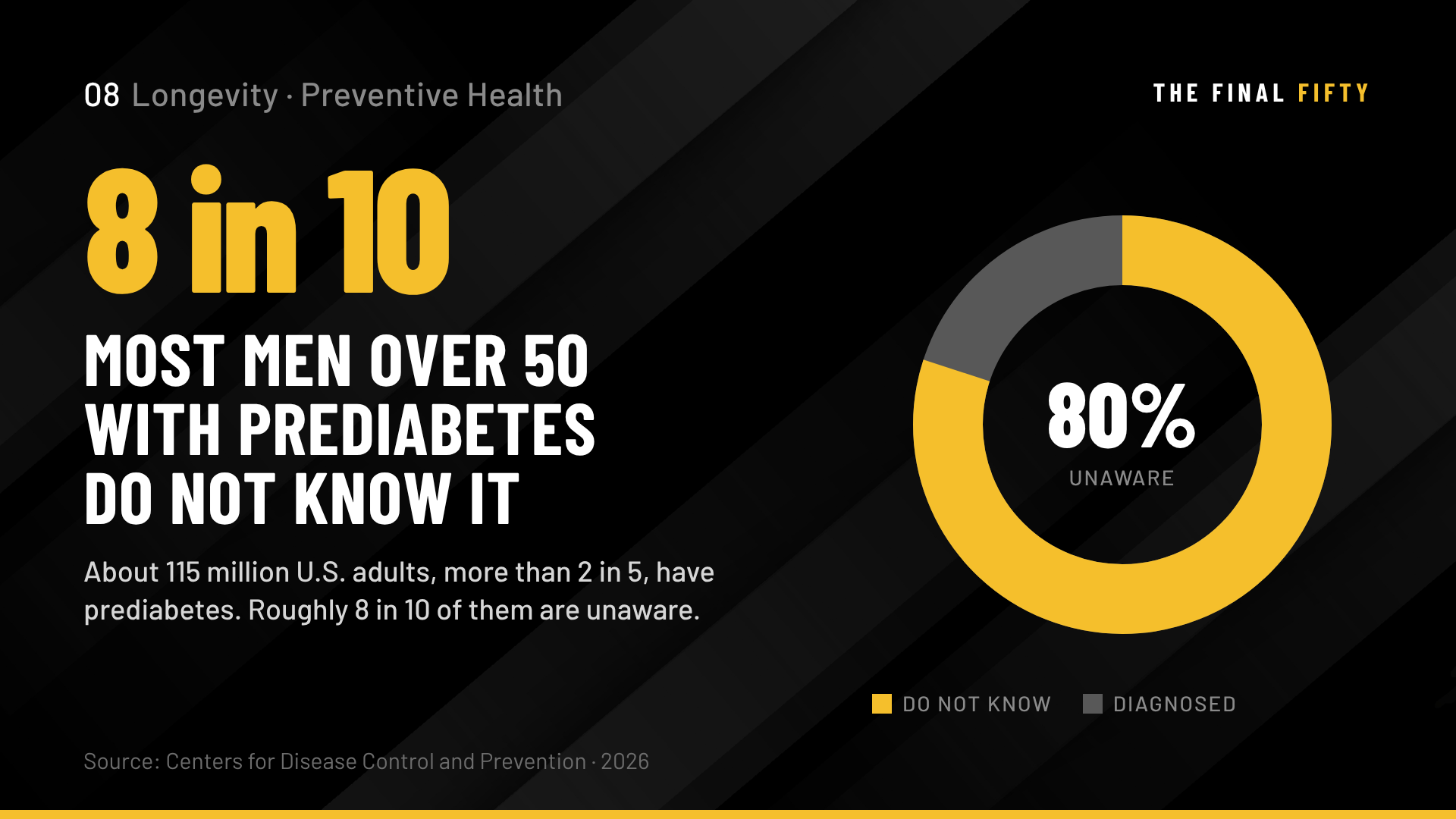
Over 80 percent of Americans with prediabetes are unaware of their condition, missing crucial opportunities for prevention. The standard physical often includes a fasting glucose measurement. It does not always include HbA1c, the three-month average blood sugar measure that identifies pre-diabetic trajectories that a single fasting glucose can miss. The man who is building toward insulin resistance and type 2 diabetes through the slow metabolic changes of the second half may have a fasting glucose that looks acceptable and an HbA1c that tells a different story.
These are not exotic or expensive additions to the standard assessment. They are widely available, covered by most insurance plans, and clinically relevant enough that physicians who practice preventive and functional medicine include them routinely. They are simply not included in the baseline physical because the baseline physical was not designed with optimized prevention in mind.
The Blood Panel That Actually Covers What Matters
The comprehensive blood panel for a man over fifty who is managing his health proactively includes several categories that the standard physical either omits entirely or addresses inadequately.
The cardiovascular risk panel that the research supports for men over fifty goes beyond the standard lipid panel to include high-sensitivity CRP as a measure of systemic inflammation and cardiovascular risk, homocysteine as a marker of methylation status and a risk factor for arterial damage, apolipoprotein B as the more accurate predictor of cardiovascular risk than LDL cholesterol, and lipoprotein(a) at least once as a genetic risk factor that lifestyle cannot change but that demands aggressive management of other cardiovascular risk factors when elevated. The 2023 American Heart Association and American College of Cardiology guidelines emphasize aggressive cholesterol management with LDL targets at or below 70 milligrams per deciliter for high-risk individuals, a target that cannot be set appropriately without knowing the full cardiovascular risk picture these advanced markers provide.
The metabolic panel that reflects a man’s actual metabolic health includes fasting glucose and HbA1c together, not either alone. It includes fasting insulin, which reveals insulin resistance before glucose dysregulation is evident in glucose or HbA1c measurements. It includes a comprehensive metabolic panel that covers kidney and liver function, because the liver carries the chemical processing burden of a high-output life and responds to dietary quality, alcohol consumption, and metabolic stress in ways that fasting glucose and cholesterol do not capture.
The hormonal panel for men over fifty extends beyond what most primary care physicians order by default. Total testosterone is the number most physicians check when hormonal status is discussed. It is not the number that tells the most complete story. Free testosterone is the biologically active fraction that the tissues can use, and SHBG, sex hormone-binding globulin, is the protein that determines how much of the total testosterone is available versus bound and inactive. The complete hormonal assessment includes total testosterone, free testosterone, SHBG, estradiol, and at a minimum, DHEA-S, all of which shift in ways that affect energy, muscle maintenance, cognitive function, and mood in ways the total testosterone number alone cannot describe. Testosterone doesn’t just affect libido. It drives muscle mass, bone density, mood, motivation, and metabolic health. Free testosterone often declines first, signaling early hormonal imbalance before the total number falls outside the normal range.
Thyroid function is another area where the standard test, TSH alone, is a partial picture at best. TSH is a signal from the brain to the thyroid, not a direct measure of thyroid hormone levels. A complete thyroid assessment includes TSH, free T4, and free T3, which measure the actual circulating thyroid hormones rather than only the brain’s request for more of them. Thyroid hormones regulate energy, metabolism, and mood. Changes in thyroid function become more common with age, but the symptoms may resemble everyday fatigue. Without the complete panel, subclinical thyroid dysfunction can be missed entirely.
Vitamin D status deserves specific mention because deficiency is pervasive in men over fifty and has documented relationships with testosterone production, immune function, bone density, cardiovascular health, and mood. The standard physical does not always include a vitamin D measurement, and many men who are supplementing are not hitting the blood level that corresponds to the benefits the research documents. The 25-hydroxyvitamin D test is straightforward, inexpensive, and provides direct guidance for supplementation dosing that cannot be reliably estimated without the measurement.
The Screening Calendar That Actually Applies to Men Over 50
Beyond the blood panel, the annual physical is the moment to confirm that the cancer screening and other preventive protocols relevant to a man over fifty are current. This is the administrative function of the annual physical that most men either use well or fail to use at all, and failing to use it means that screenings that should be on a schedule are instead happening whenever a crisis or a conversation finally forces them into the calendar.
Colorectal cancer screening should begin at age 45 for average-risk adults, with colonoscopy every ten years as the gold standard option. The annual physical is the moment to confirm that the colonoscopy schedule is current and to address any family history or symptoms that would indicate more frequent screening. Men with a family history of colorectal cancer should be screened ten years before the age at which their youngest affected family member was diagnosed. This is not a piece of information that will arrive unsolicited. It requires the man to know his family history and to bring it to the conversation.
Prostate cancer screening remains a conversation rather than a standardized protocol, but it is a conversation that belongs at the annual physical for every man over fifty. The PSA test’s sensitivity and specificity limitations are well documented, and the appropriate response to those limitations is an informed discussion with a physician rather than avoidance of the conversation. Men at average risk should be discussing PSA testing at fifty. Men with a family history of prostate cancer or who are of African American descent should have that conversation at forty-five or earlier. The decision about whether to test belongs to the man and his informed physician, not to the institutional reluctance that has made prostate health the most commonly under-discussed topic in men’s primary care.
Skin cancer screening with a dermatologist annually is not typically part of the standard primary care physical, and most primary care physicians are not conducting full-body skin examinations with the thoroughness that a dermatologist brings. Melanoma rates are rising in men over fifty, and the difference between stage one and stage four survival is the difference between a fifteen-minute examination finding something treatable and that same finding being made two years later when treatment options are dramatically more limited.
Hearing assessment every three years after fifty matters more than most men acknowledge. Research has established that untreated hearing loss is one of the most significant modifiable risk factors for cognitive decline and dementia. The man who is letting hearing loss accumulate because it feels manageable is not protecting his independence. He is building a risk factor for cognitive deterioration that is both preventable and addressable when caught early.
Shingles vaccination deserves specific mention because many men over fifty either have not had it or received the older less effective version. The Shingrix vaccine, a two-dose series, is significantly more effective than the previous single-dose Zostavax and is recommended for adults fifty and older regardless of whether they previously received the older vaccine. Shingles is not a minor inconvenience. It can produce significant pain, post-herpetic neuralgia that persists for months, and in some cases vision loss or neurological complications. The vaccine is the prevention tool. The annual physical is the moment to confirm it has been received.
How to Use the Physical as an Active Strategy
The annual physical produces the most value when the man arrives having prepared for it rather than arriving and receiving whatever the standard protocol provides. The preparation changes the visit from a passive ritual into an active health strategy session.
Arrive with a written list of the specific tests you want included beyond the standard panel. High-sensitivity CRP. Homocysteine. ApoB. Free testosterone and SHBG alongside total testosterone. Complete thyroid panel including free T3. Vitamin D. HbA1c alongside fasting glucose. Fasting insulin if metabolic health is a concern. These are not unusual requests. They are requests that most physicians will accommodate when they are made specifically rather than generally.
Arrive with your family health history documented as specifically as possible. Cardiovascular events and at what ages. Cancer history and types. Autoimmune conditions. This is the information that changes what screening protocols apply to you specifically versus what applies to an average-risk man of your age. The physician who does not know that your father had a heart attack at fifty-four cannot apply the family history risk modification that would change your cardiovascular screening approach. You have to bring the information.
Arrive with specific questions about any symptoms you have been managing or monitoring without professional evaluation. The fatigue that has been present for longer than you can explain. The sleep quality that has not recovered with the standard interventions. The body composition changes that your training and nutrition choices cannot fully account for. The annual physical is the moment to present these observations as data rather than waiting until they become acute enough to demand emergency attention.
The annual physical is not the ceiling of what healthcare has to offer a man over fifty who is serious about the second half. But it is the floor. The minimum annual data collection that allows a man to understand his biological trajectory rather than simply feeling his way through the decade without measurements. The man who uses it well, who arrives prepared and leaves with specific knowledge about his cardiovascular risk profile, his hormonal status, his metabolic health, and his cancer screening calendar, is managing his health as a system rather than responding to crises when they arrive.
That is the difference the annual physical is designed to make when a man treats it as the opportunity it is.
THE FINAL 50 FRAMEWORK
THE REFRAME
The annual physical is not a ritual that confirms you are fine. It is a data collection session that tells you what your biological trajectory looks like, what risks are building below the threshold of symptoms, and what the specific management decisions are that the data supports. A physical that produces only total cholesterol and blood pressure has not done this work. The man who arrives prepared and requests the expanded assessment is using the visit the way it was meant to be used.
THE STANDARD
The Final 50 man schedules an annual physical every year without exception. He arrives with a written list of additional tests to request beyond the standard panel: high-sensitivity CRP, ApoB, free testosterone, SHBG, complete thyroid panel, HbA1c, and vitamin D at minimum. He brings his family health history documented specifically. He has a primary care physician with whom he has an ongoing relationship, not a physician he sees for the first time at each visit. He leaves each physical knowing his numbers in these categories and what they mean for his trajectory.
THE PRACTICE
Before your next annual physical, spend thirty minutes documenting three things: the specific additional tests you want ordered beyond the standard panel, your family health history for cardiovascular disease and cancer with ages at diagnosis where known, and any symptoms or health observations from the past year that you have not brought to professional attention. Bring that document to the appointment. Use it as the agenda for the visit rather than accepting whatever the standard protocol provides. The preparation is what converts the physical from a passive ritual into an active health management session.
THE AUDIT
When was your last annual physical? Do you know your high-sensitivity CRP? Your ApoB? Your free testosterone and SHBG, not just your total testosterone? Your HbA1c? Your vitamin D level? If the honest answer to any of those questions is no, you are managing your health without data that is readily available and genuinely informative about your biological trajectory. The gap in knowledge is the gap in management. Schedule the physical. Request the full panel. Get the data.
THE PROMPT
The men in your brotherhood are each managing their health with varying degrees of information, and most of them have never had the conversation about what comprehensive preventive care for men over fifty looks like. Who in your circle has built a genuine annual health assessment practice, knows his numbers, and manages his health proactively rather than reactively? What would it look like to compare notes specifically, to share what each man is measuring and what he has learned from the data? That conversation, held with specificity, accelerates every man’s willingness to take his own assessment seriously.


