
There is a specific kind of workout that most men over fifty have never consistently done, that elite endurance athletes have built their aerobic foundations on for decades, and that the research on metabolic health, fat loss, and cardiovascular longevity increasingly identifies as the category of training most men are leaving out of their programs entirely. It does not feel hard. It does not produce the acute fatigue that signals productive effort to a man trained by decades of high-output professional life. It can feel almost embarrassingly easy relative to the effort a serious man expects training to require.
That is Zone 2 training, and the fact that it feels too easy is precisely the reason most men skip it and precisely the reason skipping it is costing them the specific cardiovascular and metabolic adaptations that the second half demands.
Zone 2 is the exercise intensity band at approximately 60 to 70 percent of maximum heart rate, the pace at which a man can hold a comfortable conversation without significant breathlessness. Heart rate is controlled, breathing is elevated but not labored, and the effort level could theoretically be sustained for hours. At this intensity, the body relies primarily on aerobic metabolism, drawing on stored fat as the dominant fuel source rather than the glycogen that higher intensities burn.
This intensity band has moved from the domain of endurance sports science into the broader longevity and performance conversation in recent years, and for good reason. The physiological benefits it produces at sufficient volume are distinct from what higher-intensity training generates, and for men over fifty managing their cardiovascular health, their metabolic function, and their body composition simultaneously, those benefits address the specific challenges the second half creates.
What Zone 2 Actually Does at the Cellular Level
The case for Zone 2 training is built primarily on what happens inside muscle cells during sustained low-intensity aerobic effort, and understanding the mechanism is what makes the investment in the slow, unglamorous work feel like the serious performance decision it is.
The primary cellular benefit of Zone 2 training is mitochondrial biogenesis: the creation of new mitochondria within muscle cells. Over weeks and months of consistent Zone 2 work, muscle cells increase their mitochondrial density, improving the capacity to oxidize fatty acids and produce energy aerobically. This mitochondrial biogenesis is activated through the PGC-1 alpha signaling pathway, the master regulator of mitochondrial production in muscle tissue, which Zone 2 stimulates through the sustained aerobic demand the intensity creates.
Twelve weeks of endurance training at three sessions per week of 45-minute duration increased VO2 max through improvements in mitochondrial function. Following twelve weeks of endurance exercise, skeletal muscle mitochondria developed better fatty acid oxidation and improved ADP sensitivity, alongside increased oxidative phosphorylation capacity that reflects overall improved intrinsic mitochondrial health.
Zone 2 also stimulates mitophagy, the cellular process that clears out old, malfunctioning mitochondria, replacing them with higher-quality versions that have greater capacity for both fat oxidation and glucose metabolism. The net effect is a muscle cell population that is more metabolically capable, more efficient at using fat as fuel, and more resilient to the metabolic dysfunction that age-related mitochondrial deterioration produces.
Capillary development is the second major Zone 2 adaptation and one that most training discussions underemphasize. Muscle capillary density is approximately 24 percent lower in older adults compared to younger adults, a reduction that correlates directly with reduced maximal oxygen consumption during exercise, impaired post-meal insulin sensitivity, and a blunted hypertrophic response to strength training. Zone 2 training at sufficient volume is one of the most effective stimuli for capillary neogenesis, the growth of new capillaries within muscle tissue, that directly addresses this age-related deficit. More capillaries mean better oxygen and nutrient delivery to muscle cells, better metabolic waste removal, and improved insulin-mediated glucose uptake that benefits body composition and metabolic health simultaneously.
The Fat Loss and Metabolic Health Case
Zone 2 training’s reputation as a fat-burning tool is accurate but requires context that the headline version of the claim does not always provide. The relationship between Zone 2 and fat metabolism operates through multiple mechanisms, and understanding the full picture helps a man use the tool correctly rather than expecting it to do work it was not designed to do.
At Zone 2 intensity, the body relies on fat oxidation as the primary fuel source to a greater degree than at any other exercise intensity. This is not because Zone 2 burns more total calories than higher intensities. It does not. It is because the percentage of calories drawn from fat is highest at moderate aerobic intensities, and because consistent Zone 2 training improves the body’s capacity to oxidize fat at all intensity levels over time. The trained man who has built his aerobic base through Zone 2 work burns more fat at rest, during exercise, and throughout the day than the untrained man with equivalent caloric intake because his metabolic machinery, specifically his mitochondrial density and capillary delivery systems, has been developed to support fat oxidation efficiently.
Zone 2 training encourages the body to rely more on fat oxidation, promoting insulin sensitivity and reducing the risk of insulin resistance and type 2 diabetes. Studies have shown that this form of training can improve blood sugar control and lipid profiles, contributing to heart health.
The insulin sensitivity benefit is where Zone 2 delivers its most significant metabolic return for men over fifty. Zone 2 training increases glucose transporter GLUT4 expression in muscle cells, the primary mechanism through which muscles take up glucose from the bloodstream in response to insulin. Increased GLUT4 expression means muscles become more responsive to insulin’s signal, requiring less insulin to clear the same glucose load from the blood. For men over fifty who are navigating the increased insulin resistance that aging, excess body fat, and reduced muscle mass tend to produce, this GLUT4 upregulation is a direct intervention against the metabolic trajectory that most commonly leads to pre-diabetes and metabolic syndrome.
Higher-quality mitochondria have greater capacity for fat oxidation and what researchers call metabolic flexibility: the ability to switch efficiently between burning carbohydrates and fat to create ATP. In people with insulin resistance, the mitochondria are less robust and less efficient at using glucose and fat. Zone 2 increases both the quality and number of mitochondria, improving metabolic flexibility in a way that benefits body composition, energy levels, and metabolic health simultaneously.
Zone 2 cardio, particularly in a fasted state, works directly against the age-related metabolic changes by addressing their root causes at the cellular level rather than simply creating a calorie deficit. After fifty, declining hormones, slowing metabolism, and growing insulin resistance all work against the strategies that produced results in earlier decades. Zone 2 addresses the biology driving those changes rather than working around it.
The Heart Health Dimension
The cardiovascular adaptations that Zone 2 training produces are structurally distinct from what resistance training or high-intensity interval training generates, and they address the specific dimensions of heart health that most concern men over fifty.
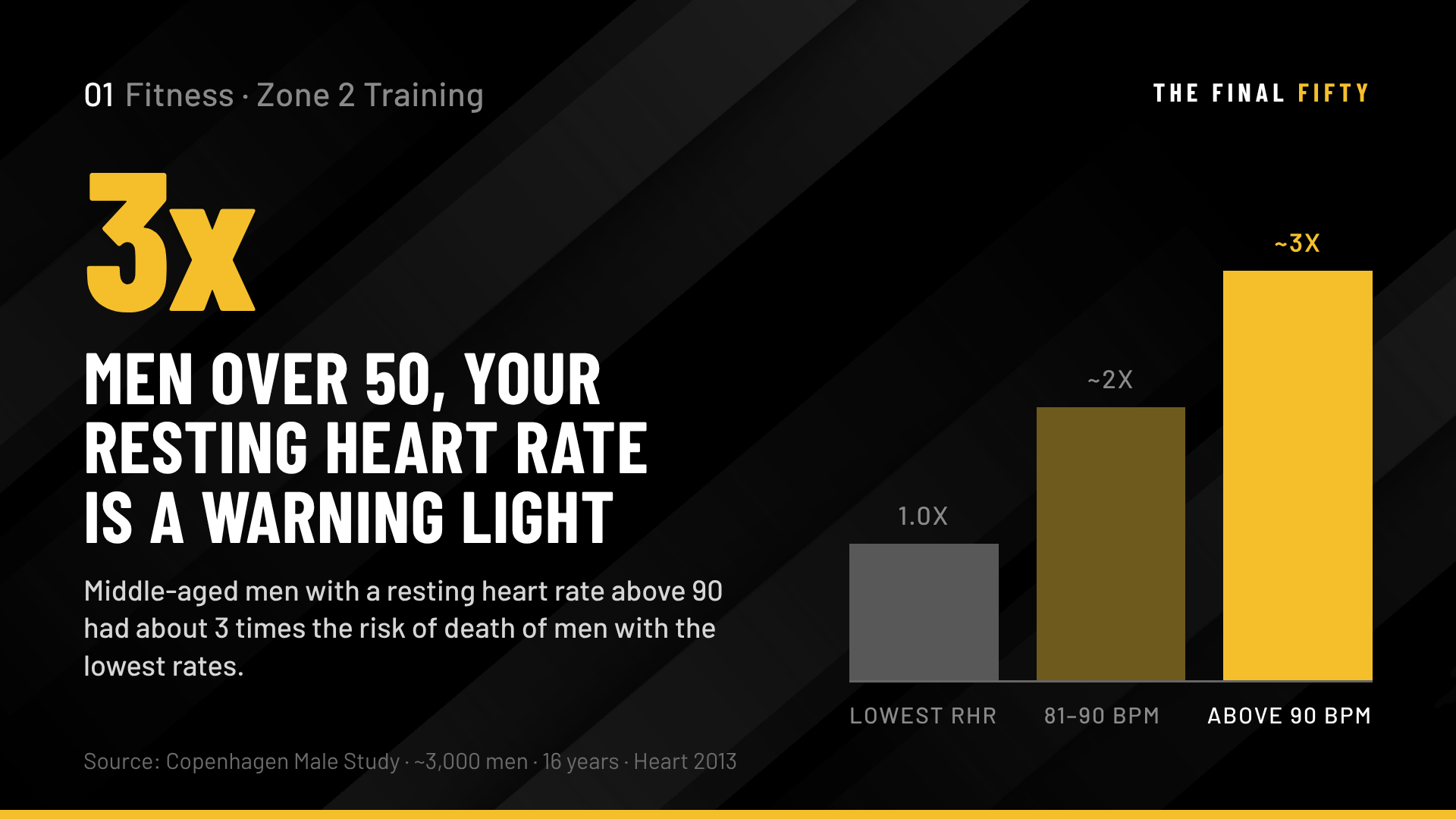
Consistent Zone 2 training strengthens the heart as a muscle, increasing stroke volume, the amount of blood pumped per heartbeat. A stronger, more efficient heart pumps more blood per beat at rest, reducing the number of beats required per minute and lowering resting heart rate. Resting heart rate typically drops by three to five beats per minute within eight to twelve weeks of consistent Zone 2 training. This reduction is not cosmetic. Resting heart rate is an independent predictor of cardiovascular mortality, and every reduction reflects improved cardiac efficiency that compounds across decades.
Zone 2 training also improves heart rate variability, the variation in time between heartbeats that reflects the balance between sympathetic and parasympathetic nervous system activity. Higher heart rate variability indicates a nervous system that can adapt fluidly to varying demands and that is not locked into the chronic sympathetic activation that chronic stress, poor sleep, and inadequate recovery produce. For men over fifty who are managing the HPA axis dysregulation that chronic stress drives, Zone 2 training’s parasympathetic-supportive effect is a direct contribution to the hormonal and nervous system balance the second half requires.
Blood pressure reduction is another consistent Zone 2 benefit, operating through improved arterial flexibility and endothelial function that resistance training alone does not fully address. The sustained low-intensity aerobic effort promotes nitric oxide production in the arterial endothelium, improving vascular tone and blood pressure regulation in ways that directly reduce the cardiovascular risk that hypertension drives in men over fifty.
An Honest Assessment of What Zone 2 Is and Is Not
The recent research on Zone 2 includes some important corrections to the most enthusiastic claims made on its behalf, and the man over fifty who wants to use this tool well deserves the honest version of the evidence rather than the marketing version.
A 2025 narrative review published in a peer-reviewed exercise science journal concluded that current evidence does not support Zone 2 training as uniquely optimal for mitochondrial capacity compared to higher intensities. When researchers compare equivalent volumes of Zone 2 and higher-intensity interval training, the intervals tend to produce larger or comparable mitochondrial responses in trained populations. The claim that Zone 2 is specifically superior to all other intensities for building mitochondria does not fully hold up under scrutiny of the mechanistic research.
What the same research does confirm is that Zone 2 is absolutely worth doing, particularly for men who are currently sedentary or undertrained. For individuals new to structured exercise, Zone 2 can jumpstart health and fitness improvements, promoting movement and supporting fat oxidation in a way that is accessible and sustainable. The benefits for this population are real and meaningful. Zone 2 is not uniquely superior to higher intensities for mitochondrial adaptation in already well-trained athletes, but that is not the population most men over fifty belong to when they begin.
The honest framework is this: Zone 2 is the aerobic foundation that makes everything else work better. It is not the only tool in the program, and it is not a replacement for the high-intensity intervals described in the previous article in this series. It is the base volume that supports cardiovascular health, metabolic flexibility, fat oxidation capacity, and recovery between more intense sessions. The man who does only Zone 2 is leaving adaptation potential on the table. The man who does only high-intensity work without a Zone 2 base is building a ceiling on an inadequate foundation. The combination of both, Zone 2 for base volume and high-intensity intervals for ceiling elevation, is the cardiovascular approach that the research most consistently supports.
How to Implement It
The practical application of Zone 2 is simpler than the physiological explanation suggests. The target is 60 to 70 percent of maximum heart rate. For most men over fifty, a rough maximum heart rate estimate is 220 minus age. For a 55-year-old, maximum heart rate is approximately 165, and Zone 2 sits between approximately 99 and 115 beats per minute. A more practical real-time guide is the talk test: Zone 2 intensity is the pace at which a man can speak in complete sentences without needing to pause for breath. Not comfortable conversation, but sustained speech without losing breath.
Mitochondrial density increases are measurable within four to six weeks of consistent Zone 2 training. Resting heart rate typically drops by three to five beats per minute within eight to twelve weeks. Fat oxidation improvements become noticeable within six to eight weeks. VO2 max improvements from Zone 2 specifically take eight to sixteen weeks of consistent training. These timelines are slower than the acute fatigue that strength training produces at each session, which is why Zone 2 requires the same discipline of consistency that makes compound strength training effective: the adaptations accumulate beneath the surface long before they feel like they are happening.
Three sessions per week at 40 to 60 minutes per session provides the volume at which the research documents the metabolic and cardiovascular benefits. The modality is secondary to the zone and the consistency. Cycling is typically the most joint-friendly option for men managing lower-body joint load from decades of training and daily wear. Brisk walking at 3.5 to 4.0 miles per hour achieves Zone 2 heart rates for many men over fifty and requires no equipment. Rowing, swimming, and elliptical work all produce the Zone 2 stimulus with varying joint demands. Choose the modality that produces the least barrier to showing up on the required days.
The ego management required to train at Zone 2 intensity is the primary obstacle most men encounter. The pace feels too slow. A man who has trained at high intensity for years will find Zone 2 sessions feel inadequate relative to the effort he associates with productive training. That feeling is the signal that he is doing it correctly. Slowing down to hold the zone, dropping the incline, reducing the resistance, these are not concessions. They are the disciplined application of a tool to the specific zone in which it produces the physiological adaptations it is intended to produce.
Train slow to build the base that supports everything fast. That is Zone 2 in a sentence. For men over fifty who have never built it, it is the most underused training investment available in the second half.
THE FINAL 50 FRAMEWORK
THE REFRAME
Zone 2 training is not the easy workout for men who cannot handle real training. It is the aerobic foundation that makes real training possible to sustain across decades. The mitochondrial density, the capillary development, the insulin sensitivity improvement, the resting heart rate reduction, and the fat oxidation capacity that Zone 2 builds at sufficient volume are the physiological infrastructure that every other training investment depends on. The man who skips Zone 2 because it does not feel hard enough is skipping the work that determines the quality of everything else.
THE STANDARD
The Final 50 man includes a minimum of three Zone 2 sessions per week at 40 to 60 minutes each as a non-negotiable component of his training week. He knows his Zone 2 heart rate range and trains within it, not above it. He uses the talk test as his real-time guide: complete sentences without losing breath. He tracks his resting heart rate across weeks as the most accessible marker of the cardiovascular adaptation the sessions are producing. And he combines the Zone 2 base with the high-intensity interval work described in the previous article, understanding that the two are complementary tools addressing different but equally necessary adaptations.
THE PRACTICE
This week, complete three Zone 2 sessions. Before beginning the first session, calculate your Zone 2 heart rate range: 220 minus your age gives your approximate maximum heart rate. Multiply by 0.60 and 0.70 to get your Zone 2 floor and ceiling. Set up whatever heart rate monitoring you have, wearable, chest strap, or manual pulse check, and start the session. If your heart rate climbs above the ceiling, slow down or reduce the intensity until it comes back into range. Hold it there for the full session. It will feel too slow. Do it anyway.
THE AUDIT
What is your resting heart rate right now? Check it tomorrow morning before getting out of bed. If you do not know it, you have been managing your cardiovascular health without one of the simplest and most informative data points available. A resting heart rate consistently above 70 beats per minute in a man who exercises regularly suggests insufficient aerobic base volume. Below 60 reflects good cardiovascular efficiency. Track it weekly over the coming months of Zone 2 training and watch what consistent aerobic base work does to the number.
THE PROMPT
The men in your brotherhood are each managing their cardiovascular training with varying degrees of intentionality about zone and volume, and most of them have never discussed whether they are spending time in the aerobic base intensity range that builds the metabolic and cardiovascular adaptations Zone 2 produces. Who in your circle has Zone 2 training built into his weekly program? What modality is he using and what has consistent Zone 2 work produced in his resting heart rate, his body composition, and his energy over time? That conversation, grounded in what the training is producing, is worth having.


