
There is a specific way that most men over fifty who are training seriously think about their progress. They track the training. They evaluate the sessions. They assess whether they are lifting more, moving better, performing at a higher level than the previous week. The variable they are almost universally not tracking with equivalent seriousness is the variable that determines whether any of the training produces the adaptation they are training to produce.
Recovery is not the rest between the hard work. It is the process through which the hard work becomes adaptation. The training session is the stimulus. It does not build muscle, improve cardiovascular function, or develop strength. It creates the conditions that trigger the biological processes that build muscle, improve cardiovascular function, and develop strength. Those processes happen during recovery. Without adequate recovery, the stimulus accumulates without producing adaptation. The man keeps training and keeps getting the signal that effort is being applied. The body stops responding, because the response requires a resource the man is not providing.
For men in their twenties and early thirties, the recovery system is robust enough to absorb moderate deficits without significant consequence. The hormonal environment is favorable, the satellite cell activity is high, the inflammatory resolution is efficient, and the biological grace of youth provides a buffer that younger men have not earned and do not need to think about. That buffer disappears in the second half of life. And the man who is training in his fifties the same way he trained at thirty-five, with the same frequency, the same volume, the same assumption that harder and more frequent is always better, is building against the most important variable he is not managing.
What Actually Changes About Recovery After 50
The recovery changes that accumulate after fifty are not a single shift. They are a cluster of biological changes that operate across multiple systems simultaneously, each one extending the time required for the body to complete the repair and adaptation cycle that training initiates.
Muscle protein synthesis, the process through which training-damaged muscle tissue is rebuilt stronger than before, becomes less efficient with age. The adequacy of recovery is impaired in older age, with recovery being delayed or attenuated following an acute exercise challenge. Older muscle tissue shows greater exercise-induced damage following identical training sessions, a slower initial repair response, and a more prolonged inflammatory resolution phase. The same deadlift session at the same relative intensity that a thirty-year-old recovers from in 24 to 48 hours takes a fifty-five-year-old 48 to 72 hours to recover from. That is not a minor scheduling adjustment. It is a fundamental change in how the training week must be structured if the training is going to produce adaptation rather than accumulate damage.
Satellite cells are the muscle stem cells that activate in response to exercise-induced damage, proliferate, differentiate, and fuse with existing muscle fibers to repair and add contractile protein. Young muscle tissue maintains a high density of satellite cells and strong signaling pathways for their activation. This biological advantage translates directly into faster, more complete recovery from training sessions. After fifty, satellite cell density and signaling efficiency are reduced, the repair process begins more slowly, and the window in which training can be safely repeated before the previous session’s damage is resolved is longer than most men over fifty are currently allowing.
Growth hormone and testosterone, the primary anabolic hormones that drive the recovery process, both decline across the second half of life. Both are released in pulses during deep sleep and decline as deep sleep quality degrades with age. Both directly fuel muscle protein synthesis and satellite cell function. Lower levels mean slower repair. The man over fifty who is already navigating the age-related reduction in these hormones and who is additionally failing to protect the sleep that allows their overnight release is compounding the recovery deficit from both directions simultaneously.
Inflammaging, the chronic low-grade systemic inflammation documented throughout this series, produces an environment in which the body struggles to distinguish the acute exercise-induced damage that needs rapid repair from the background inflammatory noise it is continuously processing. The repair signal gets muted. The recovery process that in a younger, lower-inflammatory environment would proceed with clarity and efficiency is competing with a compromised system, and the competition extends the timeline and reduces the quality of adaptation produced.
The Cost of Getting This Wrong
The consequences of inadequate recovery for men over fifty are not the same as the consequences for younger men. A twenty-eight-year-old who under recovers for a week feels fatigued and performs sub-optimally. His biological margins absorb the deficit without significant structural consequence. A fifty-five-year-old who has been under recovering for months is not experiencing a performance dip. He is accumulating damage, suppressing the very hormonal environment that training is supposed to support, and building toward the injury or the persistent overtraining state that requires weeks of reduced training to address.
Overtraining syndrome in older adults produces a specific symptom cluster that is worth naming because it is commonly misinterpreted as a need to train harder rather than a need to recover more. Persistent fatigue that does not resolve with a normal night’s sleep. Weights that feel heavier than they should at the same absolute load. Workouts that feel harder than they should at the same intensity. Sleep disturbances, including difficulty falling asleep or staying asleep, which indicate an overtaxed nervous system still under stress from training. Elevated resting heart rate in the morning, which reflects the body’s ongoing resource allocation to unresolved recovery demands. Lingering muscle soreness beyond 72 hours that signals the repair cycle has not completed before the next training session has begun.
These are not signs of insufficient training motivation. They are biological signals that the recovery system is behind the stimulus being applied to it. The man who responds to these signals by pushing harder is not demonstrating commitment. He is accelerating the accumulation of damage that the signals are warning him about.
Masters runners who maintain four to five structured days with adequate recovery between hard sessions outperform those doing six to seven mediocre days on every fitness measure. The frequency reduction is not a concession. It is the structural adjustment that allows the stimulus applied on the active days to produce adaptation rather than merely accumulate as load on a system that has not completed its previous recovery cycle.
What the Recovery Window Actually Looks Like After 50
The practical recovery requirement for men over fifty is specific enough to inform training program structure directly. After a challenging strength workout targeting large muscle groups, men in their fifties need 48 to 72 hours before training those same muscles hard again, compared to shorter recovery windows for younger adults. Recovery in the sixties and beyond can extend to four to seven days depending on workout intensity.
A well-designed study confirmed that advanced strength exercisers, both young and old, required more than two days of recovery time to maximize their training response. Following a relatively hard strength training session on Monday, muscle strength was well below baseline on Tuesday, slightly below baseline on Wednesday, significantly above baseline on Thursday, and the same amount over baseline on Friday. Full recovery and optimized response required 72 hours, not 48.
The central nervous system recovery requirement is equally important and less frequently discussed. The nervous system manages force output, coordination, and pace regulation. When it is taxed hard, it needs 48 to 72 hours to fully recover in older men. Back-to-back hard training days impair CNS recovery more than they slow protein synthesis, which is why session spacing matters as much as session quality. A man who performs a heavy compound training session Monday and a high-intensity interval session Tuesday has not provided his central nervous system adequate recovery between high-demand sessions, regardless of whether the muscle groups targeted were different.
For the man over fifty who has been training five or six days per week at meaningful intensity, the adjustment to three or four sessions with 48 to 72 hours between sessions targeting the same muscle groups does not represent a reduction in the training investment. It represents the restructuring of the training investment so that the sessions he is performing produce the adaptation he is training to produce, rather than accumulating as stimulus on a system that never fully completes its recovery cycle.
The Tools That Accelerate Recovery
Recovery is not exclusively a passive process. The inputs that support it beyond adequate session spacing are specific enough to be structured into the training program as deliberately as the training sessions themselves.
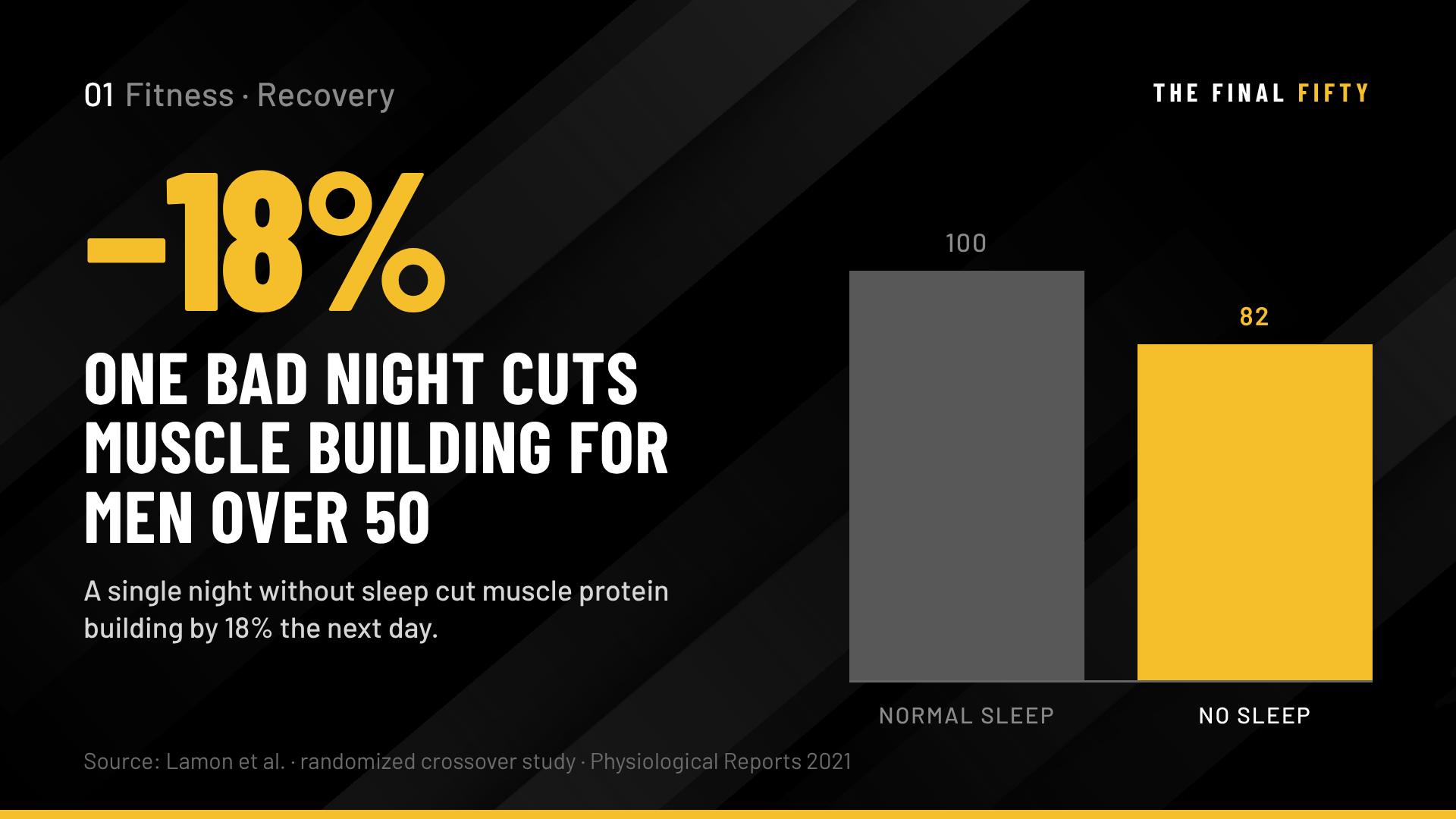
Sleep is the most potent and most frequently underinvested recovery tool available. Growth hormone and testosterone release peak during deep sleep. The overnight anabolic environment that sleep produces is the primary biological mechanism through which training-induced muscle protein synthesis is completed. Sleep deprivation of one week has been shown to reduce testosterone levels by 10 to 15 percent in young men. For men over fifty who are already managing the age-related reduction in these hormones, the additional suppression from inadequate sleep is not a minor variable. It is the difference between training that produces meaningful hormonal support and training that competes with the hormonal environment it depends on.
Protein timing across the recovery window is the nutritional variable with the most direct relationship to recovery quality. Dietary protein ingested immediately after exercise increases muscle protein synthesis rates during the acute stages of post-exercise recovery. A substantial meal containing 35 to 40 grams of high-quality protein within the two-hour post-training window, combined with carbohydrate to replenish muscle glycogen and blunt the cortisol elevation that sustained post-training cortisol produces, provides the raw material for the repair process that the training session initiated. Pre-sleep casein protein provides an additional anti-catabolic input across the overnight fast, when the absence of dietary amino acids would otherwise allow muscle protein breakdown to outpace synthesis during the long recovery window.
Active recovery sessions, low-intensity movement at Zone 2 heart rates on the days between hard training sessions, enhance blood flow to recovering muscle tissue, accelerate inflammatory resolution, and maintain the aerobic base described earlier in this series without adding meaningful additional recovery demand. The recovery day that consists of complete inactivity is not the optimal approach for most men over fifty. The recovery day that consists of 30 to 40 minutes of walking, cycling, or other low-intensity movement delivers the circulation and mild inflammatory resolution that passive rest does not, while the intensity is insufficient to add to the recovery debt.
Cold water immersion at 11 to 15 degrees Celsius for 11 to 15 minutes represents the most evidence-supported acute recovery tool beyond sleep, nutrition, and active recovery, particularly for managing delayed onset muscle soreness and the inflammatory markers associated with intense training. The 2025 network meta-analysis identifying this specific protocol as optimal for reducing muscle soreness and creatine kinase markers provides the practical specification that separates evidence-based application from general cold exposure practice.
The Mindset Shift That Makes Recovery Work
The training mindset that built serious first-half results was built around effort, volume, and frequency. Push harder. Do more. Add the session. The discomfort is the signal that productive work is being done. These inputs, in a younger man’s biological context, produced the results they were supposed to produce because the recovery system was robust enough to complete its work between the sessions.
In the second half, the same mindset applied without adjustment produces the one outcome it was never designed to produce: accumulated damage without adaptation. The man who trains hard and recovers adequately gets stronger. The man who trains hard without adequate recovery accumulates damage. Over months, those two men diverge in ways that become increasingly difficult to reverse, because the overtraining state that the second man builds toward takes longer to recover from than the first man’s well-structured program would have required in the first place.
The mindset shift is not from hard to easy. It is from more to deliberate. The deliberate training program for a man over fifty trains hard on the sessions that are scheduled, with the intensity and volume that the compound movements and performance objectives require, and then provides the 48 to 72 hours of recovery the biology demands before the next hard session. The training weeks that look less busy from the outside are producing more adaptation than the training weeks that look busier, because the adaptation is completing before the next stimulus arrives.
Recovery is not what happens when you are not training. It is the most important part of what training is. For men over fifty, getting that right is the most underrated performance variable available, and the one whose payoff compounds most directly across every other investment in the second half program.
THE FINAL 50 FRAMEWORK
THE REFRAME
Recovery is not time off from training. It is the process through which training becomes adaptation. The training session provides the stimulus. Recovery provides the response. Without adequate recovery, the stimulus accumulates without producing the adaptation the man is training to produce. After fifty, the recovery window for a challenging strength session extends to 48 to 72 hours. The training program that does not account for this window is not building a high-performing second half. It is accumulating damage at the expense of the adaptation it is supposed to be generating.
THE STANDARD
The Final 50 man structures his training week around the 48 to 72 hour recovery requirement, not around the maximum sessions he can fit into seven days. Three to four hard training sessions per week, with adequate spacing between sessions targeting the same muscle groups or demanding the same CNS resources. Sleep protected as the primary hormonal recovery environment. Post-training nutrition delivered within two hours. Active recovery movement on recovery days rather than complete inactivity. Resting heart rate and training performance tracked as primary recovery status indicators. When performance is declining at the same absolute load, he adds recovery rather than adding sessions.
THE PRACTICE
This week, check your resting heart rate every morning before getting out of bed. Write it down for seven consecutive days. If your resting heart rate is elevated on a training day compared to your baseline, treat that session as a recovery day rather than a hard session regardless of what the program calls for. One week of honest resting heart rate tracking tells a man more about his actual recovery status than any training log. The number does not lie about whether the system has completed its recovery cycle. The man who learns to read it accurately has a recovery management tool that is available every morning before he has done anything else.
THE AUDIT
How many days per week are you currently training at meaningful intensity? How many hours are separating sessions that target the same muscle groups or demand equivalent CNS resources? If the honest answer is that you are training five or six days with 24-hour or less separation between hard sessions, you have identified why your performance may have plateaued despite consistent effort. The audit question is not whether you are working hard enough. It is whether the work you are doing is completing its adaptation cycle before the next work session begins.
THE PROMPT
The men in your brotherhood are each navigating the recovery question in the second half with varying degrees of intention, and most of them have never discussed recovery as a primary performance variable rather than as the absence of training. Who in your circle has restructured his training around the recovery requirement and seen the adaptation improve rather than plateau? What did the adjustment look like and what did it produce? That conversation, specific about what the recovery investment requires and what it returns, is one of the most practically valuable ones available in the brotherhood.


