Knowing the protein target is the first problem. Hitting it every day is the second problem, and for most men over fifty it is the harder one. The daily target of 1.6 to 2.0 grams of protein per kilogram of bodyweight is not the kind of number a man casually reaches without building a deliberate food structure around it. For a 200-pound man, that target sits between 145 and 182 grams per day, every day, not just on training days, not just when the meal plan is going well, but on travel days and busy days and days when appetite is lower and the easiest path is whatever is closest and fastest.
The answer to the second problem begins with the first: the protein sources a man builds his diet around determine how naturally and sustainably the daily target is hit. Some sources are efficient, delivering high protein in concentrated form with the specific amino acid profile that aging muscle responds to. Others are adequate in general nutritional terms but inefficient as protein delivery vehicles for the specific biological demands of a man over fifty operating against anabolic resistance. Understanding the difference between the two, and building a food library around the efficient sources, is what converts a theoretical daily protein target into a practical daily habit.
Why Source Quality Matters as Much as Quantity
The previous article in this series established that total daily protein matters and that per-meal dosing matters. The third variable in the protein equation is quality, and it is the one that most general nutrition advice treats as secondary. For men over fifty, it is not secondary. It is the variable that determines whether the protein being consumed is triggering the muscle protein synthesis response the body needs or passing through the system at a fraction of its potential anabolic value.
Protein quality for the purposes of muscle building in older men is determined by three factors: leucine density, which is the leucine content per gram of protein consumed; digestibility, which is how efficiently the protein is broken down and absorbed; and amino acid completeness, which is whether the protein source delivers all nine essential amino acids in proportions the body can use without supplementation from other sources.
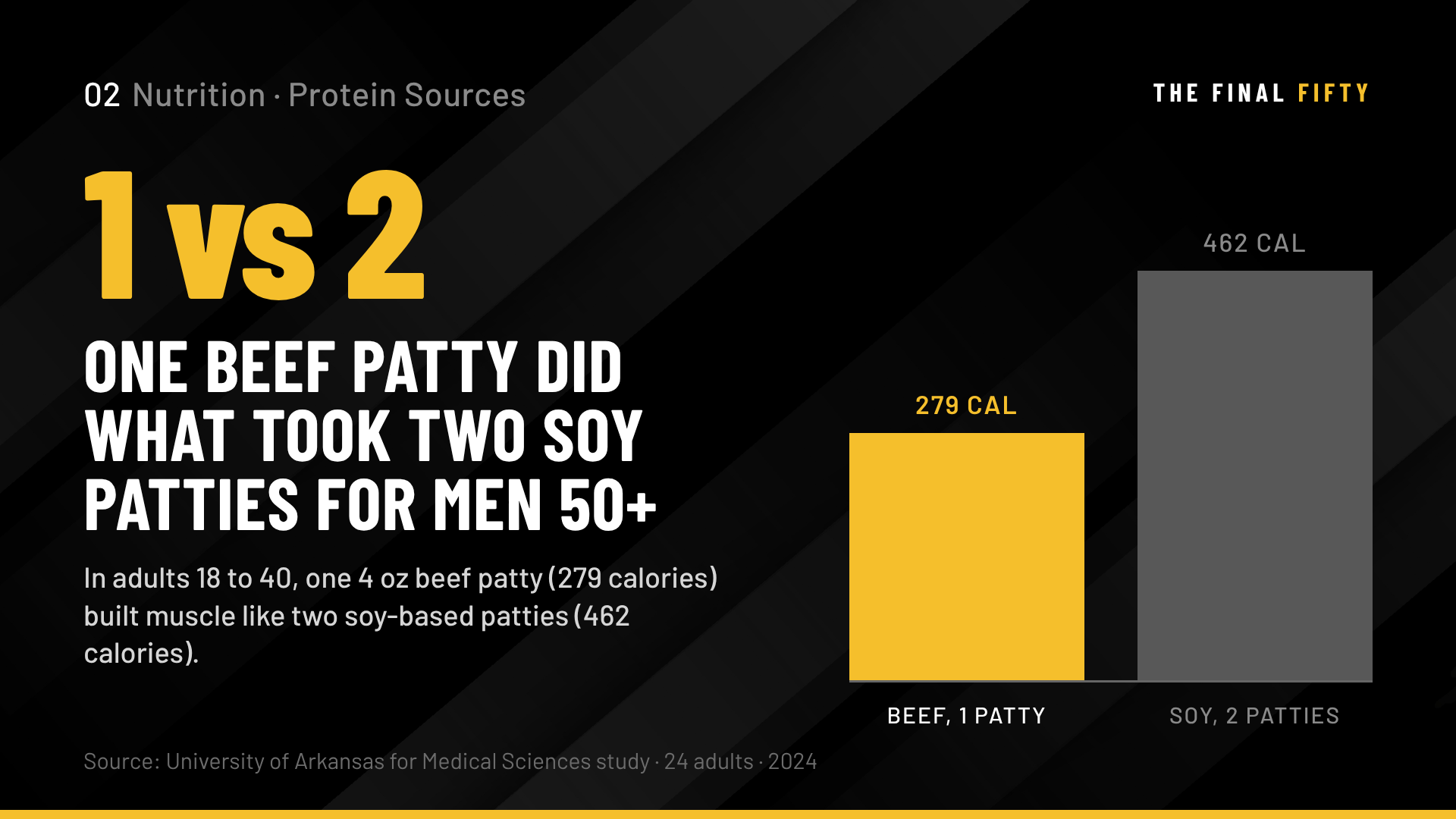
Animal proteins lead on all three measures. A 2024 study found that a four-ounce beef patty containing 27 grams of protein stimulated muscle protein synthesis similarly to an eight-ounce soy-based patty containing 41 grams of protein, despite containing significantly less total protein. The researchers credited this to a greater and more rapid availability of essential amino acids in the blood following beef consumption. Researchers speculate that animal protein is also a more potent stimulator of muscle protein synthesis due to its higher concentration of leucine, which triggers a more robust increase in muscle protein synthesis following protein intake.
Fifty-one calories of beef produced the same anabolic signal as 462 calories of plant-based protein. That is not a marginal efficiency advantage. It is a fundamental difference in how the two protein sources interact with the aging muscle protein synthesis machinery. The man over fifty who builds his protein intake around animal sources is not making a philosophical choice about diet. He is optimizing the biological efficiency of every gram of protein he consumes.
The Tier One Sources: Maximum Leucine, Maximum Efficiency
The protein sources that best serve men over fifty are the ones that reliably clear the leucine threshold of 2.5 to 3 grams per meal at practical serving sizes, that are absorbed efficiently without interference from anti-nutritional factors, and that provide the complete essential amino acid profile that muscle protein synthesis requires at each feeding.
Whey protein represents the highest-quality protein source available in supplemental form. Whey contains the highest concentration of leucine among protein powders, at approximately 10 to 11 grams of leucine per 100 grams of protein. A standard 25-gram serving of whey protein isolate delivers approximately 2.5 to 2.7 grams of leucine, reliably clearing the threshold at a relatively small dose. Whey is also rapidly absorbed, producing a sharp spike in blood leucine levels within 60 to 90 minutes of consumption that is uniquely effective in the post-training window when the muscle protein synthesis response to training stimulus is most active. For men who find hitting their daily protein target through whole foods alone challenging, a single serving of whey protein at one or two points in the day closes the gap efficiently and at minimal caloric cost. A 25-gram serving of high-quality whey isolate delivers approximately 100 calories alongside the protein, making it the most calorically efficient protein delivery tool available.
Chicken breast is the whole-food workhorse of this list. At approximately 31 grams of protein per 100 grams cooked, with leucine content of around 2.5 grams per 100 grams, a 150-gram serving of chicken breast delivers roughly 47 grams of protein and 3.75 grams of leucine, clearing the threshold with significant margin. Chicken breast has an exceptional protein-to-calorie ratio, producing approximately 165 calories per 100 grams cooked, and its neutral flavor profile makes it adaptable to virtually any seasoning or cuisine context. Batch cooking chicken breast on a weekly basis eliminates the preparation barrier that most commonly disrupts daily protein consistency. Three to four hours of Sunday cooking produces enough protein foundation for five to six days of reliable high-protein meals.
Beef and ground beef deliver dense protein alongside the specific co-nutrients, zinc, creatine, iron, and B12, that support both muscle function and broader health objectives for men over fifty. Lean ground beef at 85 to 90 percent lean provides approximately 26 grams of protein per 100 grams with leucine content of around 2.3 grams per 100 grams. A 200-gram serving, approximately 7 ounces, delivers 52 grams of protein and an estimated 4.6 grams of leucine. Grass-fed beef, as established in the anti-inflammatory nutrition article in this series, provides a superior omega-6 to omega-3 ratio compared to grain-fed and significantly higher concentrations of conjugated linoleic acid. The nutritional difference between grass-fed and grain-fed beef is not marginal for a man optimizing his diet. It is the difference between a food that actively supports his inflammatory status and one that is neutral at best.
Eggs represent one of the highest-quality protein sources available by any measure. Egg protein is recognized as the gold standard for lean protein and has the highest attainable protein digestibility score. Eggs provide all essential amino acids, along with omega-3 fatty acids, zinc, selenium, and vitamins A, D, and E. A whole egg delivers approximately 6 grams of protein and 0.6 grams of leucine, meaning that six eggs produce 36 grams of protein and 3.6 grams of leucine, reliably clearing the threshold while providing the full nutrient package the egg delivers beyond its protein content. Pasture-raised eggs provide a meaningfully superior nutritional profile, with higher omega-3 content, higher vitamins A, D, and E, and higher antioxidant levels compared to conventional eggs. For men who eat eggs daily, sourcing matters.
Fatty fish, particularly salmon, sardines, and mackerel, serve dual function in the diet of a man over fifty. They are dense protein sources, with salmon delivering approximately 25 grams of protein per 100 grams, and they are simultaneously the most powerful dietary tool available for omega-3 intake, systemic inflammation reduction, and cardiovascular health. Wild-caught salmon eaten twice or more per week addresses both the protein target and the anti-inflammatory nutrition standard simultaneously. Canned salmon and sardines provide the same nutritional profile at a fraction of the cost, with sardines particularly notable for their protein density, calcium content from edible bones, and convenience as a ready-to-eat protein source requiring no preparation.
Greek yogurt and cottage cheese occupy a specific and valuable role in the daily protein structure: slow-release casein protein that provides sustained amino acid availability across the hours between meals and particularly through the overnight fasting window. Greek yogurt delivers approximately 10 grams of protein per 100 grams, and full-fat versions provide the fat-soluble vitamins that low-fat versions sacrifice. Cottage cheese delivers approximately 11 to 12 grams of protein per 100 grams. A 200-gram serving of cottage cheese before bed provides 22 to 24 grams of casein protein that releases slowly over five to seven hours, providing anti-catabolic protection during the overnight window when the absence of dietary protein would otherwise allow muscle protein breakdown to outpace synthesis. Greek yogurt also contributes the probiotic bacteria that support gut health, making it valuable beyond its protein content.
Organ meats, particularly liver, deserve specific inclusion in any serious protein strategy for men over fifty. Beef liver delivers approximately 20 grams of protein per 100 grams alongside the most nutrient-dense micronutrient profile of any commonly available food: vitamin A, vitamin D, zinc, copper, B12, folate, and iron in concentrations that no other food source matches. A man who includes liver once or twice per week is not just adding protein. He is delivering the specific micronutrients that support testosterone production, immune function, and energy metabolism simultaneously. The cultural reluctance around organ meats is a recent historical phenomenon. The nutritional case for including them is among the strongest available in the animal-based diet.
Building the Daily Structure That Hits the Target
The daily protein target for a man over fifty is not hit by eating more protein at dinner. It is hit by building a food structure across the day that delivers 35 to 45 grams of high-quality animal protein at each of three to four meals, clearing the leucine threshold at each feeding and accumulating a daily total that reaches 1.6 to 2.0 grams per kilogram of bodyweight.
The breakfast problem is where most men’s daily protein structure collapses. Conventional breakfast culture in the United States is built around carbohydrate-dominant foods, cereal, toast, pastries, fruit, that provide minimal protein and produce none of the leucine signal that muscle protein synthesis requires. A man who eats breakfast and consumes fewer than 35 grams of protein at that meal has started the day with an eight to ten-hour window without meaningful anabolic stimulus, assuming he trained the previous evening. Breakfast built around eggs provides the most accessible high-protein option. Six to eight whole eggs scrambled or prepared any other way, with or without additional ingredients, delivers 36 to 48 grams of protein and the full nutrient package eggs provide. Adding a scoop of whey or a serving of cottage cheese alongside eggs pushes the breakfast total above 50 grams and firmly clears the leucine threshold with margin.
The lunch and dinner structure is more flexible because the cultural habit of protein-centered meals at these times already exists for most men. A palm-sized portion of any meat, poultry, or fish at approximately 150 to 200 grams cooked weight delivers 37 to 50 grams of protein depending on the source, clearing the leucine threshold at that meal. The key is portion accuracy. Most men significantly underestimate serving sizes when eating from memory rather than measurement, particularly in the early weeks of a protein-focused eating approach. A kitchen scale used for two to four weeks calibrates the eye in a way that makes subsequent estimation far more accurate.
The protein timing insight from the leucine research is worth reinforcing here: muscle protein synthesis is triggered per meal, not per day. Consuming 160 grams of protein in two large meals produces a different anabolic outcome than consuming the same 160 grams distributed across four meals of 40 grams each, because each 40-gram meal clears the leucine threshold separately and produces a discrete anabolic response. The man who eats a 20-gram protein breakfast, a 30-gram protein lunch, and a 110-gram protein dinner has reached his daily total through a structure that triggers the anabolic switch once at most rather than four times. The distribution matters as much as the total.
Whey protein as a between-meal option or post-training protocol fills the gaps that whole food meals leave. Post-training, within 60 minutes of completing a resistance training session, a 25 to 35-gram serving of whey protein delivers a rapid leucine spike that coincides with the elevated muscle protein synthesis sensitivity the training session produced. This is the highest-value timing window available in the daily eating structure, and missing it consistently with whole foods that absorb more slowly is a meaningful opportunity cost. The post-training whey is not optional for the man who is treating his protein intake as seriously as his training.
The Practical Weekly Foundation
The protein sources described in this article form a practical weekly food library that, held consistently, makes hitting the daily target the default outcome rather than the exception. Batch-cooked chicken breast for the week. Ground beef in portions ready to heat and add to any meal context. Eggs available at every meal of the day. Canned sardines and tuna as ready-to-eat options requiring no preparation. Greek yogurt and cottage cheese for rapid access between meals or before bed. Whey protein for post-training and gap-filling. Liver once or twice per week for the micronutrient package that no other food provides at the same concentration. Fatty fish two or more times per week for the omega-3 and anti-inflammatory benefits alongside the protein contribution.
This is not a complicated food structure. It is a specific one. The specificity is what makes it work. The man who knows what he is eating, has the foods available, and has built the preparation habits that eliminate the friction of daily execution is the man who hits his protein target on Tuesday when he is behind schedule and not feeling like cooking. That is where the real work of nutrition happens, not on the days when everything is easy.
The protein target is achievable. The sources that make it achievable efficiently, without excessive caloric cost and with the leucine density that aging muscle requires, are the animal-based foods described here. Build the food library. Build the preparation habits. Hit the target every day.
THE FINAL 50 FRAMEWORK
THE REFRAME
The protein target is not hit by vague intention. It is hit by building a specific food library around the sources that deliver the leucine density and bioavailability that aging muscle requires, and then holding that structure consistently enough that hitting the target becomes the default rather than the exception. The sources are the strategy. Everything else is execution.
THE STANDARD
The Final 50 man has a protein food library that he draws from every day: chicken breast, ground beef, eggs, fatty fish, Greek yogurt, cottage cheese, whey protein, and liver as a weekly inclusion. He hits 35 to 45 grams of animal protein at each of three to four meals, clearing the leucine threshold at each feeding. He uses whey protein post-training, within 60 minutes of completing his session. He batch prepares his primary protein sources weekly so that hitting the target on difficult days requires no additional decision-making or effort.
THE PRACTICE
This week, build one batch protein preparation into your weekly routine. Cook 1.5 to 2 kilograms of chicken breast on Sunday, portion it into 200-gram servings in the refrigerator, and draw from it across the week as a ready-to-deploy protein foundation. Track your protein intake with a food scale for five consecutive days, comparing what you consume against your target. The gap between what you estimate and what you eat is almost always larger than expected. The measurement tells you where the structure needs to be rebuilt.
THE AUDIT
What does your breakfast protein look like on a typical weekday? What does your lunch protein look like? What protein sources do you reach for when you are short on time and preparation? Honest answers to those three questions tell you where your protein structure is weakest and where the daily target is most frequently missed. The weakest point is the first thing to fix, because the missed target on the difficult day undoes the progress of the days when it is easy.
THE PROMPT
The men in your brotherhood are all managing the same practical challenge: turning an abstract daily protein target into a concrete eating structure that holds on the difficult days. Who in your circle has built this structure effectively? Who has the batch cooking system, the protein food library, and the daily consistency that shows up in their body composition and their training recovery? That conversation, held specifically and practically between men who are serious about the standard, accelerates every man who is still figuring out his own system.