The conversation about testosterone and men over fifty too often runs on a single track: levels decline with age, symptoms accumulate, and the only meaningful response is medical intervention. That framing is not entirely wrong. TRT is a legitimate tool for men whose levels have dropped below what lifestyle optimization can address. But it skips a step that belongs at the front of every man’s hormonal health protocol: the systematic application of what the research shows about how lifestyle choices directly influence testosterone production.
The lifestyle levers are not minor. They are not the supplemental add-ons that make a small difference at the margins while the real work happens medically. For men whose levels are suboptimal but not clinically deficient, the natural interventions are often sufficient to produce meaningful improvement. For men whose levels are genuinely low and who are considering or already using TRT, the lifestyle protocol is still essential because it determines how much benefit the medical intervention can deliver on top of the hormonal foundation the lifestyle either supports or undermines.
This article is about what the research shows. Not the supplement marketing. Not the generic health advice dressed up in hormonal language. The specific, evidence-based inputs that men over fifty can implement immediately, that are within their direct control every single day, and that compound toward a meaningfully different hormonal environment over weeks and months.
Sleep: The Intervention Most Men Are Not Taking Seriously Enough
No natural intervention for testosterone optimization is more powerful, more immediate in its effect, or more consistently neglected by high-performing men over fifty than sleep. The research on this is not ambiguous.
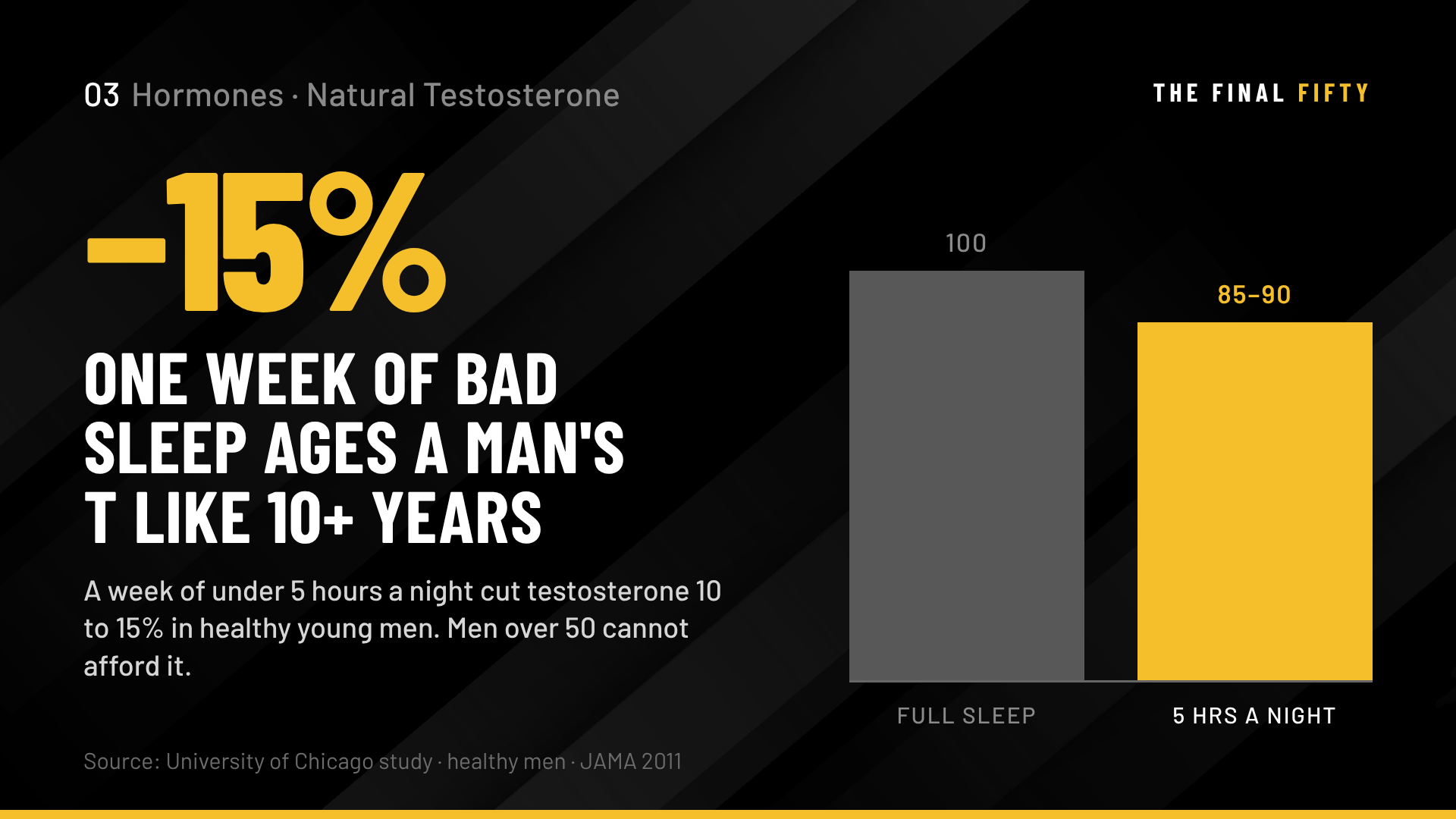
A University of Chicago study found that men who slept less than five hours a night for one week in a laboratory had significantly lower levels of testosterone than when they had a full night’s sleep. Skipping sleep reduces a young man’s testosterone levels by the same amount as aging 10 to 15 years. As research progresses, low sleep duration and poor sleep quality are increasingly recognized as endocrine disruptors.
Just one week of sleep restriction to five hours per night reduced daytime testosterone levels by 10 to 15 percent in healthy young men. The testosterone decline was equivalent to aging 10 to 15 years, demonstrating that sleep loss can rapidly age the male hormonal system. Older men may be even more susceptible to sleep-related testosterone decline, as aging already reduces hormone production and sleep quality often declines with age.
The mechanism is direct. The majority of the daily testosterone release in men occurs during sleep. Sleep fragmentation and obstructive sleep apnea are associated with reduced testosterone levels. In older men, morning testosterone levels are partly predicted by total sleep time.
The man at fifty-three who consistently sleeps six hours, who considers this an acceptable trade-off for the demands of his schedule, is not managing his testosterone with discipline. He is suppressing it deliberately while attributing the consequences to age. The research does not permit that interpretation. The deficit is real, it is immediate, and it is within direct control.
Seven to nine hours of quality sleep, protected with the same seriousness that a man brings to any other performance variable, is the single highest-leverage natural testosterone intervention available. It costs nothing. It requires no product, no protocol, no medical appointment. It requires the decision to treat sleep as the hormonal non-negotiable the research shows it to be.
Resistance Training: The Stimulus That Signals Production
Exercise is the second major natural lever, and the research on which type of exercise matters most for testosterone is specific enough to change how a man structures his training.
Within minutes of beginning a resistance training session, the body begins releasing anabolic hormones including testosterone, growth hormone, and IGF-1. Testosterone peaks in the bloodstream approximately 15 to 30 minutes after exercise ends. The acute response is more pronounced with higher training volumes, compound movements involving large muscle groups such as squats, deadlifts, and rows, shorter rest intervals, and moderate-to-high intensity. Over months and years, consistent resistance training is associated with higher resting testosterone levels compared to sedentary individuals, particularly in men.
A 2022 systematic review found that exercise training of any intensity increased basal levels of testosterone in older adults. High-intensity interval training has been found to increase free testosterone in older, sedentary men as well as master athletes.
The pattern that produces the greatest hormonal response is not the isolation work that most gym-going men over fifty drift toward as they age. It is the compound movements that load large muscle groups under meaningful intensity. Squats. Deadlifts. Rows. Overhead pressing. The training sessions that leave a man genuinely taxed, not just mildly fatigued, are the ones that produce the hormonal signal that matters.
The training session serves dual hormonal purposes. It directly stimulates testosterone release through the acute anabolic response to muscular stress. And it drives the body composition changes that reduce the aromatase activity, the visceral fat-to-estrogen conversion process, that is quietly suppressing testosterone in men who carry excess body fat.
Body Composition: The Hormonal Accelerator Most Men Underestimate
The relationship between body fat and testosterone is one of the most important and least discussed aspects of natural testosterone optimization for men over fifty. Visceral fat, the fat stored around the organs that most men carry in increasing amounts across the second half of their lives, produces aromatase, the enzyme that converts testosterone into estrogen.
This is not a minor metabolic side note. It is a self-reinforcing cycle: excess body fat reduces testosterone by converting it to estrogen, which reduces the hormonal support for muscle maintenance, which makes it harder to maintain the metabolically active muscle that keeps body fat in check, which allows more body fat to accumulate, which further reduces testosterone.
Every percentage point of body fat reduction in a man carrying excess visceral fat directly reduces aromatase activity and improves the testosterone-to-estrogen ratio. The man who loses ten pounds of body fat around his midsection has not just changed how he looks. He has reduced the enzymatic conversion of his testosterone and shifted his hormonal balance in a direction that compounds over time.
The training that builds muscle and the nutrition that reduces excess body fat are not separate projects. They are both direct inputs into the hormonal optimization protocol. A man cannot optimize his testosterone while maintaining the body composition that is enzymatically converting it.
Cortisol Management: The Hormonal Antagonist
Cortisol and testosterone operate in direct opposition. When cortisol rises, testosterone falls. This is not a theoretical relationship. It is a documented biological competition for the same precursor hormones, and it is one of the most consequential hormonal dynamics for men over fifty who are navigating high-stress professional and personal environments.
Managing stress is one of the most effective ways to boost testosterone naturally. Chronic stress elevates cortisol, which directly suppresses testosterone production and creates a hormonal environment that works against every other optimization effort a man makes.
The man who is training consistently, sleeping adequately, and maintaining good body composition but running at maximal chronic stress is fighting himself hormonally. The cortisol elevation from unmanaged stress competes with and suppresses the testosterone production his other behaviors are trying to support. A complete natural testosterone protocol addresses cortisol directly, not as a secondary consideration, but as a primary hormonal variable that must be managed if the other inputs are going to produce their intended effect.
Stress management for hormonal health is not meditation as a lifestyle brand. It is the structured, deliberate practice of managing the cortisol-producing inputs of a high-demand life: building recovery into the schedule as seriously as training, protecting sleep from work intrusion, maintaining the relationships and the brotherhood that buffer the psychological load, and developing the practices that allow genuine physiological downregulation after periods of high demand.
Nutritional Support: The Micronutrients That Matter
The dietary foundation that supports testosterone production includes the specific micronutrients that the steroidogenic pathway in the Leydig cells requires to function at full capacity.
Zinc is the most direct micronutrient input into testosterone production. Zinc deficiency consistently produces low testosterone, and zinc supplementation in deficient men produces meaningful testosterone increases. Animal foods, particularly red meat, shellfish, and eggs, are the highest-density dietary zinc sources available. The man building his diet around these foods is also providing the primary mineral input that the testosterone production pathway depends on.
Vitamin D functions more like a hormone than a traditional vitamin, and its relationship with testosterone in men over fifty is well established in the research. Most men over fifty are deficient. The vitamin D receptor is present in the Leydig cells, and adequate vitamin D levels are associated with higher testosterone across multiple studies. Supplementation in deficient men produces testosterone improvements.
Magnesium is involved in more than 300 enzymatic reactions in the body, including several that are directly relevant to testosterone production and to reducing SHBG, which would increase free testosterone availability. Most men are deficient in magnesium through diet alone.
Fat intake matters because testosterone is synthesized from cholesterol. The dietary pattern that eliminates fat, particularly saturated fat from animal sources, removes the primary substrate for steroid hormone synthesis. The research on dietary fat and testosterone is consistent: low-fat diets are associated with lower testosterone, and the animal-based dietary pattern that prioritizes protein and fat from quality animal sources provides the nutritional foundation that the testosterone synthesis pathway requires.
What Natural Optimization Can and Cannot Do
Honesty matters here. The natural interventions described in this article, held consistently and applied with genuine commitment, can produce meaningful improvements in testosterone levels for men in the fifty to sixty-five age range. The research supports increases of 10 to 25 percent over baseline through systematic lifestyle optimization in men who were previously neglecting these variables.
That is not a trivial improvement. For a man sitting at 380 nanograms per deciliter, a 20 percent increase brings him to 456, a meaningful shift in how he feels, performs, and recovers. For a man at 500, the same improvement brings him to 600, moving him from the adequate range toward a level that reflects genuine optimization.
But natural optimization has a ceiling. For men whose levels have declined below what lifestyle changes can meaningfully address, for men whose Leydig cell population has deteriorated to the point where the signal is present but the production capacity is severely limited, the lifestyle protocol supports but does not replace a medical conversation. The natural interventions are not an alternative to TRT for men who genuinely need it. They are the foundation that every man should have in place before that conversation begins, and the environment that makes TRT work better when it is appropriately prescribed.
Start with the lifestyle. Apply it completely. Measure the results. Make informed decisions from there.
THE FINAL 50 FRAMEWORK
THE REFRAME
Testosterone optimization is not a medical problem first and a lifestyle problem second. It is a lifestyle problem first, for every man, and a medical conversation for the men whose lifestyle optimization has been maximized and whose levels still require intervention. The natural levers are not minor adjustments at the margins. For most men over fifty, they are the primary opportunity. The ones who have never applied them systematically do not know what their hormonal environment looks like when the inputs are right.
THE STANDARD
The Final 50 man holds the four primary natural testosterone levers to a high and consistent standard: seven to nine hours of sleep protected as a hormonal non-negotiable, resistance training built around compound movements at meaningful intensity three to four times per week, body composition managed to minimize visceral fat and aromatase activity, and cortisol addressed through structured stress management rather than accumulated and ignored. He is supplementing zinc, vitamin D, and magnesium if deficient. His diet provides the fat and cholesterol that testosterone synthesis requires. This is the complete natural protocol. It is not optional for the man who is serious about his hormonal health.
THE PRACTICE
This week, identify the single natural lever that you are most significantly underperforming on: sleep, training intensity, body composition, or cortisol management. Not the one that is easiest to address. The one where the gap between what the research supports and what you are doing is largest. Commit to closing that gap this week specifically. Not in general. With one concrete daily action that holds the standard the research supports.
THE AUDIT
Have you measured your testosterone since implementing a structured natural optimization protocol? Most men have either never been tested or were tested before they addressed the lifestyle variables, which means their numbers reflect a suboptimal lifestyle, not their natural ceiling. If you have been holding the sleep standard, the training standard, the body composition standard, and the stress management standard for 90 days or more and have not been tested, schedule the panel. You need to know where the lifestyle protocol has brought you before you can make an informed decision about anything beyond it.
THE PROMPT
The natural testosterone optimization protocol is not a solo project. It is the kind of work that improves when men hold each other to the sleep standard, the training standard, and the body composition standard together. Which men in your brotherhood are running this protocol seriously? Who has measured their numbers before and after? What did the lifestyle changes produce in the lab work? That conversation, held between men who are serious about their hormonal health, produces the most useful real-world data available.