There is a conversation happening in gyms across the country and it goes something like this. A man in his early fifties walks in, looks around at the younger guys moving heavy weight with fast recoveries and loose warm-ups, and makes one of two decisions. He either tries to train exactly like he did at thirty-two and ends up nursing a shoulder or a back for the next six weeks. Or he decides that lifting heavy is no longer for him, dials everything back to what feels safe, and quietly accepts a version of training that stops producing any real result.
Both decisions are wrong. Both of them come from the same flawed premise: that the body at fifty is simply a slower, more fragile version of the body at thirty, and that strength training is therefore either the same game played more carefully or a game no longer worth playing at full commitment.
Neither is true.
The rules of strength training change after fifty. That is not an opinion. It is a physiological fact, and understanding exactly how and why they change is what separates the men who build real strength in the second half of their lives from the men who spend those years managing what they used to have.
The Science of What Actually Changes
The most significant shift that occurs in the male body around and after fifty is what researchers call anabolic resistance. The muscle protein synthetic response to the main anabolic stimuli, food intake and physical activity, appears to be blunted in older individuals, and this anabolic resistance is now considered a key factor contributing to the progressive loss of skeletal muscle mass across the lifespan. In plain terms, the signal your muscles receive after a training session, the signal that triggers repair and growth, does not fire as loudly or as efficiently as it did when you were younger.
This is not catastrophic. It is important context. Older men show anabolic resistance of signaling and muscle protein synthesis in response to resistance exercise, but the critical point that gets buried in most conversations about aging and training is this: the solution to anabolic resistance is not to train less. It is to train smarter, eat more protein, and apply the specific inputs that are known to override the blunted signal.
The second significant change is hormonal. Testosterone, the primary anabolic hormone in the male body, declines at roughly one percent per year after thirty, meaning a man at fifty is working with meaningfully lower levels than he was at thirty-five. This affects both the rate at which muscle is built and the speed at which the body recovers between sessions. It does not make building muscle impossible. It makes the environment in which building happens different, and responding to a different environment with the same approach that worked in the old one is where most men go wrong.
Recovery is the third variable. Research has shown lower muscle protein synthesis rates in well-trained masters athletes over multiple days of training compared to their younger competitors, and this likely contributes to poorer muscle protein repair and remodeling between sessions. The repair process takes longer, which means the window between sessions matters more than it did at thirty. Piling volume on top of incomplete recovery does not produce more results. It produces overreaching, injury, and the kind of chronic fatigue that convinces men to quit training altogether.
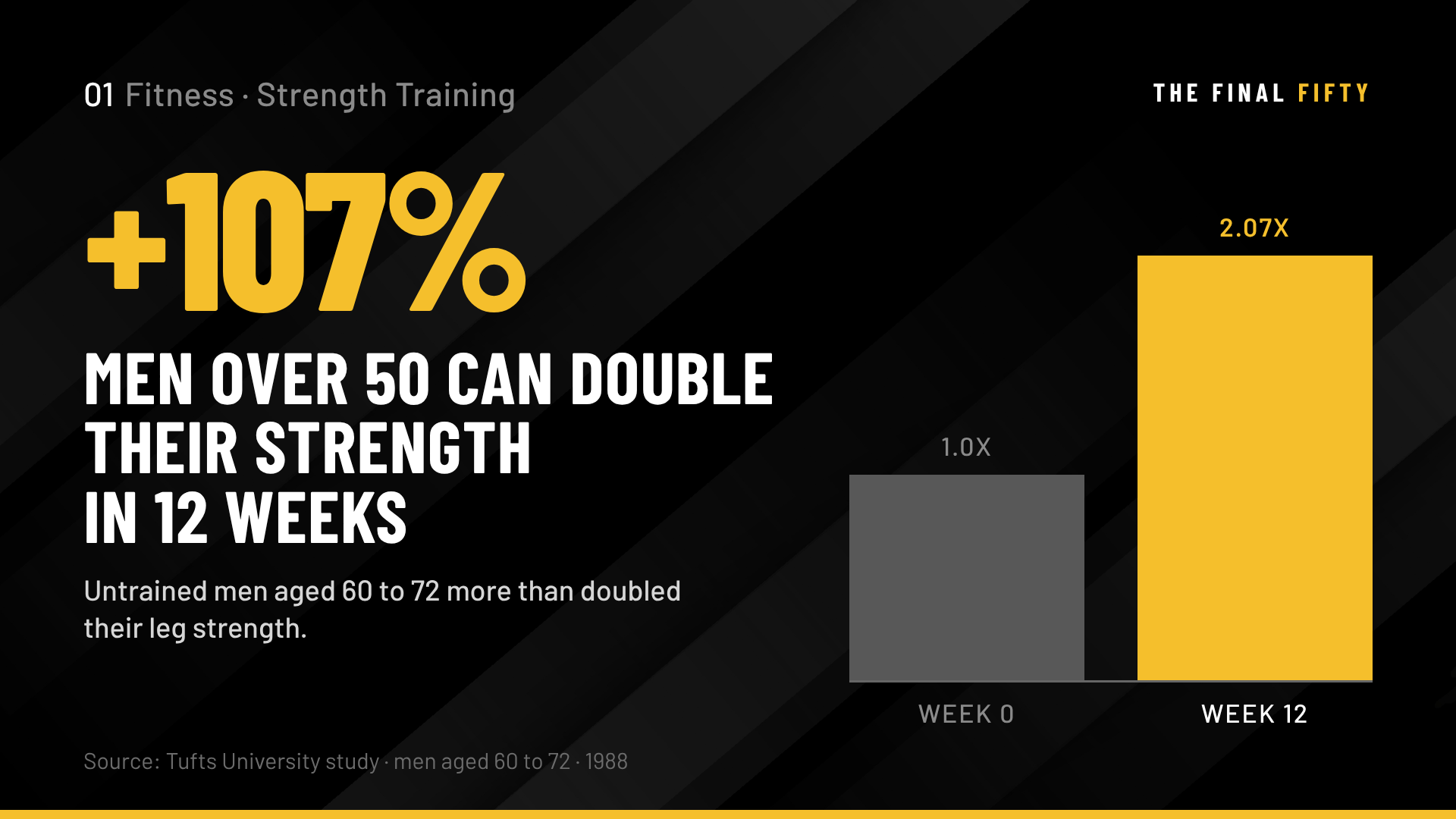
Here is what those three changes do not mean. They do not mean the game is over. As Dr. Thomas Storer, director of an exercise physiology lab at Harvard, puts it: older men can indeed increase muscle mass and it takes work, dedication, and a plan, but it is never too late to rebuild muscle and maintain it. Research has confirmed this repeatedly, including studies showing significant strength and muscle mass gains in men well into their eighties after just twelve weeks of structured training. The ceiling is higher than most men over fifty believe.
What Changes in Practice
Understanding the physiology is useful. Knowing what to do with it is what matters.
The most important adjustment a man over fifty makes to his training is prioritizing recovery as a training variable, not an afterthought. This means building at least 48 to 72 hours between sessions that work the same muscle groups and treating that gap as seriously as the training itself. A man who hits legs hard on Monday and comes back on Wednesday expecting to build from that session is working against the very process he is trying to drive.
The second adjustment is intensity management. The data is clear that muscle protein synthesis responds to intensity, peaking somewhere in the 60 to 90 percent of one rep maximum range and not rising significantly above that regardless of how much harder a man pushes. Muscle protein synthesis is dose dependent on intensity, rising to a plateau at 60 to 90 percent of one repetition maximum. Training to absolute failure on every set is not the path to more results after fifty. It is the path to accumulated fatigue and joint stress that erodes the ability to train consistently over time. Leaving one to two reps in reserve on most sets preserves the stimulus while protecting the system that delivers it.
Volume is the third lever. More is not always more after fifty, especially when recovery is slower. The goal is finding the minimum effective dose of training that drives adaptation without outrunning the body’s ability to repair. That number is individual and shifts over time, but a man who is honest about his recovery, his sleep, and his nutrition will feel the difference between a volume that builds and a volume that grinds him down.
Compound movements remain the foundation. Squats, deadlifts, presses, rows, and pulls build total-body strength, stimulate the most muscle tissue per session, and carry the highest functional return for a man who wants a body that performs in real life, not just under controlled gym conditions. The idea that men over fifty should abandon heavy compound lifts is not supported by the evidence and robs those men of the most productive tools available.
The Advantage No One Talks About
Here is what the conversation about strength training after fifty almost always misses. There are real advantages to training at this stage that younger men simply do not have.
Research shows that neuromuscular control improves up to about age fifty-five, meaning older lifters know how to recruit their muscle fibers more effectively. A man at fifty who has been training for years has a nervous system that has learned to fire the right muscles at the right time with far greater efficiency than a twenty-five-year-old who is still developing that connection. That efficiency is an asset. It means force can be produced and directed more precisely, which matters for both performance and injury prevention.
A man over fifty also has something the twenty-five-year-old in the gym does not: decades of earned self-knowledge. He knows how his body responds to different foods, different sleep amounts, different training stresses. He knows the difference between the fatigue that is worth pushing through and the warning signal that demands he back off. He is not learning those lessons in real time through costly mistakes. He already has them. That is not a small advantage. That is the accumulated wisdom of a lifetime of living in his own body, and a man who applies it to his training rather than ignoring it in pursuit of what used to work will consistently outperform the man who trains without it.
The rules change after fifty. That is true. What is equally true is that the man who understands the changes, adjusts his approach accordingly, and brings the full weight of his experience and discipline to the training floor is not working with a disadvantage. He is working with a different set of tools, and in the right hands those tools build something that lasts.
THE FINAL 50 FRAMEWORK
THE REFRAME
Strength training after fifty is not a lesser version of what you did at thirty. It is a more precise version. The margin for junk volume, poor recovery, and ignored nutrition is thinner, which means the man who trains with intention rather than habit gets better results than the man who simply shows up and works hard. Precision beats volume. Recovery is training. The rules changed. Use that.
THE STANDARD
The Final 50 man trains for strength consistently, across every decade of the second half, at a standard that builds rather than maintains. He lifts compound movements with intention. He manages intensity intelligently. He protects his recovery as seriously as he protects his training sessions. He does not skip the work because he is fifty. He does the right work because he is fifty.
THE PRACTICE
This week, audit your current training approach against what you now know. Are you managing recovery or ignoring it? Are you training at the intensity range that drives adaptation, between 60 and 90 percent of your working max, or drifting below it out of habit or comfort? Are compound movements the foundation of your program or have they been quietly replaced by machines and isolation work? One honest answer to each of those questions produces the first adjustment.
THE AUDIT
Where is your strength right now, specifically? Not in general. Can you squat your bodyweight for multiple clean reps? Press half your bodyweight overhead? Deadlift one and a half times your bodyweight from the floor? If you do not know the answers to those questions, that is the first thing to fix. You cannot build toward a standard you have not defined.
THE PROMPT
The men in your brotherhood are navigating the same questions about training in the second half. Which of them has figured something out about strength training after fifty that you have not asked about yet? Which of them is doing the work at a level that challenges you to raise your own? That conversation does not happen unless someone starts it. Start it.