
The most valuable professional output a man over fifty can produce does not come from being perpetually responsive. It does not come from attending every meeting, answering every message within the hour, or maintaining the appearance of constant availability that modern professional culture has conflated with performance. It comes from the capacity to engage for sustained, uninterrupted periods with the work that is difficult, creative, and consequential, the work that advances the mission, solves the hard problems, and builds the things that the second half was supposed to build.
That capacity is called deep work. Cal Newport, a computer science professor at Georgetown University who coined and defined the term, describes it as professional activities performed in a state of distraction-free concentration that push your cognitive capabilities to their limit. The definition contains what distinguishes it from everything else a man does during his professional hours: distraction-free, cognitively demanding, and sustained. These are precisely the conditions that the modern professional environment has been systematically dismantling.
The average knowledge worker now sustains focus for approximately 47 seconds before switching tasks. Fewer than 20 percent of knowledge workers report achieving flow state in a given week, down from 35 percent a decade ago. Half of all meetings are scheduled during peak productivity hours, directly competing with when focused cognitive work would otherwise occur. And workplace distractions cost the US economy an estimated $650 billion annually, representing the systematic displacement of the highest-value work by the lowest-value coordination, availability, and responsiveness demands of the fragmented modern workplace.
For the man over fifty who is building the second half of his life, these statistics describe not an abstract productivity problem but a direct threat to the mission. The legacy work, the professional contribution, the business development, the writing, the strategic thinking, the mentoring at depth: none of these happen in 47-second attention spans. They happen in the protected, sustained, distraction-free focus sessions that most men in the second half have allowed the reactive demands of professional and digital life to crowd out without fully recognizing what the crowding out is costing them.
Why Deep Work Is Specifically More Valuable After 50
The case for deep work as a professional priority applies to anyone doing cognitively demanding work. The case for it as a second-half priority specifically rests on two converging factors that make its value to the man over fifty greater than its value to the younger professional who has not yet encountered either.
The first is the nature of second-half contribution. The man at fifty-five who has accumulated thirty years of professional experience, pattern recognition, and domain expertise has a specific kind of value available to him that no younger professional in his field has. He can see the connections between problems that the man with five years of experience cannot recognize as connected. He can identify the pattern in a new situation that matches a pattern he navigated thirty years ago, and he can apply the lesson of the earlier experience to the current one in a way that requires no research, no consultation, and no deliberation. This experiential advantage is available only in the deep work mode. It cannot be expressed in the reactive, fragmented, shallow engagement mode of the email-and-meeting professional day, because that mode does not provide the sustained cognitive engagement through which the pattern recognition that decades of experience produces becomes available and applicable.
The second factor is the directness of the relationship between focus and cognitive longevity. The 2024 Drexel University Creativity Research Lab finding that real creative flow requires a letting go of self-monitoring, which is achievable only in the deep work mode, is the research expression of a relationship that the cognitive aging literature has also documented: the sustained, challenging mental activity that deep work represents is among the most powerful stimuli for the neuroplasticity that protects cognitive function across the second half’s decades. The man who maintains the capacity for deep work, who exercises the focused attention that cognitively demanding tasks require on a daily basis, is doing for his cognitive health what resistance training does for his muscular health: maintaining the capability through deliberate, demanding use.
The ability to perform deep work is becoming increasingly rare at exactly the moment it is becoming increasingly valuable. For the man over fifty who understands this, the protection of his deep work capacity is not a productivity optimization. It is the maintenance of the specific cognitive capability that his accumulated expertise makes most impactful and that the second half most requires him to deploy.
What Is Happening to Attention and Why
Understanding what is happening to the capacity for sustained focus requires understanding the specific mechanisms through which the modern information environment has been dismantling it, because the solution must address the mechanism rather than simply resolve to focus better.
The smartphone and the notification system it carries are engineered by teams of psychologists, neuroscientists, and product designers whose explicit professional mandate is to maximize the time a person spends attending to their platform. The variable reward schedules, the social validation signals, the infinite scroll mechanisms, and the notification architectures of the dominant digital platforms are not incidental features of useful communication tools. They are deliberate applications of the behavioral conditioning principles that produce the compulsive checking behavior that averages 96 phone checks per day in the population that has not deliberately managed this.
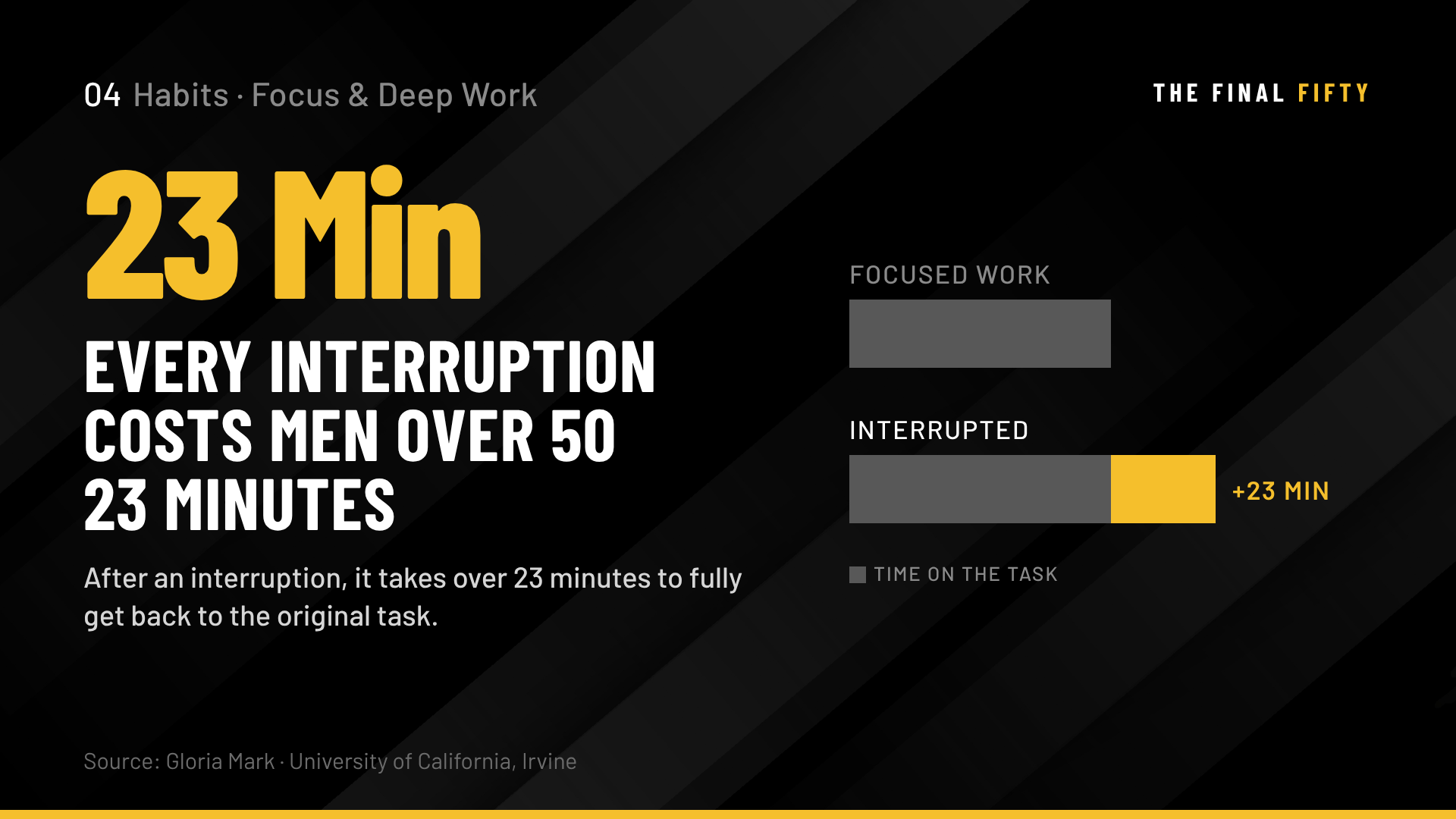
The neurological consequence of habitual fragmented attention is the degradation of the attentional control networks that sustained focus requires. When a task is switched, a portion of attention remains on the prior task in what cognitive scientists call attention residue, reducing the full cognitive engagement available to the new task. When task-switching becomes habitual and frequent, the attentional control system adapts to the fragmented mode: it becomes easier to switch and harder to sustain. The man who has been operating in the fragmented mode for years has been training his brain to switch rather than sustain, and this training produces a neurological baseline that makes the deep work mode effortful to access even when he deliberately attempts it.
The meeting culture of most professional environments adds an architectural dimension to the attentional fragmentation that the notification environment drives. Half of all meetings are scheduled during the peak productivity hours of 9 to 11 AM and 1 to 3 PM, directly competing with the time when the cognitive resources for demanding work are at their highest. A man whose morning is occupied by two meetings from nine to ten and ten-thirty to eleven-thirty has no protected morning deep work time in what would otherwise be his most cognitively available hours. His afternoon peak, if he has one, similarly disappears into the meeting architecture that no one designed intentionally but that accumulated through the path of least resistance in organizations where meetings are the primary coordination mechanism.
The Four Scheduling Philosophies: Matching Structure to Reality
The question of how to implement deep work in a professional life that includes obligations, not just discretionary attention decisions, has a structured answer in the research on how professionals who maintain deep work capacity organize their time. Newport identifies four scheduling philosophies that represent different levels of structural commitment to protected focus, each appropriate for a different professional context.
The monastic philosophy eliminates shallow work almost entirely, organizing the professional life around the exclusive pursuit of deep work. This is the approach of the writer who does not maintain a professional email address, the academic researcher who delegates all coordination to an assistant, or the author who is in a dedicated writing period. For most men over fifty who manage professional responsibilities, teams, and ongoing obligations, the monastic approach is neither available nor appropriate. It represents the maximum expression of the deep work commitment rather than the practical model.
The bimodal philosophy alternates between periods of deep work isolation and periods of conventional professional accessibility, organized at the scale of weeks or months. A man who takes a week per month at a dedicated retreat space where professional communications are managed by an assistant and his time is entirely committed to the most important strategic or creative work, returning to conventional professional life for the other three weeks, is practicing bimodal deep work. This approach is more available to the man over fifty who has established enough professional infrastructure to support periods of dedicated focus, and whose work product is delivered in forms, written documents, strategic decisions, client outputs, that do not require continuous daily presence.
The rhythmic philosophy establishes a daily deep work habit at a consistent time, typically two to four hours in the morning before the reactive demands of the professional day arrive, held with the same scheduling discipline as training sessions or medical appointments. This is the most practically accessible philosophy for most men over fifty who maintain ongoing professional responsibilities while also protecting the focused time that their most important work requires. Calendar blocking specifically for cognitive modes, rather than just activities, increases deep work success by 28 percent according to Microsoft Research. The calendar block is the structural protection. Without it, the reactive demands of the professional day will consistently occupy the time that the deep work block was supposed to hold.
The journalistic philosophy is the most flexible and the most demanding: the man who can shift into deep work mode whenever a window of uninterrupted time appears, regardless of when it appears, is practicing the journalistic philosophy. This approach works only for men who have developed such established deep work habits that the transition into focused mode is rapid and reliable rather than requiring the setup time that less experienced deep workers need. It is not appropriate as a starting strategy for the man who has been operating primarily in the reactive mode and who needs structured scheduling support to rebuild the focus capacity that fragmented attention has degraded.
The Environmental Architecture of Sustained Focus
The scheduling philosophy addresses when deep work happens. The environmental architecture addresses the conditions under which it can occur when the time has been protected.
The physical environment is the first architectural dimension. The research on environmental psychology consistently shows that the physical context in which cognitive work occurs significantly affects the quality of the cognitive engagement it produces. A dedicated physical space that is associated exclusively with focused work, even if that space is simply a specific desk or chair that is used only for deep work and for nothing else, builds the contextual associations that facilitate the cognitive mode shift when the man enters that space. The man who works on the same laptop at the same desk where he also handles email, attends video meetings, and browses the internet has not built the environmental association that separates deep work from shallow work. A different location, even a different chair in the same room, used exclusively for the focused work, builds the association that reduces the setup time for entering the deep work state.
The notification architecture is the second dimension and the most immediately impactful for most men. The phone on silent in another room is not a dramatic intervention. It is a 30-second environmental setup that eliminates the most consistent source of attentional fragmentation during the focus period. All message notifications on the computer temporarily silenced or the browser closed during the deep work block are equivalent interventions. The man who believes he can maintain focused attention while notifications arrive and consciously chooses not to check them is overestimating his attentional control and underestimating the cognitive cost of the suppression effort that choosing not to check requires. The environmental solution is simpler and more reliable than the willpower solution: make the notification structurally unavailable rather than requiring the willpower to ignore it.
Time boundaries on the deep work session are the third architectural element. The cognitive science research on attention and performance identifies approximately 90 minutes as the optimal duration for a complex problem-solving session, corresponding roughly to the ultradian rhythm of human cognitive performance. Sessions shorter than 60 minutes do not provide the full depth of engagement that complex cognitive work requires, because the first 15 to 20 minutes of a focus session are typically spent settling into the deep work mode. Sessions extending beyond 90 minutes without a break produce diminishing returns as cognitive fatigue accumulates. The two to three-hour deep work block that most serious practitioners target contains one to two 90-minute focused periods with a short break between them, organized within a protected calendar window that begins before the reactive professional day has fully commenced.
Deep Work as a Second-Half Standard
The man over fifty who treats deep work as an optional productivity enhancement rather than a core professional standard is treating the most valuable cognitive capability he has built across three decades of professional experience as something to be exercised when conditions are convenient. Conditions will never be convenient. The reactive demands of the professional and digital life will always provide a competing claim on the time that the deep work block is supposed to hold, and the competing claim will always feel urgent in the moment even when it is not more important than the focused work it is displacing.
The protection of deep work time requires the same non-negotiable scheduling commitment that training sessions and medical appointments receive in the operating system of the man who is serious about his second half. The deep work block on the calendar is not an aspiration for what the ideal day would contain. It is a commitment about what the actual day will contain, held with the same firmness that every other standard in the operating system is held.
Neurological research suggests that your perception of the world is shaped by what you pay attention to. If you spend time working deeply, your mind perceives your world as full of meaning and importance. The man who protects his deep work capacity is not simply protecting his productivity. He is protecting the quality of his engagement with the work that the second half demands from him, and the quality of his experience of that work. The difference between the professional day organized around reactive availability and the professional day organized around protected focus is not simply a difference in output. It is a difference in what the day feels like and what the man who lived it recognizes himself to be: a man who is building something or a man who is managing the demands of others building something.
Building, not managing. That distinction is available to every man over fifty who makes the specific, structural, scheduled commitment to protect the time when building happens. The deep work capacity is the condition. The standard is the protection of it. Everything else the second half is supposed to produce depends on whether that protection holds.
THE FINAL 50 FRAMEWORK
THE REFRAME
Deep work is not a productivity technique. It is the specific cognitive mode through which a man’s thirty years of accumulated expertise, pattern recognition, and domain knowledge are expressed as the output that the second half is supposed to produce. The average knowledge worker sustains focus for 47 seconds. Less than 20 percent achieve flow state in a given week. The ability to do deep work is becoming rare at exactly the moment it is becoming most valuable. For the man over fifty, protecting it is not a scheduling preference. It is the condition under which the most important work of the second half can occur.
THE STANDARD
The Final 50 man protects a daily deep work block of two to three hours at a consistent time, preferably in the morning before the reactive demands of the professional day arrive, held on the calendar with the same non-negotiability as a training session. During this block, his phone is in another room, notifications are silenced, the email client is closed, and the specific work that requires his sustained full cognitive engagement is the only work being done. He organizes his scheduling commitments to protect this block from meeting encroachment. He treats the loss of this block as a standard deviation requiring active recovery, not as the normal cost of professional availability.
THE PRACTICE
This week, block two to three hours every morning on your calendar before any meetings or reactive work begins, labeled with the specific deep work output you intend to produce each day. Not a general time block for important work, but a specific commitment: this two hours on Monday produces this specific output. Set up the physical environment before the block begins: phone in another room, notifications silenced, browser either closed or restricted to the specific research or tool the work requires. Hold the block every day this week regardless of the reactive demands that will attempt to fill it. At the week’s end, assess what the five protected blocks produced compared to what five equivalent unprotected mornings typically produce. That specific comparison is the argument for the standard that no abstract productivity claim can match.
THE AUDIT
How many hours of sustained, distraction-free focused work did you complete in the past week? Not hours spent at your desk, not hours occupied with professional activity, but hours in which a single cognitively demanding task received your full, undivided attention for at least 60 consecutive minutes. For most men who have not specifically tracked this, the honest answer is fewer than they assumed. The gap between the hours at the desk and the hours of deep work is the measure of how much of the most valuable professional capacity is being consumed by the reactive, fragmented mode rather than the focused mode that produces the second half’s most important output.
THE PROMPT
The men in your brotherhood are each navigating the tension between the reactive demands of their professional lives and the focused time that their most important second-half work requires. The conversation about how each man specifically structures and protects his deep work time, what scheduling philosophy he uses, what environmental architecture he has built, and what he has found most effective for maintaining the focus standard against the reactive demands that compete with it, is one of the most practically useful conversations available inside the brotherhood. The man who has successfully protected his deep work capacity across the most demanding periods of the second half has a specific strategy worth sharing with every man in the brotherhood who has not yet built the structural protection that strategy requires.


