
The man over fifty who has built a serious life has developed dozens of legitimate capabilities. He can manage complex situations. He can hold a strategic view across competing demands. He can assess risk with calibration that comes only from having navigated real outcomes across decades. He has accumulated expertise, judgment, and the kind of pattern recognition that younger men cannot manufacture regardless of their native ability.
There is one capability that most of those men have not developed, and that the first half of building a serious life has, in many cases, actively worked against: the ability to be fully present in the moment they are currently occupying.
This is not a soft skill. It is not the domain of meditation retreats or philosophical reflection. It is a measurable psychological state with documented consequences for happiness, relationship quality, professional performance, and the quality of the life a man experiences rather than the life he is perpetually building toward. And it is, by any honest assessment, one of the rarest things a man over fifty possesses in full and consistent measure.
The research makes this specific enough to be taken seriously rather than dismissed as motivational language.
The Number That Should Stop Every Man Over 50
Harvard psychologists Matthew Killingsworth and Daniel Gilbert spent years tracking the moment-to-moment experience of 2,250 adults, using a smartphone application that checked in with participants at random times throughout the day to record what they were doing and whether their mind was on it. After assembling 250,000 data points, they published their findings in Science.
People’s minds wandered almost 47 percent of the time. Not during specific low-engagement activities. On average, across all activities, nearly half of every waking hour was spent thinking about something other than what the person was doing. Mind-wandering was the human brain’s default mode, not an exception. And no activity was exempt: minds wandered at least 30 percent of the time during every activity measured.
The second finding is the one that changes the frame. The researchers then examined the relationship between mind-wandering and happiness, and they found a causal direction. Mind-wandering in their sample was generally the cause, not the consequence, of unhappiness. People were not wandering because they were unhappy. They were unhappy because they were wandering. As Killingsworth put it: mind-wandering is an excellent predictor of people’s happiness. How often minds leave the present and where they tend to go is a better predictor of happiness than the activities in which people are engaged.
The specific numbers: mind-wandering status accounted for approximately 10.8 percent of the variation in momentary happiness. The specific activity a person was doing accounted for only 4.6 percent. Being present mattered more than twice as much to a person’s moment-to-moment happiness as what they were doing. A man who was present during a boring task was happier than a man whose mind was wandering during an enjoyable one.
Killingsworth and Gilbert concluded that the ability to think about what is not happening is a cognitive achievement that comes at an emotional cost. The cost is nearly half of every waking hour spent partially absent from the life being lived. For the man over fifty who has built what he set out to build and who is now in the position to experience it, that cost is not abstract. It is the dinner table he was physically at but mentally absent from. The conversation with his partner where the words were received but the person was not fully there. The moment with his children that passed while his attention was somewhere else. The second half, lived at 47 percent presence.
Why the First Half Built the Wrong Muscle
The divided attention that produces the 47 percent wandering rate is not random. It follows the patterns that a man’s professional life has spent decades reinforcing. The ability to hold multiple threads simultaneously, to process the current demand while tracking adjacent concerns, to plan the next action while executing the present one, these are not failures of mental discipline. They are the cognitive habits that produced results in environments where the results required exactly that mode of operation.
The professional environment that rewarded this form of divided attention did not distinguish between contexts where it was appropriate and contexts where it was costly. It simply reinforced the pattern. And the pattern, applied uniformly, produced a man who is excellent at parallel processing and poor at the kind of singular, full-attention presence that the most valuable experiences and the most important relationships in the second half require.
Present-moment attention, nonjudgment, and decentering may become especially important for well-being across the second half of life. These aspects of mindfulness may represent psychological qualities that require a relatively modest investment of physiological and cognitive resources. The research on aging and mindfulness consistently finds that the capacity for present-moment attention, the ability to be fully where one is without the constant pull toward planning, reviewing, or evaluating, becomes both more available and more important across the second half of life. The urgency of the first half’s building mode subsides. The conditions for presence improve. And the man who never developed the capacity finds himself unable to access the experience that those conditions are finally making possible.
What Full Presence Actually Produces
The value of presence is not philosophical. It shows up in the specific outcomes that men over fifty care most about across every domain the second half contains.
In relationships, presence is the variable that determines whether an interaction produces connection or the facsimile of connection that physical proximity without attention generates. The Gottman research on marriage establishes that one of the primary drivers of relationship satisfaction is the experience of being fully attended to by one’s partner, of being the actual object of interest rather than the nominal recipient of proximity. The man who is physically at the dinner table but mentally processing tomorrow’s agenda is not providing this to the person across from him, regardless of how much he values the relationship in the abstract. What the relationship receives is the performance of presence without its substance, and over time the person on the receiving end of that performance accurately perceives what they are and are not getting.
In professional performance, presence is the mechanism through which depth of thinking becomes available. The cognitive research on attention and performance is consistent: divided attention produces the average of the partial attentions, not the quality of full engagement. The man who gives a problem 60 percent of his attention while managing adjacent concerns with the remaining 40 is not producing 100 percent output. He is producing the diminished version that 60 percent of a man’s best thinking generates. The high-value professional work of the second half, the judgment calls, the complex problem-solving, the relationship management that requires reading the person accurately rather than processing a summary of them, all of it responds to full attention in a way that divided attention cannot replicate.
A 2024 meta-analysis of 111 randomized controlled trials found that mindfulness-based interventions produced significant improvements across 15 cognitive subdomains, including sustained attention, working memory, and executive function. These are not soft outcomes. They are the cognitive resources that determine how well a man performs across every domain of the second half. The practice of deliberate present-moment attention improves the very cognitive capacities that full engagement requires.
In the experience of the life itself, presence is what determines whether the second half is actually lived or merely occupied. The man who arrives at seventy and reviews the previous two decades will not remember the professional concerns he was processing during the dinners he attended. He will remember, or more precisely fail to remember, because the memories of experiences processed with partial attention are demonstrably weaker than the memories of experiences received with full attention, the moments that passed while his mind was elsewhere. The second half contains the relationships, the experiences, and the moments that the first half was building toward. Presence is what makes a man actually available to them rather than perpetually adjacent to them.
Why It Is Rare and What Makes It Valuable
Full presence is rare not because it requires extraordinary effort to achieve but because it requires the deliberate reversal of habits that decades of rewarded behavior have embedded. The man whose professional environment spent thirty years reinforcing divided attention has a default mode that does not suspend itself because the context has changed. The habits of the first half follow the man into the second half unless he specifically, deliberately, and consistently works to build something different.
The rarity is what creates the value. In a world where 47 percent of every waking hour is spent mentally absent, the man who is fully present in an interaction is providing something that almost no one else around him is providing at that level. His partner experiences it as being seen. His children experience it as being known. The men in his brotherhood experience it as being heard rather than merely listened to. The professional who has his complete attention experiences it as being taken seriously rather than managed. Full presence is rare enough that its presence is felt and its absence is also felt, even if neither party has named what they are noticing.
The contemplative traditions that gave rise to modern mindfulness were not passive or escapist. They were about developing the kind of clear-eyed engagement with reality that allows effective action. Presence and discernment, the qualities that translate directly into high performance and deep relationship, are the outputs of a practice that the first half of most men’s lives has never required them to build.
Building it in the second half does not require becoming someone different. It requires adding to who a man already is. The judgment, the experience, the self-knowledge of a man over fifty, combined with the capacity for presence that the first half did not demand, produces something that was not available at thirty-five: the full version of the man, engaged with the full version of the life.
That is not a philosophical aspiration. It is the most practically valuable development available to a man who has already built everything else.
THE FINAL 50 FRAMEWORK
THE REFRAME
Presence is not a soft skill for men who have finished the serious work. It is a rare and valuable capability that the first half of most men’s lives actively worked against building, that the Harvard research identifies as the strongest predictor of moment-to-moment happiness available in the data, and that the second half of a well-built life desperately requires if the building is going to be experienced rather than merely occupied. The man who spends the second half perpetually adjacent to his own life, planning ahead, reviewing behind, and managing concerns that are not here, is living it at 47 percent. The man who builds presence is living it at something closer to its full value.
THE STANDARD
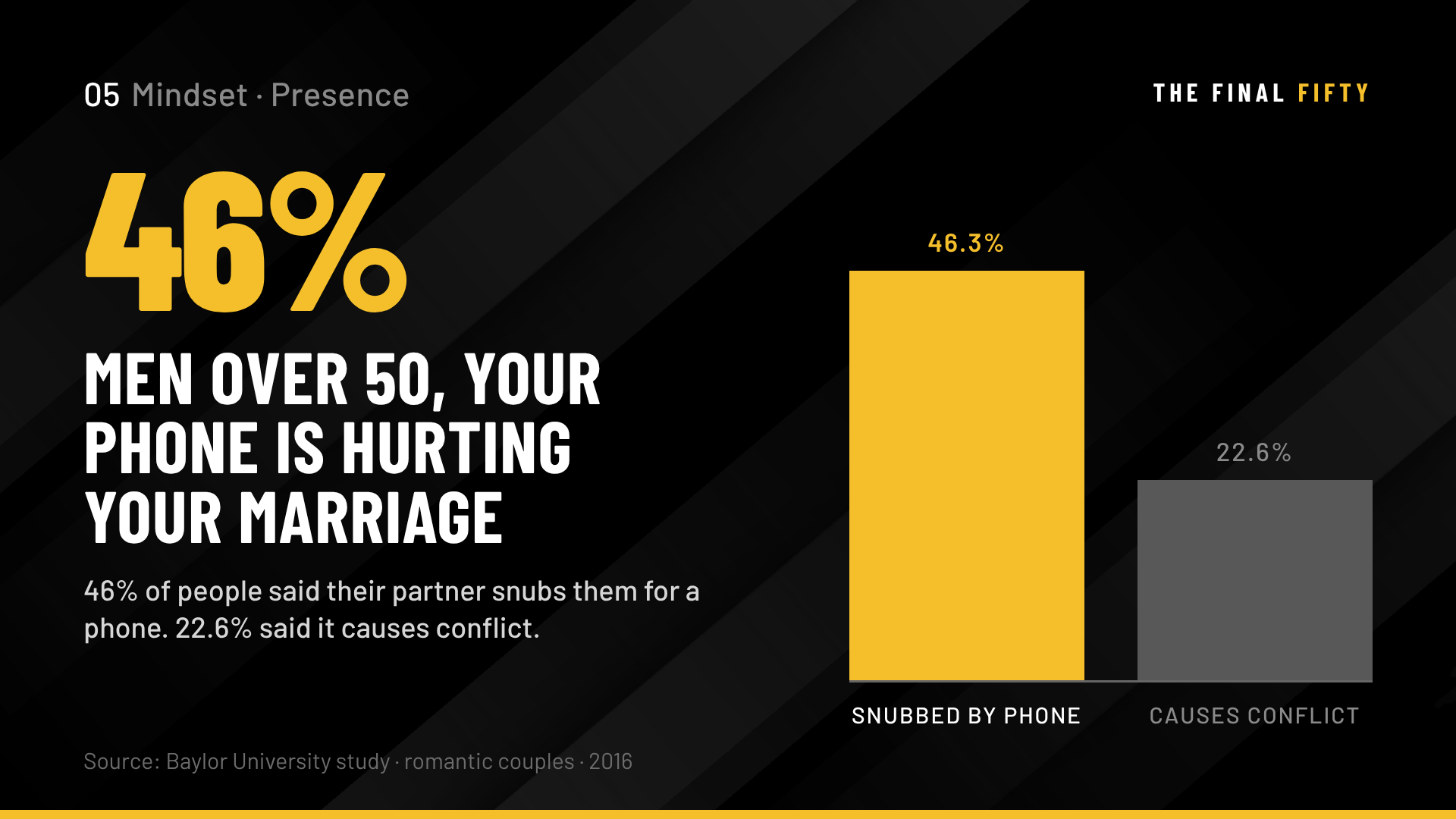
The Final 50 man treats presence as a capability to be developed and held to a standard, not a feeling to be waited for. He practices deliberate single-tasking as the default: full attention on whatever he is currently doing rather than the chronic divided attention the first half reinforced. He creates structural conditions for presence in the contexts where it matters most: phone away during the dinner table, full attention in conversations with the people he loves, no parallel processing during the interactions that deserve the complete man rather than a fraction of him. He practices five to ten minutes of deliberate attention training daily, using breath-anchored return as the mechanism for building the capacity to be where he is.
THE PRACTICE
This week, run one experiment. Choose the single context in your daily life where divided attention is most chronic and most costly. The dinner table. The first conversation of the morning with your partner. The evening time with your children. One recurring context where your physical presence and your mental presence are reliably in different places. Commit to full, undivided presence in that context every day this week. No phone visible. No parallel processing. Complete attention on what is happening. Track how the quality of that time differs when you are in it. That difference is not motivational content. It is data about what the 47 percent has been costing.
THE AUDIT
What percentage of your most important daily interactions are you present for, versus physically located during? Not what you intend. What the person across from you would honestly report if asked how present you were. The gap between your intention to be present and your actual presence in any given interaction is the gap that the 47 percent research documents in the general population. Most men are not exempt from that research. Honest assessment of where the gap is largest tells a man exactly where the development of presence would produce the greatest return.
THE PROMPT
The men in your brotherhood each have a version of this gap, and none of them are discussing it because presence is not the kind of topic that comes up in the conversations men typically have with each other. But the man who is fully present in his marriage, available to his children, and attending to the people in his brotherhood rather than managing them while his mind is elsewhere, is providing something that most men’s most important relationships are not receiving at the level they require. What would it mean to hold each other accountable not just to the physical standards of the second half but to the quality of attention each man brings to the moments and the people that the physical standards exist to protect?


