
The majority of men over fifty who are lonely do not describe themselves as lonely. They describe themselves as busy. They have a partner, a family, a professional network, a full schedule. They are surrounded, in the practical sense, by other people. And they have a small number of men they would call friends in the way that a man at fifty uses that word, men they see occasionally, who they like, who the relationship with is entirely comfortable and entirely surface-level, and with whom the honest conversation about what is actually happening in their lives almost never occurs.
They treat this as a feature of adult male life. Friendships thin out as men get older. Everyone is busy. The deep connections of youth are a product of the proximity and the shared time that adulthood does not provide. This is simply what male social life looks like after fifty, and a man who is performing adequately across his professional and family responsibilities is doing well enough.
The research disagrees with that assessment at a level of specificity that most men have never encountered and would not choose to dismiss if they had.
In 1990, 55 percent of men reported having six or more close friends. By 2021, that number had dropped to 27 percent. Half of the male social world, the part with depth and connection, vanished in three decades. And the US Surgeon General, in a 2023 advisory that was unusual enough in its directness to receive significant public attention, described the health consequences of social isolation as comparable to smoking 15 cigarettes a day. Not as a rhetorical flourish. As a finding from the epidemiological research that the advisory was built on.
Male connection is not a luxury that high-performing men can defer until the schedule permits it. It is a health variable with mortality consequences that the research now places in the same tier as the physical and dietary inputs this platform treats as non-negotiable. The man who treats it like a luxury is not choosing between his social life and his health. He is choosing a form of health neglect that does not announce itself until its consequences are already compounding.
What Isolation Is Actually Doing to Men Over 50
The biology of social isolation is not metaphorical. It operates through specific, measurable physiological pathways that connect the absence of human connection to the disease outcomes that end men’s lives and diminish the years before they end.
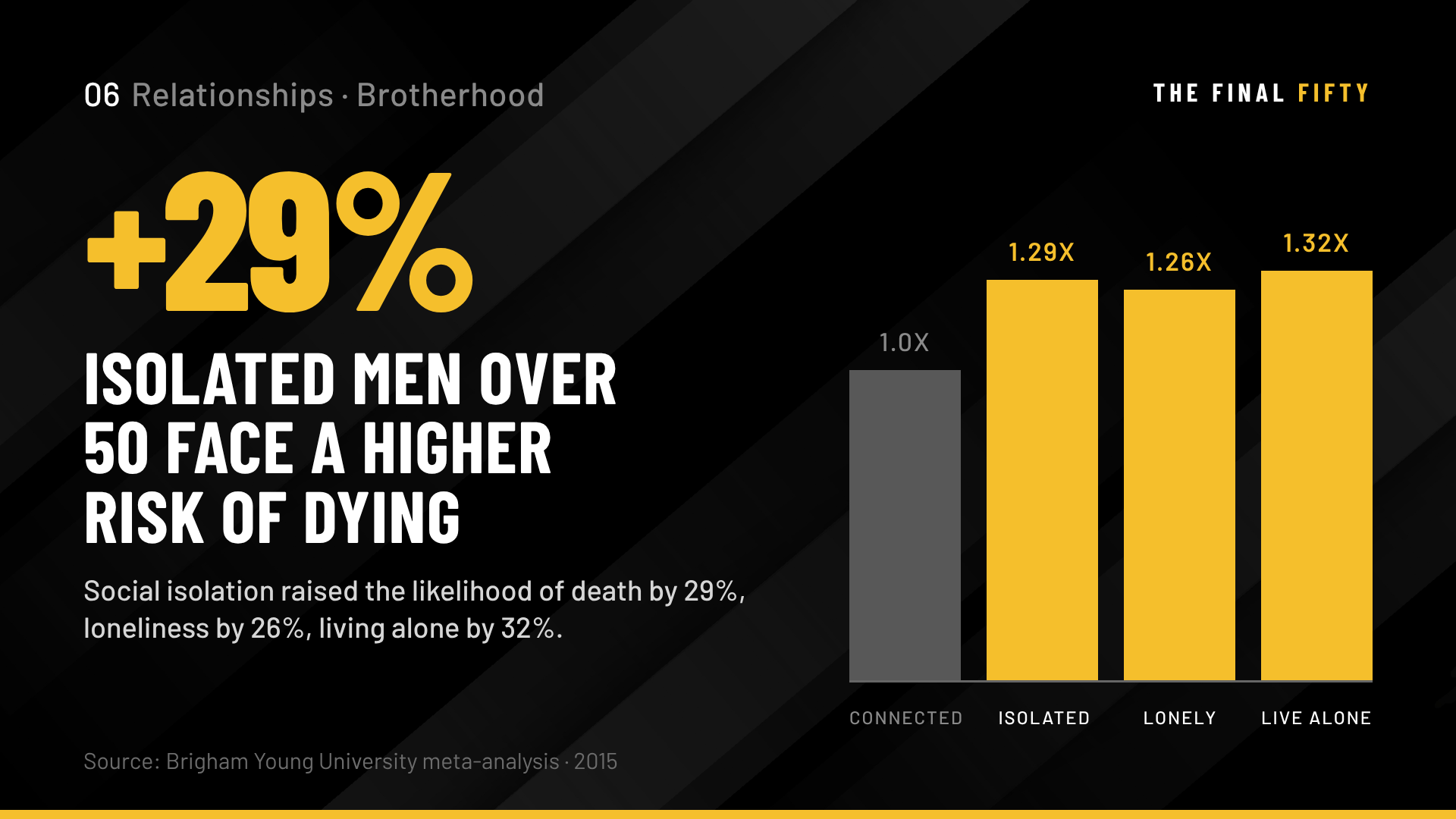
Strong relationships boost survival rates by approximately 50 percent, making them as vital to health as exercise, nutrition, and medical care. Social isolation harms health at the same magnitude as smoking and obesity. Men with strong social connections produce more telomerase, the enzyme that protects chromosome ends and slows cellular aging. Their immune systems fight infections more effectively, while loneliness triggers systemic inflammatory signaling throughout the body.
The cardiovascular consequences are specific. Men who are socially isolated are 30 percent more likely to have a stroke or heart disease. The risk of dementia increases by 50 percent with social isolation, making male connection one of the most powerful modifiable risk factors for cognitive decline available. Social isolation changes how the immune system functions, creating sustained inflammation that becomes harmful when it persists. Isolated men show higher levels of stress hormones, blood pressure, and inflammatory markers associated with the same diseases this platform addresses across every pillar.
A nationally representative sample of adults over 50 found that social isolation and loneliness were longitudinally predictive of lower psychological wellbeing in later life. Longitudinal means it compounds. The man who is socially isolated at fifty-three is not in a neutral holding pattern. He is building a trajectory toward worse health, worse cognitive function, and lower wellbeing across the following decades. The isolation is not standing still while everything else deteriorates. It is actively contributing to the deterioration.
For men over fifty who are managing their blood pressure, their lipid panels, their hormonal health, their body composition, and their training with discipline and intention, the absence of male connection is a gap in the health management system that undermines the value of everything else. The man who reduces his high-sensitivity CRP through diet and exercise while living in social isolation is fighting one inflammatory driver while allowing another of comparable magnitude to operate unchecked.
Why Men Over 50 Are the Most Vulnerable
The male friendship crisis is not distributed evenly across age groups or life stages. Men over fifty are disproportionately affected because of the specific way male friendship was built and sustained in the first half of their lives.
Most male friendships in the first half of life are built around shared contexts that provide the proximity, the regularity, and the shared experience that friendship requires without anyone having to engineer it deliberately. The workplace. The youth sports leagues that children’s activities created. The neighborhood that proximity made social. The career’s professional network, which produced many of the things friendship produces, regular contact, common purpose, mutual regard, without being built on the deeper investment that sustains friendship when the shared context disappears.
When those contexts change, which they do for most men in their fifties as careers shift, children leave, and the structures of the first half give way to the different landscape of the second, the friendships built on shared context thin out alongside the context that sustained them. What remains are the acquaintances and the surface relationships, the men a man sees less often and knows less deeply with each passing year, while the honest awareness of how thin the social world has become is managed through the same narrative that manages most uncomfortable realities: the conviction that this is just what adult male life looks like and that it is fine.
A 2025 AARP study found that men 50 and older were more likely to experience loneliness than women of the same age. Men are more likely to say they are not meaningfully part of any group or community. Men rely more heavily on their primary partner for emotional support and social connection than women do, which means that when that relationship is strained or absent, the social deficit is more severe and less buffered by alternative sources of support. The structural vulnerability of men over fifty to social isolation is not a personal failure. It is the predictable outcome of a relational approach that worked adequately in the first half because the first half provided structural support that the second half does not replicate automatically.
What Brotherhood Actually Is and Why Surface Friendship Is Not Enough
The word brotherhood is used throughout this platform in a specific and serious sense that deserves to be made explicit, because the alternative, a comfortable male social surface that provides the appearance of connection without its substance, is precisely what most men over fifty already have and precisely what the research identifies as insufficient.
Brotherhood is not a group of men who meet occasionally for activities and maintain a comfortable distance from each other’s actual lives. It is not the professional network repackaged as personal connection, the group of men whose relationship is sustained by common professional interest rather than mutual knowledge and mutual investment. It is not the group text that acknowledges birthdays and sends relevant articles and never produces an honest conversation about anything that actually matters.
Brotherhood is the sustained community of men who know enough about each other’s actual lives, their health situations, their professional challenges, their relational struggles, their inner experience of the second half, to provide useful reality-testing, meaningful accountability, and presence during the difficult periods that the second half, like every period, inevitably contains. It is the community in which a man does not have to perform fine when fine is not accurate, because the men in it have known him long enough and closely enough to distinguish between the performance and the reality.
The research distinction between having social contact and having connection is consistent and significant. Surface-level social interaction produces some of the physiological benefits of connection, but at a fraction of the magnitude of deep, reciprocal, known relationships. One in five men reports having no close friends at all. Many more have friends in name who would not, in practice, know that something was seriously wrong with them until the situation had already become a crisis. That is not a brotherhood. That is a collection of acquaintances with a more familiar name.
How to Build It: The Reality of What It Requires
Building brotherhood in the second half of life is not complicated in its requirements. It is demanding in its consistency and its willingness to invest before the investment produces visible return.
Male connection builds through shared activity before it deepens through shared disclosure. This is not a limitation of male social psychology. It is a feature: trust that develops through demonstrated reliability in shared effort produces the foundation on which more honest exchange becomes possible. The training group where men show up and hold a standard together. The shared physical challenge that creates common experience. The project undertaken alongside another man. These are the seedbeds in which brotherhood grows, not because the activity itself produces connection, but because consistent shared activity over time creates the conditions under which connection develops naturally.
From that foundation, brotherhood deepens through the deliberate increase in the quality and honesty of the conversation. The man who has trained alongside another man for six months has a different conversation with him than the man who met him three months ago at a networking event. The foundation changes what is possible. The question that goes one layer deeper than the usual exchange. The acknowledgment that something is difficult rather than the assertion that everything is fine. The request for honest feedback rather than comfortable agreement. Each of these represents a bid for a deeper form of connection than the surface allows, and each of them, when extended and received with the seriousness it deserves, builds the relationship one layer closer to what brotherhood provides.
The deliberate investment required is not primarily time, though time is necessary. It is the willingness to initiate, to be known at a level that male social convention often discourages, and to show up in the relationship not only when things are going well but when the honest conversation is more uncomfortable than the alternative. The men who have rich male friendships in the second half are not the men who were naturally more socially gifted. They are the men who decided that building connection was worth the investment and who made that investment consistently rather than waiting for it to happen on its own.
The window is not closed. But it requires a decision that most men over fifty have not yet made explicitly: the decision that the brotherhood is as non-negotiable as the training, the nutrition, and the sleep, because the research places it in the same tier of health consequence, and because the second half built without it is not the second half this platform is designed to produce.
THE FINAL 50 FRAMEWORK
THE REFRAME
Brotherhood is not a reward for the man who has handled everything else. It is one of the health variables that the research places in the same tier as training, nutrition, and sleep in its effect on longevity, cognitive health, and quality of life. The man who treats male connection as a luxury to be pursued when the schedule permits is not making a social choice. He is making a health choice, and the research is specific about what that choice costs across the years it persists. The Surgeon General’s comparison of isolation to smoking 15 cigarettes a day is not a metaphor. It is the finding.
THE STANDARD
The Final 50 man has a brotherhood: a core group of men who know what is actually happening in his life, who hold him to a standard, and who receive the same level of honest investment in return. He treats the building and the maintenance of that brotherhood as a non-negotiable priority with the same scheduling discipline he brings to his training. He initiates contact rather than waiting for it. He creates conditions for honest conversation rather than settling for the comfortable surface that male social convention often produces. He shows up for the men in his circle during the difficult periods, not only during the easy ones.
THE PRACTICE
This week, identify the three men in your life who are closest to brotherhood as this article defines it. For the man you are closest to, initiate one contact this week that goes one layer deeper than your usual exchange. Not a scheduled emotional conversation. One specific honest question about his life that you want the answer to. Receive the answer without redirecting to advice or to your own experience. Listen. That is the practice. That exchange, multiplied across the men in the brotherhood over months and years, is what male connection is actually built from.
THE AUDIT
How many men in your current life know what is actually happening in your professional situation? Your health? Your marriage or primary relationship? Your internal experience of building the second half? If the honest answer is zero or one, you have identified the most significant gap in your second-half health investment. The man who is managing every other pillar of the Final 50 while allowing his male social world to contract is not building a complete second half. He is building an impressive partial one, and the research on what the missing part costs is unambiguous.
THE PROMPT
The men around you are in the same position most men over fifty are in: socially thin in ways they have normalized, carrying more of the second half alone than the biology supports, and defaulting to the performance of fine when honest conversation would serve them better. The brotherhood does not build itself. It is built by the men in it who decide that building it is worth what it costs to build it. What would the first concrete step toward that brotherhood look like for you, not in the abstract, but this week, with a specific man, in a specific context? That step is available now.


