
The conversation about longevity tends to happen at the wrong level of abstraction. Men talk about wanting to live a long, healthy life. They read articles about centenarians. They think about their father’s health history and what it might predict about their own. They hold the goal of living well and living long in a vague, aspirational way that sits somewhere between intention and plan without fully becoming either.
What the research does not permit is the comfortable distance between the aspiration and the daily choice. Because the path to one hundred, or to eighty-seven in excellent condition, or to whatever version of a long and capable life a man is building toward, is not constructed in moments of dramatic decision. It is constructed in the ordinary moments that happen every single day, the ones so unremarkable that they rarely register as decisions at all.
The moment a man decides whether to take the elevator or the stairs. The moment he chooses what to eat at lunch. The moment he looks at his training schedule and decides whether today counts or whether it can be moved. The moment he pours a second drink or puts the glass down. The moment he goes to bed at ten-thirty or picks up his phone for another forty-five minutes. None of these moments feel important. Each of them is. And the accumulation of those unremarkable moments across years and decades is what the data consistently shows determines who gets to one hundred and who does not, who gets there in good health and who arrives diminished.
This is not a moral argument about discipline. It is a mathematical one about compounding.
The Data on What Daily Choices Actually Do to Lifespan
The most comprehensive research on the relationship between daily habits and lifespan comes from the Harvard T.H. Chan School of Public Health, whose researchers followed more than 123,000 men and women for approximately three decades to understand the measurable impact of specific lifestyle behaviors on life expectancy.
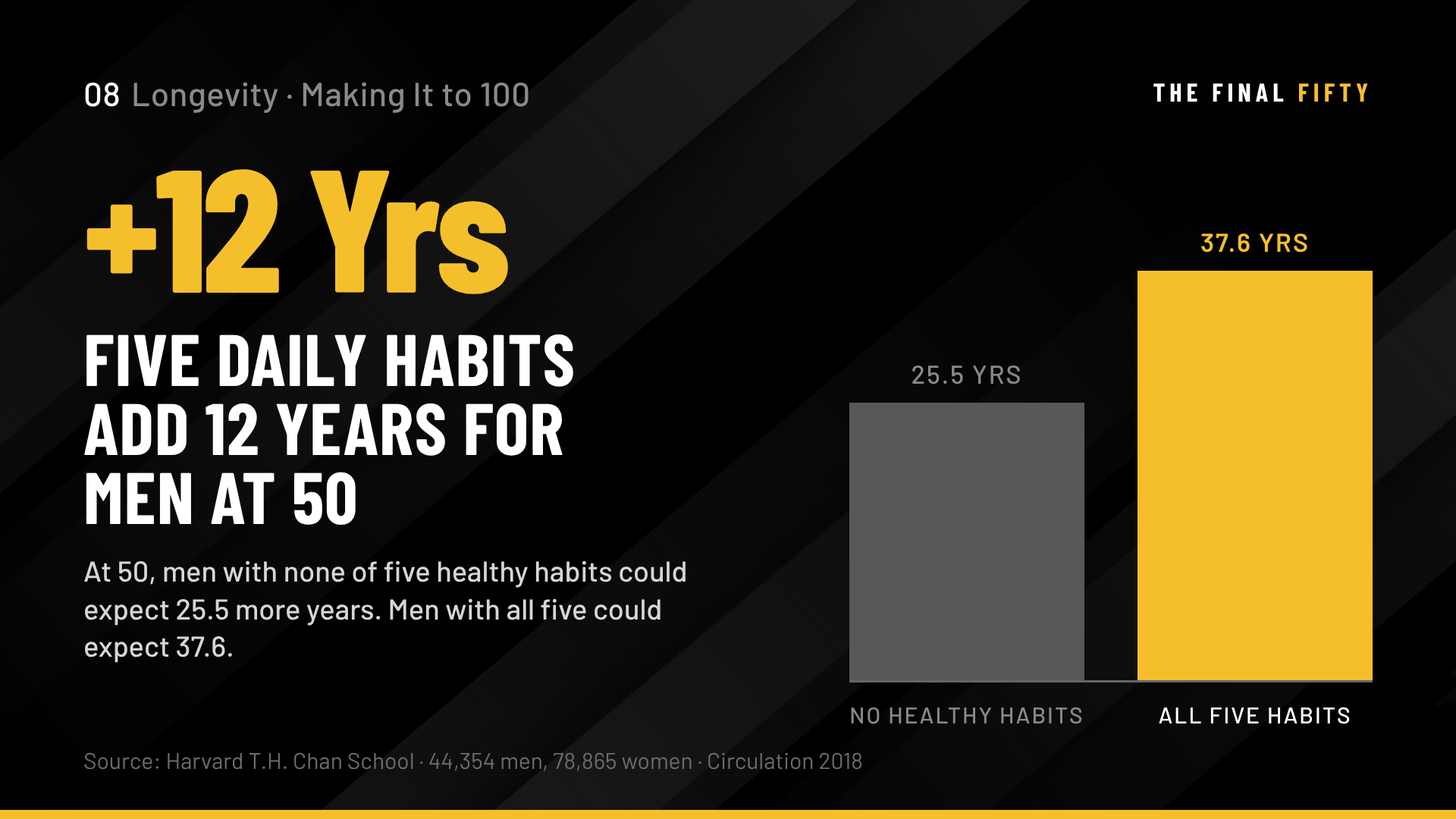
Researchers found that for study participants who did not adopt any low-risk lifestyle habits, life expectancy at age 50 was estimated at 25.5 years for men. For those who adopted all five healthy habits, eating well, exercising regularly, maintaining healthy weight, drinking alcohol only in moderation, and not smoking, life expectancy at age 50 was projected at 37.6 years. In other words, men who maintained all five healthy habits gained, on average, 12 years of life compared with those who did not maintain healthy habits.
Twelve additional years of life. Not from a single dramatic intervention. Not from a medication or a procedure. From five daily behaviors maintained consistently across the adult years. The math is not complicated once those numbers land.
The same research team then re-ran the analysis to examine healthspan rather than lifespan alone: life expectancy free of cancer, cardiovascular disease, and type 2 diabetes. The findings were equally significant. People with all five healthy habits lived dramatically more of their additional years free of the major chronic diseases that define deterioration in the second half of life.
This distinction matters enormously for men over fifty whose goal is not simply more years but more capable, functional, engaged years. The difference between a man who lives to eighty-six with a decade of managed chronic disease and a man who lives to eighty-six with his physical capacity and cognitive sharpness largely intact is not primarily genetic. It is behavioral. It is the sum of the daily decisions made across the decades before eighty-six arrived.
The Decisions That Build
The decisions that build toward a long and capable life are not exotic or expensive. They are the most basic inputs the body and brain require, applied consistently and without the exceptions that accumulate into the lifestyle that looks fine in any given week but produces the wrong trajectory over years.
Physical training is the single most impactful daily decision available to a man over fifty, and not just for the reasons most men think about. Yes, it maintains muscle mass. Yes, it supports cardiovascular health and body composition. But the research on training and longevity goes beyond those familiar benefits to something more fundamental. A 2024 Lancet Commission report found that about 45 percent of dementia cases could be prevented or delayed by addressing 14 modifiable risk factors, with exercise among the most powerful. A survey of 100 centenarians found that nearly half do some form of strength training at least once a week to keep muscles strong.
The man who trains consistently is not just building a body that looks and performs better. He is building cognitive protection. He is maintaining the insulin sensitivity that prevents the metabolic cascade that drives most age-related disease. He is sustaining the hormonal environment that supports every other system the body runs. He is generating the BDNF, brain-derived neurotrophic factor, that protects neurons and supports cognitive function into the decades ahead. The training session is not optional for the man who is serious about the long game. It is one of the most high-return daily investments available.
Nutrition is the daily decision made three to five times every day that compounds faster than almost any other variable. A man who eats well five days and poorly two days is not eating well. He is eating in a pattern that produces the trajectory of the two poor days far more than the trajectory of the five good ones, because chronic disease develops from accumulated inputs, not from isolated choices. The decision that matters is not what to eat at the next meal. It is what pattern to build and hold, recognizing that every deviation from the pattern that becomes habitual is no longer a deviation. It has become the pattern.
Sleep is the decision that men over fifty most consistently underestimate and most commonly sacrifice to what feels like more productive use of the late evening. A Fudan University research team published a study in 2024 in a sub-journal of the Journal of the American Medical Association finding that maintaining just three healthy lifestyle habits increases the chance of living to 100 by 61 percent, with regular quality sleep identified as one of the most potent contributors to centenarian longevity trajectories.
The cost of chronic sleep deprivation is not the grogginess of the next morning. It is the hormonal suppression that accumulates across weeks and months. The inflammation that chronic sleep debt produces and that drives cardiovascular risk. The cognitive impairment that compounds across years in ways that do not announce themselves until they are significant. The man who regularly sleeps six hours is not resting and recovering at the level seven to eight hours would produce. He is running a deficit that compounds biologically whether he feels it subjectively or not.
The Decisions That Quietly Work Against It
Every man over fifty has a category of daily decision that he knows, at some level, is working against the trajectory he says he wants. The question is whether he has been honest enough with himself to name it specifically and important enough about the long game to address it.
Sedentary time is the most insidious because it operates invisibly alongside apparently healthy behavior. A man who trains hard four mornings a week and sits at a desk for ten hours a day on the other days is not buffering the risk of the sitting with the training. The research does not support that comfortable assumption.
Research published in the Journal of the American Heart Association found that older adults who sat for 11.7 hours or more per day increased their risk of death by 30 percent, regardless of whether they exercised vigorously. The risk starts climbing when sitting reaches about 11 hours per day combined with the longer a person sits in a single session. Sitting more than 30 minutes at a time is associated with higher risk than sitting only 10 minutes at a time.
The man who works from a desk and spends his evenings on a couch, even if he trains in the morning, is not managing his sedentary time. He is accumulating a risk that his morning training session does not fully offset. The decision to break up sitting across the day, to stand during calls, to take a ten-minute walk at midday, to be physically active in the evening rather than sedentary in front of a screen, is not a minor adjustment. It is a meaningful daily input with mortality data behind it.
Alcohol is the daily decision most men over fifty are least honest about. The cultural normalization of regular moderate to heavy drinking in the second half of life makes it almost invisible as a health decision. It is, in fact, one of the most consequential ones a man makes. Moderate alcohol intake was one of the five lifestyle factors that together produced 12 additional years of life expectancy for men, defined in the Harvard research as no more than two drinks per day maximum, with lower consumption producing better outcomes across the longevity data.
The man who drinks more than that consistently, who considers two glasses of wine with dinner plus something afterward a normal evening, is making a daily decision with compounding consequences for his sleep quality, his hormonal health, his inflammatory status, his liver function, and his cognitive trajectory. Each individual evening seems unremarkable. The pattern across years is not.
The Compounding Logic
The reason daily decisions determine the trajectory to one hundred is not complicated. The body is a biological system that responds to inputs. The inputs it receives consistently produce the outputs it generates consistently. A man who provides the inputs of regular training, quality nutrition, adequate sleep, managed sedentary time, and controlled alcohol consumption is delivering the biological conditions for cellular health, hormonal balance, low systemic inflammation, preserved cognitive function, and maintained muscle mass to compound positively over years and decades.
The man who provides the opposite inputs is delivering the conditions for the opposite outcomes to compound with the same efficiency and the same indifference to his intentions. The biology does not grade on intention. It responds to behavior.
The Fudan University research found that maintaining just three healthy lifestyle habits increases the chance of living to 100 by 61 percent, and researchers emphasize that no matter a person’s age, making changes now can still significantly boost the chances of healthy aging and extended life.
Not at thirty. Not at twenty-five when the stakes felt high and the motivation felt clear. Now. At whatever age the man reading this article currently is. The compounding begins at the next decision and runs forward from there, not backward from where it should have started.
have at eighty, at eighty-five, at ninety. Every one of them counts. And every one of them is made again tomorrow, providing a new opportunity to build or to quietly work against the life that is still available to him.
THE FINAL 50 FRAMEWORK
THE REFRAME
The path to a long, high-performance life is not built in moments of dramatic decision. It is built in the unremarkable daily choices that accumulate into a pattern, and the pattern becomes the biology. The Harvard research showing that five daily habits add 12 years of life to men at fifty is not a study about heroic lifestyle choices. It is a study about consistent ordinary behavior, held day after day until it has compounded into a trajectory that the biology reflects. The daily decision is the strategy. There is no other one.
THE STANDARD
The Final 50 man treats his daily decisions as the architecture of his future health, not as isolated choices that reset every morning. He trains consistently. He eats with the long game in mind, not just the next meal. He protects his sleep as the primary recovery and hormonal maintenance window it is. He manages his sedentary time across the full day, not just the training hours. He holds his alcohol consumption at the level the data supports for longevity, not the level that the culture normalizes. These are not extreme positions. They are the decisions that 12 additional years of healthy life are built on.
THE PRACTICE
This week, identify the single daily decision that is doing the most to quietly work against the trajectory you say you want. Not the most dramatic failure. The most consistent one. The one that happens almost automatically, that has been normalized by habit or culture or convenience, that you have never formally decided to accept but that has been accepted through the absence of a decision to change it. Name it specifically. Then make the opposite decision tomorrow and hold it for seven days. That is the start of a different compound.
THE AUDIT
Score yourself honestly from one to ten on each of the five Harvard longevity behaviors: daily physical activity, nutritional quality and pattern, maintenance of healthy body weight, alcohol consumption at or below moderate levels, and sleep quality and duration. Do not score what you do on your best days. Score what you do consistently. The average of those five scores is a rough proxy for the longevity trajectory you are currently on. The gap between that score and ten is the gap between the life you are building and the one the research says is available.
THE PROMPT
The men in your brotherhood are making the same daily decisions you are, and they are compounding in the same direction whether any of you is paying attention to them or not. What would it mean to hold each other accountable not at the level of the major life goals, but at the level of the daily decision? The training session kept. The sleep protected. The drink put down. That accountability, held specifically and consistently inside the brotherhood, changes what is possible at the level where change happens.


