
The pace of change in professional environments is not something most men over fifty underestimated on purpose. They made reasonable assumptions about how their fields would evolve, built careers of genuine substance around those assumptions, and arrived at fifty holding real capability earned over decades of serious work. The reasonable assumption was that the pace of change would be manageable. Continuous, perhaps accelerating, but navigable. The kind of change a man of experience could track and stay ahead of through normal professional attention.
The assumption was wrong. Not catastrophically, not in a way that makes the experience meaningless, but wrong in a way that has specific consequences for every man over fifty who is not actively managing his response to it.
By 2030, 70 percent of the skills used in most jobs will change. AI is accelerating work change, and we are entering one of the largest change management exercises in history. Every business leader and professional will need to embrace it in order to unlock the value of AI.
Seventy percent. Not on the margins. Not in adjacent fields. In most jobs. That is not the pace of change most men over fifty built their career expectations around, and it is arriving faster than the training systems, organizational development programs, and individual professional habits that were adequate for previous rates of change can address.
The question is not whether the change is real. It is whether the man at fifty is going to engage it deliberately and use every advantage his experience provides, or manage it passively and hope that what he built in the first half holds without active maintenance in the second.
What the Data Shows About Who Is Actually Winning
Before addressing what men over fifty should do, it is worth being clear about what the research shows about what is happening to experienced workers in the current disruption landscape. Because the story is not the one most men are carrying.
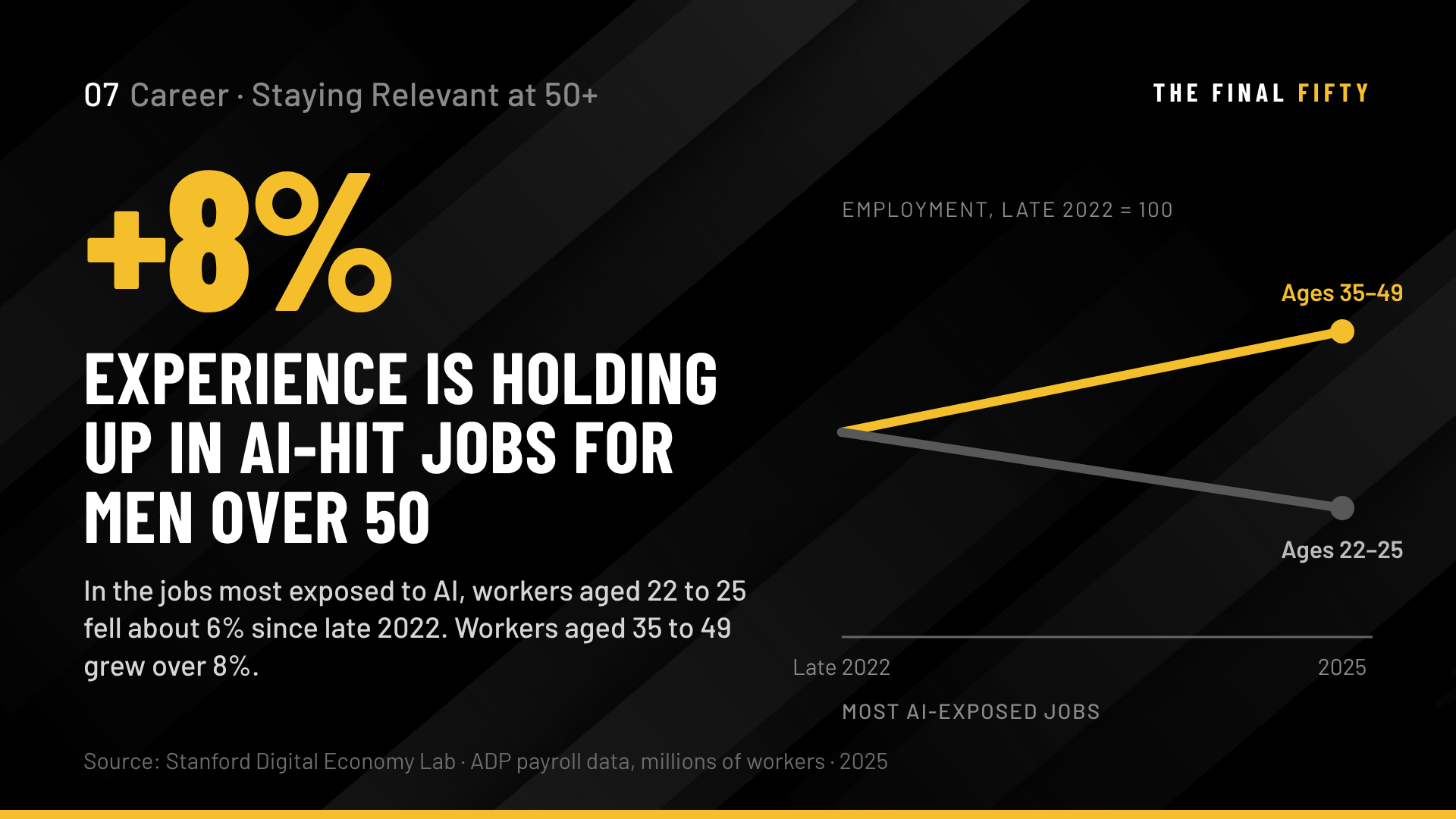
According to ADP research, AI has mainly affected early-career workers in fields with high exposure to AI, such as software engineering and customer service. Employment for 22- to 25-year-olds in high AI exposure roles fell by 6 percent between 2022 and 2025. However, during that same time, employment for workers 30 and older in those same fields increased by 13 percent.
Read that contrast carefully. In the very fields that have seen the most AI disruption, the most job elimination and role restructuring, younger workers are losing ground while experienced workers are gaining it. The mechanism is not complicated once it is named. AI is automating the routine, rules-based, repetitive tasks that entry-level and junior workers have historically performed as the foundation of their learning path. The tasks that required judgment, pattern recognition from real experience, stakeholder management, and contextual decision-making, the work that senior professionals do, are not being automated. They are being augmented.
Decline happens in roles where AI automates junior-level tasks. Growth occurs in roles where AI augments those tasks. The distinction is the mechanism driving the divide between how younger workers and older, more experienced professionals are experiencing the current disruption.
This is an enormous strategic advantage for the man over fifty who understands it and positions himself accordingly. He is not competing with AI on the tasks AI performs best. He is the judgment layer that makes AI-generated output usable, accurate in context, appropriately applied, and defensible to the stakeholders who cannot be managed by an algorithm. That is not a consolation. It is the value proposition that the disruption is, paradoxically, making more important.
Research contradicts the assumption of technological ineptitude in older workers. When hiring managers were asked to assess the job performance of the mid-career and older workers they already employed, a striking 89 percent reported that experienced workers performed as well, if not better, than their younger peers.
The Specific Threat Men Over 50 Are Most Vulnerable To
The advantage of experience in a disrupted landscape is real and significant. It does not, however, operate automatically or indefinitely without active maintenance. The specific threat that men over fifty face in industries changing at the current pace is not that their experience becomes worthless. It is that they allow the technical fluency required to apply that experience in the current environment to decay while they rely on the credibility that the experience produces.
86 percent of employers expect AI and information processing technologies to transform their business by 2030. The World Economic Forum survey found that 41 percent of employers plan to reduce staff whose skills are becoming less relevant or where roles are no longer needed.
The man at fifty-three whose professional credibility is still real but whose technical engagement with how his field has changed has not kept pace is walking toward an invisible cliff. The credibility provides runway. It does not prevent the fall.
While familiarity with AI is increasing among workers over 50, concerns about job loss, displacement, and workplace disruption remain at the forefront of many older workers’ minds. Crucially, training continues to lag behind interest in this demographic, creating a gap between awareness of the need to adapt and the actual skill development that adaptation requires.
Being aware that the field is changing is not the same as actively building the capability to operate in the changed field. The gap between awareness and action is where men over fifty are most at risk, and it is a gap that closes only through the deliberate investment in continuous skill development that most men in this demographic are not currently making at the level the pace of change demands.
What Staying Sharp Actually Requires
The man over fifty who is going to remain genuinely sharp in an industry changing faster than he expected is not the one who protests the rate of change or waits for his organization to develop him. He is the one who takes his own professional development into his hands with the same seriousness he brings to his physical training and his financial management.
The first requirement is AI fluency. Not expert-level technical implementation. Functional fluency in how the tools reshaping his industry operate, what they can and cannot do reliably, how to direct them toward useful output, and how to evaluate and apply that output with the judgment that only experience provides. The biggest misconception about AI is that it is replacing entire industries. In reality, AI is dividing industries rather than replacing them. In nearly every sector, organizations integrating AI into core workflows are gaining operational advantages over those moving slowly or resisting adoption altogether.
The man who does not develop this fluency is not avoiding the technology. He is handing his influence over to the people who are using it and relying on them to apply his experience correctly. That is not a durable professional position.
The second requirement is active network maintenance. In stable industries, a network built over twenty-five years retains much of its value through the relationships’ longevity. In industries changing rapidly, the network requires active curation. The people who matter most for professional survival in a disrupted landscape are not necessarily the ones a man worked with at the peak of his first-half career. They are the people who are currently navigating the changed landscape successfully, who see what is coming before it arrives, and who can provide the market intelligence that allows a man to adapt rather than react.
The third requirement is visibility in the new environment, not just the old one. A man whose professional reputation was built in the environment that existed before the disruption began needs to actively translate that reputation into the new context. This means contributing in the channels where the current conversation about his field is happening, not just the ones where the conversation happened when he built his standing. Thought leadership, mentoring, speaking, advising, writing, these are not optional extras for a man with established expertise. They are the mechanisms through which that expertise remains legible to the people making decisions about who remains central and who becomes peripheral.
The Advantage That Compounds with Age
The man over fifty who engages the disruption rather than avoiding it has an advantage that younger competitors cannot manufacture regardless of their technical ability: the application layer. The WEF report anticipates the need for creative thinking, curiosity, and human-centered skills alongside technical AI capability. Employers should look beyond purely technical skills to thrive in a space driven by innovation.
The creative thinking, the ability to navigate organizational complexity, the judgment built from real outcomes across decades, the relationships that determine whether a good idea becomes an implemented change, these are not learnable from a course or a certification program. They are the product of years of actual work, of wins and losses and the self-knowledge that comes from navigating both. They are what the man over fifty has that no amount of technical fluency alone can replicate.
The competitive strategy for the man over fifty in a rapidly changing industry is not to compete with AI or with younger workers on technical grounds. It is to combine the judgment and experience that only his career has produced with sufficient technical engagement that the judgment remains applicable in the current environment. The man who achieves that combination is not vulnerable to disruption. He is the person who makes the disruption useful.
Workers completing AI-focused reskilling are 3.4 times more likely to remain central to their organizations. The competitive premium goes to the experienced professional who engages the new tools with the same commitment he brought to mastering the tools of his earlier career.
The industries are changing faster than expected. That is the condition. The man over fifty who decides to engage it rather than endure it is not just protecting what he has built. He is building the professional second half that only a man with his specific combination of experience, judgment, and adaptive commitment can produce.
THE FINAL 50 FRAMEWORK
THE REFRAME
The disruption in your industry is not primarily a threat to men with your level of experience. It is primarily a threat to the entry-level roles that were the foundation of junior careers and a significant advantage for the man who combines deep experience with the technical fluency to make that experience applicable in the new environment. The man over fifty who engages the disruption actively is not competing against it. He is the judgment layer that makes it work.
THE STANDARD
The Final 50 man treats his professional development as a non-negotiable ongoing investment, not a periodic event. He develops functional AI fluency in his field, not to compete with technology but to direct it with the judgment his experience provides. He actively maintains and expands his network in the current environment, not just the one that existed when he built his standing. He makes his expertise visible in the channels where his field’s conversation is happening now, and he invests in the human-centered skills, relationship management, contextual judgment, and strategic thinking, that are becoming more valuable as the routine work is automated away.
THE PRACTICE
This week, identify the single AI tool or technology that is doing the most to reshape your specific field right now. Not in general. In your actual domain, with your actual stakeholders, in your actual competitive environment. Then spend two hours this week using it, not studying it in the abstract but applying it to a real problem in your work. The familiarity that comes from actual use is categorically different from the awareness that comes from reading about it. Start there. Build from there.
THE AUDIT
How current is your professional standing in the environment that exists today, not the one that existed five years ago? Are you contributing to the conversations that are defining how your field is navigating the current disruption? Are the people in your network the ones who see what is coming or the ones who helped build what already exists? Is the expertise that defines your professional value legible to the decision-makers who matter in the current environment? Honest answers to each of those questions tell you where the reinvestment is most urgently needed.
THE PROMPT
The men in your brotherhood are navigating the same professional disruption you are, and the intelligence gathered by comparing notes across different industries and different vantage points is more valuable than anything a single man can see from his own position. Who in your circle is doing this well? Who has figured out how to combine their experience with the current technological environment in a way that is producing results? That conversation, held directly and with specificity rather than in general terms, accelerates every man who is willing to have it.


