
Few topics in nutrition have been discussed with less precision and more noise than red meat. The headline version of the conversation has run for decades in a single direction: red meat is linked to heart disease, cancer, and early death, and men who eat it are making a choice that shortens their lives. That version of the story has been repeated often enough and with enough institutional authority that most men over fifty carry some form of it as a background assumption about their diet, even when they have never stopped to examine the evidence behind it.
The evidence is more complicated than the headlines suggest. Not because red meat is without risk at any dose or in any form. It is not. But because the specific claims most commonly made about red meat, the cardiovascular disease link, the cancer link, the mortality link, are drawn primarily from a category of research with significant methodological limitations, and because the distinction between unprocessed red meat and processed red meat, a distinction the headlines routinely collapse, is one of the most important in the entire nutrition literature.
A man over fifty who makes his dietary decisions based on the headline version of the red meat story is not making evidence-informed decisions. He is making decisions based on a simplified version of contested evidence that may lead him to restrict one of the most nutrient-dense foods available to him while the actual driver of the risks attributed to red meat in general goes unaddressed in his diet.
This article is about what the research shows, what red meat actually provides, and what a man over fifty who is eating for performance and longevity should actually know about this food category beyond what the headlines have told him.
The Methodological Problem Most Coverage Ignores
The primary evidence linking red meat to cardiovascular disease, cancer, and mortality comes from observational epidemiological studies: large population surveys that track what people report eating and what health outcomes they subsequently experience. These studies can identify associations between dietary patterns and outcomes, but they cannot establish that the dietary pattern caused the outcome. And in the case of red meat, the confounding problem is severe enough that honest researchers acknowledge the limitations openly.
A comprehensive systematic review concluded that the links between red meat and adverse health outcomes are backed by low- to very-low-certainty evidence. When statistical models isolate lifestyle factors like smoking, obesity, and physical inactivity, the statistical association between unprocessed red meat and chronic disease largely dissipates. The people who eat the most red meat in most Western observational datasets are also more likely to smoke, to be sedentary, to consume more alcohol, and to eat overall diets with higher processed food content. Controlling for these factors is attempted, but the control is never complete. The residual confounding that remains is sufficient to account for a significant portion of the associations that are attributed to the red meat itself.
The controlled trial evidence tells a different story. A 2024 systematic review and meta-analysis specifically examining randomized controlled trials, where participants are assigned to consume specific amounts of beef under controlled conditions and outcomes are measured, concluded that RCTs have not clearly demonstrated a link between red meat consumption and cardiovascular disease risk factors. A separate network meta-analysis of 36 RCTs found that consuming plant proteins produced a greater reduction in total and LDL cholesterol compared to red meat, but the effect sizes were modest, and the authors noted important distinctions between the types of red meat studied and the quality of the comparator diets.
This does not mean red meat is without risk. It means the certainty of the risk is substantially lower than the headlines convey, and that the specific form of red meat matters enormously.
The Distinction That Changes Everything: Processed Versus Unprocessed
The most important finding in the red meat research literature, and the one most consistently obscured by headline-level coverage, is that the risks associated with red meat consumption fall almost entirely in the processed meat category and are dramatically weaker or absent for unprocessed red meat.
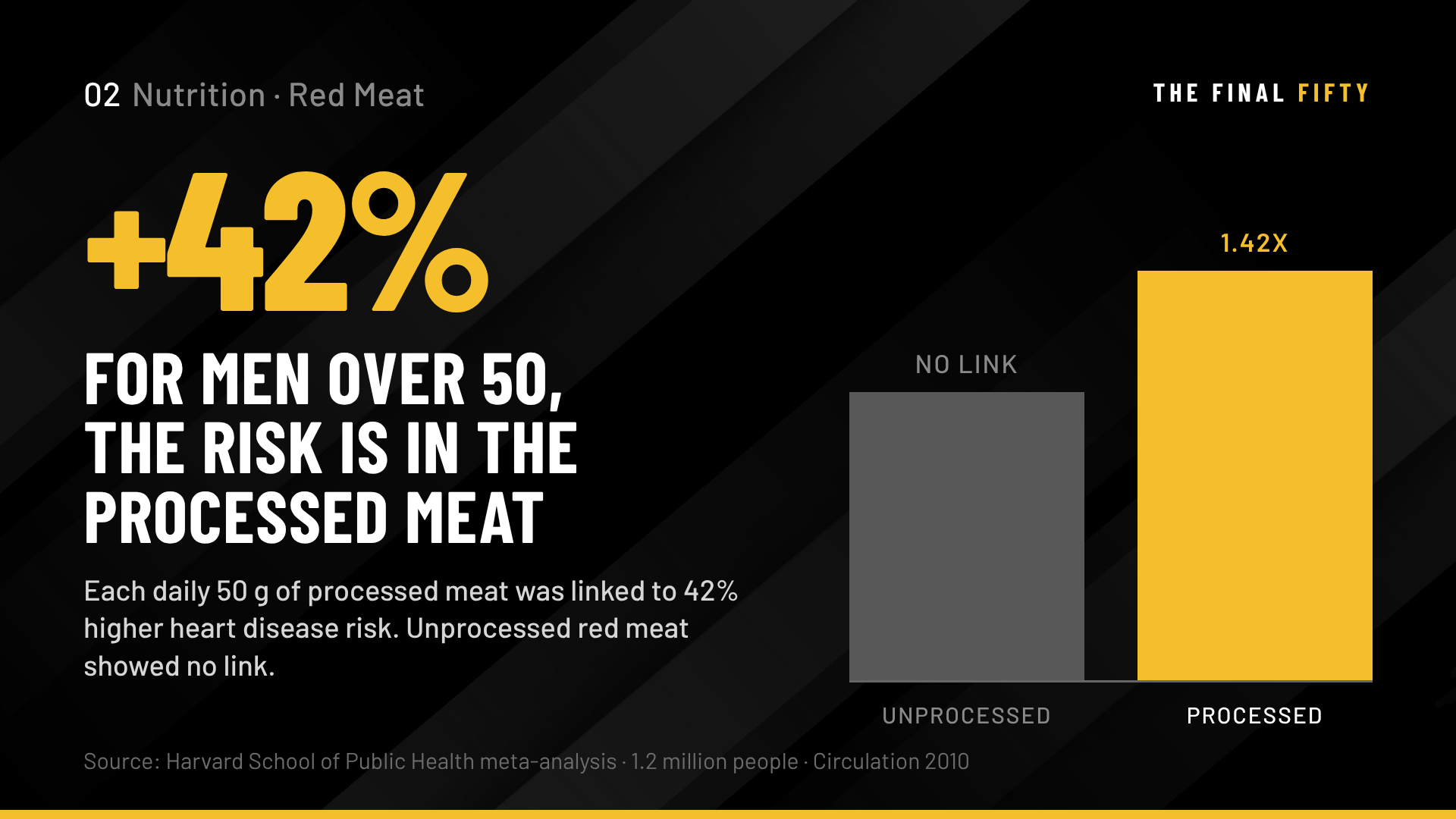
A meta-analysis pooling data from over 600,000 participants found that each 50-gram daily serving of processed meat was associated with a 42 percent higher risk of coronary heart disease. Unprocessed red meat, by contrast, showed no significant association with heart disease risk at intakes up to 100 grams per day in pooled analyses of multiple cohorts. In cardiovascular mortality specifically: intake of unprocessed red meat was not significantly associated with total or cause-specific mortality, while intake of processed meat was associated with a 30 percent higher rate of cardiovascular disease per 50 grams per day. The researchers identified preservatives as the notable difference, calculating that the blood-pressure effects of sodium content, approximately 400 percent higher in processed meats, explain most of the observed higher risk.
The cancer evidence follows the same pattern. Processed meat has been classified as a Group 1 carcinogen by the World Health Organization, meaning the evidence that it causes colorectal cancer is considered sufficient. Unprocessed red meat is classified as Group 2A, probably carcinogenic, a meaningfully lower classification reflecting weaker and more uncertain evidence. A large analysis of data from the Nurses’ Health Study and Health Professionals Follow-up Study found that processed meat intake was positively associated with colorectal cancer risk, while unprocessed red meat showed an inverse association with distal colon cancer and only a weak, non-significant positive association with proximal cancer.
The critical practical implication is that the bacon, sausage, deli meat, hot dogs, and cured meats that constitute processed red meat are in a completely different risk category from the steak, ground beef, and roasts that constitute unprocessed red meat. A man who eliminates or minimizes processed meat while maintaining unprocessed red meat as a component of his diet is addressing the primary source of risk while preserving the nutritional benefits. A man who restricts all red meat based on the headline risk claims may be eliminating one of the most nutrient-dense foods in his diet based on a conflation the research does not support.
What Unprocessed Red Meat Actually Delivers
The case for unprocessed red meat in the diet of men over fifty is not built only on what the risk evidence does not show. It is built on what red meat provides that matters specifically for the physiological demands of the second half.
Unprocessed red meat is a highly bioavailable source of essential nutrients. It possesses an exceptionally high indispensable amino acid score, rich in leucine, which is the primary molecular trigger for muscle protein synthesis. The leucine threshold for maximally stimulating muscle protein synthesis in older men, established in the protein articles in this series, is reliably met by a modest serving of beef, without the volume of food that lower-leucine protein sources would require to achieve the same anabolic signal.
Beyond the amino acid profile, red meat provides heme iron at a bioavailability of 15 to 35 percent, compared to 2 to 20 percent for the non-heme iron found in plant foods. It provides zinc at levels and in forms that the body absorbs two to three times more efficiently than from plant sources, a critical micronutrient for testosterone production and immune function. It provides vitamin B12 in direct, immediately usable form, without the conversion inefficiency that characterizes B12 precursors in plant foods. A three-ounce serving provides approximately 45 percent of the daily protein requirement and 35 percent of the daily B12 requirement for most adult men.
Red meat also contains several bioactive compounds that are difficult or impossible to obtain from plant sources and that have specific relevance for men over fifty. Creatine, found only in animal foods, fuels rapid energy demands in muscle and brain tissue and directly supports the high-intensity training described throughout this platform. Men who do not eat animal foods have significantly lower muscle creatine stores than omnivores, and the training performance difference is measurable. Carnosine and anserine support cellular energy production and intramuscular buffering during high-intensity exercise. Taurine supports cardiovascular function and neurology. None of these compounds are obtained from plant sources at meaningful levels.
Grass-fed beef provides a meaningfully superior nutritional profile in the dimensions most relevant to the anti-inflammatory and hormonal health objectives of the Final 50. Grass-fed beef is significantly higher in conjugated linoleic acid, a fatty acid with anti-inflammatory and body composition benefits, and provides an omega-6 to omega-3 ratio of approximately 1.5 to 1 compared to grain-fed beef’s approximately 7.5 to 1. It also contains significantly more vitamin E and other antioxidants. The distinction between grass-fed and grain-fed is not merely a sourcing preference. It is a nutritional difference with direct relevance to the inflammatory and hormonal management objectives that the second half demands.
How to Think About Red Meat After 50
The framework that the research supports for men over fifty is neither the unrestricted consumption of any form of red meat nor the blanket restriction that the headline version of the story implies. It is a specific, evidence-informed approach built around the distinctions the research establishes.
Processed meat, defined as meat that has been industrially processed by adding sodium, nitrites, preservatives, or coloring agents, or that has been smoked, dried, cured, or fermented to extend shelf life, belongs in the restricted category. The evidence that processed meat elevates cardiovascular and cancer risk is the strongest in the entire red meat literature, and the mechanism is well understood. Minimizing bacon, sausage, deli meats, hot dogs, and other industrially processed meat products is supported by the evidence. This is the category the headline warnings are most accurately describing.
Unprocessed red meat, specifically beef, bison, lamb, and venison that has not undergone industrial preservation processing, occupies a different evidential position. The controlled trial evidence does not establish a clear cardiovascular risk link at moderate consumption levels. The observational associations, when properly controlled for confounding lifestyle factors, are substantially weaker than the headline versions suggest. And the nutritional benefits, particularly the leucine density, heme iron, zinc, creatine, and B12, are directly relevant to the specific physiological demands of men over fifty who are training seriously, managing their hormonal health, and building the second half on a foundation of genuine nutritional adequacy.
Quality sourcing is the third variable. Grass-fed, minimally processed, fresh unprocessed beef provides a different nutritional profile than conventional grain-fed beef, and the difference is meaningful specifically in the dimensions of omega-3 content, CLA, and antioxidant density that the inflammatory management objectives of this platform prioritize. When the sourcing investment is available, it is warranted on the evidence.
The man over fifty who eats unprocessed red meat at reasonable frequency as part of an overall diet built around the animal-based nutritional foundation this series has described, who limits or eliminates processed meat, who sources grass-fed when practical, and who understands the actual state of the evidence rather than the headline version of it is not making a reckless dietary choice. He is making one of the most nutrient-dense choices available to him, informed by a more honest reading of the research than most nutrition headlines provide.
THE FINAL 50 FRAMEWORK
THE REFRAME
The red meat conversation has been dominated by headlines that collapse the critical distinction between processed and unprocessed meat, draw primarily from observational studies with significant confounding limitations, and generate more certainty about risk than the controlled trial evidence supports. The man who restricts all red meat based on this headline version may be eliminating one of the most nutrient-dense foods available to him while the actual primary risk driver, processed meat specifically, goes unaddressed. The research supports precision, not blanket restriction.
THE STANDARD
The Final 50 man distinguishes between processed and unprocessed red meat as a non-negotiable dietary principle. Processed meat, products with added sodium, nitrites, preservatives, and industrial curing processes, is minimized or eliminated. Unprocessed red meat, fresh beef, bison, lamb, and other minimally processed forms, is included as a foundation of the animal-based diet this platform recommends, sourced grass-fed where practical. He eats red meat for what it provides: leucine for muscle protein synthesis, heme iron for oxygen-carrying capacity, zinc for testosterone production, creatine for training performance, and B12 for neurological function. He does not avoid it based on headlines he has not read carefully.
THE PRACTICE
This week, conduct an honest audit of the red meat you currently eat. Separate the processed forms, any meat with added preservatives, sodium nitrites, curing agents, or extended shelf-life processing, from the unprocessed forms. If your current red meat intake is primarily processed, the first change is the category shift: replace processed with unprocessed. If you have been avoiding red meat entirely based on health concerns, look honestly at whether those concerns are supported by the controlled trial evidence this article describes or primarily by observational associations with significant confounding limitations.
THE AUDIT
What is the current ratio of processed to unprocessed red meat in your diet? What is your current source: conventional grain-fed or grass-fed? Do you know your serum zinc levels, since zinc deficiency, measurable through blood work, directly suppresses testosterone production and immune function, and red meat is one of the most bioavailable sources available? These three questions tell you where the nutritional gap between what you are currently eating and the evidence-based approach this platform describes sits.
THE PROMPT
The men in your brotherhood are each making red meat decisions based on varying combinations of the headline narrative, personal preference, and whatever they have read or been told by their physicians. Few of them have had the processed versus unprocessed distinction explained clearly, and fewer still have considered the sourcing variable in terms of what the nutritional profile difference produces. What would it look like to share the actual state of the evidence inside the brotherhood, to compare what each man is currently eating against what the research supports, and to hold each other to a standard that is informed by the evidence rather than the headline?


