There is a version of the evening that most men over fifty know intimately. The day ends. The obligations release. The body lands on the couch. The television turns on, or the phone comes out, or both happen simultaneously in a half-attentive combination that occupies the next two to three hours with something that does not quite constitute entertainment and does not constitute rest. It is passive consumption, and it is the default state of the evening for most men in the second half of their lives.
The default feels earned. After a day of decisions, demands, and output, the pull toward something that asks nothing in return is real and understandable. The problem is not the desire to stop producing. The desire to stop producing is healthy and appropriate. The problem is that the specific form most men use to satisfy it, passive screen consumption, is neither the rest it feels like nor the recovery the biology requires. It is a low-grade stimulation of the alert system that simultaneously produces none of the cognitive benefits of genuine relaxation and accumulates costs that show up in sleep quality, cognitive health, and the use of the limited daily hours that the second half has finally freed up.
The evening question is not whether to wind down. It is how to wind down in a way that restores what the day depleted, without surrendering two to three hours to a habit that delivers less than it promises.
What Passive Screen Consumption Is Actually Doing
The research on passive television viewing in adults over fifty is specific and sobering enough to warrant being named directly rather than left in the comfortable vagueness most men assign to the habit.
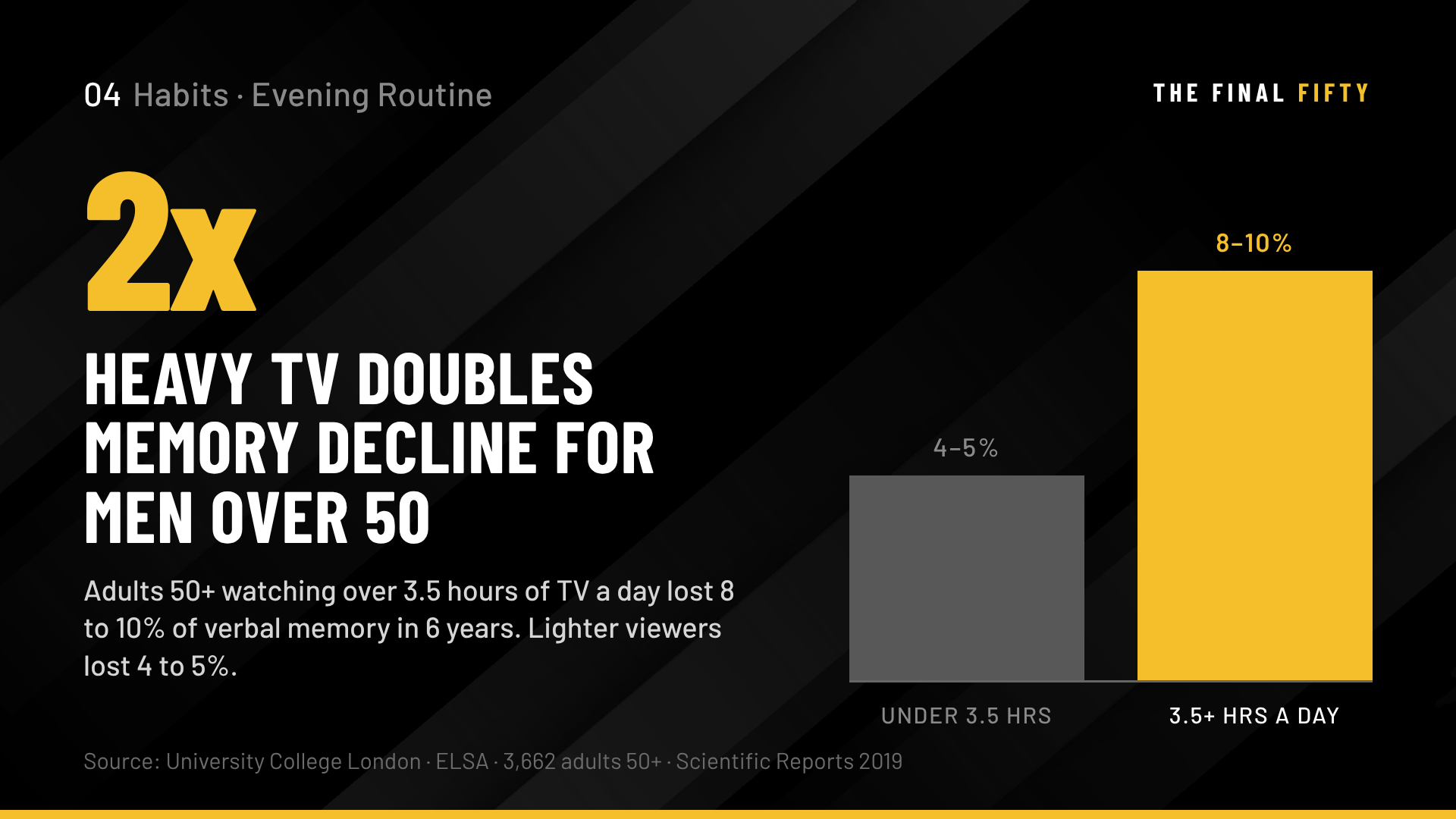
A study using data from the English Longitudinal Study of Aging involving 3,662 adults aged 50 and over found that watching television for more than 3.5 hours per day is associated with a dose-response decline in verbal memory over the following six years, independent of confounding variables. These results were found particularly among those with better cognition at baseline. The research distinguished between television watching and other sedentary activities: while using the internet, which requires active engagement, was associated with cognitive preservation, passive television viewing was not. The sedentary nature of television was not the sole explanation. The passivity was.
A Mendelian randomization analysis found that genetic predisposition to increased television watching time remained significantly associated with worse cognitive function after adjustment for body mass index, physical activity, and education. The researchers noted that passive sedentary behavior such as watching television is associated with a higher risk of depression, unlike sedentary behavior involving mentally engaging activities such as playing computer games. The distinction is not between sitting and not sitting. It is between passive and active cognitive engagement during the sitting.
A study examining mentally passive versus active sedentary behavior over nearly twenty years found that those who added an hour of mentally active sedentary behavior, reading, knitting, puzzles, while maintaining their usual levels of physically and mentally passive sedentary behavior, saw an 11 percent lower risk of developing dementia. The protective effect was especially pronounced among participants ages 50 to 64. The researchers concluded that how the brain is used while sitting appears to be a crucial determinant of future cognitive functioning and may predict dementia onset.
Sedentary screen time, television viewing and video streaming outside of work and educational pursuits, consumes more than half of available discretionary time and is the single most prevalent use of time for Americans outside of work and sleep. It poses far greater health risks than other sedentary pursuits.
The evening hours that feel like downtime are producing cognitive and health consequences that accumulate invisibly across years. This is not a moral argument about productivity. It is a biological argument about what passive screen consumption does to the brain and body of a man over fifty who has not chosen it deliberately so much as arrived at it by default.
Why the Evening Feels Different After 50
Men over fifty typically have more unstructured evening time than they did during the peak demand years of building a career and raising children. The schedule that used to fill those hours has changed. The children are older or gone. The professional output, while still significant, is more experienced and less frantic. There is space in the evening that was not there before, and that space carries a specific risk: it fills with whatever requires the least conscious decision to initiate.
Passive screen consumption requires essentially no decision. It is already set up, already accessible, already normalized by the culture that surrounds it. The television is there. The streaming queue is there. The phone is already in the hand. The path of least resistance in the evening is the one most traveled precisely because it is the lowest-friction option available.
The irony is that this is the same period of life when the evening hours have finally become genuinely available for something meaningful. The man at fifty-three who has two or three hours of genuine discretionary time in the evening is holding a resource that the man at thirty-eight who was putting children to bed and answering late emails could not access. What he does with that resource is one of the most consequential daily decisions available to him in the second half of his life. Whether he is aware of having made a decision at all is the variable that determines the outcome.
The Active Leisure Alternative
The research literature on what produces the cognitive protection, the stress reduction, the wellbeing outcomes, and the genuine restoration that men believe they are getting from passive screen consumption consistently points toward a different category of evening activity: active leisure.
Active leisure is not intensive. It is not the opposite of rest. It is engagement, the state of being absorbed in something that requires a modest level of attention and skill, produces a sense of progress or mastery, and returns the person to the present moment rather than the stimulation-without-engagement pattern that passive consumption produces. The research on this consistently shows that active sedentary behavior, the kind that engages the brain in a creative, strategic, or learning task, produces cognitive benefits and wellbeing outcomes that passive sedentary behavior does not.
Engaging in hobbies has beneficial effects on objective and subjective cognitive functions, which are consistent across cultures, highlighting the importance of incorporating hobby activities into global public health strategies, particularly for aging populations. A scoping review published in 2025 found that hobbies help connect people, build relationships, and promote a sense of community, with several studies noting lower levels of depression, anxiety, or stress as direct benefits of hobby participation.
The specific activities that qualify as active leisure for a man over fifty are not exotic or demanding. Reading, particularly books that require genuine attention and offer the absorption that sustained narrative or argument produces, is the single most accessible and most consistently researched alternative to passive screen consumption. It is cognitively engaging without being cognitively demanding. It requires no equipment, no scheduling, no preparation. It is available for any number of minutes the evening provides.
Physical hobby engagement, whether that is something a man has maintained across his adult life or something new he develops in the second half, provides the combined benefit of physical movement and cognitive engagement that passive consumption provides for neither. Woodworking, cooking that goes beyond routine preparation, musical practice, any form of skill-based physical activity, requires the attentional engagement and the sense of progress that passive consumption structurally cannot offer.
Social connection in the evening is the third category, and it is the one most consistently undervalued by men who have absorbed the cultural norm that the evening is a solo recovery period. The research on social connection and male wellbeing is unambiguous: the quality of a man’s relationships is one of the strongest predictors of longevity, cognitive health, and mental wellbeing available in the epidemiological literature. An evening hour spent in genuine conversation with a partner, a friend, or a man from the brotherhood produces different biological outcomes than an evening hour spent watching a screen in the same room as those same people.
The Transition Problem: How to Move from Default to Deliberate
The challenge with changing the evening default is not motivation. Most men who understand the research described above are motivated to use their evenings better. The challenge is that the passive screen habit is deeply embedded in the architecture of the evening. The television is in the room. The remote is on the table. The streaming service opens automatically. The phone notifications arrive. The habit has structural support that the alternative does not.
Changing the default requires changing the architecture before the motivation is tested. The phone goes in another room at a defined time, not when the man decides he has had enough of it, but at a set time before the decision point arrives. The television stays off for the first hour after dinner, not because the man is denying himself entertainment but because the first hour is when the alternative habit needs space to establish itself. The book goes on the table where the remote used to be. The craft project stays set up and visible rather than packed away. The friction for the active alternative must be lower than the friction for the passive one if the architecture is going to support the behavior change.
Building one specific evening practice for a defined period, thirty days is the minimum threshold at which new habits begin to require less conscious maintenance, produces a different outcome than deciding in general to watch less television. The specificity of the practice, reading for thirty minutes immediately after dinner, calling a friend from the brotherhood on Tuesday evenings, spending one hour on a specific project three evenings a week, is what creates the structure that passive consumption currently occupies. Nature abhors a vacuum. The evening hours that are freed from passive consumption do not automatically fill with something better. They fill with whatever is most accessible. The practice is what determines what that is.
What the Evening Is Actually For
The evening hours in the second half of life are not a holding pattern between the productive day and the sleep that follows it. For a man who has done the morning routine work, who has trained, who has managed his professional output, who has invested in his relationships, the evening is the one unstructured period where the agenda belongs entirely to him.
What a man does with that period reflects his values and his priorities in a way that nothing else in the daily schedule does, because nothing else in the daily schedule is truly unstructured. The morning has its protocol. The training session has its program. The professional hours have their demands. The evening is where a man chooses, either deliberately or by default, how he uses the discretionary capacity that remains when everything obligatory is complete.
A man who winds down deliberately, who uses the evening for genuine restoration through active engagement, for connection with the people who matter most, for the development of a skill or craft or knowledge that the first half never had time for, is not sacrificing the rest his body needs. He is building the kind of evening that produces better sleep, better cognitive health, and a richer sense of the life he is building in the second half than two hours of passive consumption ever has or ever will.
The screens are not the enemy. Passive consumption is not morally wrong. But it is an expensive way to spend the hours that the second half has finally made available, and most men who use those hours passively by default have never made a conscious decision to do so. The deliberate alternative is not harder. It is simply chosen rather than defaulted into.
That choice is available tonight.
THE FINAL 50 FRAMEWORK
THE REFRAME
Passive screen consumption is not rest. It is low-grade stimulation of the alert system that produces neither the cognitive engagement of active leisure nor the physiological restoration of genuine recovery. The research on television viewing and cognitive decline in adults over fifty is specific: more than 3.5 hours per day is associated with measurable decline in verbal memory over six years. The evening hours are not a reward for the day’s effort. They are the last significant discretionary resource in the day, and how a man uses them determines what the second half produces.
THE STANDARD
The Final 50 man has a deliberate evening practice that is not passive screen consumption. He reads for a defined period each evening. He maintains one or more active leisure pursuits that require engagement rather than mere attention. He invests genuine, non-logistical time in his closest relationships at least several evenings per week. His television and phone use is chosen deliberately rather than defaulted into. The evenings belong to him because he has claimed them.
THE PRACTICE
This week, establish one structural change to the evening architecture: the phone goes in another room at 8:30 PM, or whatever time is thirty minutes before the passive consumption typically begins. Put something in its place that requires active engagement. A book on the table. A project set up and visible. A recurring call scheduled with someone from the brotherhood. Make the active option physically closer and lower-friction than the passive one. Hold this structural change for seven consecutive evenings. The architecture is the practice.
THE AUDIT
How many hours did you spend in passive screen consumption last week across the evening hours? Be specific. Count the evenings and estimate the hours. Then ask what the alternative use of those hours would have produced: what would you have read, built, learned, or experienced if those hours had been available? The gap between what was consumed and what was possible is the actual cost of the default. Seeing it clearly makes the deliberate choice available.
THE PROMPT
The men in your brotherhood are spending their evenings in approximately the same way, and none of them are discussing it. Most of them have not consciously chosen passive consumption as the primary use of their discretionary time. They have simply arrived there by the path of least resistance. What would it look like to share what each of you is doing with the evening hours, what active practice you have built or are building, and to hold each other accountable not just to the training standard but to the standard of how the discretionary hours are used? That conversation reframes the second half in a way that the morning conversation cannot reach.