
The man over fifty who looks at his body composition and decides to do something about it almost always arrives at the same starting point: the approach that worked before. Reduce calories. Do more cardio. Tighten up the diet. Cut the obvious excesses. This approach worked reasonably well at thirty-five, well enough to produce visible results within weeks, and the expectation is that applying it again will produce the same results.
It does not produce the same results. Not because the man is doing something wrong, and not because the biology has broken in some irreversible way. It is because the approach that worked at thirty-five was designed for a biological context that has changed significantly by fifty-five. The same inputs applied to the changed context produce different and typically much less satisfying outputs, and the man who does not understand what has changed cannot adjust his approach to account for it.
The changes are specific. The appropriate response to each of them is also specific. This article names both.
What Has Changed and What Has Not
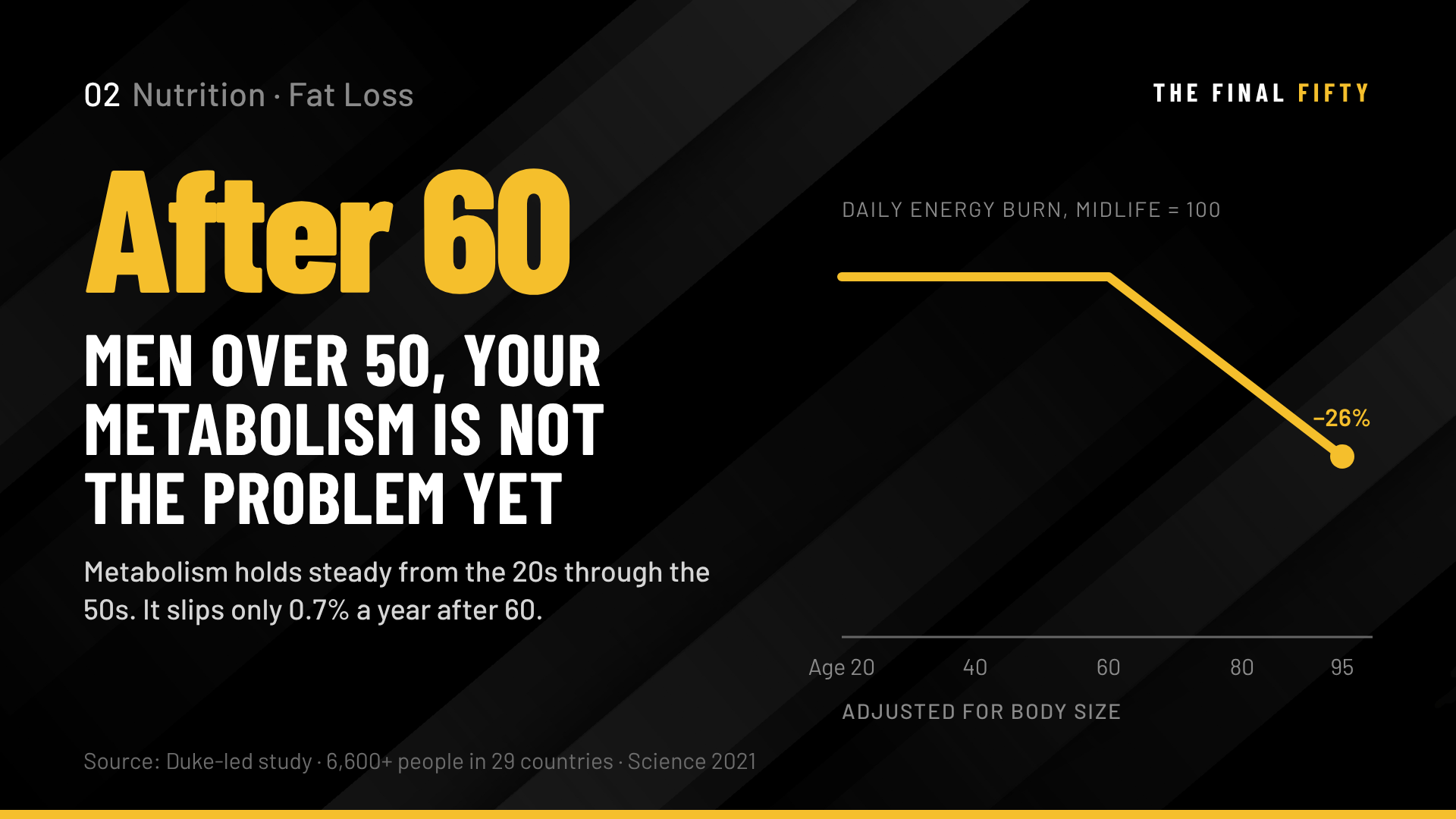
The first myth worth addressing before the practical approach is the one that causes the most confusion: the widespread belief that metabolism crashes after fifty and that the metabolic decline of aging is the primary reason fat loss becomes harder. The research does not support this narrative at the scale most men assume.
Metabolism remains relatively stable between ages 20 and 60, only declining modestly after that point. A study of 959 people found that individuals aged 70 had about 20 pounds less muscle mass and an 11 percent slower resting metabolic rate compared to those aged 40. The metabolic impact is real but not catastrophic, and it is driven primarily by muscle loss rather than by an inherent metabolic slowdown that is independent of body composition. The man who has maintained or built muscle through his fifties has a significantly higher resting metabolic rate than the man who has lost muscle across the same period, and the gap between them is larger than the gap produced by age alone.
What has changed significantly by fifty is the hormonal environment governing the relationship between caloric intake, muscle retention, and fat loss. Testosterone declines by approximately one to two percent per year after the mid-thirties, and by fifty the cumulative reduction is meaningful enough to change how the body responds to caloric restriction. Lower testosterone levels lead to decreased muscle mass and increased body fat, particularly visceral fat, and affect the hormones that regulate appetite and metabolism. The man at fifty-five operating in a testosterone environment that is 20 to 30 percent lower than it was at thirty-five is not experiencing a simple reduction in metabolic rate. He is experiencing a shift in the hormonal signals that determine whether a caloric deficit produces predominantly fat loss or predominantly muscle loss.
Insulin resistance increases with age, visceral fat accumulation, and reduced physical activity, creating a metabolic environment in which the glucose disposal that was efficient at thirty-five becomes less efficient at fifty-five. Insulin resistance more pronounced in the second half means that the same carbohydrate inputs that were managed without significant consequences in the first half are now driving the blood glucose elevations and subsequent fat storage that contribute to the body composition problem the man is trying to address.
The appetite regulation system has also changed. Leptin, the hormone that signals fullness, becomes less effective with age, particularly in the presence of chronic inflammation or excess body fat. Ghrelin, the hunger hormone, may not decline as sharply after meals. This means hunger signals are less reliable at fifty-five than they were at thirty-five: a man may feel hungrier more often and less satisfied after eating even when his caloric intake is adequate for fat loss purposes. The approaches that relied on hunger as the primary signal for caloric management become less reliable precisely when precise caloric management matters most.
The Problem With the Old Approach
The fat loss approach most men over fifty default to, reduce calories and do more cardio, fails at the second half for a specific reason that the research now documents with enough precision to be stated directly: caloric restriction without resistance training produces muscle loss alongside fat loss, and in men over fifty the proportion of weight lost as muscle is dramatically higher than most men assume.
The evidence is specific and recent. A systematic review of individuals aged 50 and older with BMI above 25 found that 81 percent of those in the energy restriction-only group lost 15 percent or more of their total weight loss as fat-free mass. Muscle. Not fat. Of the weight that left the body during caloric restriction alone, more than one seventh was muscle in eight out of ten men studied. The remaining 19 percent of the group who did not lose significant muscle are likely men who were already at low body fat percentages with minimal excess fat available, making muscle loss the path of least resistance for the caloric deficit to satisfy itself.
A 2025 to 2026 study in Frontiers in Endocrinology measuring the effects of resistance training, aerobic training, and no exercise during a calorie-restricted diet found that only resistance training participants gained fat-free mass while reducing fat mass. The aerobic exercise group preserved some fat-free mass but did not gain it. The no-exercise group lost significant fat-free mass. In men specifically, the resistance training group gained an average of 1.15 kilograms of fat-free mass while losing fat. This is the body recomposition outcome — simultaneously losing fat and gaining muscle — that most men have been told is impossible or nearly impossible, particularly in men over fifty. The evidence says it is not only possible but the expected outcome when resistance training is combined with adequate protein and a moderate caloric deficit.
The cardiovascular-only approach to fat loss fails for men over fifty for a second reason beyond muscle loss: elevated cortisol from chronic moderate-intensity cardio without adequate recovery actively works against the hormonal environment that fat loss requires. Extended moderate-intensity cardio sessions elevate cortisol, and sustained cortisol elevation promotes visceral fat retention, suppresses testosterone, and impairs the insulin sensitivity that determines how efficiently the body processes the caloric deficit. The approach that produced weight loss at thirty-five by creating a caloric deficit through cardio is creating a hormonal environment at fifty-five that partially offsets the caloric deficit it produces.
The Correct Approach: Body Recomposition as the Goal
The shift in goal from weight loss to body recomposition is the most important conceptual adjustment a man over fifty can make to his fat loss approach, and it is the one that the research most directly supports as appropriate for this demographic. The target is not simply less mass. It is less fat mass and maintained or increased muscle mass. The scale is not the primary indicator of success. Body composition is.
A simple 3 percent loss of initial body weight already reduces the risk of fatty liver disease by 31 percent, according to 2024 research published in Maturitas. Waist circumference, a proxy for visceral fat, is a better indicator than scale weight alone. The man whose waist measurement is decreasing while his scale weight holds steady or decreases only modestly may be achieving better health outcomes than the man whose scale weight drops more dramatically but whose muscle loss is accompanying the fat loss at a ratio that is not serving his second-half health objectives.
Body recomposition as the goal reorients the entire approach. Caloric restriction becomes moderate rather than aggressive, because aggressive restriction accelerates muscle loss by depriving the body of the raw material that muscle protein synthesis requires. The appropriate caloric deficit for men over fifty aiming for body recomposition is 300 to 500 kilocalories per day below maintenance, producing weight loss at a rate of 0.3 to 0.6 kilograms per week. Progressive weight loss at this rate preserves muscle to a far greater degree than the aggressive restriction that most men default to when they decide to lose fat, and it produces a hormonal environment in which the resistance training stimulus can still drive muscle protein synthesis even in the presence of a caloric deficit.
Protein is the nutritional variable that most directly determines whether the caloric deficit produces fat loss or muscle loss alongside fat loss. The protein target for men over fifty during fat loss is 1.6 to 2.2 grams per kilogram of bodyweight daily, with emerging research supporting the higher end of this range during caloric restriction specifically to protect against the muscle loss that the deficit would otherwise accelerate. At 200 pounds, this target is 145 to 200 grams of protein per day. That level of protein intake during a moderate caloric deficit, combined with resistance training, is the combination that the research identifies as producing body recomposition rather than simple weight loss in men over fifty.
The Training Requirement
The research finding that only resistance training participants gained fat-free mass during caloric restriction establishes resistance training not as a supplementary component of the fat loss approach but as the primary component. The nutritional approach creates the conditions. The training produces the outcome.
Resistance training during fat loss works through a specific mechanism: the training stimulus signals to the body that the muscle is being used and therefore needs to be preserved and ideally strengthened, even in the presence of reduced caloric availability. Without that signal, the caloric deficit has no reason to preferentially target fat stores over muscle. The body reduces mass from wherever it is most metabolically convenient to reduce it, which in a man with declining anabolic hormones is often muscle. The training signal changes the equation: it tells the body that muscle is load-bearing and essential, and the caloric deficit draws primarily from fat stores rather than from the muscle that the training is actively requiring.
The resistance training protocol that most effectively supports fat loss in men over fifty is the same compound-movement-based, progressive overload protocol described throughout the fitness pillar of this series. Squats or squat variations, hip hinge patterns, horizontal and vertical pushing and pulling, with progressive load increases as strength develops. This is not a different program for fat loss. It is the same program with the nutritional environment adjusted to create the moderate deficit that produces fat loss while the training preserves and builds muscle.
The Zone 2 cardiovascular training described in the cardiovascular articles contributes to fat loss through its effect on fat oxidation capacity and its improvement of insulin sensitivity, without the cortisol-elevating, muscle-depleting consequences of chronic high-volume moderate-intensity cardio. Two to three Zone 2 sessions per week of 40 to 60 minutes complement the resistance training without competing with it for recovery resources. The combination of three to four resistance training sessions and two to three Zone 2 sessions per week, with the protein and caloric targets described above, is the complete fat loss approach that the research supports for men over fifty. It is not the approach most men attempt. It is the approach that works.
The Variables That Most Commonly Undermine the Approach
Understanding the correct approach is the starting point. Understanding what undermines it in practice is what determines whether the approach produces results over months rather than weeks of initial progress followed by a plateau.
Sleep is the most commonly underweighted variable in fat loss for men over fifty. Sleeping fewer than seven hours per night is associated with increased abdominal fat and difficulty losing weight. Sleep deprivation raises cortisol, disrupts the hunger hormones leptin and ghrelin in the directions that increase appetite and reduce satiety, reduces insulin sensitivity, and suppresses the testosterone and growth hormone release that recovery from resistance training requires. The man who is training correctly, eating correctly, and sleeping inadequately is fighting his own fat loss approach through the hormonal environment his sleep deprivation is producing.
Alcohol is the second. Alcohol adds caloric intake that most men do not account for, impairs fat metabolism during the hours following consumption, disrupts the sleep architecture that the overnight hormonal recovery depends on, and elevates cortisol. For men who consume alcohol regularly, the honest accounting of its contribution to the caloric environment and its hormonal consequences is frequently the most direct explanation for why fat loss is not progressing despite apparent adherence to the dietary and training approach.
Stress management is the third. Chronic cortisol elevation from unmanaged stress promotes visceral fat retention specifically, because visceral adipose tissue has a higher concentration of cortisol receptors than subcutaneous fat. The man who is training, eating correctly, and sleeping adequately but carrying significant unmanaged chronic stress may find his visceral fat particularly resistant to reduction because the cortisol environment is actively defending those stores. The stress management work described in the mental performance pillar is not separate from the fat loss approach. It is a component of it.
The fourth is the measurement error that most men make by tracking scale weight rather than body composition. The body recomposition that resistance training produces during a moderate caloric deficit in men over fifty may produce weeks where the scale does not move or moves minimally, because fat loss and muscle gain are occurring simultaneously and partially offsetting each other on the scale. The man who is using scale weight as his primary indicator abandons a working approach because the measurement he is tracking is not the measurement that reflects the outcome he is achieving. Waist circumference, body fat percentage where measurement is available, and the mirror alongside performance metrics are better indicators of whether the body recomposition approach is working than the scale alone.
THE FINAL 50 FRAMEWORK
THE REFRAME
Fat loss after fifty is not the same process as fat loss at thirty-five, and applying the thirty-five approach to the fifty-five biology produces the fifty-five results that most men are frustrated by. The rules have changed specifically and addressably. The caloric restriction that produced fat loss at thirty-five produces muscle loss alongside fat loss at fifty-five when it is not combined with resistance training and high protein intake. The cardiovascular approach that created the deficit at thirty-five creates a cortisol environment at fifty-five that partially offsets the deficit it produces. The goal is not weight loss. It is body recomposition. The approach is different. The outcomes, when the approach is correct, are real.
THE STANDARD
The Final 50 man pursuing fat loss operates from the body recomposition framework: a moderate caloric deficit of 300 to 500 kilocalories below maintenance, a protein target of 1.6 to 2.2 grams per kilogram of bodyweight daily, four resistance training sessions per week using progressive compound movements, and two to three Zone 2 cardiovascular sessions of 40 to 60 minutes. He protects seven to nine hours of sleep as a non-negotiable component of the fat loss approach. He manages chronic stress as a specific fat loss variable rather than as a general wellbeing concern. He tracks waist circumference and body composition rather than scale weight as his primary progress indicators.
THE PRACTICE
This week, calculate your actual protein intake across three consecutive days using a food tracking application. Do not estimate. Track every protein-containing food and sum the grams. Compare the result to your target of 1.6 to 2.2 grams per kilogram of bodyweight. For most men over fifty who have not specifically tracked protein, the result will be significantly below target. The protein gap is the most commonly overlooked and most directly addressable variable in second-half fat loss. Close the gap this week by identifying the specific meals where protein is lowest and making one specific change to each. That is the starting adjustment.
THE AUDIT
How many of the four variables most commonly undermining second-half fat loss are present in your current approach? Insufficient sleep below seven hours. Regular alcohol consumption whose caloric and hormonal contribution has not been honestly accounted for. Unmanaged chronic stress producing a cortisol environment that defends visceral fat. Scale weight as the primary progress indicator obscuring body recomposition that is occurring but not being credited. Each of these is addressable. The audit tells a man which ones are most relevant to why his current approach is producing less than the results his effort deserves.
THE PROMPT
The men in your brotherhood are each navigating the fat loss challenge of the second half with varying degrees of understanding about what has changed and what the correct approach looks like now. Most of them are still applying a version of the approach that worked in an earlier biological context and getting the results that approach produces in the current one. What would it mean to compare body composition approaches honestly inside the brotherhood, to share what each man’s protein intake, training protocol, and sleep investment look like, and to hold each other to the standard that the research supports rather than the conventional wisdom that does not apply to where you are now?


