
Two men are training. Same age, same program, same gym. One is training to maintain his health because his physician told him he should. The other is training because he has a specific vision of who he intends to be at seventy, because that vision is connected to the contribution he is making to the people around him, and because every session is a specific investment in the physical infrastructure that the second half’s mission requires. They are doing the same work. They are not in the same biological state while doing it, and over time they will not produce the same outcomes.
The difference is purpose. Not enthusiasm. Not motivation, which comes and goes with circumstances and mood. Purpose: the sustained sense that what the man is doing is connected to something that matters beyond the immediate activity, that the work of the second half is building toward something specific and meaningful, and that the man’s continued investment in his health, his relationships, his professional contribution, and his daily standards is serving a direction that he has consciously chosen rather than simply maintaining patterns he has accumulated by default.
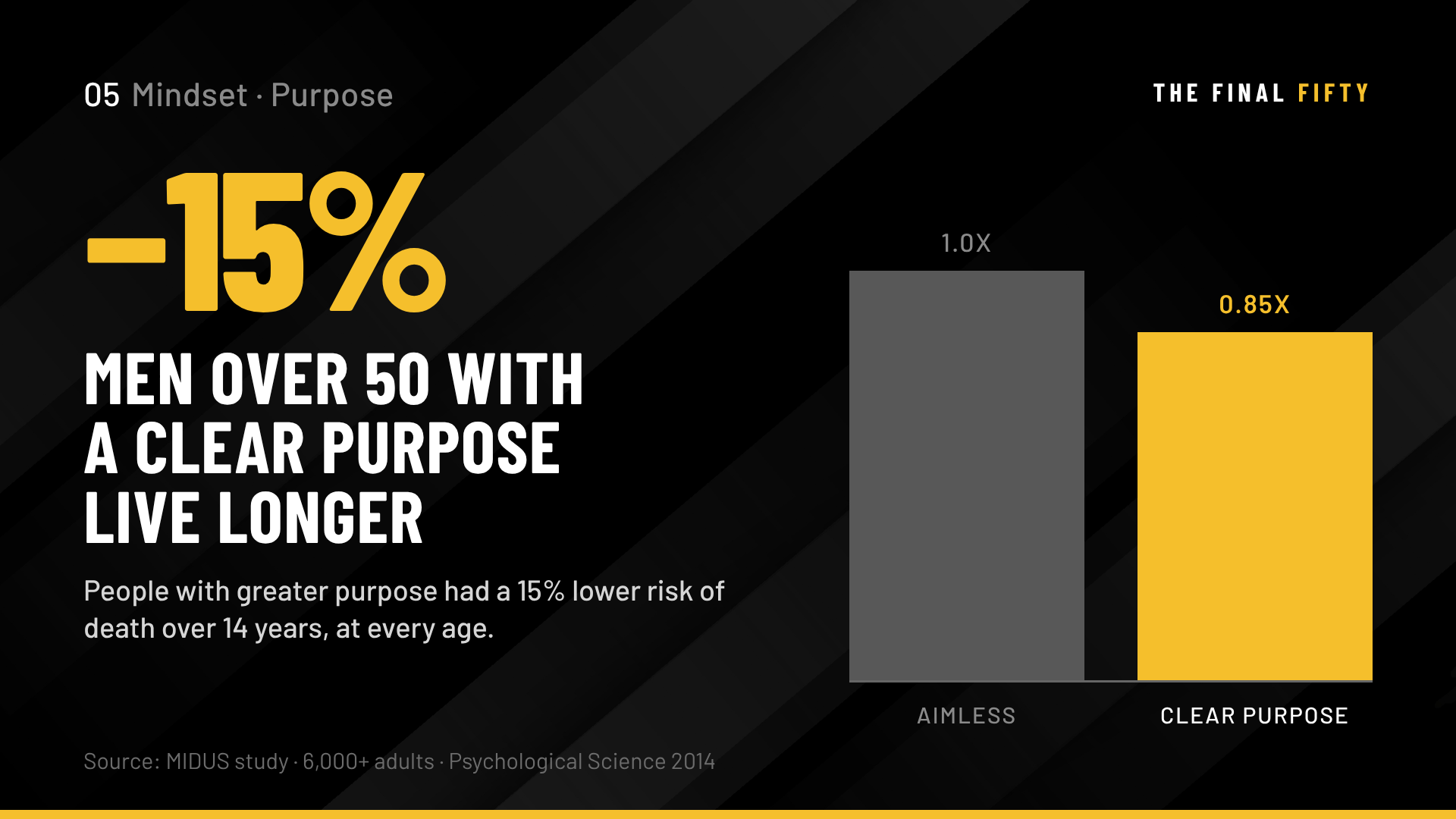
The research on purpose and health in adults over fifty has moved from correlation to mechanism in ways that make the distinction between the purposeful man and the purposeless man measurable at the biological level. A 2026 study published in the European Journal of Personality, using four waves of data from the Health and Retirement Study with 11,390 adults over fifty across twelve years, found that purpose predicts subsequent health more strongly than health predicts subsequent purpose. The man who has strong purpose maintains better health across the following years more reliably than the man with good health but diminished purpose maintains his health. The causal arrow points from purpose to health more than from health to purpose. This is not a soft finding about wellbeing. It is a hard finding about the biology of the second half.
The Mortality Finding: What 46 Percent Lower Risk Means
The mortality finding from the purpose research is specific enough to warrant direct engagement. A study by Eric Kim and colleagues found that older adults with the highest sense of purpose had a 46 percent lower risk of mortality over four years compared to those with the lowest scores. This mortality risk reduction is close to 1.8 times as effective as not smoking or engaging in physical activity in the same populations. The man over fifty who thinks carefully about the health investments most likely to protect his longevity trajectory and does not include purpose as one of the primary investments has omitted the variable with one of the largest documented effects.
The JAMA Network Open study that established the association between life purpose and mortality in US adults over fifty used data that allowed the researchers to control for demographic factors, socioeconomic status, and existing health conditions. The finding held across these controls: stronger purpose in life was independently associated with decreased all-cause mortality. Life purpose is a modifiable risk factor whose association with health outcomes is strong enough to warrant specific interventions. The man who treats his sense of purpose as a philosophical matter that is nice to have but separate from his health investment is treating a primary health variable as optional.
The 24 percent reduction in physical inactivity and the 33 percent reduction in sleep problems associated with higher purpose scores in research populations document the behavioral pathways through which purpose affects mortality: the purposeful man is more likely to maintain his physical investment, more likely to protect his sleep, and more likely to engage in the health behaviors that his purpose compels him to maintain because those behaviors are serving something he cares about deeply. Purpose does not replace the training. It is what makes the man more likely to train consistently, more likely to protect his recovery, and more likely to maintain the investment during the difficult periods that the second half reliably produces.
The Cortisol Mechanism: How Purpose Changes the Biology of Stress
The biological mechanism through which purpose produces its health benefits has been studied at the level of daily cortisol dynamics in ways that make the purpose-performance connection specific rather than abstract. A study of 170 older adults measuring salivary cortisol four times per day over seven consecutive days found that higher sense of purpose was associated with better management of and less reactivity to daily negative experiences, with lower cortisol responses to the same daily stressors compared to lower-purpose individuals in the same situations.
Cortisol is the primary stress hormone whose chronic elevation drives the inflammatory cascade, the sleep disruption, the hormonal suppression, and the accelerated biological aging that chronic stress produces across the second half. The man whose daily cortisol is elevated by the accumulated weight of undefined purpose, unclear direction, and the low-grade existential anxiety of a second half that is not organized around a clear mission is running a biological state that his training, his nutrition, and his sleep investments are all working against. The man whose purpose provides the psychological framework that makes daily adversity navigable rather than threatening is running a different cortisol profile from the same life events, and that difference compounds across years into a measurable divergence in biological age.
The mechanism is specific: purpose provides what researchers call an appraisal buffer, a cognitive framework that interprets stressors against the larger context of what the man is building. The difficult professional situation is harder for the man with no sense of direction than for the man who knows the difficult situation is one episode in a meaningful trajectory. The health challenge is more threatening for the man who has no purposeful context in which to locate it than for the man whose purpose gives him a reason to navigate the challenge rather than simply endure it. The appraisal changes the cortisol response, and the cortisol response changes the biology, and the biology compounds over the years of the second half into the difference between the man who outlasts and the man who does not.
Cognitive Resilience: Purpose and the Brain That Keeps Building
The cognitive research on purpose in older adults documents a second biological pathway through which the purposeful man outperforms: cognitive resilience, the brain’s capacity to maintain function in the face of the neurobiological changes that aging produces. Studies show that people with higher purpose scores perform better on tests of memory, verbal fluency, and executive function. When people are purpose-driven they often seek out mentally stimulating activities and engage with others in society, which builds cognitive reserve, the neurological buffer that determines how much structural brain change a person can sustain before functional decline becomes apparent.
Cognitive reserve is the specific neurological variable that explains why two individuals with the same degree of structural brain aging can perform very differently on cognitive tasks: the individual with higher cognitive reserve, built through years of mentally stimulating engagement and social connection, can sustain more structural change before the functional consequence appears. Purpose is one of the strongest predictors of the lifestyle behaviors that build cognitive reserve because the man with strong purpose is more likely to remain engaged in the intellectually demanding, socially connected, and physically active lifestyle that reserve requires.
The cognitive performance advantage of purpose extends to the specific executive functions that professional performance and life management require: working memory, processing speed, and the cognitive flexibility that navigating complex problems demands. The man who is operating with strong purpose is operating in a cognitive environment that his purpose has enhanced through the behavioral and neurobiological pathways the research documents. The man who has allowed purpose to thin in the second half, whose daily engagement has contracted to the maintenance of comfortable routines rather than the pursuit of meaningful goals, is operating in a cognitive environment that the absence of purpose has progressively diminished.
The Performance Advantage: What Knowing Why Produces in the Daily Work
The title of this article names two outcomes for the purposeful man: he outlasts and he outperforms. The outlasting is documented in the mortality and healthspan research. The outperforming is documented in the behavioral and cognitive research but is also legible in the straightforward observation of what purpose does to the quality of the man’s daily work.
The man who knows why he is doing what he is doing brings a different quality of engagement to the work than the man who does what he has always done because it is what he has always done. The training session, when it is connected to a specific vision of physical capacity at a specific future age, receives a different quality of effort than the training session that is a health behavior the man maintains because he should. The professional engagement, when it is connected to the specific contribution the man has identified as his second-half mission, produces a different quality of output than the professional maintenance of a position the man occupies without a clear sense of why it matters. The relationship investment, when it is connected to the legacy the man has committed to building in the people around him, receives a different quality of presence than the relationship management that the man maintains by habit.
This quality difference compounds across the years of the second half in ways that produce meaningfully different outcomes. The man who has trained consistently and with purpose for ten years has not simply trained more than the man who has trained inconsistently and without clear direction. He has trained at a different quality level, with a different recovery investment, and with a different behavioral consistency under stress and disruption. His physical outcomes at the end of those ten years are not marginally better. They are categorically better, because purpose compounded the quality of every session across the decade.
The outperformance advantage of purpose is not primarily about motivation, which the motivational literature consistently shows declines with difficulty and time regardless of its initial level. It is about the consistency that purpose provides when motivation is low: the man who knows why he is training is more likely to train when he does not feel like it, because the training is serving something that matters more than his current mood. The man who trains because he should is more vulnerable to the disruption that mood, circumstance, and competing demands produce, because the should is insufficient to override the resistance that the difficult morning or the busy week introduces.
The Epigenetic Clock: Purpose and Biological Age
The most specific finding in the purpose and health research is the association between higher sense of purpose and reduced epigenetic aging, the rate at which the biological clock advances relative to the chronological one. Higher purpose correlates with reduced epigenetic aging at the cellular level, as measured by the epigenetic clocks that the biological aging research uses to assess biological age acceleration or deceleration.
This finding places purpose alongside the nutritional and training investments this platform describes as a direct modifier of the biological aging rate, operating through the cortisol, inflammatory, and behavioral pathways that the research has documented. The man with strong purpose is aging more slowly at the cellular level than the man without it, holding all other variables constant. The implications for the second half’s investment portfolio are direct: purpose belongs in the same conversation as training, nutrition, sleep, and the metabolic interventions that this platform addresses as the primary levers for the longevity trajectory the hundred-year standard demands.
The biological age advantage of purpose is not the product of the purposeful man being exempt from the stressors of the second half. He faces the same health events, the same professional transitions, and the same losses that every man in the second half faces. What the epigenetic research suggests is that his biological response to these stressors is different: the cortisol management, the behavioral consistency, and the social engagement that purpose supports produce a cellular environment that ages more slowly under the same chronological conditions. The man who outlasts is not the man who avoided the second half’s adversities. He is the man whose purpose gave him the biological resources to navigate them without the accumulated cellular cost that the purposeless man’s stress response compounds.
What Purpose Is and Is Not: The Distinction That Matters
Purpose in the research literature is defined as the extent to which individuals perceive their lives as having direction, goals, and meaning. It is not the same as passion, which is an intense interest that may or may not be connected to the larger direction of the man’s life. It is not the same as motivation, which is a state that fluctuates with circumstances. And it is not the same as happiness, which is a mood that the purposeful man may or may not experience in proportion to his sense of purpose, because purpose sometimes requires the man to do difficult things in service of what matters rather than comfortable things in service of his immediate mood.
Purpose is the answer to the question this platform raises in different forms across multiple domains: what am I building, and why does it matter? The man whose life has a clear answer to this question at the level of the second half’s contribution, his specific role in the lives of the people around him, his professional mission, and the legacy he has committed to building, is operating from purpose in the sense the research documents as health-protective and performance-enhancing. The man whose answer to these questions is vague, whose direction has been defined by the momentum of the first half rather than by the deliberate choice of the second, is living from the absence of purpose that the research associates with elevated cortisol, reduced cognitive reserve, and the mortality risk that the purposeful man’s biological profile avoids.
The research on purpose trajectories across the adult lifespan documents a pattern with specific implications for the man over fifty: purpose scores tend to decline gradually in older adulthood on average, but with notable variability among individuals. The decline is not inevitable. It is the consequence of the winding-down orientation this platform addresses across multiple articles, of the failure to consciously reconstruct purpose around the second half’s specific contribution framework as the first half’s achievement and accumulation frame loses its motivational pull. The man who consciously rebuilds his sense of purpose around the second half’s specific contribution, legacy, and building orientation is not fighting against an inevitable developmental decline. He is choosing the trajectory that the research consistently finds in the men who outlast and outperform.
Building Purpose: The Practical Work
Purpose is not discovered through introspection alone, though honest reflection is part of the process. The research on purpose development in older adults consistently finds that purpose is built through engagement: the active pursuit of meaningful goals, the relational investment in others whose lives the man is committed to influencing, and the contribution work that gives the man’s effort a direction that extends beyond himself.
The man who is waiting to feel purposeful before taking the purposeful actions has the sequence reversed. Purpose in the research literature follows engagement rather than preceding it. The man who begins mentoring because he has committed to developing the next generation in his domain discovers the sense of purpose that the mentorship builds rather than the reverse. The man who takes on the community project, the institutional responsibility, or the creative work that his accumulated expertise positions him to contribute to finds the purpose of the contribution through the doing rather than through the prior clarity that he may be waiting for.
The specific purpose-building investments that the research most directly supports for men over fifty are the generativity-focused engagements described throughout this platform: mentorship and knowledge transfer, the contribution work that extends beyond personal gain, the relationship investments in people whose development the man is committed to supporting, and the building orientation that treats the second half as a construction period rather than a maintenance one. Each of these engagements provides the direction, goals, and sense that what the man is doing matters beyond himself that the purpose research identifies as the specific psychological profile associated with the 46 percent lower mortality risk.
The brotherhood provides the accountability structure for the purpose investment in the same way it provides accountability for the physical and professional standards. The man who has named his purpose clearly, who has described what he is building and why it matters, and who has placed that statement in the hands of the men who will ask about it regularly and hold him to the investment it demands, has converted the purpose from a private aspiration into a public commitment with the social accountability that makes sustained engagement more likely. Purpose named in the brotherhood is purpose protected by the brotherhood. And purpose protected by the brotherhood is one of the specific social conditions that the research on longevity and performance most consistently identifies as a driver of the outcomes the second half requires.
THE FINAL 50 FRAMEWORK
THE REFRAME
Purpose is not a soft addition to the man’s health investment portfolio. A 12-year longitudinal study of 11,390 adults over fifty found that purpose predicts subsequent health more strongly than health predicts subsequent purpose. Older adults with the highest purpose scores had a 46 percent lower mortality risk over four years, lower cortisol reactivity to daily stressors, better cognitive function, and reduced epigenetic aging at the cellular level. The man who knows why he is building is not simply more motivated than the man who does not. He is biologically different: running lower chronic cortisol, building more cognitive reserve, aging more slowly at the cellular level, and maintaining the behavioral consistency under adversity that the man without clear purpose cannot sustain. Purpose belongs in the same investment portfolio as training, nutrition, and sleep.
THE STANDARD
The Final 50 man has a specific, articulable answer to the purpose question at the level the research documents as health-protective: a clear sense of what he is building in the second half, why it matters beyond his own comfort and achievement, and how the specific daily investments in his health, his relationships, and his professional contribution are serving that direction. He has named this purpose in the brotherhood context where it is held and where he is asked about it regularly. He builds purpose through engagement rather than waiting for clarity before acting: the mentorship, the contribution work, and the building orientation that generate purpose through the doing rather than through prior resolution of the philosophical question.
THE PRACTICE
This week, write a specific answer to the purpose question in one paragraph: what are you building in the second half, who is it for beyond yourself, and why does it matter more than the comfort of the default the second half’s momentum would produce without deliberate choice? The paragraph does not need to be polished or final. It needs to be honest and specific enough that the man who reads it could describe what you are doing and why. Read it against your current weekly schedule and identify the one calendar commitment that most directly serves the purpose described and the one that is most misaligned with it. The alignment between the stated purpose and the actual schedule is the measure of whether the purpose is a philosophy or a commitment.
THE AUDIT
Rate your current sense of purpose honestly: do you have a clear sense of direction for the second half that extends beyond maintaining what you have built, that is connected to contribution beyond yourself, and that provides the framework that makes daily adversity navigable rather than simply demanding? If the honest answer is that the sense of direction is vague, that the contribution dimension is underdeveloped, or that the daily adversities feel more threatening than they would if the purpose framework were clear and strong, you have identified the primary mental performance investment that the biological research says will produce the largest return on the longevity and performance outcomes the second half requires.
THE PROMPT
The brotherhood conversation about purpose that most men over fifty have never held at the level of specific commitment is the one where each man names what he is building and why it matters, and then asks the brotherhood whether the life each man is currently living is consistent with that stated purpose. The gap between what the man says his purpose is and what his schedule, his energy allocation, and his daily choices reveal his priority to be is the specific data that the brotherhood’s honest reflection provides. The man who can hear this gap named by men who know him well, and who can hold the naming without defensiveness, has received the most valuable external input available for closing the distance between the purpose he intends and the purpose he is living.


