
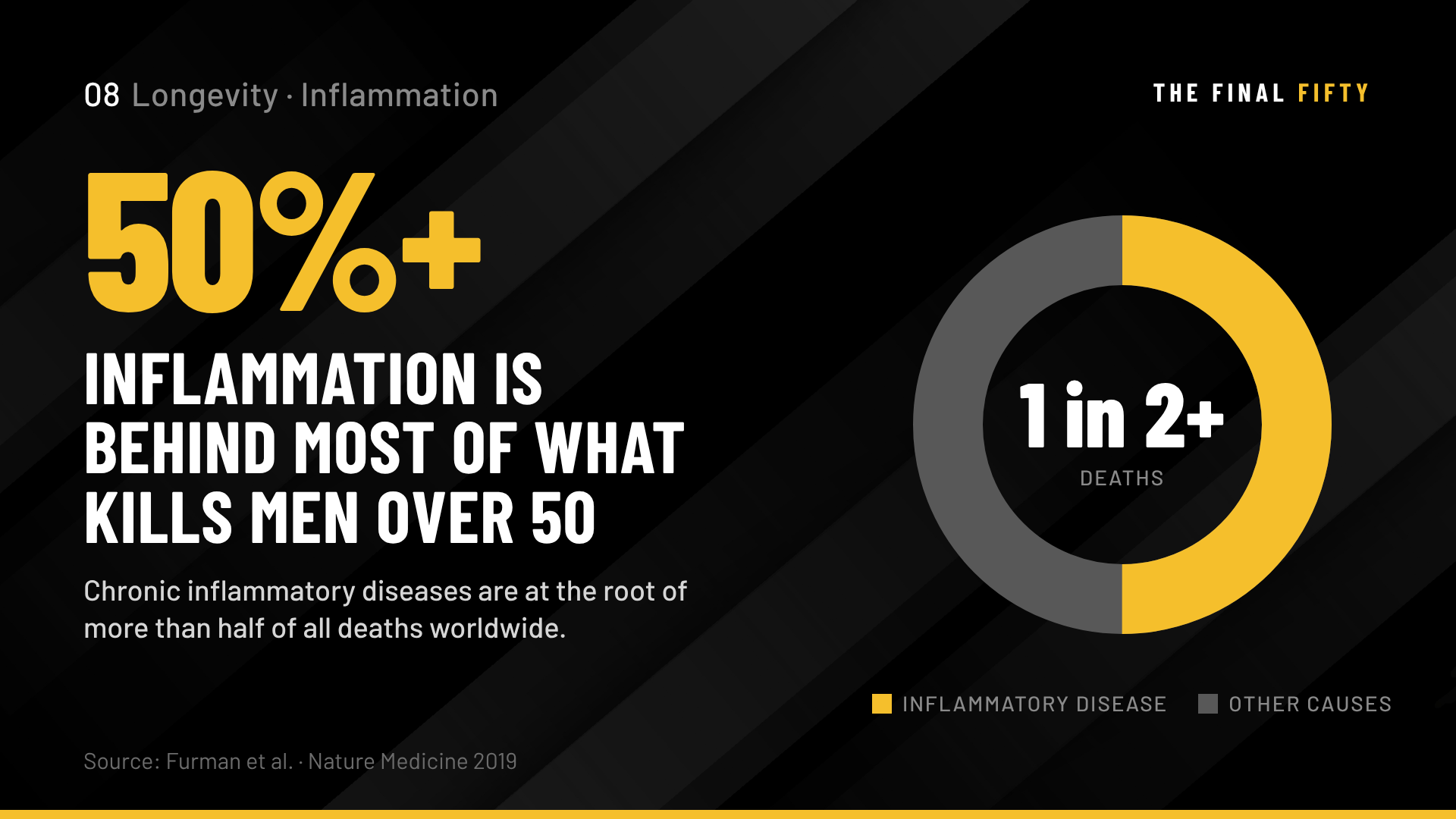
Most of what kills men in the second half of their lives has the same root. Not the same name. Not the same symptoms or the same organ system or the same clinical presentation. But the same underlying mechanism running through all of them, connecting the cardiovascular disease and the cancer and the type 2 diabetes and the cognitive decline that collectively account for the overwhelming majority of mortality and disability in men over fifty.
That mechanism is chronic inflammation.
Not the acute inflammation that is the immune system doing its job, responding to injury or infection with the rapid targeted cascade that clears a threat and initiates repair. The acute version is not the problem. The problem is inflammation that does not resolve, that becomes sustained and systemic, that operates at a low level across years and decades, producing cumulative damage to arterial walls, to metabolic function, to neurological tissue, to cellular DNA, that eventually crosses the threshold into the disease categories that carry diagnoses and drive mortality statistics.
Chronic inflammation is directly associated with the morbidity and mortality of cardiovascular disease, chronic kidney disease, diabetes mellitus, non-alcoholic fatty liver disease, cancer, autoimmune diseases, and neurodegenerative disorders. Not associated with some of them. With all of them. The thread running through the diseases that most commonly kill and disable men over fifty is not a collection of unrelated biological failures. It is one process, operating across multiple systems simultaneously, producing different clinical outcomes depending on which tissues it damages most severely and over what timeframe.
A man who understands this does not need to have a different strategy for each disease he is trying to prevent. He needs a strategy for the underlying mechanism that they all share.
What Inflammaging Is and Why It Worsens After 50
The scientific community has given a specific name to the chronic low-grade systemic inflammation that characterizes aging: inflammaging. The term captures the relationship precisely. Inflammation and aging are not separate processes that happen to coexist in older bodies. They are intertwined at the biological level. Aging promotes inflammation, and inflammation accelerates aging, and the bidirectional relationship between the two produces a compounding biological process that, without deliberate intervention, tends to worsen across the second half of a man’s life.
Inflammaging, characterized by persistent chronic inflammation in older adults, has emerged as a critical factor linked to age-related diseases such as cardiovascular diseases, metabolic disorders, and cognitive decline, which collectively contribute to the leading causes of death globally. Elevated levels of cytokines, chemokines, and other inflammatory mediators characterize inflammaging and serve as indicators of biological age.
The mechanisms driving inflammaging after fifty are multiple and overlapping. The immune system, which is highly effective at clearing inflammatory signals in younger tissue, becomes less efficient at resolving inflammation as it ages. Senescent cells, cells that have stopped dividing but have not died, accumulate in aging tissue and produce pro-inflammatory signals called the senescence-associated secretory phenotype. Mitochondrial dysfunction increases with age, producing reactive oxygen species that trigger inflammatory cascades. Gut microbiome composition shifts in ways that increase intestinal permeability and allow bacterial components to enter the bloodstream, activating systemic inflammatory responses. And the decades of accumulated inputs from diet, stress, sleep deprivation, and sedentary behavior that most men carry into the second half have been steadily stoking the inflammatory fire the entire time.
The result is that many men over fifty are carrying a significantly elevated inflammatory baseline that they have never measured, never named, and have been attributing piece by piece to the individual diseases it is producing rather than to the common root process driving all of them.
The Disease Connections That Make This Non-Negotiable
Understanding the specific disease connections between chronic inflammation and the conditions most likely to affect men over fifty is what converts the abstract concept of inflammaging into the concrete motivation for systematic intervention.
Cardiovascular disease is the most thoroughly documented inflammatory condition in medicine. Atherosclerosis, the buildup of plaque in arterial walls that leads to heart attack and stroke, is not simply the mechanical accumulation of cholesterol. It is an inflammatory process. Plaque formation begins with inflammatory damage to the arterial endothelium. Macrophages, the immune system’s cleanup cells, infiltrate the arterial wall in response to that damage and contribute to plaque growth. Inflammatory cytokines destabilize plaques and produce the rupture events that cause most acute myocardial infarctions. A single random assessment of high-sensitivity CRP provides a greater spread of cardiovascular risk prediction for future events over the next 30 years when compared directly with either LDL cholesterol or lipoprotein(a). The inflammatory marker outperforms the cholesterol markers in long-term cardiovascular risk prediction. That finding alone should change how men over fifty think about what they are managing.
Cancer. The relationship between chronic inflammation and cancer has been documented across multiple cancer types. When cells are injured due to external or internal stimuli, an inflammatory response is initiated. However, when inflammation becomes dysregulated or persists beyond its intended duration, it can contribute to chronic tissue damage and the development of cancer alongside cardiovascular diseases and type 2 diabetes. The mechanism by which inflammation contributes to cancer development includes the production of reactive oxygen species that damage DNA, the creation of microenvironments that support tumor growth, and the suppression of immune surveillance that would otherwise identify and eliminate cancerous cells before they establish.
Type 2 diabetes and metabolic syndrome are both products of chronic inflammatory dysfunction. Inflammatory cytokines interfere with insulin signaling at the cellular level, producing insulin resistance that forces the pancreas to compensate with increased insulin output. The resulting metabolic environment further elevates inflammatory signaling, creating the same compounding cycle that characterizes inflammaging more broadly. Low-grade inflammation is a risk factor for cardiovascular events and all-cause mortality in patients with type 2 diabetes, linking the metabolic and cardiovascular inflammatory pathways in a web that makes each condition worse when the other is present.
Cognitive decline and neurodegenerative disease complete the picture. Chronic neuroinflammation is now established as a primary driver of Alzheimer’s disease progression, not only a consequence of it. The same inflammatory processes that damage arterial walls and metabolic function also damage neuronal tissue, accelerate the accumulation of amyloid plaques, and impair the glymphatic clearance system that removes metabolic waste from the brain during sleep. A man whose systemic inflammatory burden is high is not only at elevated cardiovascular and metabolic risk. He is building the neurological conditions for cognitive deterioration at a rate the brain cannot compensate for indefinitely.
How to Measure Your Inflammatory Status
The most important practical point about chronic inflammation is that it is measurable. A man does not have to guess whether his inflammatory burden is elevated or whether the lifestyle interventions he is making are reducing it. The blood markers exist, are widely available, and are straightforward to interpret.
High-sensitivity CRP is the primary inflammatory biomarker for clinical risk assessment. A reading below 1.0 milligrams per liter is optimal. Between 1.0 and 3.0 indicates elevated cardiovascular and metabolic risk. Above 3.0 is a significant signal demanding immediate attention. High-sensitivity CRP is not simply a measure of whether an infection is present. It is a measure of chronic systemic inflammatory activity that reflects the cumulative effect of lifestyle inputs across weeks and months.
Interleukin-6, IL-6, is a pro-inflammatory cytokine that is elevated in inflammaging and that predicts cardiovascular outcomes, metabolic dysfunction, and cognitive decline independently of other markers. It is not available on all standard panels but is increasingly included in functional medicine assessments and is worth requesting.
Homocysteine reflects methylation status and B-vitamin adequacy. Elevated homocysteine is pro-inflammatory at the arterial wall and associated with cardiovascular disease, cognitive decline, and accelerated biological aging. It is directly addressable through targeted B-vitamin supplementation in most cases.
Ferritin, when elevated without evidence of iron deficiency anemia, functions as an inflammatory marker. High ferritin reflects oxidative load and is often elevated in metabolic syndrome, in men with significant visceral adiposity, and in chronic stress states. It provides additional inflammatory context that the standard CBC and lipid panel do not capture.
Getting these numbers annually is not optional for the man who is treating his health as a managed system rather than a passive waiting game. The measurements tell a man what his lifestyle is producing at the cellular level.
The Systematic Attack: What the Research Supports
The interventions that reduce chronic inflammation are the same interventions that the Final 50 platform has described throughout this content library in the context of physical performance, hormonal health, and longevity. They are not a separate anti-inflammation protocol. They are the lifestyle foundation whose primary mechanism of benefit at the physiological level is the reduction of chronic inflammatory burden.
Exercise is the most potent anti-inflammatory lifestyle intervention available. A single 20-minute brisk walk reduces the number of immune cells that produce tumor necrosis factor, a key driver of chronic inflammation. Participating in three 60-minute bouts of exercise per week produces significant decreases in IL-6 and cortisol in older adults, reducing both the inflammatory and the stress hormonal burden simultaneously. Regular physical activity stimulates the production of anti-inflammatory cytokines and reduces the pro-inflammatory output of visceral adipose tissue. The man who trains consistently is not just building muscle and protecting cardiovascular function. He is systematically suppressing the inflammatory process that connects those goals to his long-term survival.
Diet has the most consistent daily impact on inflammatory markers of any lifestyle variable, and its effects compound in both directions. The dietary pattern that drives chronic inflammation, high in processed foods, refined seed oils, added sugar, and refined carbohydrates, maintains the elevated CRP and IL-6 that produce the disease risk described above. The dietary pattern that reduces it, built around omega-3 rich animal foods, minimal processing, and elimination of the primary inflammatory inputs, produces measurable reductions in inflammatory markers within weeks of consistent implementation. Omega-3 fatty acids from fatty fish reduce levels of CRP, IL-6, and TNF-alpha directly. The animal-based nutritional foundation described throughout this series is simultaneously the protein-optimization strategy, the hormonal support strategy, and the anti-inflammatory dietary strategy. These are not three separate goals requiring three separate approaches. They converge in the same food structure.
Sleep, as established in multiple articles in this series, is the overnight biological reset that resolves inflammatory signals accumulated during the day. Chronic sleep restriction elevates IL-6, CRP, and TNF-alpha. Adequate sleep of seven to nine hours per night is not a passive recovery activity. It is one of the primary mechanisms through which the body manages its inflammatory burden. The man who chronically undersleeps while training and eating well is fighting his own recovery system.
Stress management reduces the cortisol elevation that directly drives inflammatory cytokine production. The HPA axis dysregulation that chronic unmanaged stress produces results in glucocorticoid receptor resistance, which impairs the body’s ability to use cortisol to resolve inflammation, allowing inflammatory signaling to persist without adequate biological check. The breathwork practice, the structured recovery, and the brotherhood that buffer psychological load are all anti-inflammatory interventions in their physiological mechanism, not only in their wellbeing effects.
Visceral fat reduction is perhaps the most mechanistically direct intervention available for men over fifty who are carrying excess body fat around the midsection. Visceral adipose tissue is metabolically active, producing pro-inflammatory cytokines and aromatase that convert testosterone to estrogen. Every reduction in visceral fat directly reduces the inflammatory output of that tissue and the hormonal disruption that accompanies it. The body composition work is the inflammatory management work.
The Integrated Strategy
The man over fifty who understands that chronic inflammation is the common root of most of what will determine his health trajectory in the decades ahead does not need to add a separate anti-inflammation protocol to an already full health management approach. He needs to understand that the training, the nutrition, the sleep, the stress management, and the body composition work he is already doing for other reasons are his primary anti-inflammatory interventions, and that doing them consistently and well is doing the most important disease prevention work available.
What he may need to add is the measurement. The annual high-sensitivity CRP, the IL-6, the homocysteine, the ferritin that tell him what his lifestyle is producing at the systemic inflammatory level. And the willingness to interpret those numbers as the primary health data they are rather than as secondary markers of interest primarily to physicians managing existing disease.
The diseases that chronic inflammation produces do not arrive with announcements. They build silently across the years that the inflammatory burden is elevated, producing the damage that eventually crosses the clinical threshold. The man who measures his inflammatory status annually, who uses that data to manage his lifestyle inputs deliberately, and who treats the training, the nutrition, the sleep, and the stress management as the disease prevention strategy the research identifies them as, is not doing something different from what this platform recommends in every pillar. He is doing the same things with a fuller understanding of why they matter.
The root is chronic inflammation. The attack on it is the second half of life, lived deliberately.
THE FINAL 50 FRAMEWORK
THE REFRAME
Chronic inflammation is not one of many health concerns competing for attention in the second half. It is the underlying mechanism connecting most of them. The cardiovascular disease and the metabolic dysfunction and the cognitive decline that most commonly kill and disable men over fifty are not separate biological failures requiring separate prevention strategies. They are different expressions of the same inflammatory process. A man who attacks the root attacks all of them simultaneously. Everything this platform describes across all eight pillars, when done consistently and well, is an attack on the root.
THE STANDARD
The Final 50 man measures his inflammatory status annually: high-sensitivity CRP, and at minimum homocysteine and ferritin alongside the standard panel. He treats a CRP above 1.0 milligrams per liter as a signal requiring investigation and adjustment rather than as an acceptable finding. He understands that his training, his nutrition, his sleep, and his stress management are his primary anti-inflammatory interventions and holds them accordingly. He does not treat disease prevention as a separate project from performance optimization. At the physiological level, they are the same project.
THE PRACTICE
This week, request a high-sensitivity CRP test if you have not had one in the past twelve months. If you have a recent result, look at it now with the context this article provides: below 1.0 is optimal, 1.0 to 3.0 is elevated risk, above 3.0 demands immediate lifestyle adjustment. Then identify the single lifestyle input that is most likely driving your inflammatory status in the wrong direction. For many men it is diet, specifically the processed food, seed oil, and refined carbohydrate inputs that are maintaining the inflammatory environment. For others it is sleep. For others it is unmanaged chronic stress. Name the primary driver. Begin addressing it this week.
THE AUDIT
Do you know your high-sensitivity CRP number? Your homocysteine? Your ferritin? If the honest answer is no, you are managing your most important long-term health variable without the data that would tell you whether your lifestyle is producing the inflammatory outcome you need it to produce. Schedule the test. Get the numbers. Then use them.
THE PROMPT
The men in your brotherhood are each carrying an inflammatory burden they have never measured and are managing through the same lifestyle inputs that this platform prescribes for every other reason. What would it mean to compare inflammatory markers honestly inside the brotherhood, to know whose CRP is optimal and whose is elevated, and to use that data to hold each other to the lifestyle standards that the research says most directly determine those numbers? That conversation, grounded in actual data rather than general intention, is one of the most health-consequential ones available.


