
The cultural story about entrepreneurship and age runs in one direction: it belongs to the young. The mythology of the startup world is populated by twenty-two-year-olds in hoodies with world-changing ideas and the reckless conviction to pursue them without the experience to know what could go wrong. That mythology has been so thoroughly repeated across the past two decades that it has become the ambient assumption about who builds companies and when the best window for doing so is open.
The data says something different. Not slightly different. Categorically different.
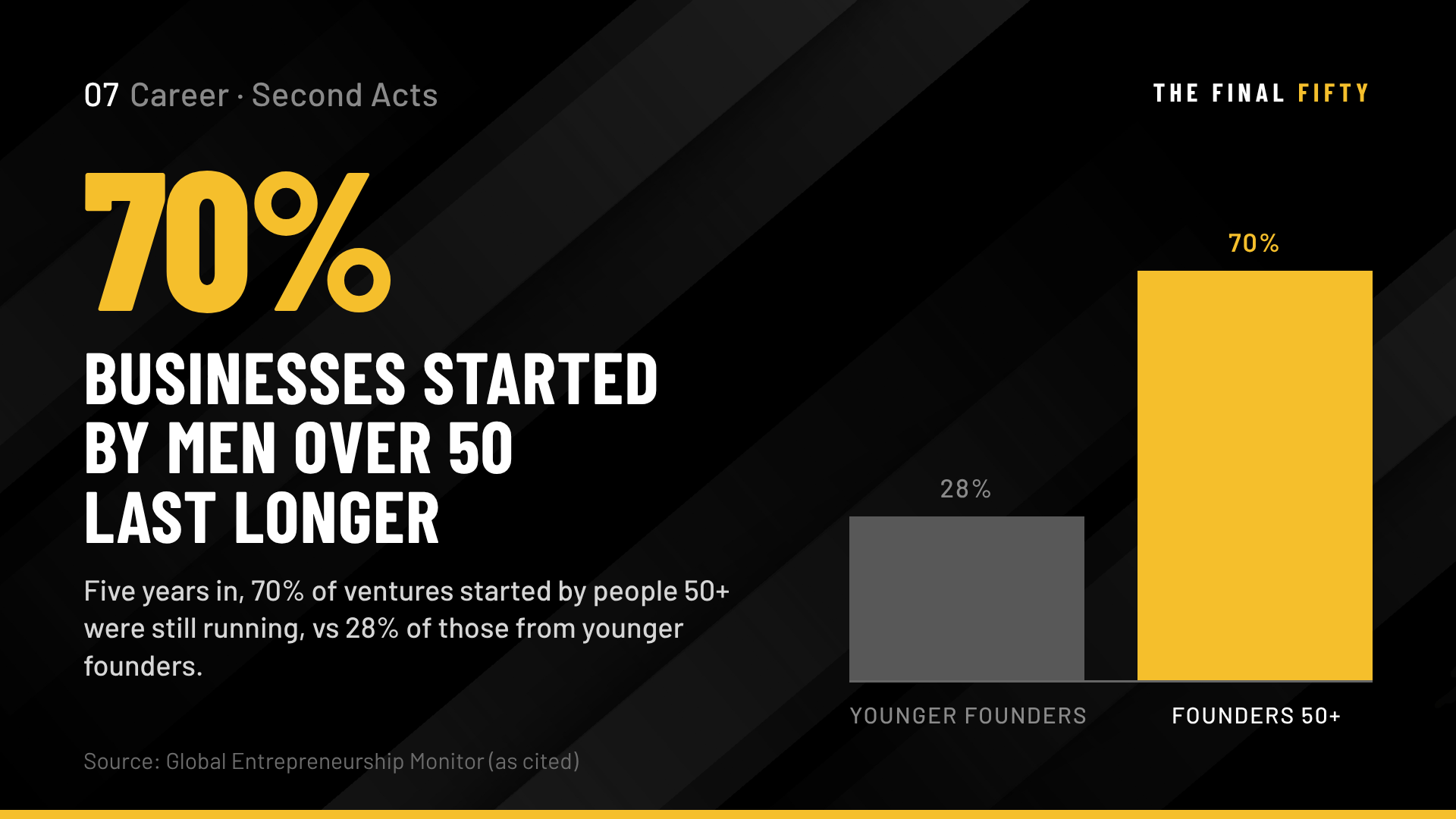
A landmark study from researchers at MIT, Northwestern University, and the University of Pennsylvania examined over 2.7 million business founders and found that the average age of founders of the fastest-growing companies is 45. A 50-year-old founder is 1.8 times more likely to achieve upper-tail growth than a 30-year-old founder. Founders in their early twenties have the lowest likelihood of successful exit or high growth of any age group studied. The narrative around super high-growth firms is that they are often founded by people in their twenties. The data does not support that narrative. The research was clear enough that Benjamin Jones, one of the study’s authors and a professor at Northwestern’s Kellogg School of Management, described himself as surprised by the findings. The longer a founder has been around, the better the odds.
For men over fifty who have spent the first half of their professional lives building expertise, relationships, credibility, and financial resources in domains they understand deeply, this is not a consolation prize. It is the research telling them that the window they are standing in is not closing. It may be the widest it has ever been.
Why the Numbers Favor Men Over 50
The 1.8 times success advantage for 50-year-old founders over 30-year-old founders does not come from luck or from some mysterious quality that age bestows automatically. It comes from the specific, concrete, measurable assets that decades of professional experience produce, and that entrepreneurship requires in greater quantity than the startup mythology acknowledges.
The first asset is market knowledge. The older founder who starts a business in a domain he has worked in for twenty years does not need to study the market from the outside. He has lived inside it. He knows who the actual buyers are and what they care about versus what they say they care about. He knows which problems look solvable from the outside but are structurally intractable, and which problems look minor but are the source of significant friction that a well-designed solution could remove. Gusto’s research found that 44 percent of founders over 50 said they started a business because they saw an unfulfilled market need, compared to 34 percent of respondents overall. The older founder sees the opportunity that the younger founder cannot yet perceive because he has not been close enough to the problem long enough to recognize it as a problem rather than as the background noise of the industry.
The second asset is the professional network. A man who has worked in a domain for two or three decades has accumulated relationships that a younger founder spends years trying to build. He knows the decision-makers. He has a track record with the people who would be his first clients, his first partners, and his first referral sources. He has trust that was earned rather than requested. The high-tech startup world is twice as likely to have a founder over fifty than under twenty-five, not because older founders are better technologists, but because they know who will buy the technology and how to get in front of them. The network is not a soft asset. It is the mechanism through which a new business finds its first revenue faster than it would if the founder had to build the network and the business simultaneously.
The third asset is financial stability. The existential pressure that characterizes early entrepreneurship for younger founders, the need to generate revenue before the personal financial runway runs out, is significantly reduced for the man over fifty who has built a financial foundation across his career. He can take a longer view. He can invest in the business without the panic that comes from needing it to work within months. He can make better decisions about pricing, about clients, about partnerships, because the desperation that produces bad early-stage decisions is absent or reduced. Baby Boomers starting businesses on Gusto’s platform take home an average of sixty thousand dollars in their first year of operation. That is six times the ten thousand dollars that Gen Z founders pay themselves in year one. The financial advantage compounds from the first day of operation.
The fourth asset is pattern recognition. A man who has watched businesses succeed and fail over decades of close observation has something that cannot be taught and cannot be accelerated: the accumulated library of what happens rather than what theory predicts should happen. He knows what early-stage organizational dysfunction looks like before it becomes a crisis. He knows what a client relationship that is about to fail looks like. He knows the difference between a product problem and a sales problem and a market problem, distinctions that younger founders often spend years learning to make correctly. This pattern recognition produces the fewer rookie mistakes that the Harvard Business Review identifies as one of the primary reasons founders in their fifties build high-growth startups twice as often as those in their thirties.
What the Second-Act Business Actually Looks Like
The entrepreneurship available to a man over fifty is not the same as the entrepreneurship available to a twenty-five-year-old, and understanding the difference is what allows the man at fifty to build from his actual asset base rather than trying to replicate a first-act model that was designed for a different set of resources and a different risk profile.
The second-act business is almost always built on the expertise, the relationships, and the credibility that the first act produced. It is not a departure from what a man knows. It is the application of what he knows in a form that he controls. The healthcare executive who spent thirty years inside large systems and who starts an advisory practice serving smaller organizations navigating the same systems she spent her career inside is not starting over. She is deploying thirty years of highly specific expertise in a form that no larger organization can replicate, because the expertise is inseparable from the person who developed it. The same structure applies in every domain. The finance professional who starts a boutique advisory firm. The operations executive who launches a consulting practice. The marketer who builds a strategy consultancy. These are not consolation businesses for men who could not keep up with the pace of corporate change. They are the direct deployment of the most valuable professional assets a man has ever held, in a form that he controls and that scales with his reputation rather than with headcount.
Nearly one-fourth of new businesses are started by founders between the ages of 55 and 64, up from 15 percent two decades ago, according to the Kauffman Foundation. More than half of small businesses in the United States are owned by people 55 and older. These are not men who ran out of options. They are men who recognized that the second half of a professional life built on expertise is the moment when building something of their own produces better returns, more satisfaction, and more lasting impact than continuing to deploy that expertise inside someone else’s structure.
The Assets That Make It More Likely to Work
Beyond the general advantages of age and experience, the specific assets that men over fifty have accumulated in the first half of their professional lives create conditions for entrepreneurship that the research identifies as directly predictive of success.
Domain expertise accumulated over decades is the most direct predictor of entrepreneurial success for older founders. The man who has spent twenty years in a specific industry, profession, or function has knowledge that cannot be replicated quickly and that has significant market value when deployed independently. The Kauffman Foundation research found that older entrepreneurs have a consistent advantage in identifying unfulfilled market needs precisely because their domain depth allows them to see problems that surface-level market observation misses. The depth is the competitive advantage.
The professional credibility that comes with a track record is the second. A man over fifty who has a documented history of successful outcomes in his domain does not have to spend the first year of his business convincing potential clients that he can deliver. The credibility arrived before the business did. This changes the sales dynamic fundamentally. The younger founder is asking for trust that has not yet been established. The older founder is offering access to a track record that has already been tested. In professional services and advisory businesses, which represent the largest category of successful second-act entrepreneurship, this credibility advantage is often the single most important factor in early revenue generation.
Financial resources and reduced personal financial pressure allow the man over fifty to invest in his business from a position of stability rather than desperation. Decisions made from stability are different from decisions made from desperation, and the quality difference shows up in pricing, in client selection, in the willingness to walk away from revenue that comes with conditions that compromise the business’s long-term position. The man who does not need the next client at any price to survive has the negotiating position that produces better engagements, better terms, and better clients than the man who needs the revenue to make rent.
What Holds Men Back and Why It Is the Wrong Frame
The primary reason that men over fifty who have the assets, the expertise, and the desire to build something of their own do not do so is not a lack of resources or a lack of opportunity. It is the persistence of the first-half frame applied to a second-half decision.
The first-half frame says that starting something new at fifty means giving up the security of what has been built, accepting a step backward in income and status, and competing from a position of weakness against younger, more energetic, more technologically current competitors. Every element of that frame is either wrong or misapplied.
Starting something new at fifty means deploying from the full strength of what has been built, not abandoning it. The expertise, the relationships, the credibility, the financial stability, the pattern recognition, these are the starting inventory of the second-act business, not the casualties of the transition. The man who leaves an executive role to build his own advisory practice is not giving up his assets. He is converting them from assets held inside someone else’s structure to assets deployed in a structure he controls.
The income trajectory of second-act entrepreneurship typically does not represent a permanent step backward. It may represent a temporary reduction in monthly income during the build phase. For men over fifty who have managed the financial foundation well, that temporary reduction is manageable. And the income ceiling of a business that scales with reputation and expertise is not constrained by a salary band or an organizational hierarchy. It is constrained only by the market value of what the man can deliver, which in professional services is often higher than what any single employer would compensate him for.
The competition from younger, more energetic founders is real in certain categories and irrelevant in others. In the categories where second-act entrepreneurship succeeds, the competition is not from twenty-five-year-olds with energy and technology but from other experienced professionals who may or may not have built the same depth, the same relationships, or the same credibility. The man over fifty who has built rare expertise in a domain is not competing against everyone. He is competing against the small number of people who have built comparable depth, and the research shows that the depth advantage is real and durable.
The Window Is Open
The research on entrepreneurial success by age does not suggest that the window for building something meaningful opens at twenty-five and closes at forty. It suggests the opposite: that the probability of entrepreneurial success increases with age and experience through the fifties and into the sixties, and that the man who has spent his career building the assets that entrepreneurship requires is better positioned to use them at fifty-three than he was at thirty-three.
The question is not whether the window is open. The data confirms that it is. The question is whether the man standing in it is going to treat the assets he has accumulated as the foundation of the next build or as the inventory of a career that has already peaked.
For men over fifty who have been thinking about building something of their own, who have had the idea for the practice or the business or the platform that their expertise and their market knowledge make possible, the research on older entrepreneurship does not provide a reason to wait for a better moment. The better moment is not coming. The moment a man over fifty has built twenty or thirty years of expertise, strong relationships, earned credibility, and the financial stability to take a measured risk is the moment the data says entrepreneurship is most likely to succeed.
That moment is now. The only remaining question is whether the man who has spent the first half building the assets is willing to deploy them in the second.
THE FINAL 50 FRAMEWORK
THE REFRAME
The cultural story that entrepreneurship belongs to the young is not supported by the data. A 50-year-old founder is 1.8 times more likely to achieve high growth than a 30-year-old founder. The average age of founders of the fastest-growing companies is 45. The assets that entrepreneurship most requires, domain expertise, professional relationships, credibility, financial stability, and pattern recognition, are the precise assets that a man over fifty has accumulated at levels a younger founder cannot replicate. The window is not closing. For the man who has built the right asset base, it may be wider now than it has ever been.
THE STANDARD
The Final 50 man who has spent the first half of his professional life building expertise in a domain has evaluated seriously what a second-act business built on that expertise would look like. He has not dismissed the possibility because it feels risky or because the cultural story says the window has closed. He has assessed his actual assets, the expertise, the relationships, the credibility, and the financial stability, against the requirements of the business he has been thinking about, and he has made a deliberate decision about whether the build belongs in his second half.
THE PRACTICE
This week, write down the specific business or practice that your expertise and your market knowledge make possible, the one you have thought about but not moved on. Do not evaluate whether it is the right time or whether you are ready. Simply describe it specifically: what the business does, who it serves, what problem it solves, and what assets you already hold that give you an advantage in building it. Then identify the one question whose answer would determine whether the build is feasible. That is the next step, not the full business plan. The one clarifying question. Find the answer.
THE AUDIT
What is the expertise you hold that no one in your current professional structure would deploy more effectively than you could deploy it independently? What relationships do you have that would follow you into a business you control? What problems in your domain have you identified that existing solutions are not adequately addressing? Honest answers to those three questions describe the raw material of a second-act business that is already in your possession. The business is not something you build from nothing. It is something you build from what you already have.
THE PROMPT
The men in your brotherhood are each sitting on accumulated assets that the research says are more valuable for entrepreneurship than the assets most startup founders bring to the table. Who in your circle has made the move to build something of his own? What did the first year look like, not the curated version, but the honest one? What would he do differently? That conversation, held with specificity about what was hard and what worked, gives every man in the brotherhood better information for making his own decision than any business planning resource can provide.


