Exercise is one of the most powerful natural interventions available for supporting testosterone in men over fifty. That statement appears in nearly every resource on the subject, and it is true. What appears far less often is the specificity that makes it actionable: not all training produces the same hormonal response, not all exercise intensities trigger meaningful testosterone output, and not all men over fifty are training in the way that maximizes the signal their body sends to produce more of the hormone their lifestyle depends on.
The man who is training consistently but not training specifically is likely leaving a significant portion of the natural testosterone optimization potential on the table. He is earning the general health benefits of exercise without structuring his training around the specific variables, movement selection, intensity, volume, rest periods, training frequency, and the role of complementary modalities, that the research identifies as most directly connected to the hormonal response he is trying to produce.
This article is about the specific protocols. Not exercise in general. The training decisions that, when implemented correctly and consistently, produce the greatest testosterone signal in the aging male endocrine system.
Why Training Variables Matter More After 50
The training-testosterone relationship operates through mechanisms that become increasingly relevant and increasingly specific as men age. Younger men have a hormonal environment robust enough to produce reasonable testosterone responses across a wide range of training approaches. The anabolic signal from exercise reaches the hypothalamic-pituitary-gonadal axis, the Leydig cells respond, and testosterone production rises in proportion to the training stimulus.
For men over fifty, this system has changed. The Leydig cell population has diminished. The sensitivity of the system to training stimuli is different. The recovery window required between intense sessions is longer. And the acute testosterone response to a training session is both more important, because it is one of the primary natural stimuli remaining, and more dependent on specific protocol variables that younger men do not need to manage as carefully.
The practical implication is that a man over fifty who is doing moderate-intensity machine-based isolation work three times per week is not producing the same hormonal response as a man who is performing compound movements at meaningful intensity with adequate volume and appropriate recovery. Both men are exercising. Only one is training in a way that meaningfully engages the testosterone production pathway.
The Compound Movement Requirement
The most consistently supported finding in the research on training and testosterone is that exercises engaging large amounts of muscle mass produce significantly greater hormonal responses than exercises targeting small, isolated muscle groups. This is not a marginal difference. It is categorical.
Compound movements maximize hormonal response because exercises engaging large muscle groups, squats, deadlifts, rows, trigger significantly greater testosterone increases than isolation exercises like bicep curls. A comprehensive study of men aged 40 to 65 found that resistance training programs emphasizing compound movements like squats, deadlifts, and bench presses produced 15 to 20 percent increases in total testosterone levels over 12 weeks.
The mechanism behind this is the systemic metabolic demand that large multi-joint movements create. When a man performs a heavy squat or deadlift, he is recruiting an enormous proportion of his total muscle mass simultaneously. The metabolic and mechanical stress of that recruitment sends a systemic signal to the endocrine system that the body is under significant physical demand. The anabolic hormone response, including testosterone and growth hormone, scales with the magnitude of that systemic signal. A leg extension or a bicep curl, regardless of how hard a man works within the exercise, simply does not create the same systemic demand and does not produce the same hormonal response.
The practical implication for programming is unambiguous. The sessions that drive the greatest testosterone response are the sessions built around squat, hinge, push, and pull patterns using compound movements at meaningful loads. The isolation work that most men over fifty default to because it feels safer and more manageable produces a fraction of the hormonal return of the compound work it replaces.
The Intensity Variable: Why Load Matters
Not all resistance training produces the same testosterone response even when compound movements are used. The intensity of the training, expressed as a percentage of a man’s one-repetition maximum for each exercise, is the variable that most directly governs the hormonal signal produced.
The greatest hormonal responses in the research consistently occur with moderate to heavy loads at 70 to 85 percent of one-repetition maximum performed for six to eight repetitions per set. Training frequency of three to four sessions per week with adequate recovery between sessions optimized testosterone production while preventing overtraining-induced hormone suppression. The study revealed that testosterone optimization requires balancing training stress with adequate recovery.
The lower end of this intensity range, around 70 percent of one-repetition maximum, corresponds roughly to a weight a man can lift for ten to twelve repetitions before reaching failure. The upper end, around 85 percent, corresponds roughly to a weight he can lift for five to six repetitions before reaching failure. Working within this window, on compound movements, at a training frequency that allows adequate recovery, is the resistance training protocol most directly supported by the research for testosterone optimization in older men.
It was found that all resistance training protocols increased testosterone except the protocol applied with 50 percent of one-repetition maximum load. This is a critical finding. Training that is genuinely easy, that does not challenge the neuromuscular system with meaningful load, does not produce the hormonal response. The comfortable weight a man selects because it feels manageable is not providing the physiological stimulus that drives the hormonal adaptation. The training must be hard enough to constitute a genuine demand on the system it is intended to signal.
This does not mean training to failure on every set. Research on optimal training stress consistently shows that taking most sets to or near failure while leaving one to two repetitions in reserve, the point at which the next repetition would fail, produces the greatest combination of training adaptation and recovery efficiency. Training to failure on every set elevates cortisol disproportionately, which competes with and suppresses testosterone. The optimal zone is significant challenge with managed recovery, not maximal output followed by inadequate recovery.
The HIIT Protocol: The Complementary Hormonal Tool
High-intensity interval training represents the second most potent training protocol for testosterone support in men over fifty, and it operates through mechanisms that complement rather than duplicate those of resistance training.
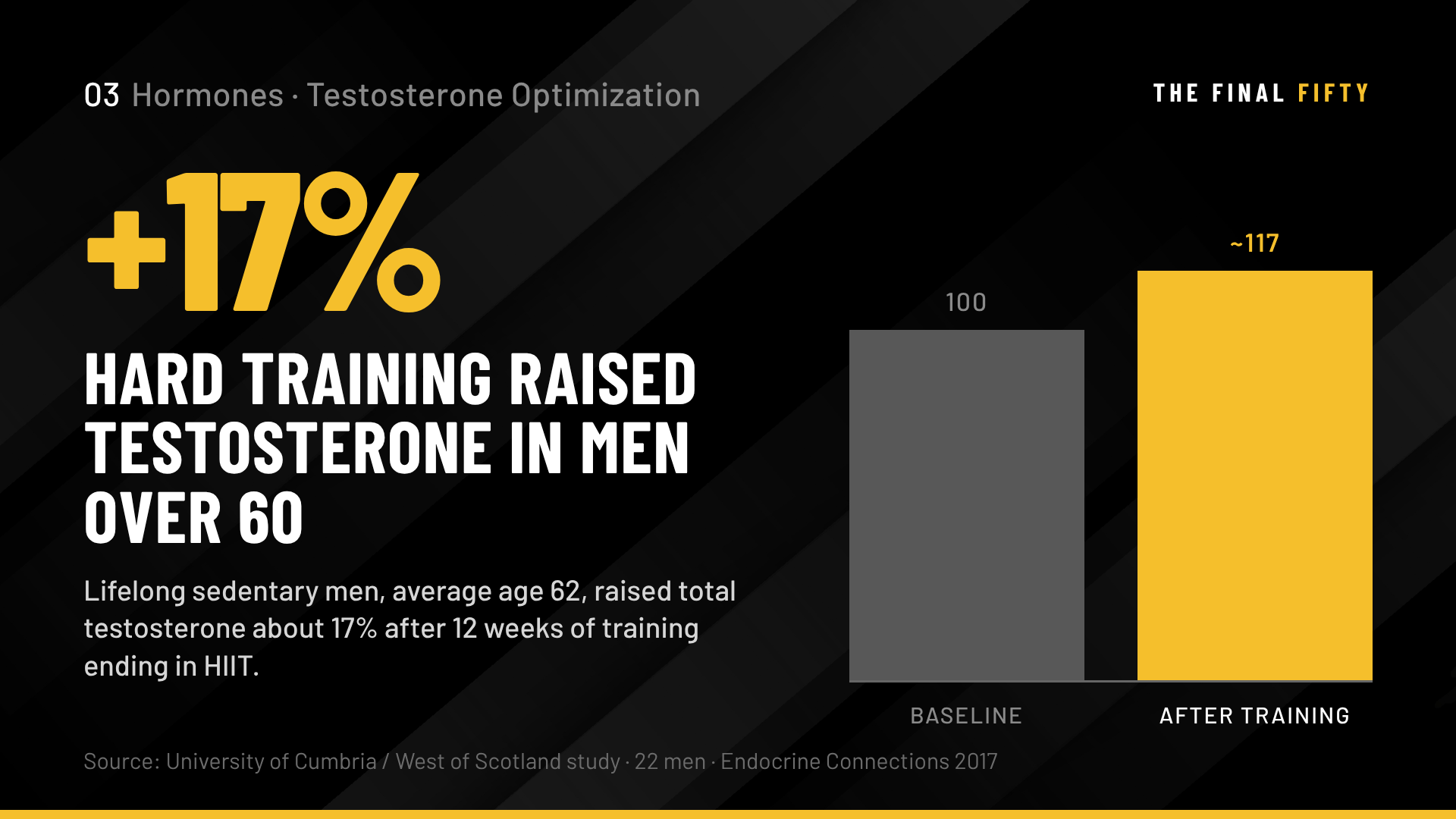
Research investigating HIIT in lifelong sedentary aging men with an average age of 62 found that total testosterone was significantly increased following HIIT by approximately 17 percent, with most of the increase occurring during the preconditioning phase. Free testosterone was significantly higher following HIIT compared to baseline by approximately 4.5 percent. The same research group found that both sedentary older males and endurance-trained masters athletes experienced increased free testosterone following HIIT.
A 2021 study published in the Journal of Clinical Medicine found that HIIT sessions increased testosterone in males, making it a valuable tool to enhance well-being and partly counter harmful age-related changes. The authors noted that HIIT can positively affect quality of life and health by physiologically increasing testosterone levels, lowering cortisol, and improving the anabolic-catabolic balance and muscle strength.
The HIIT protocol that produced these results in the aging men research used six 30-second sprint intervals at high intensity, interspersed with three minutes of active recovery, performed across nine sessions over six weeks. This is not an elaborate or time-consuming protocol. It is brief, intense, and specific. The hormonal signal comes from the intensity of the effort, not from the duration of the session.
The testosterone-to-cortisol ratio is the most important hormonal metric for training optimization in men over fifty, and it is where HIIT and resistance training work together. Resistance training at the intensities described above produces a significant testosterone response. The time-integrated testosterone-to-cortisol value is greater after HIIT compared to sustained moderate-intensity cardio. This means that the cortisol cost of the training session is lower relative to the testosterone produced, producing a more favorable anabolic environment in the hours following the session.
Sustained moderate-intensity steady-state cardio, the kind most men over fifty default to when they add aerobic work to their program, produces none of this hormonal benefit. It elevates cortisol proportionally to its duration. It does not meaningfully stimulate testosterone. It competes with the recovery resources the strength training sessions require. For men who are training for hormonal optimization specifically, steady-state cardio has its place in overall health but should not be the primary aerobic modality if testosterone support is an objective.
The Volume and Recovery Balance
Volume, the total number of sets and repetitions performed in a training session and across the training week, has a non-linear relationship with the testosterone response. Up to a point, more volume produces more hormonal stimulus. Beyond that point, excessive volume elevates cortisol disproportionately, begins to suppress the testosterone response, and requires recovery resources that the aging male system cannot reliably provide across consecutive days.
The research supports three to four resistance training sessions per week for men over fifty optimizing testosterone, with at least 48 hours of recovery between sessions targeting the same muscle groups. The sessions themselves should involve three to four working sets per compound movement at the intensities described, with rest periods of two to three minutes between sets to allow meaningful recovery of the neuromuscular system without allowing the metabolic stimulus to dissipate entirely.
The overtraining risk is real and specific for men over fifty. Avoid excessive training volume or daily intense sessions, as overtraining can suppress testosterone production. The man who trains too frequently at high intensity without adequate recovery is not getting more testosterone signal. He is getting chronic cortisol elevation that suppresses the testosterone signal his training would otherwise produce. The recovery is not optional. It is the mechanism through which the adaptation occurs.
For men combining resistance training with HIIT, the practical weekly structure might look like three resistance training sessions on non-consecutive days, with one to two HIIT sessions on alternate days and at least one full recovery day. This structure provides the compound training stimulus for testosterone support through resistance work, the complementary HIIT stimulus for free testosterone and cardiovascular adaptation, and the recovery window the aging endocrine system requires to produce the hormonal response that the training is intended to generate.
The Body Composition Variable
No discussion of training and testosterone optimization is complete without acknowledging that training-induced body composition change is itself a testosterone intervention. The exercise-induced improvements in body composition, particularly reduced abdominal fat, contribute to better hormonal health since excess body fat increases testosterone conversion to estrogen.
This creates the most important compounding dynamic in the entire training-testosterone relationship: the training protocols that produce the greatest direct testosterone response are also the protocols that most effectively drive the body composition changes that reduce aromatase activity and further improve the testosterone environment. Compound resistance training at meaningful intensity builds muscle, burns fat, reduces visceral adipose tissue, and directly stimulates testosterone production simultaneously. The man who is doing this work consistently is not just managing three separate variables. He is managing one integrated system where each improvement reinforces the others.
The man who implements the protocols described in this article, who trains compound movements at 70 to 85 percent intensity three to four times per week, who adds one to two HIIT sessions in the complementary training windows, who protects the recovery that allows the adaptation to occur, and who manages his body composition through the training and nutritional approaches described elsewhere in this content library, is building a training system that works on the testosterone problem from multiple angles simultaneously. That is not just exercise. That is hormonal management through deliberate physical performance.
THE FINAL 50 FRAMEWORK
THE REFRAME
Training is a hormonal intervention. Not all training is the same hormonal intervention. The man who structures his sessions around compound movements at meaningful intensity, who manages his training volume within the recovery window his biology provides, and who uses HIIT as a complementary tool rather than steady-state cardio as a default, is training specifically for the testosterone response. The man who trains at comfortable intensity on machines is exercising. These are not the same activity.
THE STANDARD
The Final 50 man builds his training week around three to four compound resistance sessions at 70 to 85 percent of his one-repetition maximum, with three to four sets per major movement and two to three minutes of rest between sets. He includes one to two HIIT sessions in the complementary training windows, six intervals of 30 seconds at genuine high intensity with three minutes of active recovery. He protects at least 48 hours of recovery between sessions targeting the same muscle groups. He does not confuse comfort with adequate training stimulus.
THE PRACTICE
This week, assess the intensity at which you are currently training your primary compound movements. For your squat, deadlift, press, and row: what percentage of your maximum are you using, and how many repetitions from failure are you finishing each set? If the honest answer is that you finish most sets with five or more repetitions remaining, you are not in the intensity range that drives the testosterone response the research supports. Add weight. Work in the six to ten repetition range to near failure. That is the practice. One session, one intensity adjustment, held through the full session. Notice the difference in the metabolic demand and the post-session recovery requirement.
THE AUDIT
What does your current training week look like against the protocol described above? How many sessions are built around compound movements? What intensity are you training at? Are you including any HIIT work, or is your aerobic training entirely moderate-intensity steady-state? Are you protecting 48 hours of recovery between sessions targeting the same muscle groups? Honest answers to each of those questions tell you specifically where the gap between your current training and the optimal testosterone protocol sits. The gap is the priority.
THE PROMPT
The men in your brotherhood are training with varying degrees of protocol specificity, and most of them have never structured a training program explicitly around the hormonal response rather than the mechanical output. Who in your circle trains with this level of intention? Who has tracked the specific impact of training changes on their energy, recovery, body composition, and lab work? That conversation, held between men who are treating training as the hormonal tool it is, produces insights that no individual man finds on his own.