
Distance in a marriage does not arrive as a dramatic event. There is no moment that can be identified afterward as the turning point. No argument that crossed a line. No single decision that sent two people in separate directions. Distance arrives the way most things that matter most in a man’s life arrive when he is not paying attention: gradually, quietly, and without announcing itself until it has already become the default state of the relationship.
The man at fifty who has been present in his marriage the way he has been present in his career, in body but not in mind, responsive when necessary but not engaged as a matter of daily intention, is not a man who failed to love his partner. He is a man who succeeded so completely at the first half of his life that the relationship got what was left over rather than what it deserved. And now, standing in the second half with the children mostly grown and the career pressures shifted and the structure that kept two people moving in parallel finally gone, the question is not whether the distance exists. The question is whether the man is going to see it clearly and do something about it before it defines the next thirty years.
Reinvestment is not a repair job. It is a building project. And it starts with understanding what makes marriages thrive over the long term, not what the culture says about romance and spontaneity, but what the research shows about the intentional behaviors that separate the marriages that flourish from the ones that simply survive.
What the Research Says About Flourishing Marriages
The most important finding in the scientific literature on what makes marriages work long-term is also the one that most directly contradicts the cultural mythology that surrounds relationships.
Enduring connection in marriage results more from the intentional efforts of the spouses than it does from spontaneous love and emotional spark. High-connection marriages have three times higher scores on proactive behaviors than low-connection couples, specifically in spending meaningful time together, doing acts of kindness for each other, and forgiving offenses. Spouses in high-connection marriages score twice as high as spouses in low-connection marriages on life satisfaction and life meaning.
Three times more proactive behavior. Not more chemistry. Not better communication skills acquired at a workshop. Not a more compatible personality match. Three times more of the deliberate, consistent, unglamorous work of showing up intentionally in the relationship rather than waiting for the feeling to arrive on its own.
Contentment, satisfaction, and happiness in marriage do not arise spontaneously. They require sustained effort from both partners to preserve the health of the relationship. As a result, marriages can either thrive or falter.
The man who is waiting to feel like reinvesting before he begins is waiting for the wrong signal. The feeling follows the behavior, not the other way around. The research on this is consistent and unambiguous. Intentional investment produces connection, which produces the emotional warmth that makes further investment feel natural. The man who waits for the warmth before making the investment has the sequence backward, and the marriage reflects that sequence in the gap between what he wants it to be and what it currently is.
The Gottman Map of What Goes Wrong
John Gottman spent more than four decades at the University of Washington studying what distinguishes marriages that last from those that fail. His research involved observing thousands of couples in controlled settings with physiological measurement, coding of interaction patterns, and multi-year follow-up data. The results produced some of the most actionable findings available in relationship science.
Gottman’s research points to a magic ratio: 5 to 1. Healthy, stable relationships maintain at least five positive interactions for every negative one. These positive moments do not need to be grand gestures. A genuine compliment, a moment of physical affection, or simply expressing thanks for something small all count.
For men over fifty in long-term marriages, this ratio is where the problem typically lives. The relationship is not failing because of catastrophic events. It is operating with a positive-to-negative ratio that has slowly slipped below the threshold that sustains genuine connection. The negative interactions are not usually dramatic. They are the impatient response to a question asked at the wrong moment. The eye roll that registered as contempt without being intended that way. The distracted half-listening that communicates to a partner that whatever she is saying is less important than whatever is occupying his mind. Small inputs, accumulated over years, that have quietly moved the ratio in the wrong direction.
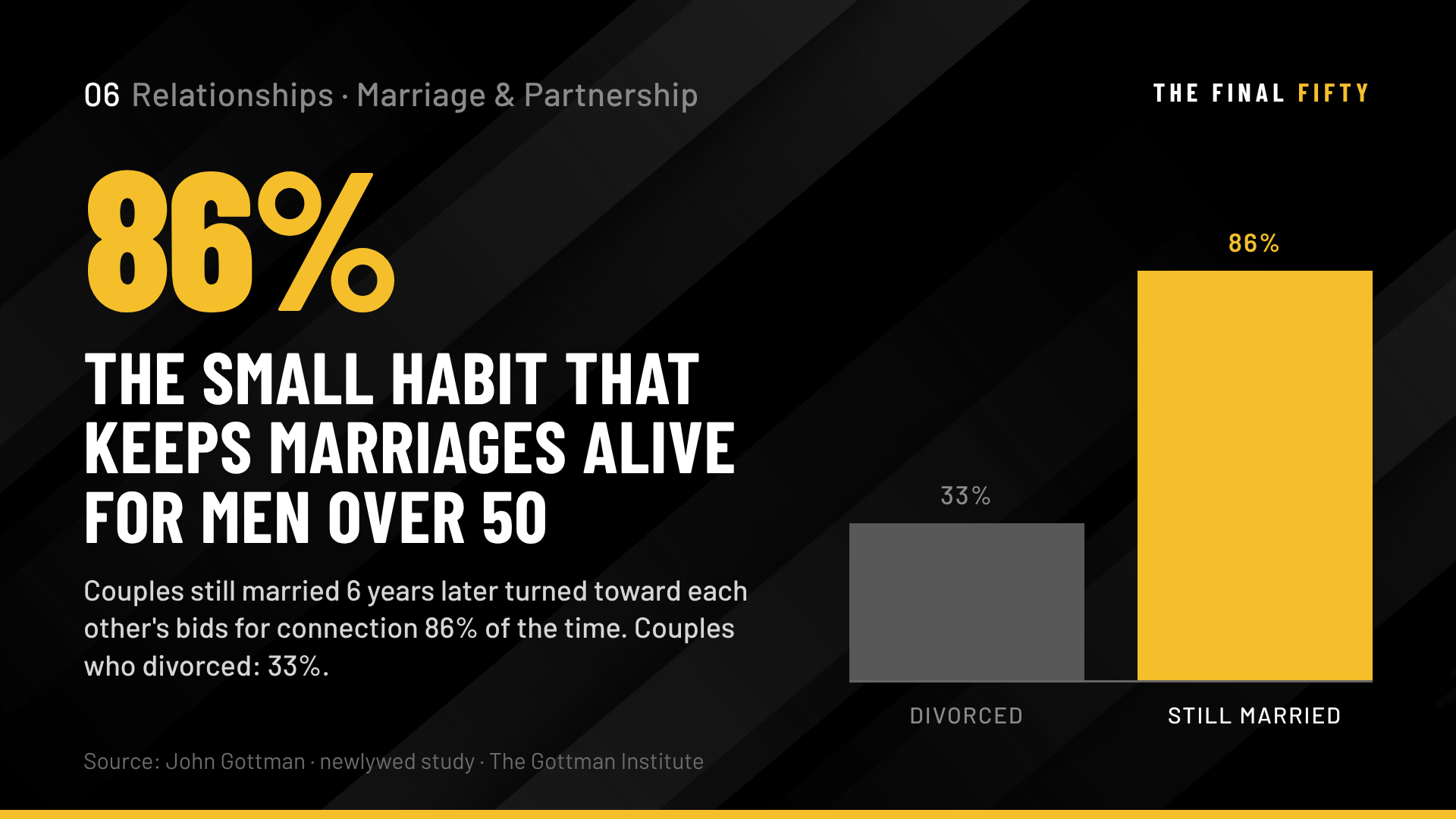
One of the greatest predictors of a relationship’s success is the ability to turn toward bids for connection, the verbal or non-verbal attempts a person makes to connect with their partner. These small moments build emotional trust. Ignoring bids leads to more conflict.
Bids for connection are the micro-moments that define the daily texture of a marriage. A comment about something that happened during the day. A question about how a meeting went. A touch in passing. A joke that reaches for shared laughter. Each of these is a small reach toward connection, and each one is either turned toward, turned away from, or turned against. In marriages where connection has eroded, the bid pattern is almost always the first thing that changed. The bids stopped being made because they stopped being acknowledged. The acknowledgment stopped because the man was somewhere else in his mind when the bid arrived. The somewhere else became the default, and the bids became less frequent, and the distance filled the space left behind.
Turning toward a bid does not have to mean dropping everything. It means acknowledging that your partner just reached for you. That acknowledgment, multiplied over thousands of small moments, is what builds the emotional bank account that sustains a relationship through hard times.
What Reinvestment Actually Looks Like for Men Over 50
The reinvestment conversation in most relationship resources focuses on grand gestures, weekend getaways, and structured communication exercises. These have their place. They are not the foundation. The foundation of reinvestment in a long-term marriage is something far more accessible and far more demanding: the daily practice of turning toward rather than away.
For men over fifty whose professional lives have trained them to be mentally elsewhere even when physically present, this is the specific competency that matters most. The dinner table where the phone is not on the table and the mind is not already at tomorrow’s agenda. The conversation where a man listens for what his partner is saying rather than preparing his response while she is still speaking. The morning exchange that goes beyond logistics. These are not romantic investments. They are deposits in the emotional bank account that Gottman’s research identifies as the foundation of relational security.
The second component of reinvestment is curiosity. The man at fifty who believes he knows everything significant about his partner has stopped paying attention to who she is becoming. People change across decades of marriage, and the man who is still operating with a model of his partner built in 2005 is not in relationship with the woman who is currently in front of him. He is in relationship with his idea of her. Genuine curiosity, the kind that asks real questions and receives the answers without rushing to interpret them through an existing framework, is one of the most powerful signals of investment a man can send. It communicates that what she thinks, feels, experiences, and wants still matters enough to find out about.
The third component is shared experience. New research finds that enduring connection in marriage results more from personal virtues and intentional efforts than from spontaneous love and emotional spark. High-connection couples spend meaningful time together as a core proactive behavior, specifically creating shared experiences that build and maintain the relational foundation that sustained the marriage through the building years.
Shared experience in the second half looks different than it did at thirty-five. The children’s schedules no longer structure the shared calendar. The career urgencies no longer provide the shared narrative. What replaces them has to be built deliberately. The activity planned together. The trip designed around something both people want. The recurring ritual, however simple, that creates the rhythm of shared life that parallel independent living erodes.
The Patterns That Require Attention
Reinvestment after fifty also means addressing the communication patterns that have developed across decades of marriage and that quietly do damage regardless of the intention behind them.
Gottman identified four conflict behaviors that predicted divorce with startling accuracy: criticism, contempt, defensiveness, and stonewalling. Contempt, described as the relationship’s sulfuric acid, including eye-rolling, mockery, and expressions of superiority, is the single strongest predictor. Every couple shows these patterns sometimes. What distinguishes lasting relationships is repair: the speed and reliability of coming back after a difficult exchange.
Men over fifty in long marriages have often developed interaction habits so ingrained they are no longer visible as choices. The dismissive tone that was irritation in 1998 and has become the default register for disagreement. The way a man goes quiet when conflict arises that was self-protection in 2003 and has become stonewalling. The pattern of deflection or minimization when his partner raises something emotionally significant. These are not character flaws. They are learned responses that have calcified into habits, and they are addressable precisely because they are habits rather than fixed personality traits.
The repair attempt is the mechanism Gottman’s research identifies as most important in breaking these patterns. What distinguished the relationships that lasted was not horseman-free conflict. It was repair: the bid to de-escalate mid-fight, the acknowledgment of impact, the willingness to come back and try again. Failed repair attempts were among the most sensitive predictors of divorce.
For men over fifty, the repair attempt requires something that the first-half operating system often undervalued: the willingness to be wrong, to acknowledge the impact of a behavior regardless of the intention behind it, and to prioritize the relationship over the position. These are not weaknesses. They are the specific strengths the second half demands of a man who is serious about building something worth having.
The Investment That Returns the Most
The man who reinvests in his marriage in the second half is not doing compensatory work for the first half’s neglect. He is making the highest-leverage investment available to him in the years ahead. The research on marriage and male health is consistent: the quality of the marital relationship is one of the most powerful predictors of male longevity, cognitive health, and quality of life in the decades after fifty. The man who builds a genuinely connected marriage in the second half is not just building a better relationship. He is building a better biological environment for everything else he is trying to accomplish.
The distance that becomes the default in a neglected marriage does not require a dramatic failure to produce its consequences. It just requires the absence of the intentional investment that the relationship needs and has always needed. The man who sees that, who decides the second half is the time to provide what the first half too often deferred, is not repairing a broken marriage. He is building the one he always intended to have.
That building starts today, with the next interaction, the next conversation, the next moment when a bid for connection arrives and a man decides to turn toward it rather than away.
THE FINAL 50 FRAMEWORK
THE REFRAME
Distance in marriage is not an event. It is the accumulated result of countless moments when a man was present in body but absent in attention, available in schedule but unavailable in investment. Reinvestment is not a repair project for a damaged marriage. It is the deliberate, daily practice of building the connection that the second half requires and that the first half too often deferred. The relationship does not need grand gestures. It needs the man who shows up intentionally, every day, and turns toward the person he chose rather than toward whatever else is competing for his attention.
THE STANDARD
The Final 50 man monitors his positive-to-negative ratio in his marriage and holds it at 5 to 1 or above as a non-negotiable standard. He turns toward bids for connection as they arrive rather than past them. He brings genuine curiosity to his partner rather than operating from a model of her built years ago. He creates shared experiences deliberately because he knows that parallel independent living is not partnership. He repairs quickly when conflict produces damage because the speed of repair is one of the most important measures of a marriage’s health.
THE PRACTICE
This week, make one bid for connection every day that has nothing to do with logistics. Not coordinating the schedule. Not discussing a problem. A genuine reach toward your partner as a person: a question about her inner life, an expression of appreciation for something specific, a moment of physical presence without agenda. Do it seven days in a row and notice what shifts in the texture of the daily relationship. That shift is what reinvestment feels like in real time.
THE AUDIT
What is your current positive-to-negative ratio in this marriage? Not the one you intend or believe yourself to have. The actual one, based on the last week of daily interaction. How many moments of genuine connection, expressed appreciation, turned-toward bids, and shared laughter occurred versus how many moments of dismissal, distraction, impatience, or minimization? The honest count tells you more about the state of the marriage than any assessment tool available.
THE PROMPT
The brotherhood conversation about marriage is the one most men avoid having honestly. Not because they do not care about their marriages, but because the gap between where the relationship is and where a man knows it should be is uncomfortable to name in front of other men. What would it mean to have that conversation inside your brotherhood, not as a crisis disclosure, but as a serious discussion between men who are all navigating the same investment challenge in the second half? That conversation, held with honesty and without judgment, is one of the most valuable things available inside a genuine brotherhood.


