
There is a specific conversation most men over fifty have never had with a physician about sleep, and it goes beyond whether they are getting enough hours. The conversation that would most change how seriously a man in the second half treats his sleep quality is the one about what sleep is doing hormonally, and what the specific changes in sleep architecture that begin decades before fifty are costing the man who experiences them without understanding them.
The University of Chicago research that mapped the chronology of age-related sleep changes across the male lifespan produced findings that most men would find alarming if they encountered them in the context of any other health variable. Deep sleep, the slow-wave stage in which the majority of growth hormone is secreted, declines from nearly 20 percent of a normal night’s sleep for men younger than 25 to less than five percent for men older than 35. By age 45, most men have almost entirely lost the ability to generate significant amounts of deep sleep. Growth hormone secretion declines by approximately 75 percent across this same period. Not in old age. In the decade before fifty.
The second stage of deterioration begins after fifty. Total sleep time declines by approximately 27 minutes per decade. Night-time awakenings become more frequent and longer. REM sleep reduces to approximately 50 percent of young-adult levels. And the elevated evening cortisol that drives these changes creates the feedback loop that makes the deterioration self-perpetuating: reduced deep sleep elevates cortisol, and elevated cortisol further disrupts deep sleep.
Men in their fifties average just 5.7 hours of sleep per night. Sleeping fewer than six hours around age 50 correlates with notably lower testosterone levels over time. One week of sleeping five hours per night in young men reduced testosterone by 10 to 15 percent, equivalent to aging 10 to 15 years in testosterone terms. The hormonal cost of inadequate sleep in the second half is not a background variable that other health investments can compensate for. It is a central determinant of what every other health investment in this platform can produce.
The Two-Stage Deterioration: What Is Happening
Understanding the specific changes in sleep architecture that occur across the second half requires distinguishing between the sleep that feels adequate in terms of total hours and the sleep that is producing the hormonal, cognitive, and physical maintenance the body requires. A man who sleeps seven hours but whose sleep consists primarily of light stages with minimal deep sleep and reduced REM is not sleeping seven hours in any biologically meaningful sense. He is spending seven hours in bed while his body performs a fraction of the maintenance work that seven hours of healthy sleep architecture would provide.
Deep sleep, technically called slow-wave sleep or stage 3 NREM sleep, is the stage in which growth hormone is primarily secreted, in which the most effective physical tissue repair occurs, and in which the deepest cognitive restoration takes place. The decline from nearly 20 percent deep sleep at 25 to less than five percent by 35 represents a loss of approximately an hour and a quarter of deep sleep per night in the space of a decade, most of which occurs before a man has reached fifty or begun actively managing his health with the deliberateness this platform describes.
By age 45, the research indicates that most men have almost entirely lost significant deep sleep generation. This is not a consequence of behavioral choices or poor sleep hygiene in most cases. It is a consequence of the hormonal changes that accompany midlife in men: declining testosterone reduces the depth and duration of slow-wave sleep, and declining growth hormone reduces the feedback that deep sleep produces for further growth hormone release. The two systems undermine each other progressively.
The post-50 changes compound the midlife changes rather than replacing them. Total sleep time falls, awakenings increase in frequency and duration, and REM sleep, the stage most associated with emotional processing and testosterone secretion during sleep, reduces further. The man at 55 who believes he is sleeping adequately based on total hours in bed may be experiencing a sleep architecture that is producing a fraction of the hormonal maintenance that his 25-year-old sleep architecture provided, even if the bed time is identical.
The cortisol-sleep feedback loop is the mechanism that most directly drives the post-50 deterioration. Cortisol levels normally follow a clear diurnal rhythm, peaking in the morning and declining to very low levels in the evening to allow sleep transition and the overnight hormonal maintenance that sleep is supposed to provide. The loss of REM sleep after 50 is associated with elevated evening cortisol levels. High evening cortisol promotes wakefulness and fragmented sleep. Reduced deep sleep from the fragmentation leads to higher cortisol. Which further disrupts deep sleep. The loop is self-perpetuating without deliberate structural intervention, and the man who is not deliberately managing his evening cortisol environment is allowing the loop to run without opposition.
Why Sleep Matters More After 50 Than It Did Before
The sleep that was not perfect at thirty-five cost the man relatively little compared to what the same sleep quality costs at fifty-five. The hormonal reserves that previously absorbed the cost of poor sleep are no longer present at the same level, and the health investments that depend on sleep for their return are more numerous and more consequential.
Testosterone is the most directly affected. Sleep loss and lower sleep duration are associated with lower morning, afternoon, and 24-hour testosterone, as well as higher afternoon cortisol. These reciprocal changes create a hormonal imbalance between testosterone and cortisol, the main anabolic and catabolic signals in men. The man whose sleep is consistently inadequate in duration or architecture is suppressing testosterone from the sleep-deprivation pathway simultaneously with the age-related decline pathway, producing testosterone levels that reflect two simultaneous sources of suppression rather than aging alone. Much of what men experience as testosterone decline in their fifties is at least partially driven by the sleep architecture deterioration that begins in the thirties and that they have been managing inadequately because no one explained to them what it was costing.
Growth hormone is the second. Sleep deprivation reduced growth hormone secretion by nearly 30 percent, significantly impacting the body’s ability to repair tissues and maintain lean muscle mass. This reduction becomes particularly problematic as men age, when growth hormone production naturally declines and quality sleep becomes even more crucial for maintaining healthy body composition. The man over fifty whose training program is designed to maintain and build muscle is depending on growth hormone release during deep sleep for a significant portion of the tissue repair and adaptation the training produces. The sleep that does not produce adequate deep sleep stages is not producing the growth hormone release that his training was designed to access.
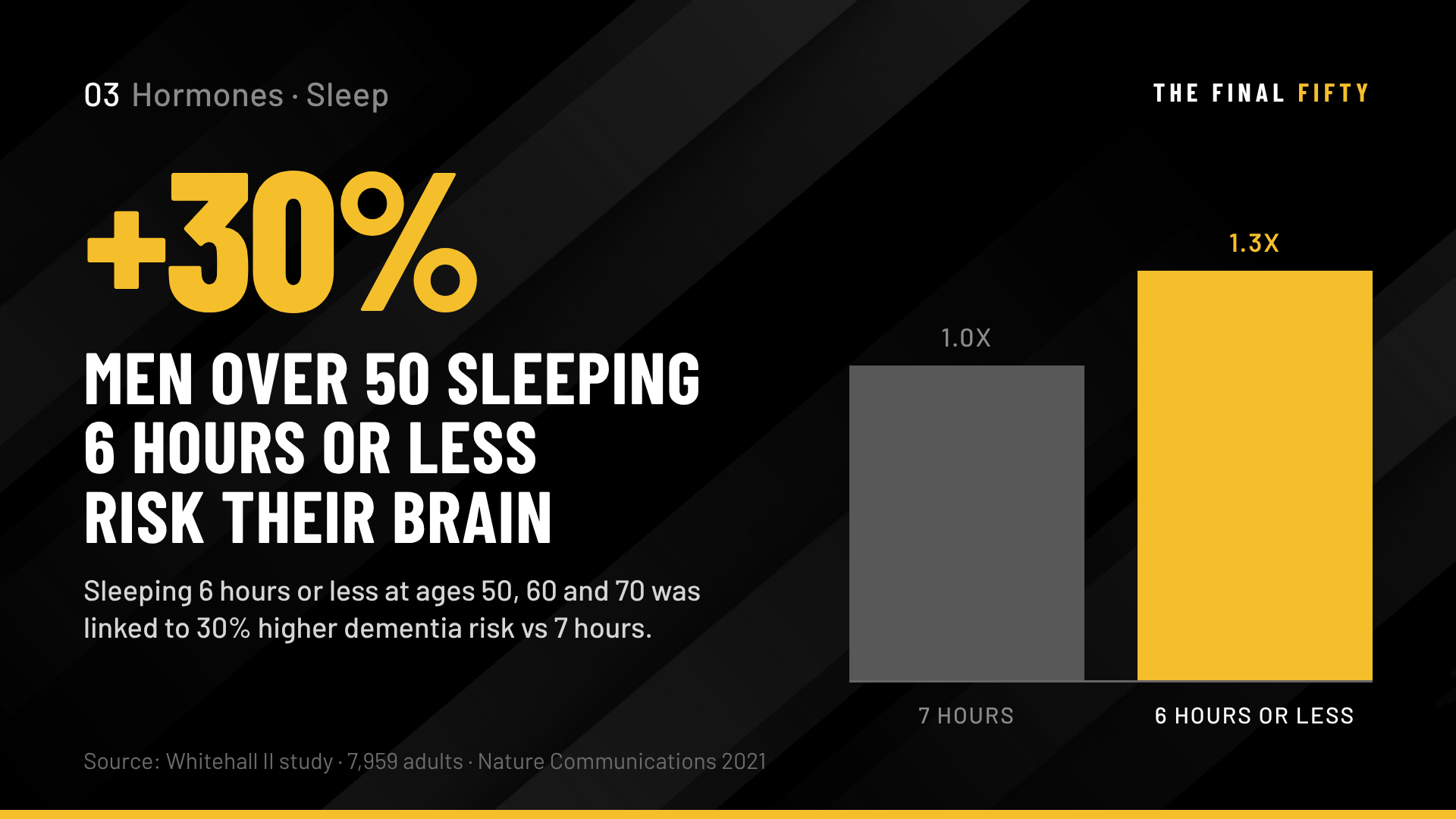
Cognitive maintenance is the third. During deep sleep, the glymphatic system clears brain waste including amyloid beta and tau proteins linked to Alzheimer’s disease. Poor sleep accelerates cognitive decline and increases dementia risk by 30 to 50 percent. The brain health investment described in the longevity pillar of this series depends on sleep for its primary maintenance window. Every night of inadequate sleep is a night of reduced glymphatic clearance, and the amyloid accumulation that reduced glymphatic clearance permits has been documented as a contributor to the Alzheimer’s pathology that brain health investment is designed to prevent.
Cardiovascular health, immune function, metabolic regulation, and inflammatory management are all further domains in which adequate sleep provides protection and inadequate sleep produces measurable damage. The man over fifty who is managing his cardiovascular risk, his inflammation, and his metabolic health through the training and nutritional standards this platform describes while consistently sleeping five to six hours is partially offsetting those investments through the cardiovascular strain, inflammatory elevation, and metabolic dysfunction that inadequate sleep produces.
The Specific Changes Most Men Over 50 Experience
The sleep changes that most men over fifty attribute to stress, a busy schedule, or simply getting older are typically the specific architectural changes that the research documents rather than random fluctuations in sleep quality. Recognizing the pattern is the first step toward addressing it correctly.
Difficulty falling asleep despite tiredness is often the expression of the elevated evening cortisol that the cortisol-sleep feedback loop produces. The man who is tired but whose nervous system is maintaining the sympathetic activation of cortisol elevation cannot make the transition to sleep efficiently regardless of his desire to do so. The bed is present. The hours are available. The cortisol is preventing the transition.
Early morning waking, typically between three and five in the morning, is the expression of the cortisol awakening response arriving earlier than it should. Normal cortisol rises sharply in the 30 minutes following waking, which is what produces the alert transition from sleep to wakefulness that the morning requires. In men whose cortisol rhythm is disrupted, this rise can occur several hours before the intended waking time, producing the pre-dawn waking that most men find among the most frustrating expressions of second-half sleep deterioration.
Multiple night-time awakenings, often accompanied by the need to urinate, represent the lighter sleep architecture of the second half in which the man is spending more time in stages one and two, from which waking is considerably easier than from the deep sleep that he was generating at greater depth and duration two decades earlier. The need to urinate at night also increases with age through mechanisms including reduced bladder capacity and the reduced antidiuretic hormone production that allows the kidney to concentrate urine adequately for the overnight period.
Unrestorative sleep, the experience of waking after a full night that did not feel like adequate rest, is the subjective experience of deep sleep and REM sleep reduction: the man spent the hours in bed but the architecture did not provide the stages where the most restorative maintenance occurs. Sleep duration and sleep quality are not the same variable, and the man who measures his sleep by hours rather than by how he feels in the morning is measuring the wrong indicator.
What Fixes It: Evidence-Based Interventions
The sleep interventions that produce the most meaningful improvement in both sleep duration and sleep architecture for men over fifty are the same structural and behavioral investments that this platform describes across multiple pillars for their benefits to the systems those pillars address. Sleep hygiene, as a concept, is undersold in its capacity to produce architectural improvement when it is executed with the same discipline that this platform applies to training and nutrition.
Consistent wake time is the highest-leverage single sleep intervention available. The circadian rhythm that governs sleep and wake timing is anchored more powerfully by wake time than by bed time, because the cortisol awakening response that produces the transition to wakefulness is timed relative to habitual wake time rather than relative to when the man went to bed. The man who wakes at 5:30 every morning regardless of when he went to bed is training his circadian clock to produce the cortisol response and the sleep pressure that will allow him to fall asleep efficiently at his intended bed time. The man whose wake time varies by two or more hours across the week is disrupting the circadian anchor that sleep architecture depends on, regardless of how many hours he is spending in bed.
Evening cortisol reduction through deliberate disengagement is the structural intervention that most directly addresses the elevated evening cortisol that is driving the cortisol-sleep feedback loop. A defined end point to professional engagement, after which screens are away and the cognitive mode is explicitly shifted from production to recovery, is the behavioral mechanism that allows cortisol to follow its intended decline rather than maintaining elevation into the period when sleep transition should be occurring. The specific timing is individual but the principle is universal: cortisol cannot decline in an environment that is continuously providing the professional stimulation that maintains its elevation.
Sleep apnea assessment is the most commonly overlooked structural intervention for men over fifty, and the most consequential when it is present and unaddressed. Obstructive sleep apnea affects approximately 40 percent of men aged 50 to 70. Sleep apnea significantly lowers testosterone levels independent of age and obesity by fragmenting the sleep architecture at the points where testosterone secretion is occurring. The man who is attributing his poor sleep quality, his low testosterone, and his reduced energy to normal aging may be primarily experiencing the treatable consequences of undiagnosed obstructive sleep apnea. A sleep study, either in a laboratory or through a validated home sleep testing device, is the diagnostic investment that determines whether the sleep problem is behavioral and architectural, in which case the behavioral and structural interventions described here are appropriate, or medical, in which case CPAP or other medical intervention is the primary treatment.
Sleep environment optimization removes the specific environmental signals that maintain sympathetic nervous system activation into the sleep period. Cool room temperature, between 65 and 68 degrees Fahrenheit or 18 to 20 degrees Celsius, is the most evidence-supported environmental variable for deep sleep promotion: core body temperature naturally declines during the transition to sleep, and a cool room environment supports this decline more effectively than a warm one. Complete darkness removes the light-induced melatonin suppression that delays sleep onset and reduces sleep depth. Removal of the phone from the sleep environment eliminates the variable alertness stimulus that device proximity maintains.
Alcohol management is the sleep intervention that most men over fifty resist most strongly and that produces among the most significant improvements when acted upon. Alcohol is sedating and initially facilitates sleep onset, which is why most men who drink regularly report that it helps them fall asleep. What they do not observe is the architectural disruption that alcohol produces in the second half of the night: the suppression of REM sleep that alcohol causes produces the unrestorative, vivid-dreaming, early-waking night that characterizes the alcohol-disrupted sleep architecture. The man who drinks three or more evenings per week and who reports chronically unrestorative sleep has identified the primary driver.
THE FINAL 50 FRAMEWORK
THE REFRAME
Sleep is not rest. It is the most active maintenance window available to the male body, during which growth hormone is secreted, testosterone is produced, muscle tissue is repaired, the brain’s glymphatic clearance removes amyloid and tau proteins, and the cortisol-testosterone hormonal balance is restored for the following day. Deep sleep declines from nearly 20 percent at age 25 to less than five percent by 35. Growth hormone drops 75 percent across the same period. After 50, total sleep falls further and REM reduces to half its young-adult level. The man who treats sleep as a passive background variable rather than the primary hormonal maintenance investment it is has left the most important recovery window in the second half unmanaged.
THE STANDARD
The Final 50 man protects seven to nine hours of sleep per night with the same non-negotiable scheduling discipline he applies to his training program. He maintains a consistent wake time seven days per week as the primary circadian anchor. He has been assessed for obstructive sleep apnea and has addressed it if present. He manages evening cortisol through deliberate disengagement from professional stimulation in the two hours before sleep. He sleeps in a cool, dark room without his phone. He has audited his alcohol consumption against its impact on sleep architecture. He treats sleep quality rather than total hours as the primary indicator of sleep adequacy.
THE PRACTICE
This week, set one consistent wake time and hold it every day including the weekend. Choose the time you need to wake on your most constrained weekday and apply it uniformly. Notice by day four and five whether sleep onset is occurring more naturally and whether the morning waking feels less effortful. The consistent wake time produces its circadian anchoring effect within three to five days of consistent application. It costs nothing. It requires no supplements or medical intervention. And for the man whose irregular wake time has been disrupting his circadian architecture, it is the single change that produces the most immediate architectural improvement available.
THE AUDIT
How does your sleep feel in the morning, not in terms of hours but in terms of restoration? If the honest answer is that your mornings consistently feel unrestorative despite adequate hours in bed, you have identified either an architectural problem, reduced deep sleep and REM, an apnea problem requiring medical assessment, or an environmental and behavioral problem that the interventions in this article address. Which of the five interventions described, consistent wake time, evening cortisol reduction, sleep apnea assessment, environment optimization, or alcohol management, is most clearly not present in your current sleep practice? That absence is where the intervention begins.
THE PROMPT
The men in your brotherhood are each managing some version of the second-half sleep deterioration that the research documents, and most of them have never had the specific conversation about sleep architecture rather than sleep duration, about what their sleep is producing hormonally and cognitively, or about which of the specific interventions has produced the most meaningful improvement for the men who have tried them. Who in your circle has made a specific structural change to his sleep and tracked what it produced? What changed in his training performance, his testosterone picture, or his cognitive clarity when the sleep architecture improved? That conversation, grounded in specific experience rather than general sleep advice, is among the most practically valuable the brotherhood can have.


