
Testosterone replacement therapy sits at the intersection of two cultures that have produced significant noise and insufficient clarity. The medical establishment has been historically cautious about it, shaped by early observational studies that raised cardiovascular concerns, by the complexity of diagnosing the condition it treats, and by legitimate uncertainty about long-term outcomes in a population that is now being studied with the rigor those questions require. Meanwhile the men’s health optimization culture has positioned TRT as a near-universal intervention for the second half of male life, accessible through a growing network of direct-to-consumer clinics that apply minimal clinical rigor and market convenience over appropriateness.
Both cultures have made the conversation more difficult than it needs to be. The man over fifty who wants an honest, evidence-grounded understanding of what TRT is, what it does, who it is appropriate for, and what the actual risk picture looks like after the largest clinical trial ever conducted on the subject has reported its results, is not well served by either the historical reluctance of conventional medicine or the commercial enthusiasm of the optimization industry.
This article addresses that man. It is not a recommendation to pursue or avoid TRT. It is the information that allows a man to walk into a physician’s office with enough understanding to have an informed conversation rather than arriving without context and accepting whatever conclusion the physician’s time constraints and institutional defaults produce.
What TRT Is and What It Is Treating
Testosterone replacement therapy is the administration of exogenous testosterone to raise circulating testosterone levels in men whose bodies are not producing adequate testosterone on their own. It is a medical treatment for a clinical condition, not a performance enhancement tool that happens to be prescribed. The condition it treats is hypogonadism, specifically late-onset hypogonadism in the context of men over fifty, which is defined by the combination of biochemically confirmed low testosterone and the clinical symptoms that low testosterone produces.
The distinction between those two requirements, biochemical confirmation and symptomatic presentation, is the most important clinical principle in the TRT conversation and the one most commonly collapsed in both directions. Low testosterone without symptoms may not warrant treatment, since some men function well at testosterone levels that would produce significant symptoms in others. Symptoms consistent with low testosterone without biochemical confirmation of low levels may have another cause that TRT will not address and that requires different investigation. Appropriate TRT requires both, and the clinical assessment that establishes both is what separates legitimate TRT from the casual prescribing that produces the outcomes that give TRT a bad reputation.
Testosterone levels in men decline with age, typically beginning in the fourth decade of life and accelerating thereafter. This process, often described as late-onset hypogonadism, is characterized by progressive declines in serum testosterone, impaired sexual and physical function, metabolic disturbances, and reduced quality of life. The symptoms of late-onset hypogonadism include reduced libido, erectile dysfunction, decreased muscle mass and strength, increased body fat particularly in the visceral region, fatigue and reduced energy, mood disturbance including depression and irritability, reduced cognitive function including concentration and memory difficulties, and reduced bone mineral density. These symptoms are not unique to low testosterone, which is why the biochemical confirmation requirement exists alongside the symptom assessment. Depression, thyroid dysfunction, sleep apnea, and other conditions produce overlapping symptoms that require exclusion before low testosterone is established as the primary driver.
The Clinical Criteria: Who the Evidence Says TRT Is For
The clinical guidelines for TRT prescription have become more refined as the evidence base has grown and as the specific population that benefits from treatment has been more precisely characterized through controlled trial data.
A 2025 comprehensive narrative review of TRT in men aged 50 and above, covering randomized controlled trials, cohort studies, systematic reviews, and meta-analyses from January 2000 to July 2025, concluded that TRT consistently improved sexual desire, erectile function, lean body mass, bone mineral density, insulin sensitivity, and vitality, with most benefits observed in men with baseline testosterone levels below 300 nanograms per deciliter and target levels maintained at 500 to 800 nanograms per deciliter. The baseline threshold of 300 nanograms per deciliter is the American Urological Association’s diagnostic criterion for hypogonadism, confirmed on two separate morning measurements to account for the natural diurnal variation in testosterone levels.
The man who meets the clinical criteria for TRT is the man who has documented total testosterone below 300 nanograms per deciliter on two separate morning blood draws, who has free testosterone and SHBG measurements that confirm the low bioavailable fraction is not simply explained by elevated SHBG with normal total testosterone, and who is experiencing clinical symptoms attributable to hypogonadism that have persisted after addressing the modifiable lifestyle factors that independently suppress testosterone, including obesity, sleep apnea, alcohol excess, and severe stress. The lifestyle optimization comes first, not because it replaces TRT for men who genuinely need it, but because it resolves the secondary hypogonadism that lifestyle factors produce without requiring medical intervention and establishes the cleanest possible baseline from which the medical conversation can be conducted.
Men with prostate cancer, breast cancer, a hematocrit above 54 percent, severe untreated sleep apnea, uncontrolled heart failure, or a recent history of thromboembolic events are generally not candidates for TRT regardless of testosterone levels. These represent the contraindications that remain regardless of the otherwise favorable evidence base, and they are not limitations that can be negotiated around through clinical creativity or commercial enthusiasm.
A significant proportion of men aged over 50 surveyed reported experiencing prolonged symptoms of testosterone deficiency prior to seeking care. Eighty-six percent delayed treatment for at least a year, including 24 percent who experienced symptoms for over five years before seeking care. Men over 50 are 1.61 times more likely to delay treatment compared to younger men. The delay is not primarily clinical. It is cultural: the expectation that the symptoms of declining testosterone are simply the normal experience of aging, to be accepted rather than investigated and potentially addressed.
They are the normal experience of aging, in the sense that they are common. They are not inevitable or untreatable in the men who meet the clinical criteria for TRT. The distinction matters and is worth making explicitly.
What the TRAVERSE Trial Resolved
The question that had most significantly constrained the appropriate use of TRT for men with hypogonadism was the cardiovascular safety question. Early observational studies in 2013 and 2014 suggested potential cardiovascular risk increases associated with testosterone therapy, and the US Food and Drug Administration in 2015 required that manufacturers conduct clinical trials to determine whether TRT was associated with an increased risk of cardiovascular events.
The resulting trial, the Testosterone Replacement Therapy for Assessment of Long-term Vascular Events and Efficacy Response in Hypogonadal Men, known as TRAVERSE, enrolled 5,246 men aged 45 to 80 years with symptomatic hypogonadism and pre-existing or high risk of cardiovascular disease. It was the largest randomized controlled trial of testosterone therapy conducted, with participants followed for a median of 33 months and results published in the New England Journal of Medicine in 2023.
The primary finding was definitive: testosterone replacement therapy was not associated with an increase in major adverse cardiovascular events compared with placebo. The results were noninferior to placebo for the incidence of cardiovascular death, nonfatal heart attack, and nonfatal stroke. The results are very reassuring in that testosterone replacement does not increase overall cardiovascular risk in this group of patients with symptomatic hypogonadism and low testosterone level.
The trial also identified areas requiring continued monitoring. Rates of nonfatal arrhythmia warranting intervention, atrial fibrillation, and acute kidney injury were higher in the testosterone group than in the placebo group. These findings support the existing guidance that TRT should be used with caution in men with prior thromboembolic events and that regular monitoring is appropriate throughout treatment. The trial did not establish TRT as risk-free. It established that the cardiovascular mortality concern that had most significantly limited appropriate TRT use in men with confirmed hypogonadism is not supported by the rigorous trial evidence.
A concurrent randomized clinical trial examining prostate safety during TRT found that during 14,304 person-years of follow-up in 5,204 men with hypogonadism, the incidences of high-grade or any prostate cancer, acute urinary retention, invasive surgical procedures, and new pharmacologic treatment were low and did not differ significantly between the testosterone and placebo groups. The historical concern that TRT causes prostate cancer has not been supported by controlled evidence. The appropriate monitoring of prostate health through PSA testing during TRT remains standard clinical practice, but the treatment itself does not appear to initiate or accelerate prostate cancer in men without pre-existing disease.
The Delivery Options and What They Mean in Practice
TRT is not a single intervention. It is a category that encompasses several delivery mechanisms, each with specific characteristics that affect the clinical experience, the monitoring requirements, and the adherence patterns that determine whether treatment produces the intended outcomes.
Injectable testosterone cypionate or enanthate, administered every one to two weeks by injection, is the most widely used and most cost-effective formulation. Injections produce higher peak testosterone levels shortly after administration and lower trough levels approaching the next injection, creating a cyclical hormonal pattern rather than the more stable levels that other delivery mechanisms produce. For men who prefer self-injection and who tolerate the peak-to-trough fluctuation, injectable testosterone is the standard of care and the formulation with the most extensive clinical evidence base.
Transdermal testosterone gels applied daily to the skin produce more stable testosterone levels than injections, mimicking the natural diurnal pattern more closely. The primary limitation of gels is the transfer risk to partners and children through skin contact, which requires specific precautions about drying time and covered application sites. Gels are also more expensive than injectables over time and require daily application discipline that some men find challenging to sustain.
Testosterone pellets implanted subcutaneously every three to six months provide the most stable and sustained testosterone delivery of the available options, releasing testosterone gradually over the implantation period. Pellets eliminate the daily or weekly adherence requirement and produce stable levels without the cyclical variation of injectables. The limitation is that if any adverse effects emerge or if the dose proves incorrect, the pellets cannot be removed and the effect persists until they dissolve.
Oral testosterone undecanoate, available in newer formulations that bypass the first-pass liver metabolism that made earlier oral testosterone products problematic, provides a non-injectable option that some men prefer. The twice-daily dosing requirement and the variability in absorption related to fat content of concurrent meals are the primary practical limitations.
The selection of formulation is a conversation between the man and his prescribing physician that involves clinical factors, lifestyle factors, cost considerations, and patient preference. No formulation is universally superior. The best formulation is the one a man will use consistently and that produces the stable testosterone levels within the 500 to 800 nanograms per deciliter therapeutic target that the evidence associates with benefit.
The Conversation That Needs to Happen
The man over fifty who is experiencing the symptoms associated with low testosterone and who has not yet had a comprehensive hormonal assessment has not yet started the conversation that the evidence supports having. That conversation begins with the blood work described in the lab work articles in this series: total testosterone, free testosterone, SHBG, estradiol, and the additional markers that provide the complete hormonal picture rather than the single total testosterone number that most standard panels provide.
If the complete hormonal assessment confirms biochemically low testosterone alongside a clinical symptom burden, the conversation moves to a physician who practices in this area with clinical rigor rather than commercial convenience: an endocrinologist, a urologist, or a men’s health physician who takes a complete medical history, orders the relevant exclusionary workup, addresses the modifiable lifestyle factors that may be contributing to the suppression, and discusses the treatment options and monitoring requirements with the specificity the decision requires.
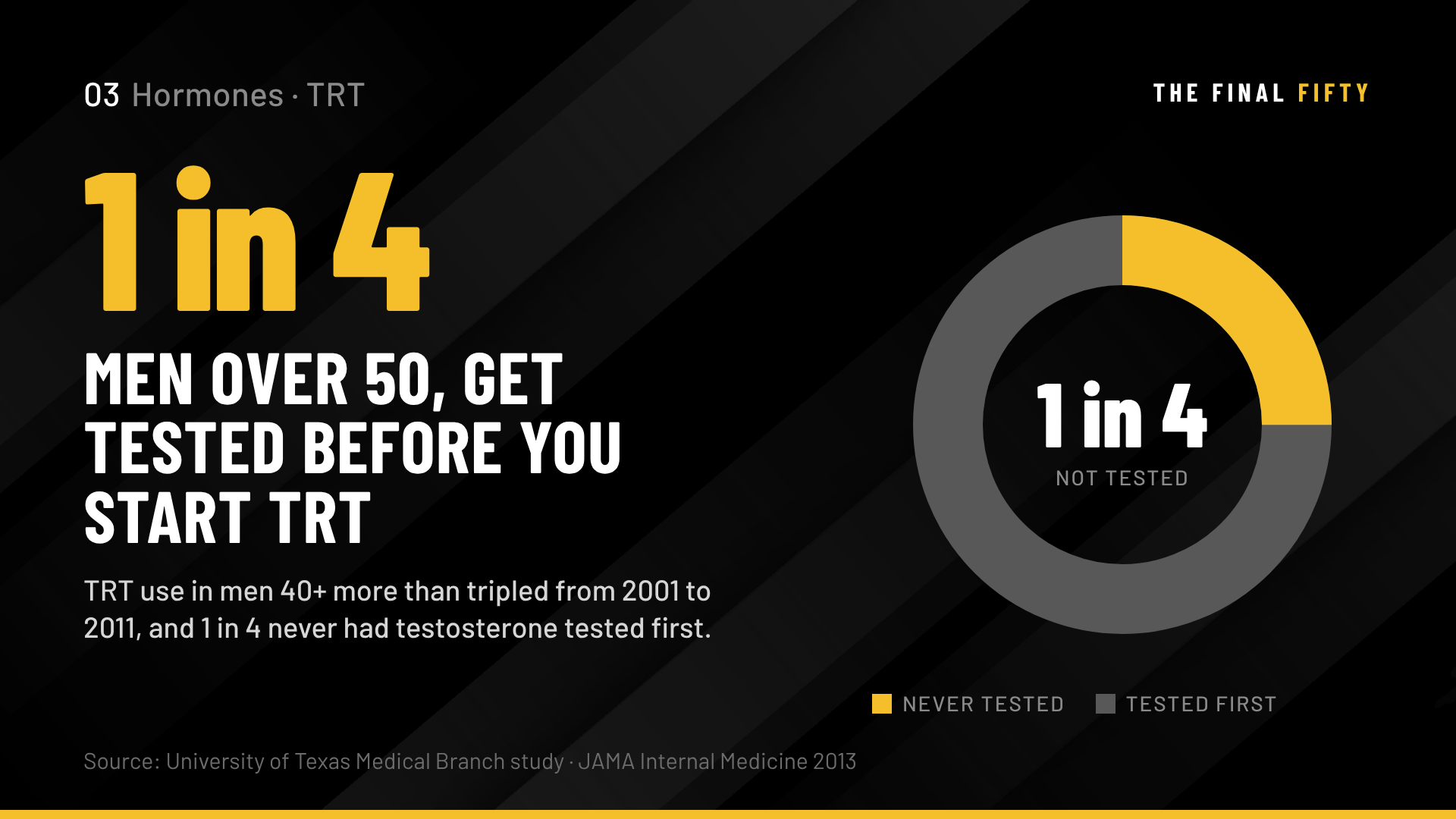
The man who pursues TRT through a direct-to-consumer telehealth platform with a brief online questionnaire and a single testosterone measurement is not pursuing TRT as the clinical literature describes and supports it. He is purchasing testosterone access with minimal clinical oversight, which produces outcomes that range from beneficial to problematic depending entirely on whether he happens to meet the clinical criteria that the platform’s expedited process did not rigorously establish.
TRT, when appropriate and properly monitored, is one of the most impactful medical interventions available for men over fifty with confirmed hypogonadism. Getting there requires the conversation, not the shortcut.
THE FINAL 50 FRAMEWORK
THE REFRAME
TRT is not a lifestyle optimization tool for any man who wants more testosterone. It is a medical treatment for a specific condition defined by biochemically confirmed low testosterone combined with clinical symptoms attributable to that deficiency. The TRAVERSE trial, the largest randomized controlled trial ever conducted on testosterone therapy, found no increase in cardiovascular mortality in men with confirmed hypogonadism who received TRT versus placebo. This does not make TRT appropriate for every man over fifty. It makes TRT appropriate, under rigorous clinical assessment and monitoring, for the specific population the evidence defines.
THE STANDARD
The Final 50 man who is experiencing symptoms consistent with low testosterone does not attribute them to aging and accept them. He investigates them through the complete hormonal blood panel described in this series, addresses the modifiable lifestyle factors that independently suppress testosterone before drawing conclusions about primary hypogonadism, and has the physician conversation that the complete hormonal picture warrants rather than either pursuing commercial TRT access without clinical rigor or accepting the symptoms because a brief physician visit produced a normal total testosterone number without the full assessment.
THE PRACTICE
If you are experiencing fatigue, reduced libido, difficulty maintaining muscle mass, mood disturbance, or cognitive slowing that persists despite consistent training, adequate sleep, and managed stress, this week request the complete hormonal panel: total testosterone on two separate morning draws, free testosterone, SHBG, and estradiol. Do not draw conclusions from total testosterone alone. Do not pursue a clinical conversation about TRT until the complete picture is available. The complete picture is what allows the conversation to be productive rather than based on incomplete information that produces decisions in either direction that the evidence does not support.
THE AUDIT
Have you had a comprehensive hormonal assessment in the past 12 months? Do you know your free testosterone and SHBG alongside your total testosterone? Have you addressed the primary modifiable suppressors of testosterone, body fat percentage, sleep apnea, alcohol consumption, and chronic stress, before attributing a low testosterone reading to primary hypogonadism? Have you had the conversation about your symptoms and your hormonal data with a physician who practices in this area with clinical rigor rather than scheduling efficiency? Honest answers to those four questions tell a man exactly where he is in the process and what the next step is.
THE PROMPT
The men in your brotherhood are managing their hormonal health with varying degrees of clinical engagement and varying levels of accurate information about what TRT is and who it is appropriate for. The conversation about testosterone in male social circles tends toward the commercial and the anecdotal rather than the clinical and the evidenced. What would it mean to bring the clinical conversation into the brotherhood, to share what each man’s complete hormonal panel shows and what his physician has said about it, and to support each man in having the rigorous clinical conversation rather than the expedient commercial one? That conversation, held honestly, produces better outcomes than any of the available shortcuts.


