
There is a gap between the man a man over 50 intends to be and the man he actually is each day, and the size of that gap is determined almost entirely by one variable: whether his most important daily behaviors are standards or intentions.
An intention is something a man plans to do when conditions permit. He intends to train this week. He intends to eat well starting Monday. He intends to be present with his family in the evenings after the current work pressure settles. Intentions are genuine. They reflect real desire for a different outcome. And they produce the same result with striking consistency: the behavior happens when it is convenient and disappears when it is not, which means it happens less often than the man believes it does and less reliably than the outcome he is pursuing requires.
A standard is different. A standard is a non-negotiable behavior that happens regardless of whether conditions are favorable. It is not evaluated each morning against competing demands. It is not renegotiated when the schedule is difficult. It exists at the level of identity rather than at the level of preference, and the research on what makes behaviors durable versus fragile maps almost precisely onto this distinction.
For men over fifty who are building the second half of their lives deliberately, the daily standards are not a collection of good habits. They are the operating system on which everything else runs. The physical performance, the hormonal health, the professional clarity, the relational investment, all of it depends on a set of daily behaviors that are held to the standard level, not the intention level. The man who understands this distinction and builds his daily life around it is building something categorically different from the man who is still operating primarily on intention.
The Science of Why Standards Work and Intentions Do Not
The research on self-control, habit formation, and behavioral consistency has produced one of the most practically important findings in applied psychology: willpower is not the primary mechanism that separates people who consistently execute their most important behaviors from people who do not. Systems are.
By the time the average individual retires for the night, they may have navigated an astonishing 35,000 decisions, each one chipping away at a finite reserve of mental energy. This constant stream of choices carries an unseen but substantial cost. This phenomenon, known as decision fatigue, describes the deterioration in the quality of decisions after a long session of decision-making. It is not a character flaw or a failure of willpower but rather a fundamental consequence of the brain’s operational limits.
The most successful people do not have more willpower than others. They simply must use it less often. They build systems, habits, routines, and pre-commitments that automate trivial choices, thereby conserving their finite mental energy for the decisions that truly matter. The behaviors that matter most are not left to daily willpower evaluation. They are built into the structure of the day as defaults that do not require a decision each time they occur.
Automating mundane daily choices is a powerful way to liberate finite mental energy for more critical, higher-order decisions. The brain’s basal ganglia are highly involved in habit formation, allowing actions to become automatic and consume minimal cognitive effort. Consistent morning routines, standardized eating patterns, and predictable exercise schedules bypass the need for conscious decision-making each day, conserving the willpower that genuinely important decisions require.
Research published in 2024 found that framing habits in terms of identity rather than outcome produces significantly stronger habit formation and durability. The person who frames his training as something he does, which can be evaluated against competing demands, will train less consistently than the person who frames it as who he is, for whom not training requires explanation while training requires no decision at all. This identity framing is not self-deception. It is the behavioral science of how durable standards are built and maintained.
What Daily Standards Are Not
Before describing what daily standards for men over fifty should include, it is worth being precise about what they are not, because the confusion between standards and aspirations is what keeps most men operating at the intention level indefinitely.
Daily standards are not comprehensive optimization protocols. The man who builds fifteen daily non-negotiables has not built a standard-based life. He has built an elaborate system that will collapse the first time a genuine life disruption arrives, leaving him with nothing because the all-or-nothing architecture of fifteen simultaneous requirements produces total failure when any one of them is disrupted. Daily standards are few in number. Four to six at most. Held every day without exception. These are the behaviors so foundational to who a man is and what he is building that nothing short of genuine medical incapacity removes them from the day.
Daily standards are not the same as goals. A goal is a specific outcome a man intends to achieve. A standard is a behavior he holds daily regardless of whether today’s performance moves a measurable needle toward the goal. The man whose goal is to lose twenty pounds and whose standard is to train every morning and not eat after eight in the evening may take months to reach his goal. His standard is met or not met every day, independent of whether the scale is moving in any given week. The standard is what makes the goal achievable. Without the standard, the goal is only an aspiration.
Daily standards are not aspirational at the high end and negotiable at the low end. The word non-negotiable exists for a reason. The standard that gets modified when the schedule is tight, negotiated when motivation is low, and traded away when something else feels more urgent is not a standard. It is an intention with better marketing. The defining feature of a standard is that it holds under the conditions where an intention would not.
The Five Categories Where Daily Standards Matter Most
For men over fifty who are building the second half with intention, the daily standards that produce the greatest compounding return cluster in five categories. These are not the only areas where standards apply, but they are the areas where consistent daily behavior produces outcomes that no amount of occasional effort can replicate.
Physical training is the standard that most directly protects the hormonal environment, the muscle maintenance capacity, the cognitive function, and the longevity trajectory that the second half depends on. The research throughout this content library has established that training is not optional for the man who is serious about performing at a high level across the next thirty years. The standard version of this behavior is not training when the schedule permits. It is training every day that the program requires, at the intensity and volume the program calls for, regardless of whether that particular morning feels right for it. The session happens. The standard is held. The compound return accumulates.
Sleep is the standard most commonly sacrificed to what feels like productivity and most consistently undervalued as the primary biological recovery and hormonal maintenance mechanism that the second half requires. The research on sleep restriction and testosterone decline, on sleep deprivation and cognitive impairment, on sleep quality and inflammatory status, all of it converges on the same standard: seven to nine hours, protected with the same non-negotiability that a man brings to his most important professional commitment. The meeting that could not be moved would not move the sleep window. The training session that took priority would not take priority over the sleep that makes recovery from that session possible. Sleep held to a standard is not laziness. It is the biological prerequisite for everything else.
Nutrition held to a standard means that the primary dietary inputs, protein targets, food quality, elimination of processed food and refined seed oils, are maintained as non-negotiable daily behaviors rather than aspirations that hold when convenient and fail when the day is difficult. The standard is not perfection at every meal. It is the baseline that the body receives consistently enough to produce the physiology the second half demands. The man who eats well four days and poorly three days is not eating well. He is eating inconsistently, and inconsistency produces the inconsistent results that look like a diet problem but are actually a standard problem.
Cognitive investment held to a standard means that the man over fifty who is building the second half as a growth phase rather than a maintenance phase is doing something daily that challenges his mind at the level of genuine learning. Reading that engages. Writing that organizes thought. Problems that require sustained concentration. Skills that demand deliberate practice. The research on cognitive decline and its most potent modifiable risk factors consistently shows that mental engagement, maintained at sufficient frequency and challenge, is among the most powerful protective factors available. The man whose daily standard includes deliberate cognitive work is not doing something extra. He is doing the minimum that the evidence supports for protecting cognitive function across the decade ahead.
Relational investment held to a standard means that the man’s most important relationships, his marriage or partnership, his children, and his brotherhood, receive deliberate, non-logistical attention on a daily or near-daily basis. Not the attention that remains after everything else is handled. The attention that is protected before everything else takes it. A single genuine check-in with a partner. A text to an adult child that communicates care rather than coordinates logistics. A scheduled interaction within the brotherhood that holds even when the week is full. These are not grand gestures. They are the daily deposits that build the relational capital that makes the second half a life worth building rather than a performance worth watching.
Building the Standard: The Architecture That Makes It Hold
Understanding what daily standards should include is the easier part. Building the architecture that makes them hold when motivation is low, when the schedule is disrupted, and when the competing demands of a full life are pressing hardest is the actual work.
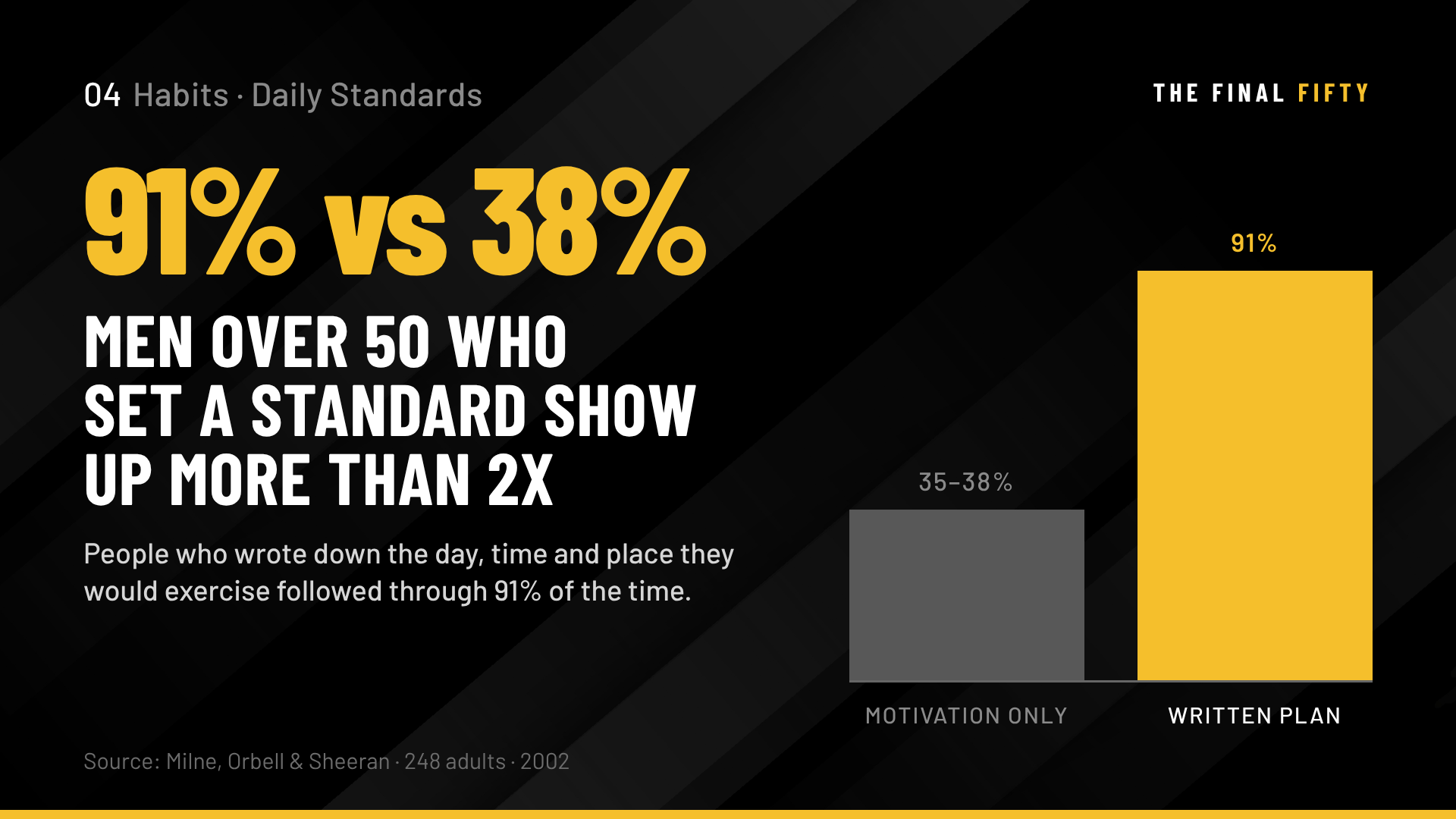
The research on implementation intentions, specific plans that take the form of when situation X occurs, I will do behavior Y, demonstrates dramatically increased follow-through compared to goal intentions that specify only what a man wants to achieve. The man who has decided he will train in the morning has made a goal intention. The man who has decided he will train every morning at 5:30 AM before his phone goes on has made an implementation intention. The specificity of the when and the where is what converts an intention into a behavior that the brain begins to treat as automatic rather than as a daily choice.
The environmental design that reduces friction for the standard behavior and increases friction for the competing behavior is the practical tool that supports implementation intentions in daily life. The training clothes set out the night before. The phone left in a room other than the bedroom. The food that meets the nutritional standard stocked and the food that does not removed from the home. These are not tricks. They are the deliberate design of the physical environment to support the man a man has decided to be rather than to accommodate the path of least resistance.
The recovery protocol for when the standard is missed matters as much as the standard itself. No man holds every standard every day across years. Travel disrupts training schedules. Illness disrupts sleep. Genuine life complexity disrupts the best-designed routine. The standard that cannot survive a single missed day is not resilient enough to serve its function. What matters is the rule about the rule: the standard is that when a day is missed, the next day is treated as day one of holding the standard again. Not with recrimination. Not with the extended self-permission that treats a missed Monday as a reason to restart on the following Monday. With the matter-of-fact recommitment that treats the standard as what it is: the behavior of the man he has decided to be, resumed as soon as circumstances permit.
The daily standard is not a destination. It is the road. Every man who builds the second half of his life at the level this platform describes will have a different specific set of standards, calibrated to his particular health situation, his professional demands, his family configuration, and his developmental priorities. The content is specific to the man. The architecture is universal: behaviors held at the standard level, built into the structure of the day as non-negotiable defaults, and maintained through the environmental design and the implementation intentions that make them durable rather than aspirational. That is the operating system. Everything else runs on it.
THE FINAL 50 FRAMEWORK
THE REFRAME
Daily standards are not habits that good men happen to have. They are the deliberate architecture that separates the man who is building the second half from the man who is coasting through it. The research on decision fatigue establishes that willpower is a finite and depleting resource. The man who relies on daily willpower to execute his most important behaviors is drawing from a resource that depletes as the day progresses. The man whose most important behaviors are standards requires no willpower to execute them. They happen because not happening would require an exception that the standard does not permit.
THE STANDARD
The Final 50 man has identified his four to six non-negotiable daily standards and holds them regardless of conditions. Training happens on the days the program calls for it. Sleep is protected at the duration and quality the biology requires. Nutrition meets the baseline the second half demands. Cognitive investment of some deliberate form occurs daily. Relational attention reaches the people who matter most before the day’s demands take the remaining energy. These standards are not aspirations. They are the behaviors that define who he is, held at the level that produces the compounding return the second half requires.
THE PRACTICE
This week, write down your four to six non-negotiable daily standards. Not what you hope to do or intend to do. The specific behaviors that you are committing to hold every single day, framed as who you are rather than what you plan to do. For each standard, write one implementation intention: when this specific circumstance occurs, I will perform this specific behavior, in this specific place, at this specific time. Then design one environmental change that reduces friction for the behavior. That is the architecture. Hold it for thirty consecutive days and notice what happens to the mental energy available for everything else.
THE AUDIT
Of the behaviors you currently call your daily habits or routines, which ones are standards, held regardless of conditions, and which ones are intentions, held when conditions are favorable? Be honest. The difference between the two shows up in what happens on a difficult Tuesday when the schedule is full, motivation is low, and the competing demands are loud. The standards happen. The intentions negotiate. If most of what you call your daily habits negotiate on difficult Tuesdays, you are operating primarily on intentions. That is the gap to close.
THE PROMPT
The men in your brotherhood each have a set of daily behaviors that are holding and a set that are slipping, and most of them have never named the difference between their standards and their intentions with enough honesty to address it. What would it look like to share your four to six non-negotiable daily standards with the brotherhood and to hold each other to the standard level rather than the intention level? That accountability, applied to the daily behaviors that matter most, is one of the most valuable things a genuine brotherhood can provide.


