
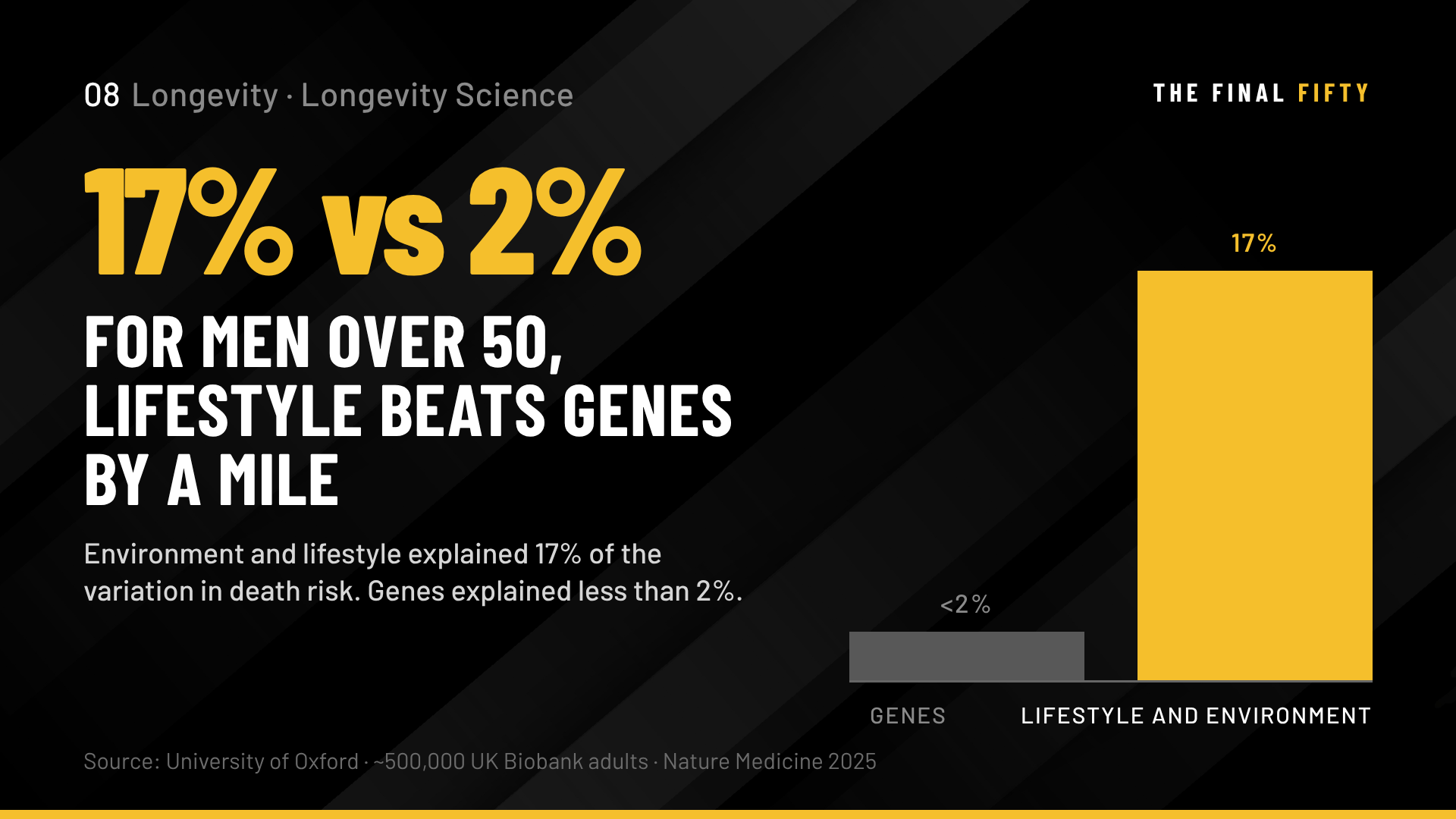
The longevity space has expanded from a niche scientific concern into a multi-billion-dollar industry, a podcast genre, a supplement category, and a cultural conversation all at once, and this expansion has produced the specific information problem that most men over fifty who care about their health now face: a vast amount of content about longevity, ranging from the rigorously established to the entirely speculative, delivered in a voice of authority that does not distinguish between them. The man who has spent three hours per week across a year consuming longevity content may know more about NAD precursors, senolytics, and epigenetic reprogramming than about the exercise, cardiovascular, and nutritional interventions with decades of human clinical trial evidence and population-scale outcome data behind them.
Longevity for men over fifty is not about fringe biohacks. It is about doing the proven basics exceptionally well, measuring the right things, and avoiding the specific diseases that kill most men early. This is not a conservative position that dismisses emerging science. It is the position that the evidence hierarchy itself supports: the interventions with the strongest evidence in human populations across the longest time horizons are the lifestyle interventions, not the pharmaceutical or nutraceutical additions. And the man who has not yet optimized those lifestyle interventions does not need to add NAD drips and senolytic compounds. He needs to do the things that the evidence says matter most, consistently, at the level the evidence says they need to be done.
This article organizes the longevity science into what the evidence has established clearly, what is emerging with promising evidence that warrants tracking without wholesale adoption, and what is speculative enough that the man over fifty should understand it as a developing story rather than a proven protocol. The organization is not about dismissing what is new. It is about allocating attention and investment in proportion to evidence strength, which is the approach that produces the best longevity outcomes for the man who has limited time and limited money and who wants to spend both where they will do the most demonstrable good.
Tier One: What Human Evidence Has Established
The Tier One longevity interventions are those with consistent, large-scale, long-term evidence in human populations across multiple independent research programs. They are not emerging. They are not promising. They are established.
Exercise is the most studied longevity intervention in existence and the one with the strongest evidence across the longest time horizon. A landmark meta-analysis published in The Lancet in 2025, synthesizing data from nearly one million people, found that regular walking reduces death risk by almost half and protects against many major diseases. Zone 2 low-intensity aerobic exercise at 60 to 70 percent of maximum heart rate for 150 to 180 minutes per week is the single most effective longevity intervention supported by the current evidence base. Resistance training maintaining muscle mass through strength training two to four times weekly preserves functional capacity and metabolic health across the second half. The combination of these two forms of training, described throughout this platform’s fitness content, is not a longevity supplement. It is the longevity intervention with the largest human evidence base.
Cardiovascular risk management is the second Tier One category. The leading causes of death in men over 50 are cardiovascular disease, cancer, and unintentional injury, in that order. Cardiovascular disease is responsible for more premature male deaths than any other category, and its primary risk factors, hypertension, elevated ApoB cholesterol, elevated Lp(a), elevated blood glucose, and smoking, are all measurable, most are modifiable, and the evidence for the mortality benefit of managing them is among the strongest in medicine. Treating hypertension is one of the highest-leverage interventions in medicine. ApoB management through dietary and pharmaceutical intervention reduces cardiovascular events in a dose-dependent fashion across multiple trial designs. The man who has not optimized his cardiovascular risk factors is not ready for the longevity supplement conversation. He is still in the foundational intervention tier where the largest mortality reductions are available.
Sleep protection is the third Tier One category, grounded in the biological evidence described throughout this platform’s hormonal health content: the glymphatic clearance of amyloid beta during slow-wave sleep, the testosterone and growth hormone production that sleep architecture enables, and the cortisol management that adequate sleep provides. Consistently sleeping fewer than six hours is associated with significantly elevated all-cause mortality risk across multiple large prospective studies. The intervention is not pharmacological. It is the protection of seven to nine hours of quality sleep as a non-negotiable health standard.
Nutritional fundamentals occupy the fourth Tier One category. Not the specific dietary optimization debates around macronutrient ratios, fasting windows, or specific food avoidances that fill the longevity content space, but the established baseline that all evidence-based dietary approaches agree on: minimizing ultra-processed foods, maintaining adequate protein for muscle mass preservation, managing caloric intake for body composition, and consuming the omega-3 fatty acids and micronutrients that the established biomarker evidence identifies as most commonly deficient. These fundamentals have the same relationship to the dietary optimization debates that cardiovascular risk management has to the longevity pharmaceutical debates: they come first, they produce the largest effects, and the man who has not done them consistently does not benefit from adding the sophistication that sits on top of them.
Not smoking and managing alcohol are the fifth established category. Smoking remains the single modifiable factor with the strongest dose-response relationship to premature mortality. Heavy alcohol consumption is associated with increased all-cause mortality through cardiovascular, hepatic, oncologic, and neurological pathways. Neither of these requires elaboration. The man who smokes or drinks heavily and is interested in longevity has identified his most consequential interventions before reaching any other category in this article.
Tier Two: What Is Emerging With Promising Evidence
The Tier Two longevity interventions have promising human evidence that is not yet sufficient to establish them as clearly as the Tier One interventions, but is sufficiently robust that informed attention is warranted. These are not speculative. They are developing, and the man who follows the evidence should be aware of them while not allowing the enthusiasm they generate in the longevity media to assign them the same priority as the Tier One interventions.
VO2 max improvement through structured cardiovascular training has emerged as one of the strongest individual predictors of longevity in the contemporary evidence base. The Framingham Heart Study and several subsequent cohort analyses have found that VO2 max is among the most powerful single predictors of all-cause mortality, with men in the lowest VO2 max quintile having mortality rates multiple times higher than men in the highest quintile. The intervention, structured cardiorespiratory training including Zone 2 and high-intensity interval training, is not pharmacological and sits within the Tier One exercise category, but the specific VO2 max framing as a longevity biomarker worth tracking and targeting has gained sufficient evidence in the past several years to warrant separate mention.
Continuous glucose monitoring and metabolic health optimization have developed from diabetes management tools into longevity interventions in the period between 2020 and 2025. The evidence that postprandial glucose spikes, elevated fasting insulin, and insulin resistance are independently associated with accelerated aging, cardiovascular risk, and cognitive decline has strengthened across multiple large prospective cohorts. The specific interventions, dietary modification, resistance training, and targeted weight management, are all Tier One. The use of continuous glucose monitoring to personalize the application of these interventions based on individual metabolic responses is a Tier Two approach that is emerging as a clinically useful longevity tool for the man who has the resources and the commitment to use it.
Low-dose aspirin therapy for men with specific cardiovascular risk profiles occupies a nuanced position in the current evidence. The large ASPREE trial found that aspirin did not improve longevity in generally healthy older adults and increased bleeding risk, revising earlier guidance that supported broader aspirin use for primary prevention. For men with established cardiovascular disease or specific high-risk profiles identified through discussion with their physician, the risk-benefit calculation may support aspirin use. For men without these specific indications, the current evidence does not support aspirin for primary longevity benefit.
Low-dose rapamycin, the mTOR inhibitor used clinically as an immunosuppressant, has generated significant longevity research interest. The PEARL trial, a 48-week randomized controlled study in healthy adults aged 50 to 85, found that weekly low-dose rapamycin was associated with significant improvements in lean tissue mass and pain in women, with a manageable safety profile. The mTOR pathway’s role in cellular aging and the consistent lifespan extension seen in multiple animal models make rapamycin the longevity pharmaceutical candidate with the strongest mechanistic rationale. The clinical evidence in healthy humans is promising but limited in duration and scope. This is a development worth tracking for the man who follows the longevity science, not yet an intervention that the current human evidence justifies adopting outside of a clinical trial or specialist supervision.
Tier Three: What Remains Speculative
The Tier Three category contains interventions with either limited human evidence, conflicting evidence, or primary evidence from animal models or cell studies that has not been translated into demonstrated human benefit at comparable scale. The longevity media discusses many of these with the enthusiasm appropriate to emerging science but often without the epistemic humility appropriate to the actual evidence base.
NAD precursors, including NMN and NR, have generated substantial enthusiasm based on their role in cellular energy metabolism and on robust animal model evidence showing benefits for aging-related outcomes. The human clinical trial evidence is much more limited: several small trials have shown increases in circulating NAD levels from supplementation, but the translation of elevated NAD levels into meaningful longevity or healthspan outcomes in humans has not been established at the scale or duration that would justify the interventions’ current popularity and cost. This may change as longer trials produce more comprehensive data. The current evidence does not support prioritizing NAD supplementation over the Tier One interventions for the man who has not yet optimized his exercise, sleep, cardiovascular risk, and nutritional fundamentals.
Senolytics, drugs that selectively clear senescent cells, represent one of the most mechanistically compelling areas of longevity research. Senescent cells, sometimes called zombie cells, accumulate with age and secrete inflammatory signals that accelerate tissue aging. Animal model evidence for senolytic benefit is robust. Human clinical evidence is early: initial trials in specific disease populations have shown promising results, and the field is advancing rapidly. For the healthy man over fifty who does not have the specific conditions for which senolytic clinical trials are currently enrolling, the current evidence does not yet support adoption.
Epigenetic reprogramming through Yamanaka factors represents the most ambitious frontier in longevity biology: the partial resetting of cells’ epigenetic clocks to younger states without erasing their tissue identity. Early 2025 research demonstrated successful partial reprogramming in aged mice. The translation to human therapy is years or decades away from clinical application. This is worth understanding as a developing area of longevity science, not as an intervention available or appropriate to consider now.
Cold exposure through cold plunges and ice baths, intermittent hypoxia training, various peptides including BPC-157, and numerous other interventions that fill the longevity content space fall into the category of interventions with interesting mechanistic rationale and limited or absent controlled human trial evidence at the scale that would justify their priority positioning. Some of these may develop stronger evidence bases as research continues. The man who has fully optimized his Tier One interventions and who has the resources and interest to explore Tier Two developments has the standing to explore this category with appropriate skepticism. The man who has not optimized his sleep, his cardiovascular risk profile, or his exercise program does not yet have the foundational interventions in place that the Tier Three explorations build on.
The Biomarker Framework: Measuring What Matters
The longevity medicine approach that the evidence supports is not a protocol of supplements and interventions applied uniformly to all men over fifty. It is a measurement-driven approach that identifies the specific risk factors and deficits that apply to the individual man and applies the evidence-based interventions that address them most directly. The goal is not to track fifty markers quarterly. It is to establish a baseline, catch the specific things that kill men early, and update periodically.
The priority biomarkers for men over fifty, grounded in their association with the specific causes of male premature mortality, are: ApoB as the most directly actionable measure of cardiovascular risk from cholesterol-carrying particles, Lp(a) as the genetic cardiovascular risk factor that is present in approximately one in five people and that dietary and lifestyle modification cannot reduce, fasting glucose and fasting insulin as the metabolic health markers that predict cardiovascular risk, cognitive risk, and cancer risk independently of other factors, blood pressure as the most treatable cardiovascular risk factor in primary care, testosterone and the complete hormonal panel described in this platform’s hormonal health content, and the 25-hydroxyvitamin D level that determines whether vitamin D supplementation is hitting the therapeutic target.
VO2 max is worth assessing either through a formal exercise stress test or through the validated estimate that sustained-effort running time produces, because it is both a direct measure of cardiovascular fitness and one of the strongest individual longevity predictors now documented. The DEXA scan for bone density and body composition provides the specific body composition data that scale weight cannot, and that the second half’s sarcopenia and bone density risks make worth tracking annually. The sleep study for men who have not been assessed for obstructive sleep apnea completes the foundational measurement picture.
The man who has these measurements current, who knows where he stands on each, and who has applied the evidence-based interventions that address his specific findings is practicing the longevity medicine that the evidence supports. The man who has not done this assessment but who is spending money on NAD precursors and senolytic supplements is investing in the frontier while leaving the foundational work undone, which is the most common and most consequential error in the way men over fifty currently engage with the longevity space.
THE FINAL 50 FRAMEWORK
THE REFRAME
The longevity space is full of content that treats the most speculative interventions with the same authority as the most established ones. For men over fifty, this creates the specific risk of investing attention and money in emerging compounds and protocols while leaving the foundational interventions, exercise, cardiovascular risk management, sleep, nutrition, and smoking and alcohol management, at less than their optimal level. The Lancet 2025 meta-analysis of nearly one million people found that walking reduces death risk by almost half. The single most effective longevity intervention is aerobic exercise at the correct intensity and duration. That is not a consolation finding. It is the state of the evidence, and the man who acts on it consistently produces better longevity outcomes than the man who chases the frontier while leaving the foundation incomplete.
THE STANDARD
The Final 50 man has current measurements for ApoB, Lp(a), fasting glucose and insulin, blood pressure, testosterone and the complete hormonal panel, 25-hydroxyvitamin D, VO2 max estimation, DEXA body composition, and sleep apnea assessment. He has applied the evidence-based interventions that address his specific findings in each category. He maintains his Tier One intervention program, exercise, cardiovascular risk management, sleep protection, and nutritional fundamentals, at the level the evidence says they need to be done. He follows Tier Two developments with informed interest. He treats Tier Three interventions as a developing story rather than a proven protocol.
THE PRACTICE
This week, assess your current biomarker status honestly against the priority list described in this article. For each biomarker, ask: do you have a current measurement? If not, when will you get one? For each measurement you have, ask: are you actively managing this with the evidence-based intervention the measurement indicated? The biomarker assessment tells a man what his foundational risk profile is. The intervention assessment tells him where the gaps between the evidence and his current practice are. Those gaps are the longevity investment that produces the largest return per unit of attention and cost, consistently outperforming the supplements and protocols that fill most of the longevity content space.
THE AUDIT
What percentage of your current longevity investment, in time, money, and attention, is directed at Tier One interventions versus Tier Two and Three? If the honest answer is that the supplement spend and the biohacking attention exceeds the exercise investment, the sleep protection rigor, or the cardiovascular risk management engagement, you have identified the allocation problem that the evidence does not support. The Tier One interventions are not simple to execute consistently. They are demanding. The consistency with which they are executed, at the level the evidence says they need to be done, determines the longevity outcome more than any combination of supplements or frontier protocols applied on top of an inconsistent foundation.
THE PROMPT
The longevity conversation in the brotherhood that most changes individual behavior is not the one about which supplements each man is taking. It is the one about which biomarkers each man has current, which specific risk factors his measurements identified, and what evidence-based interventions he is applying to address them. The man who knows his ApoB, knows his VO2 max, has had his sleep assessed, and can describe the specific interventions he is using to address his specific risk profile is practicing longevity medicine. That conversation, shared among men who know each other well enough to be honest about gaps between intention and practice, produces more longevity benefit than any individual supplement recommendation the brotherhood could exchange.


