
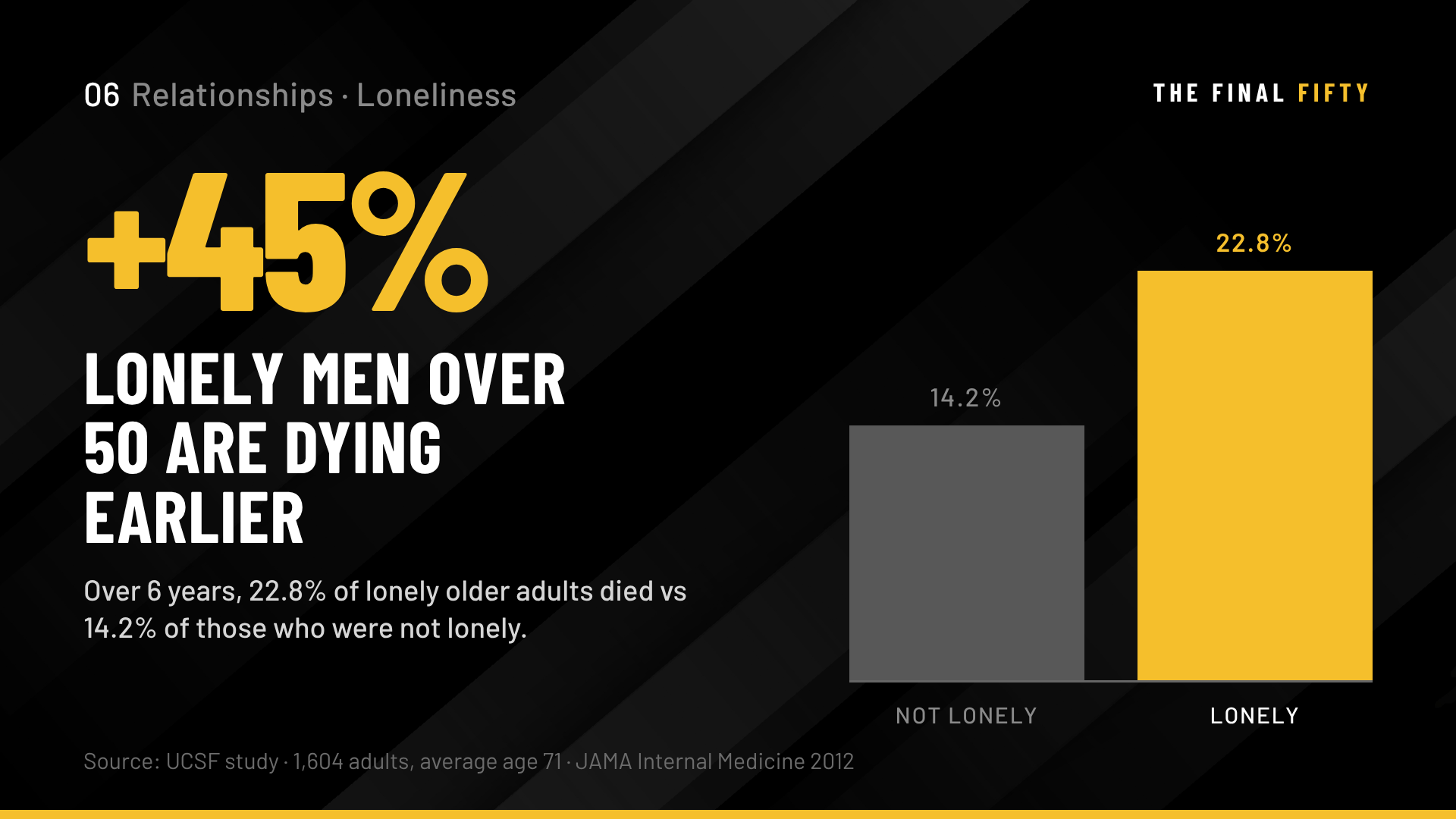
In 2023, the United States Surgeon General issued an advisory on loneliness and social isolation, framing them as a public health crisis of the same magnitude as smoking and obesity. The advisory cited research showing that social disconnection carries a 26 percent increased risk of premature death, that loneliness is associated with a 29 percent increased risk of heart disease and a 32 percent increased risk of stroke, and that adequate social connection is as important to longevity as adequate physical activity. These are not soft psychological findings. They are biological consequences of a social condition that is far more prevalent among men over fifty than the culture around male stoicism allows most men to name.
The friendship recession among men is documented with a specificity that makes the scale of the problem undeniable. In 1990, three percent of men reported having no close friends. Today that number is 15 percent, a fivefold increase in three decades. The number of men who reported six or more close friends fell from 55 percent to 27 percent across the same period, meaning the population of men with a robust friendship network has been cut in half. Forty percent of men report feeling lonely at least once a week. Among single men, 20 percent report zero close friends.
The men experiencing this are not exclusively men who never built friendships. Many of them built substantial friendship networks during the first half of their lives, in college, in early professional settings, in the neighborhoods where they raised their children, in the organizations they participated in across the building years. The friendships did not disappear by choice. They eroded through the mechanisms that the second half’s structure consistently produces: the professional demands that expanded, the family responsibilities that consumed, the geographic moves that scattered, and the cultural norm that assigns maintenance of social relationships almost entirely to women and treats male friendship as something that should happen naturally without deliberate investment.
The result is that men in their fifties often carry a private experience of social disconnection that they have never named to anyone, including themselves, because the vocabulary for naming it collides with the identity of the man who handles his own affairs. That collision is the specific cultural mechanism by which male loneliness becomes more dangerous than it would be otherwise: the condition that most requires social connection to address is the condition that most reliably prevents men from seeking it.
The Scale of the Problem: What the Research Documents
Understanding the prevalence of male loneliness after fifty requires distinguishing between loneliness, the subjective feeling of insufficient social connection, and social isolation, the objective condition of having few social relationships. Both are significant. They do not always coincide. A man can be surrounded by people at work and in family life and be experiencing the subjective loneliness of having no one to talk to about what is happening inside him. A man can be objectively socially isolated while not experiencing the subjective distress of loneliness if his baseline expectation for social connection has adjusted downward to match his circumstances.
A nationally representative University of Michigan poll of adults aged 50 to 80 documents the scope. Among community-dwelling older adults, loneliness and social isolation were highly prevalent and changed over time, with loneliness particularly elevated during periods of disruption. The 2024 Frontiers in Public Health review of male-specific loneliness data for men over fifty found episodic rates of approximately 20 percent in population-based samples, with rates rising to 28 to 30 percent among older men during high-stress periods. One in four or one in five men over fifty is experiencing significant loneliness at any given time. The proportion who would name it as such is considerably smaller.
Men are more likely than women to report feelings of disconnection or irrelevance rather than loneliness directly. Men are more likely to say that they are not meaningfully part of any group or community. The data reveals a meaningful gender difference not in the experience of social insufficiency but in how men describe it and whether they recognize it as the loneliness that the word names. Men are more likely to say they feel irrelevant than to say they feel lonely, which means the problem runs larger than the headline loneliness statistics alone capture.
The reliance on a single person, typically a partner, for emotional support is the structural vulnerability that most directly exposes men over fifty to the consequences of social disconnection. Research found that 74 percent of men would first turn to a spouse or partner for emotional support, while they reach out to friends or relatives far less often than women do. This single-source dependency means that the man who loses his partner through death, divorce, or estrangement loses his entire emotional support infrastructure simultaneously. For women, the research shows a distributed support network: friends, family members, and community connections provide support alongside the primary partnership. For most men over fifty, the primary partnership is the network, and its loss is not a reduction in support but the elimination of it.
Why the Second Half Produces Loneliness: The Structural Mechanisms
Male loneliness after fifty is not primarily a character failure or a relational deficit. It is the predictable consequence of structural changes that the second half reliably produces and that most men have never been taught to actively counter.
The professional community is the largest friendship infrastructure that most men in the first half built without recognizing it as friendship infrastructure. The colleagues who became friends, the professional relationships that extended into personal ones, the sense of belonging and social identity that the professional community provided, these are not relationships that transfer automatically when the professional context changes. The man who retires, changes careers, or significantly restructures his professional life in the second half loses not only his professional role but the social architecture that was embedded in it. He may not recognize this as a loss until the social deficit has accumulated for months.
The neighborhood and school-based community that organized much of the social life of the family-raising years disperses when the children leave home. The other parents who became familiar faces at soccer games and school events are not friends in most cases. They are contextual acquaintances whose connection was mediated by shared proximity to the same children at the same stage of development. When the children launch, the context dissolves and the connections dissolve with it. The men who had not built friendships that existed outside this context are left with the social experience of the family-raising years without the social infrastructure.
Increased social isolation, romantic partnership dissolution, and long-term disability are among the strongest predictors of male loneliness across the second half. These are not rare events in the lives of men over fifty. The partnership dissolution rate in the second half, through divorce and widowhood, is high enough that the man who has not invested in a friendship network independent of his partnership is statistically likely to face the social isolation of its loss at some point in the second half without the resources to recover from it.
The cultural norm that treats friendship maintenance as a female responsibility produces a specific competence gap in most men over fifty: they do not know how to build new friendships in adulthood, because most of their first-half friendships developed through contexts, schools, sports teams, neighborhoods, professional environments, that provided the repeated proximity and shared activity that friendship requires without demanding that the man consciously invest in the relationship. Building friendship in adulthood, in the absence of the automatic proximity that school and work and neighborhood provided, requires deliberate investment that most men have never practiced and that the culture around male self-sufficiency marks as unnecessary.
The Health Consequences: Why This Is Not a Soft Problem
The Surgeon General’s characterization of loneliness as a public health crisis equivalent to smoking reflects the specific, well-documented biological consequences of chronic social disconnection rather than a rhetorical elevation of a psychological concern to a medical one.
Cardiovascular consequences are the most extensively documented. Loneliness is associated with a 29 percent increased risk of heart disease and a 32 percent increased risk of stroke. The mechanisms are specific: chronic loneliness elevates cortisol through the sustained activation of the threat-response system that perceived social isolation triggers, increases systemic inflammation through the inflammatory signaling that stress hormones drive, and disrupts the hypothalamic-pituitary-adrenal axis regulation that adequate social connection supports. The lonely man’s cardiovascular system is operating under the chronic stress burden that the brain’s social threat-detection system generates in the absence of adequate connection, independently of whether the man recognizes the loneliness as a stressor.
The Tromsø longitudinal study, following nearly 18,000 adults across nearly three decades, found that the most socially isolated men had a hazard ratio of 1.41 for all-cause mortality compared to the least isolated, meaning a 41 percent higher risk of dying from any cause. Loneliness specifically showed an adjusted hazard ratio of 1.46. For men under fifty, the social isolation mortality effect was even stronger, with a hazard ratio of 1.76, suggesting that social connection matters for survival across the full adult lifespan, not only in old age.
The Surgeon General’s advisory framed the mortality equivalence with a specific comparison: lacking social connection carries health risks similar to smoking up to 15 cigarettes a day. The man who would not smoke fifteen cigarettes daily but who tolerates chronic social isolation as an acceptable condition of second-half life is accepting a comparable mortality risk without the cultural stigma that would prompt him to address it.
Cognitive consequences compound the cardiovascular and mortality risks. Social isolation and loneliness are among the Lancet Commission’s 14 modifiable dementia risk factors. The cognitive engagement that social interaction provides, the processing of other people’s perspectives, the communication demands of maintaining relationships, the emotional regulation that the social context requires, are among the most cognitively stimulating activities available. Their absence removes a significant cognitive demand from the brain’s daily load, reducing the cognitive engagement that neuroplasticity research identifies as one of the strongest protective factors against cognitive aging. The lonely man is not simply unhappy. He is cognitively understimulated and biologically stressed in ways that accumulate into the health outcomes the research documents.
Why Men Do Not Admit It: The Specific Cultural Mechanisms
The gap between the prevalence of male loneliness and the frequency with which men name it, to themselves or to anyone else, is not explained by the absence of the experience. It is explained by the specific cultural mechanisms that prevent men from recognizing and naming it.
The male socialization that assigns the asking for emotional support to the category of weakness produces a specific internal censorship in men over fifty who are experiencing loneliness. The thought sequence that begins I am lonely is often intercepted by the question what does that say about me? which in the context of male socialization produces the answer that the man who is lonely is the man who failed to build the relationships a capable man builds, which is the identity threat that the stoic suppression of the acknowledgment is protecting against. The man who does not admit loneliness is not being dishonest. He is protecting an identity that the admission would threaten under the specific cultural framework through which he has been taught to evaluate himself.
Men are less likely to report feelings of loneliness or speak with others about mental health issues, possibly due to societal stigmas and deeply entrenched gender roles. The same social norms that prevented men from building the friendship maintenance habits that would have protected them against second-half loneliness now prevent them from naming the loneliness that the absence of those habits has produced. The cultural mechanism operates at both ends: it produces the condition and then prevents the disclosure that would initiate its address.
Men are more likely to report feelings of disconnection or irrelevance, categories that do not carry the same vulnerability implications that the word loneliness carries for men who have internalized the cultural norms around self-sufficiency. This matters practically: the man who says I feel irrelevant is expressing the same social insufficiency as the man who says I am lonely, but in a frame that does not require the identity vulnerability that naming loneliness directly would produce. The path to addressing male loneliness after fifty must go through the vocabulary men can use, which may not initially include the word itself.
What the Research Says About Addressing It
The research on effective interventions for loneliness in older adults consistently finds that the most effective approaches address the underlying social disconnection rather than simply managing the psychological symptoms of loneliness. Changing the frame from how do I feel better about being alone to how do I build the connections that make the loneliness unnecessary is the intervention that the research supports.
Purpose-driven social connection is significantly more effective at building durable friendships in adulthood than social interaction organized around casual proximity. The man who joins a group organized around a shared activity, a training program, a professional development organization, a service commitment, a competitive sport, has the repeated proximity and shared investment that adult friendship requires to develop. Friendship in adulthood does not develop through conversation alone. It develops through shared activity over time, which is why the neighborhood and professional contexts of the first half were so effective at producing it and why the absence of equivalent structured contexts in the second half produces the friendship recession the statistics document.
Initiating rather than waiting is the specific behavioral change most required. The man who is experiencing loneliness in the second half is typically waiting for the social connection that the first half’s automatic contexts provided to arrive through equivalent automatic mechanisms. It will not. The social contexts that produced first-half friendships have dissolved. New ones require deliberate construction. The man who reaches out first, who invites rather than waits to be invited, who initiates the coffee, the training session, the professional conversation, is doing the relational work that the second half requires and that the first half’s contexts did without requiring deliberate investment.
The brotherhood model that this platform is built around is the structural answer to the male loneliness that the second half produces. It is not a support group in the conventional sense. It is a community of men organized around a shared mission of building the best possible second half, whose shared mission provides the purpose-driven context that adult friendship requires and whose deliberate structure provides the repeated engagement that friendship needs to develop and deepen. The man who participates in the brotherhood is not seeking emotional support in the vulnerable-admission sense that his cultural formation prevents. He is participating in a mission-aligned community that produces the social connection as a consequence of the shared endeavor, which is precisely the mechanism through which men have always built their most durable friendships.
THE FINAL 50 FRAMEWORK
THE REFRAME
Male loneliness after fifty is not a character failure or an admission of weakness. It is the predictable consequence of structural changes that the second half reliably produces, the dissolution of the professional community, the dispersal of the family-raising neighborhood, the single-source emotional support dependency on a partnership, and the cultural norm that prevents the deliberate investment in friendship that the first half’s automatic contexts provided without requiring deliberate action. Fifteen percent of men now report zero close friends, up from three percent in 1990. Loneliness carries a 26 percent increased risk of premature death. These are health consequences of a social condition, not a moral judgment of the man experiencing it.
THE STANDARD
The Final 50 man treats social connection as a health investment requiring the same deliberate, scheduled, non-negotiable commitment that physical training receives. He does not rely on a single person, including his partner, as his sole source of emotional support. He has identified and is actively cultivating at least three to five relationships with men outside his professional and immediate family context. He reaches out first rather than waiting for others to initiate. He participates in at least one recurring, purpose-driven group activity that provides the structured context for friendship development that the second half’s dissolved first-half contexts no longer provide automatically.
THE PRACTICE
This week, identify the three men, outside your immediate family and your current professional environment, with whom you have the most contact. For each one, assess honestly: when did you last speak to this person about something other than logistics, sports, or professional matters? When did you last invest time in the relationship without a specific occasion driving it? If the honest answer to either question is months or longer, you have identified a friendship that requires investment to remain a friendship rather than an acquaintance. Reach out to each of the three this week, not to address the gap directly, but to initiate the contact that the maintenance of the relationship requires. The initiation is the practice.
THE AUDIT
How many men, outside your professional role and your immediate family, would you contact if something significant happened in your life, something that required sharing with someone who knows you and whose perspective you trust? Count the honest number. If the count is below three, you have identified the social isolation risk that the research documents as a significant longevity and health variable. The audit is not a judgment about what the number should have been earlier. It is a clear assessment of where the investment needs to go now.
THE PROMPT
The brotherhood is the specific, structural answer to the male loneliness that the second half produces. It is not built on the vulnerable admission that most men over fifty cannot access through the cultural formation they carry. It is built on shared mission, shared standards, and shared investment in building the best possible second half, which provides the purpose-driven context in which real friendship develops among men who would never describe what they are doing as looking for friendship. The brotherhood conversation about loneliness is the one in which each man names where his social connection is strongest and where it is thinnest, not to seek support but to identify where the investment the second half requires has not yet been made. That conversation changes what men do next week with the time they would otherwise spend in isolation that neither they nor anyone else has named as such.


